


Hair Transplant vs Dermomine Micrograft Therapy


Choosing between surgical restoration and cellular regeneration isn't just a matter of budget; it's a decision that dictates the long-term health of your scalp's limited donor hair. Many patients assume that a hair transplant is the only definitive answer to thinning, yet this often leads to premature surgery on follicles that are simply dormant, not dead. If you're hesitant about the downtime of surgery or the potential for linear scarring, it's essential to understand that hair transplant vs dermomine represents two entirely different clinical philosophies.
You likely want a result that looks entirely natural and avoids the "worked-on" appearance common in aggressive procedures. This expert breakdown provides a clear clinical perspective to help you distinguish between the need for follicle redistribution and the benefits of regenerative micrograft technology. We'll explore how Dr. Renee and Dr. Cheok evaluate your follicular viability, the specific trade-offs regarding recovery, and why the most successful outcomes often prioritize preservation over replacement. By understanding the science behind each approach, you can avoid ineffective treatments and choose the path that offers the most sustainable density for your specific stage of hair loss.
Table of Contents
Understanding the Mechanism: Restoration vs. Regeneration
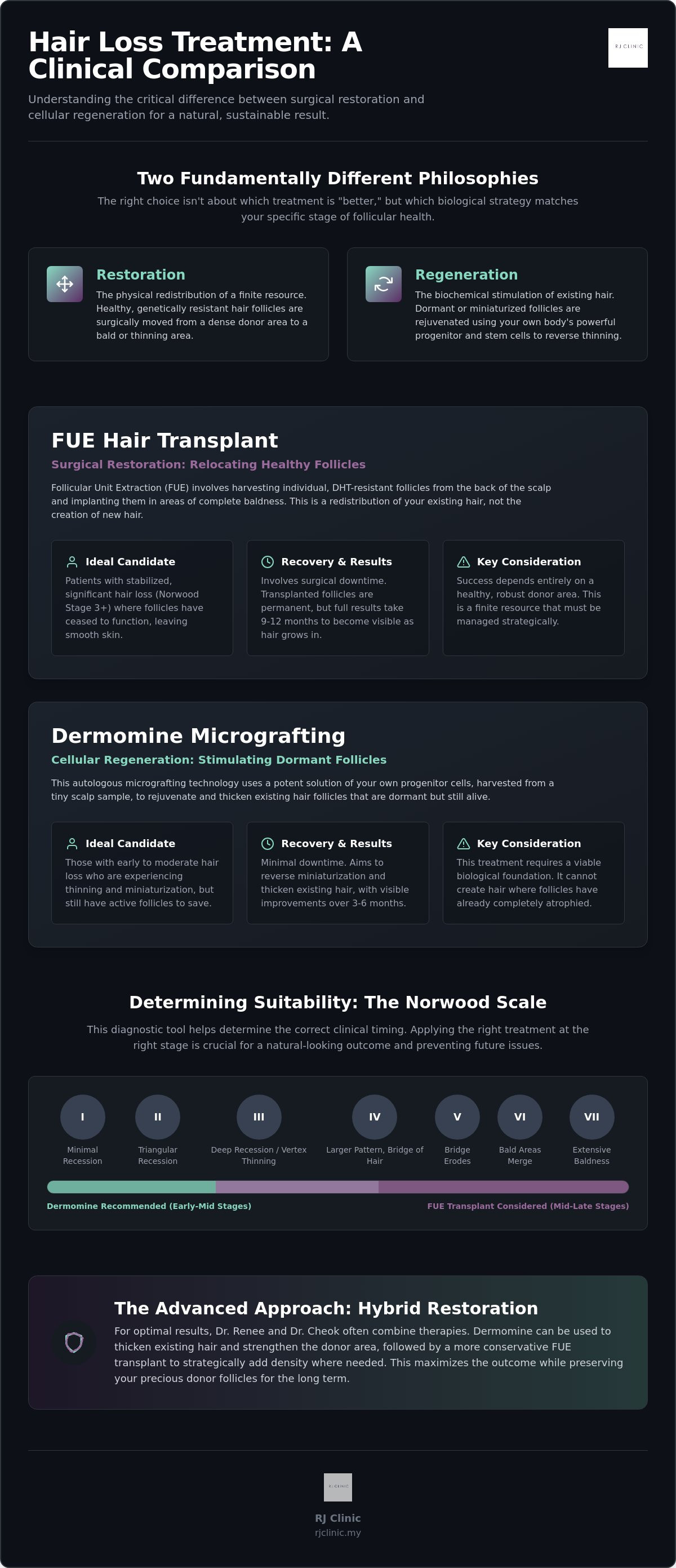
Patients often approach a consultation asking which treatment is "better," but this framing misses a critical clinical distinction. When comparing a hair transplant vs dermomine, we aren't looking at two versions of the same solution. We're looking at two different biological strategies: restoration and regeneration. Restoration is the physical movement of hair from one site to another. Regeneration is the biochemical stimulation of the hair you already have. These are not interchangeable; they're specific tools for different stages of follicular health.
FUE Hair Transplant: Relocating Healthy Follicles
In a Follicular Unit Extraction (FUE) procedure, Dr. Renee and Dr. Cheok perform a precise hair transplantation procedure that involves harvesting individual follicles from a "donor area," typically the back or sides of the scalp. These areas are genetically programmed to resist Dihydrotestosterone (DHT), the hormone responsible for male pattern baldness. Once relocated to thinning areas, these follicles retain their resistance and continue to grow indefinitely.
It's vital to recognize that FUE is a redistribution of a finite resource. You aren't growing new hair; you're moving it. This makes the surgical approach ideal for areas of complete baldness where the skin has become smooth and follicles have entirely ceased to function. At RJ Clinic, we emphasize that a successful FUE hair transplant requires a healthy donor supply to achieve a natural, dense result without over-harvesting the back of your head.
Dermomine Micrografting: Stimulating Dormant Follicles
Dermomine operates on a regenerative principle known as autologous micrografting. Instead of moving entire hair units, this technology focuses on the cellular environment. We harvest a tiny tissue sample from the patient's own scalp, which is rich in progenitor cells, fibroblasts, and mesenchymal stem cells. These cells are then processed through a specialized kit and reinjected into thinning areas.
The clinical logic here is to rejuvenate follicles that have entered a prolonged dormant phase. These follicles are still alive but have miniaturized due to hormonal or environmental stress. By introducing a concentrated "boost" of your own regenerative cells, we can reverse this miniaturization and thicken the existing hair shaft. However, unlike surgery, Dermomine cannot create hair where the follicle has already died. It requires a viable, albeit weakened, biological foundation to be effective. This makes it a powerful choice for those in the early to moderate stages of hair loss who still have active follicles to save.
Determining Suitability: Which Stage of Hair Loss Are You In?
Clinical success in hair restoration depends less on the technology itself and more on the timing of its application. To provide a structured framework for our patients, we utilize the Norwood Scale. This diagnostic tool categorizes hair loss into seven distinct stages, ranging from minor recession to complete baldness. Understanding where you sit on this scale is the first step in resolving the hair transplant vs dermomine dilemma. A premature surgery can be just as problematic as a late-stage regenerative attempt.
Performing surgery on a "moving target," meaning hair that is still actively thinning, is a common clinical pitfall. If we transplant hair into a hairline that is still actively receding, you may eventually be left with isolated islands of transplanted hair as your native hair continues to retreat behind them. This creates an unnatural appearance that requires further corrective surgery. Conversely, regenerative treatments like Dermomine have a "ceiling." If an area has progressed to Norwood Stage 6 or 7, where the scalp is smooth and shiny, the follicles have likely undergone complete atrophy. In these cases, stimulation is no longer a viable path.
The Ideal Candidate for Surgical Hair Restoration
We typically consider FUE hair transplants for patients at Norwood Stage 3 or higher. At this point, the pattern of loss has usually stabilized enough to allow for a permanent aesthetic design. The primary requirement for a successful FUE hair transplant is a robust donor area. Dr. Renee and Dr. Cheok carefully assess the density and caliber of hair at the back of your scalp to ensure you have enough "follicular capital" to cover the balding areas without thinning out the donor site itself.
When Dermomine is the Strategic First Step
For those in the early stages of thinning (Norwood 1-2) or experiencing diffuse thinning across the entire scalp, Dermomine offers a superior strategic advantage. It serves as a sophisticated form of hair loss treatment that prioritizes the preservation of your existing hair. By strengthening miniaturized follicles, we can often delay the need for surgery by years. It's also an excellent preventative measure for younger patients with a strong family history of alopecia who wish to maintain their current density. While there are various medically-approved hair loss treatments available, the autologous nature of Dermomine provides a personalized, biocompatible solution that fits seamlessly into a luxury care plan. If you are unsure which stage you currently occupy, a diagnostic consultation with our LCP-certified doctors in KL can provide the clarity you need to move forward with confidence.
Practical Trade-offs: Recovery, Cost, and Longevity
When evaluating the practicalities of a hair transplant vs dermomine, we must look beyond the initial procedure day. A common misunderstanding is that the "cheaper" option today is the more economical one over time. From a clinical perspective, we analyze the "Total Cost of Ownership" over a five-year horizon. A surgical restoration involves a higher upfront commitment but remains a permanent fixture of your aesthetic profile. In contrast, Dermomine requires a lower initial investment but typically necessitates a maintenance session every 12 to 18 months to sustain the regenerative boost to your follicles. Over half a decade, the financial gap between these two paths may narrow significantly.
Downtime and Post-Operative Management
FUE is a surgical endeavor. It requires a 7-10 day recovery window where social downtime is expected. During this time, the tiny scabs at the graft sites must be protected, and the donor area at the back of the head will show signs of healing. We provide a meticulous post-care protocol to ensure graft survival, as the first 72 hours are critical for the new follicles to establish blood supply. If you're a public-facing professional, this window must be factored into your decision.
Dermomine is a "lunchtime procedure." Because it uses micro-injections rather than surgical incisions, the visible marks are minimal and usually resolve within 24 to 48 hours. There are no grafts to protect and no surgical wounds to manage. This makes it a preferred choice for those who cannot afford a week away from their routine but still want scientifically proven results.
Long-term Results and Maintenance Cycles
The longevity of results is where these two paths diverge most sharply. Transplanted hair is considered permanent because it utilizes follicles from the back of the head that are naturally resistant to thinning. Once these grafts take hold, they grow for a lifetime. For a deeper look at the financial and clinical planning involved, we recommend reviewing our guide on Hair Transplant Cost in Malaysia.
Dermomine results are biological, not mechanical. The thickening effect relies on the continued health of your native follicles. Most of our patients find that the peak results last between 12 to 18 months before the regenerative signals begin to fade. To extend these results, we often suggest an integrated approach, such as using PRP treatment as a supportive maintenance adjunct for both surgical and non-surgical patients. If you're balancing the need for immediate density against a busy schedule, schedule a consultation with Dr. Renee or Dr. Cheok to map out your five-year restoration plan.
The RJ Clinic Approach: Consultation and Combination Therapy
At RJ Clinic, we believe that the most successful outcomes aren't born from a menu of services, but from a rigorous diagnostic process. Dr. Renee and Dr. Cheok approach every patient with the understanding that hair loss is a dynamic, progressive condition. A one-size-fits-all package often fails because it ignores the unique rate of your follicular miniaturization. By prioritizing a personalized clinical strategy, we ensure that whether you choose a hair transplant vs dermomine, the result aligns with your long-term aesthetic goals and biological reality.
We often introduce patients to the concept of "Hybrid Restoration." This strategy involves using Dermomine as a preparatory step to strengthen the donor area before an FUE procedure, or as a secondary treatment to boost the density of the native hair surrounding your new grafts. This synergy prevents the common issue of "islanding," where transplanted hair remains healthy but the surrounding natural hair continues to thin. This creates a seamless, high-density look that maintains its integrity as you age.
Why a Combined Approach Often Yields the Best Results
Integrating various hair loss treatments ensures that your restoration isn't just a temporary fix. While surgery addresses the visible gaps, regenerative therapy maintains the vitality of the remaining follicles. The goal is to create a transition between transplanted and natural hair that is undetectable even under close inspection. By improving the health of the entire scalp environment, we maximize the survival rate of transplanted grafts and the thickness of your native hair shafts.
What to Expect During Your Consultation
During your visit to our KL clinic, we perform a detailed microscopic scalp analysis. We don't just look at where hair is missing; we examine the health of the follicles that remain. Dr. Renee and Dr. Cheok will discuss your medical history, genetic predispositions, and lifestyle factors to determine the root cause of your thinning. This meticulousness allows us to design a custom-designed plan that prioritizes safety and artistic precision. We focus on subtle, organic-looking outcomes that avoid the artificial appearance of traditional interventions. If you're ready to move beyond guesswork and into a clinically-led restoration plan, you can book a hair loss assessment with our LCP-certified doctors to begin your journey.
Your Path to Sustainable Hair Density
Deciding between a hair transplant vs dermomine is a clinical choice that depends entirely on the current viability of your follicles. While FUE remains the gold standard for restoring areas of complete loss with permanent, DHT-resistant hair, Dermomine offers a sophisticated regenerative alternative for those in the earlier stages of thinning. The most successful outcomes aren't just about filling gaps today; they're about preserving your native hair and protecting your donor supply for the future.
At RJ Clinic, our LCP-certified aesthetic physicians prioritize a diagnostic approach that avoids over-treatment and focuses on subtle, organic-looking results. Whether you require advanced autologous micrograft technology to thicken diffuse thinning or a precision FUE restoration as specialists in natural-looking hair, the first step is a professional assessment of your scalp health. We invite you to Consult Dr. Renee or Dr. Cheok for a Personalised Hair Plan to determine which biological strategy aligns with your goals. Taking a proactive, scientifically-backed approach today ensures your hair remains a source of confidence for years to come.
Frequently Asked Questions
Is Dermomine as effective as a hair transplant for a receding hairline?
Dermomine is highly effective for thickening a hairline that is in the early stages of thinning, but it cannot restore hair in areas where the follicles have completely atrophied. For a significantly recessed hairline where the scalp has become smooth, an FUE hair transplant is the clinically indicated solution. When comparing a hair transplant vs dermomine for hairline restoration, the choice depends on whether we are stimulating existing hair or creating new growth in a bald area.
Can I have Dermomine after a hair transplant to improve density?
Yes, we often recommend Dermomine as a supportive treatment following a surgical restoration. It works synergistically to improve the health of the scalp and thicken the native, non-transplanted hair surrounding the new grafts. This combined approach ensures a more uniform density and helps prevent the "islanding" effect that can occur if your original hair continues to thin behind the transplanted hairline.
Does a hair transplant leave visible scars compared to Dermomine?
Modern FUE techniques used by Dr. Renee and Dr. Cheok leave microscopic, point-like scars in the donor area that are typically invisible to the naked eye, even with relatively short hair. Dermomine is virtually scarless. It involves only a tiny tissue harvest from behind the ear that heals within a few days and micro-injections in the thinning areas that leave no permanent marks.
Which treatment is more cost-effective in the long run?
A hair transplant is generally more cost-effective over a ten-year period because it is a permanent, one-time procedure. While the initial investment is higher, it doesn't require recurring sessions. Dermomine has a lower entry cost but requires maintenance treatments every 12 to 18 months to sustain the regenerative results, which means the cumulative cost increases over time.
How soon can I return to work after Dermomine vs a hair transplant?
Dermomine offers a much faster return to routine, with most patients back in the office within 24 to 48 hours. A hair transplant requires more significant social downtime, typically between 7 to 10 days. This window is necessary to allow the surgical scabs to shed naturally and to ensure the transplanted follicles have successfully anchored into the scalp.
Are the results of Dermomine permanent like a transplant?
The results of Dermomine are not permanent because they rely on biological stimulation rather than the relocation of DHT-resistant follicles. While a hair transplant provides a lifelong aesthetic change, the thickening effects of Dermomine usually last between 12 to 18 months. Periodic maintenance is required to keep the follicles in an active, productive growth phase.


Comments