


How to Stop Hair Loss in Women: A Clinical Perspective in Malaysia (2026)

Updated: Jul 21

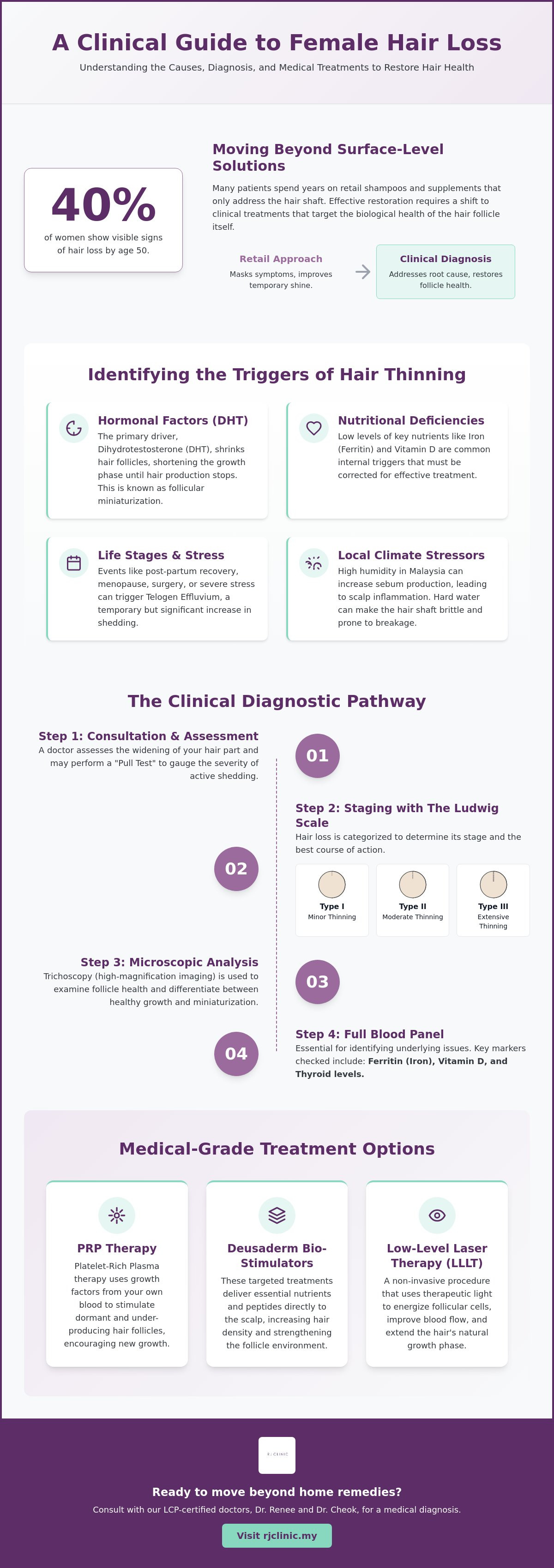
Did you know that by age 50, approximately 40% of women show visible signs of female pattern hair loss? In a clinical setting, we frequently meet patients who have spent years cycling through botanical shampoos and over the counter supplements, only to find their hair density continuing to decline. Understanding how to stop hair loss in women malaysia requires moving beyond surface level retail products to address the biological health of the follicle itself, where the actual growth cycle is determined.
Most patients struggle with the decision of whether to continue with home remedies or seek professional help, often waiting until the thinning is advanced before consulting a specialist. This guide provides a doctor led perspective on the diagnostic steps and medical grade treatments available in our Kuala Lumpur clinic to help you regain control. We will discuss how Dr Renee and Dr Cheok identify specific triggers like hormonal shifts or tropical scalp stressors, and outline the clinical pathways, such as PRP therapy and LLLT, that offer a sustainable route to hair restoration and long term scalp health.
Table of Contents
The Clinical Reality of Female Hair Loss in Malaysia: Identifying the Triggers
Understanding how to stop hair loss in women malaysia begins with a clear distinction between daily shedding and true follicular miniaturization. While losing 50 to 100 strands a day is physiologically normal, Pattern hair loss, or androgenetic alopecia, involves a progressive shortening of the hair's growth phase. This process is largely driven by Dihydrotestosterone (DHT), a hormone that causes follicles to shrink until they can no longer produce visible hair. In our clinical experience, Dr Renee and Dr Cheok observe that many patients focus solely on "growth" without first stabilizing the "soil," specifically the scalp environment, which is often compromised by local stressors.
When we assess a patient at the clinic, we look for signs of thinning at the mid-part or crown, which are hallmark indicators of female pattern hair loss. Unlike the receding hairlines often seen in men, women tend to maintain their frontal hairline while losing overall volume. Identifying this early is essential; medical grade hair loss treatment is significantly more effective when the follicle is still active rather than dormant.
Environmental Factors Specific to Kuala Lumpur
Kuala Lumpur's unique climate presents specific challenges that exacerbate scalp inflammation. High humidity levels trigger excessive sebum production, which can lead to seborrheic dermatitis if not managed correctly. When combined with the mineral buildup from local hard water, the hair shaft becomes brittle and prone to breakage. It's vital to distinguish between this mechanical breakage and root-level loss. While breakage makes the hair look thin, it doesn't indicate a failure of the follicle itself.
Hormonal and Life-Stage Triggers
Life stages also dictate our clinical approach to hair restoration. Post-partum hair loss typically manifests three to six months after delivery as estrogen levels normalize and the body sheds the hair it "held onto" during pregnancy. Conversely, menopause brings a decline in protective estrogen, allowing androgens to exert more influence on the follicles and leading to a wider part line. Telogen Effluvium is a reversible response to systemic shock, such as surgery or severe stress, that shifts a large number of hairs into the shedding phase simultaneously. For those seeking to address these hormonal imbalances through specialized telehealth services, iscript.care offers medically-supervised support for hormonal health and longevity.
Diagnosing the Pattern: When to Move Beyond Home Remedies
Many women first notice a change not in the amount of hair on their brush, but in the visibility of their scalp when they part their hair. This widening part is often the first clinical indicator of female pattern thinning. To provide a standardized assessment, we utilize the Ludwig Scale, which categorizes thinning across the crown from Type I (perceivable thinning) to Type III (extensive rarefaction). Identifying your specific stage early is the most critical factor in determining the success of any medical intervention.
During a consultation, Dr Cheok often employs a "Pull Test" to gauge the severity of active shedding and uses trichoscopy to examine the scalp at high magnification. This digital analysis reveals the health of individual follicles and helps us distinguish between healthy growth and miniaturization. Before committing to a plan, we prioritize a full blood panel. Low ferritin levels, thyroid imbalances, and vitamin D deficiencies are among the most common causes of female hair loss that must be corrected before aesthetic treatments can yield results.
Medical Consultation vs. Salon Treatments
It's easy to be swayed by the luxury of a salon "hair spa," but these services typically address the hair shaft rather than the follicle. While they may improve shine, they often mask underlying medical issues. For a sustainable result, seeking an LCP-certified doctor ensures that you receive a diagnosis based on medical science rather than cosmetic trends. When you are ready to explore a clinical hair loss treatment, the focus shifts from topical masking to biological restoration. Understanding how to stop hair loss in women malaysia involves this transition from superficial care to evidence-based medical protocols.
Nutritional Deficiencies and Hair Health
Nutrition plays a silent but pivotal role in hair density. In our local context, we find that many patients are deficient in iron, which is essential for the oxygenation of follicular cells. While biotin supplements are frequently marketed as a cure-all, they are often secondary to correcting protein intake and iron stores. For those looking to support their intake naturally, le jus offers fresh, nutrient-dense smoothies that exemplify a health-conscious approach to diet. We only recommend supplementation when blood work confirms a clinical need, as over-supplementing certain vitamins can sometimes be counterproductive to hair health.
Medical Interventions for Female Hair Restoration in KL
Once the underlying nutritional or hormonal triggers have been stabilized, the clinical focus shifts to active follicular rehabilitation. Medical interventions in our Kuala Lumpur clinic move beyond the limitations of over the counter solutions by delivering active ingredients directly to the scalp's dermal layer. For many patients, the question of how to stop hair loss in women malaysia finds its answer in regenerative medicine, specifically through Platelet-Rich Plasma (PRP) and advanced bio-stimulators.
PRP therapy utilizes the patient’s own growth factors to stimulate blood flow and wake dormant follicles. While topical treatments are a common starting point for female pattern hair loss, they often struggle with absorption issues. Clinical procedures bypass the skin barrier, ensuring that the follicle receives the necessary signals to re-enter the anagen, or growth, phase.
Non-Surgical Growth Stimulation
For those seeking increased density without surgery, we often recommend peptide-based hair fillers like Deusaderm. These bio-stimulators act as a sustained-release mechanism, providing the scalp with essential nutrients that prolong the growth cycle. Unlike a standard "hair spa," these injections target the biological root of the thinning. Patients should maintain realistic expectations; visible changes in hair diameter and density typically require a three to six month window, mirroring the natural hair growth cycle.
When to Consider FUE Hair Transplant
In cases where the thinning is localized to the temples or the frontal hairline has visibly receded, a surgical approach may be the most effective long-term solution. A hair FUE transplant involves moving healthy follicles from the back of the scalp to the thinning areas. This is not a "one-size-fits-all" procedure. Suitability depends on the quality of your donor hair and the stability of your current hair loss.
For women, the goal is always a subtle, organic-looking restoration of density rather than a dramatic change in the hairline shape. You can explore our detailed hair transplant Malaysia guide to understand the surgical process and recovery period. If you are noticing persistent thinning despite using home remedies, we invite you to schedule a clinical consultation with Dr Renee or Dr Cheok to determine which medical intervention aligns with your biological needs.
Maintaining Results: Long-Term Hair Health in a Tropical Climate
Securing a successful outcome through clinical intervention is only the first phase of the journey. In our experience, the longevity of hair density depends heavily on how you manage your scalp environment after the initial treatment phase. Understanding how to stop hair loss in women malaysia requires a commitment to a sustainable maintenance plan that accounts for the constant interplay between high humidity and follicular health.
Periodic booster treatments are essential for maintaining the hair shaft's diameter over time. While procedures like PRP or hair fillers provide a significant biological "reset," the natural aging process and hormonal fluctuations continue. We typically recommend maintenance sessions every few months to ensure the follicles remain in the active growth phase. Additionally, managing systemic stress is crucial; high cortisol levels can trigger a recurring episode of Telogen Effluvium, undoing the progress made through clinical care.
Daily Habits for Malaysian Hair Health
In Kuala Lumpur's climate, scalp hygiene is a delicate balance. We recommend washing your hair daily or every other day using medical-grade cleansers that remove excess sebum and sweat without stripping the scalp's natural protective barrier. Clogged pores can lead to inflammation, which is a known antagonist to healthy hair growth. Sun protection for the scalp is also often overlooked; intense sun exposure can damage the protein structure of the hair and cause oxidative stress to the follicle itself. Targeted scalp massage serves as a mechanical catalyst for micro-circulation, ensuring that the nutrient-rich blood supply actually reaches the hair bulb.
The Importance of Follow-up Care
Effective hair restoration is a meticulous, long-term process rather than a one-time event. At RJ Clinic, we use digital trichoscopy during follow-up appointments to monitor your progress objectively. This allows Dr Renee and Dr Cheok to observe changes in hair density and follicle health that aren't yet visible to the naked eye, adjusting your protocol as needed. If you're ready to move beyond temporary fixes and establish a professional management plan, we invite you to schedule a consultation with Dr Renee or Dr Cheok to begin your personalized restoration plan.
Taking the Next Step Toward Hair Restoration
Addressing thinning hair requires a transition from trial and error home remedies to a precise, medical grade approach. By identifying the specific biological triggers and environmental stressors unique to our region, you can move toward a solution that offers more than just temporary coverage. Whether through regenerative biostimulators or advanced FUE techniques, the path to how to stop hair loss in women malaysia is built on a foundation of clinical diagnosis and consistent maintenance.
At our clinics in Mont Kiara and Bangsar, Dr Renee and Dr Cheok utilize FDA-approved hair restoration technologies to design protocols tailored to your unique scalp health. As LCP-certified doctors, they prioritize safety and natural-looking outcomes that align with your aesthetic goals. You don't have to navigate the confusion of retail products alone when a medically led strategy is within reach. We invite you to consult our LCP-certified doctors for a personalized hair restoration plan and begin the journey toward a more confident, refined version of yourself. Your hair health is a long term investment, and we're here to guide you through every stage of its recovery.
Frequently Asked Questions
Can hair loss in women be reversed without surgery?
Yes, non-surgical medical interventions are often the primary line of defense for female patients. Clinical treatments like PRP and bio-stimulators work by reactivating dormant follicles and extending the growth phase. When considering how to stop hair loss in women malaysia, we prioritize these regenerative methods to avoid the downtime of surgery while still achieving visible density improvements through biological restoration.
Is the hard water in Kuala Lumpur actually causing my hair to fall out?
Hard water in Kuala Lumpur typically causes hair shaft breakage rather than permanent loss from the root. The minerals in the water create a film that makes the hair brittle and less elastic, leading to snapping during brushing or styling. While this reduces overall volume, it's a mechanical issue that can be managed with medical grade cleansers and proper scalp hygiene protocols.
How long does it take to see results from PRP hair treatment?
You should expect to see initial improvements in hair texture and reduced shedding within three months, with visible density changes occurring around the six month mark. This timeline reflects the natural biological cycle of the hair follicle as it transitions back into the growth phase. Consistency is key; most clinical protocols require an initial series of sessions followed by periodic maintenance to sustain the results.
What is the difference between hair shedding and hair thinning?
Hair shedding is a temporary increase in the number of hairs falling out, often due to systemic shock, while hair thinning refers to the gradual miniaturization of the follicle. In thinning, the hair diameter becomes progressively finer until the follicle eventually stops producing hair. Dr Cheok uses digital trichoscopy to distinguish between these conditions and determine if the loss is a reversible response or a progressive pattern.
Are hair fillers like Deusaderm safe for women with sensitive scalps?
Deusaderm and other medical grade hair fillers are composed of biocompatible peptides, making them suitable for most patients with sensitive scalps. These treatments are administered via precise micro-injections into the dermal layer, which bypasses the surface sensitivity of the skin. Dr Renee performs a thorough scalp assessment before any procedure to ensure the treatment area is healthy and free of active inflammation.
Does wearing a hijab or tight hairstyles contribute to hair loss in Malaysia?
Prolonged tension from tight hairstyles or constant friction from certain fabrics can lead to traction alopecia, particularly around the hairline and temples. In Malaysia's humid climate, moisture trapped under a head covering can also contribute to scalp irritation or seborrheic dermatitis if hygiene isn't prioritized. We recommend using breathable fabrics and avoiding hairstyles that pull excessively on the same follicular groups to prevent permanent damage.



Comments