


Hair Loss Specialist Near Me in TTDI: A Clinical Perspective on Restoration

Updated: Jul 16

Many patients arrive at our clinic after spending months on "scalp therapy" packages at high-end salons, only to realize that their hairline continues to recede despite the luxury price tag. It's a common clinical observation that these cosmetic treatments often fail because they address the surface of the scalp rather than the underlying biological causes of androgenetic alopecia. Finding a qualified hair loss specialist near me ttdi is about more than just proximity; it's about securing a diagnosis from a physician who understands the complex physiology of hair follicles and the medical precision required for restoration.
You likely feel a mix of frustration and hesitation, particularly if you've seen unnatural or "pluggy" results from outdated procedures elsewhere. We believe that hair restoration should be a subtle enhancement that respects your natural aesthetics and facial proportions. This clinical guide provides a framework for evaluating Follicular Unit Extraction (FUE) and non-surgical options, focusing on the safety standards and expertise of LCP-certified doctors like Dr. Renee and Dr. Cheok. By moving away from trial-and-error marketing, you can focus on scientifically proven density improvements that prioritize your long-term health and confidence.
Table of Contents
Navigating Hair Loss in TTDI: Why Proximity Must Match Clinical Expertise
Residents in the Taman Tun Dr. Ismail (TTDI) area often lead demanding professional lives where maintaining a polished image is essential. When hair thinning begins, the initial reaction is frequently to visit a local hair salon for a "scalp detox" or to purchase expensive herbal tonics. While these might improve the hair shaft's appearance, they rarely address the physiological root of the problem. Clinical hair loss is a progressive medical condition requiring early diagnosis. Distinguishing between temporary shedding, often caused by stress or nutritional gaps, and Androgenetic Alopecia, which is genetic and permanent, is the first step in successful restoration. Finding a qualified hair loss specialist near me ttdi ensures that you receive a medical diagnosis rather than a retail recommendation.
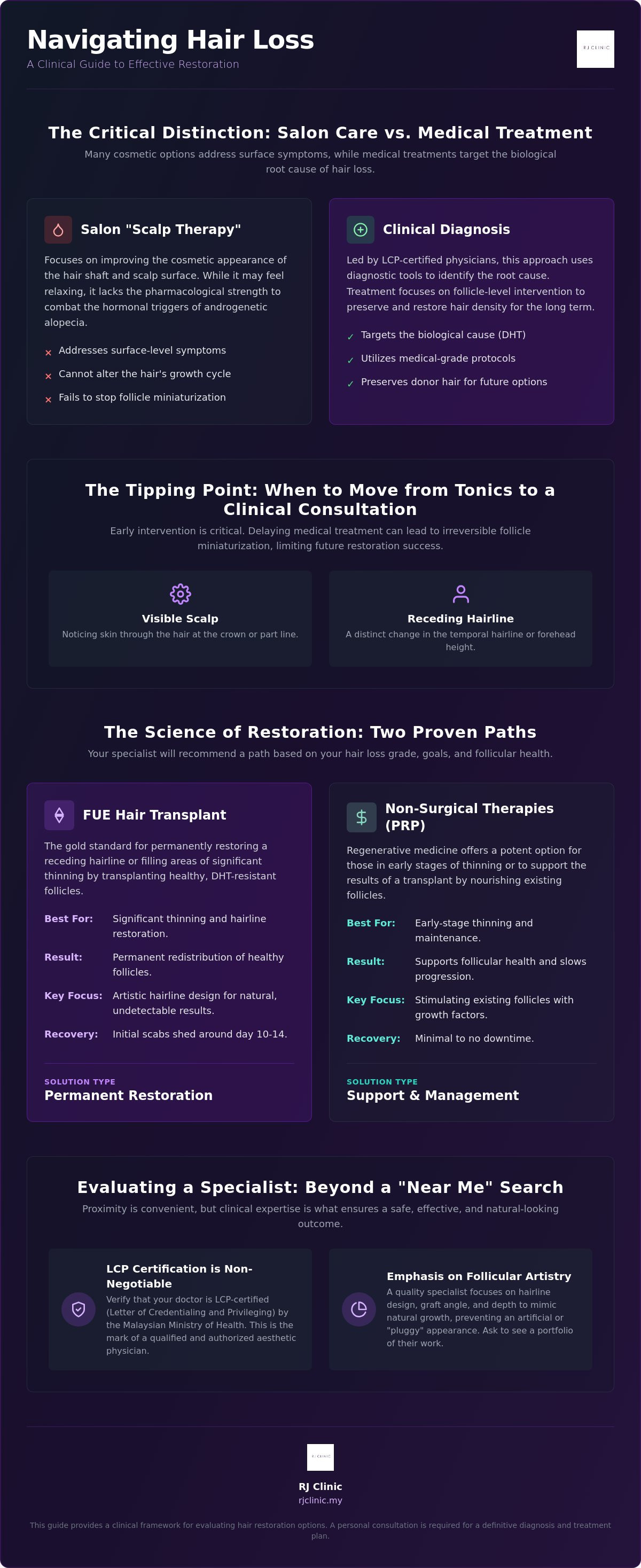
A medical clinic differs significantly from a salon because it's led by LCP-certified physicians like Dr. Renee and Dr. Cheok, who are authorized to prescribe medical-grade treatments. While a salon focuses on the "experience," a clinical specialist focuses on follicular health and long-term hair density. This distinction is vital because delaying medical treatment while waiting for tonics to work often leads to irreversible follicle miniaturization.
Common Misconceptions in Local Hair Care
Many patients believe that a change in shampoo can halt a receding hairline. In reality, most retail-grade products cannot penetrate the scalp deeply enough to influence the follicle. Medical restoration focuses on DHT-blocking medications and clinical hair loss treatment protocols that alter the hair's growth cycle. While a salon treatment might feel relaxing, it lacks the pharmacological strength to combat the hormonal triggers of male or female pattern baldness. Transitioning from aesthetic maintenance to medical care means moving from surface-level cleaning to follicle-level intervention.
When to Move from Tonics to Clinical Consultations
The "tipping point" usually occurs when you notice visible scalp through the hair at the crown or a distinct change in the temporal hairline. At this stage, we use diagnostic tools like trichoscopy to examine the density and diameter of individual hairs. Early intervention in your 30s or 40s is critical because it preserves the quality of your donor area. If you eventually opt for Follicular Unit Extraction (FUE), having a healthy supply of donor hair is the difference between a sparse result and a dense, natural-looking restoration.
The Science of Restoration: FUE Hair Transplant vs. Non-Surgical Therapies
Patients often face a difficult choice: should they invest in a permanent surgical solution or manage thinning through non-invasive maintenance? When searching for a hair loss specialist near me ttdi, the goal is to find a clinician who can objectively weigh these options based on your specific hair loss grade. Follicular Unit Extraction (FUE) remains the gold standard for those seeking to restore a receding hairline or fill significant thinning. Unlike maintenance therapies, FUE provides a permanent redistribution of healthy, DHT-resistant follicles. The International Society of Hair Restoration Surgery provides excellent guidance on choosing a specialist to ensure your procedure meets global benchmarks for safety and artistry.
Understanding FUE (Follicular Unit Extraction)
Precision is the foundation of a successful FUE Hair Transplant. Each graft must be extracted with minimal trauma to the follicle to ensure high survival rates once transplanted. At RJ Clinic, Dr. Renee and Dr. Cheok emphasize the artistry of hairline design, ensuring that the angle and depth of each graft mimic your natural growth patterns. This prevents the "row-like" or artificial appearance often seen in lower-quality procedures. The first 14 days are the most critical for recovery. You'll notice small scabs forming around the grafts, which typically shed by day ten, allowing you to return to your professional routine in TTDI with minimal visible evidence of the procedure.
The Role of Regenerative Medicine (PRP and Growth Factors)
For those in the early stages of thinning or those not yet ready for surgery, regenerative medicine offers a potent alternative. Platelet-Rich Plasma (PRP) uses autologous blood concentrates to deliver high levels of growth factors directly to the scalp. This treatment is particularly effective for stimulating dormant follicles and increasing the diameter of existing hair shafts. We also utilize medical growth factors that work synergistically with these concentrates to prolong the anagen phase of the hair cycle.
Suitability depends on the state of your follicles. If a follicle has completely scarred over, PRP won't be effective; in those cases, a transplant is necessary. However, many of our patients benefit from a hybrid approach, using hair loss treatment protocols like PRP alongside FUE to accelerate healing and support the health of non-transplanted hair. While the initial cost of a transplant is higher, its lifetime value often exceeds the cumulative expense of decades of temporary tonics. If you're unsure which path fits your current hair density, a personalized consultation can clarify your clinical needs. Choosing a hair loss specialist near me ttdi means choosing a partner who understands that restoration is a journey, not a single appointment.
Evaluating a Hair Loss Specialist: Beyond the 'Near Me' Search
Selecting a clinic based purely on a search for a hair loss specialist near me ttdi can lead to a decision based on proximity rather than proficiency. In the clinical community, we often see the consequences of this choice when patients present with over-harvested donor areas or unnatural hairline placement. A hair transplant is a permanent medical intervention, and the credentials of the person holding the punch tool are the single most important factor in your safety and satisfaction.
The Significance of LCP Certification in Malaysia
In Malaysia, the Ministry of Health regulates aesthetic medicine through the Letter of Credentialing and Privileging (LCP). This certification ensures that your doctor has undergone rigorous training and assessment specifically in aesthetic procedures. Dr. Renee and Dr. Cheok are LCP-certified physicians who prioritize clinical judgment over commercial sales targets. This certification acts as a trust signal, confirming that the clinic adheres to national safety standards and is equipped to manage complex cases. You can verify a doctor's status through the Medical Practitioner's Register to ensure they're legally permitted to perform hair restoration.
Suitability Assessment: Are You a Candidate?
A doctor's primary duty is to determine if a patient is actually a candidate for restoration. Not everyone who experiences thinning should proceed with surgery. During your consultation, we examine:
The density and quality of the available donor hair.
The stability of the current hair loss pattern.
Underlying hormonal, stress-related, or systemic factors.
If your hair loss is currently in an active, aggressive shedding phase, we may recommend medical stabilization before considering a transplant. We also address the "one-and-done" myth; permanent restoration often requires ongoing medical management to protect the non-transplanted hair from further thinning.
The danger of budget clinics often lies in their use of unlicensed technicians to perform the bulk of the graft extraction and placement. This practice significantly increases the risk of follicle trauma and poor graft survival. The best specialist prioritises donor area preservation over maximum graft counts, recognizing that your donor hair is a finite resource. To determine if you meet the clinical criteria for a successful procedure, you should seek a professional suitability assessment from a certified medical expert.
Precision Hair Restoration at RJ Clinic Kuala Lumpur
At RJ Clinic, we view hair restoration as a sophisticated blend of medical science and artistic refinement. Our core philosophy centers on creating subtle, organic-looking outcomes that age gracefully alongside the patient, avoiding the artificial or "overdone" hairlines often associated with lower-tier clinics. When you seek a hair loss specialist near me ttdi, you're choosing more than just a proceduralist; you're selecting a physician who understands the nuances of facial harmony and follicular health. We specialize in FUE Hair Transplant procedures that prioritize the long-term preservation of your donor area while achieving maximum density in the recipient sites.
The Consultation Process with Dr. Renee and Dr. Cheok
Every restoration journey begins with an in-depth consultation with Dr. Renee or Dr. Cheok. This is where we move beyond a generic template to develop a bespoke restoration map tailored to your specific facial structure and hair loss progression. We maintain absolute transparency regarding hair transplant cost and provide realistic graft estimations based on your clinical needs. Our approach relies on a specific clinical logic: we distribute grafts to create maximum visual impact in the most visible areas, ensuring the transition from the forehead to the mid-scalp remains seamless and natural. This meticulous planning is designed to reduce post-operative friction and ensure you feel secure at every stage of the process.
Managing Expectations and Long-term Results
Patience is a critical component of successful hair restoration. Patients must be prepared for the "shedding phase," a temporary period where transplanted hairs fall out to make way for new, permanent growth. While initial growth is visible within a few months, the final, high-density results typically materialize between 6 to 12 months after the procedure. To support these results, we often integrate medical hair loss treatments such as PRP or growth factor therapies. These treatments help maintain the health of your native hair, preventing further thinning in non-transplanted areas. By building a lifelong relationship with your aesthetic physician, you ensure that your hair restoration remains a durable investment in your self-confidence. If you are ready to move from temporary fixes to a permanent, doctor-led solution, finding a hair loss specialist near me ttdi is the first step toward a restored, natural profile.
Restoring Your Confidence Through Clinical Precision
Choosing to address hair loss is a significant step toward reclaiming your professional image and personal confidence. By shifting your focus from retail-grade tonics to a medical diagnosis, you ensure that every intervention is grounded in clinical science rather than marketing claims. Whether you require the permanent density of an FUE procedure or the regenerative support of non-surgical therapies, your results depend entirely on the precision of an LCP-certified physician. At RJ Clinic, our specialized FUE transplant suite is designed to deliver natural-looking, subtle restoration results that respect your unique facial proportions and hair growth patterns.
Finding a hair loss specialist near me ttdi shouldn't be a matter of luck; it's a deliberate choice to partner with experts who prioritize your long-term follicular health and safety. We invite you to schedule a clinical hair restoration consultation with our LCP-certified doctors, Dr. Renee and Dr. Cheok. During this session, we'll move beyond generic solutions to map out a bespoke restoration plan that aligns with your aesthetic goals. It's time to replace the anxiety of thinning hair with a clear, medically sound path toward a fuller, more youthful profile.
Frequently Asked Questions
How do I know if I need a hair transplant or just medical treatment?
The decision depends entirely on the viability of your hair follicles. If you're experiencing thinning but the follicles are still active, medical treatments like PRP or specialized growth factors can often restore density without surgery. However, if an area is completely bald, the follicles have likely scarred over, making a transplant the only way to redistribute healthy hair to that region.
Is the FUE hair transplant procedure painful?
Most patients find the procedure surprisingly comfortable because we use local anesthesia to numb both the donor and recipient areas. You'll feel a slight pinching sensation during the initial numbing process, but the extraction and placement phases are generally painless. Post-operative discomfort is typically mild and can be managed with standard over-the-counter pain relief, allowing for a restful recovery.
What is the average cost of hair loss treatment in the TTDI and KL area?
When searching for a hair loss specialist near me ttdi, you'll find that pricing varies significantly based on the complexity of your case and the number of grafts required. Factors such as the doctor's clinical experience, the technology used, and the level of personalized care also influence the total investment. We recommend a clinical consultation to receive an accurate assessment tailored to your specific hair density goals.
How many days of downtime should I expect after a hair transplant?
Can women also undergo FUE hair transplants at RJ Clinic?
Yes, women are excellent candidates for FUE, particularly those with localized thinning or a naturally high hairline. Female pattern hair loss often presents as diffuse thinning across the crown, so a thorough diagnostic check is essential to ensure there's enough stable donor hair. Our approach for women focuses on subtle density improvement that blends seamlessly with existing hair for a natural appearance.
What happens if my hair loss continues after the transplant?
Transplanted hair is harvested from DHT-resistant zones, meaning it's intended to be permanent. However, your original, non-transplanted hair remains susceptible to genetic thinning, which is why we emphasize long-term medical management. Combining your transplant with ongoing maintenance helps preserve your native hair density and prevents the need for additional procedures as you age. Finding a hair loss specialist near me ttdi who offers integrated care is key to lasting results.


Comments