


Hair Transplant Density Explained

Updated: Jul 22

The most common misunderstanding in hair restoration is the belief that a successful result requires replicating your original, teenage hair count. In reality, achieving a natural hair transplant density isn't a race to the highest graft number, but a sophisticated exercise in clinical geometry and the strategic illusion of fullness. Many patients arrive at our clinic concerned that their results will look sparse or see-through if they don't maximize every square centimeter of the recipient area. It's a valid anxiety when you're investing significantly in your appearance, but the science of graft survival suggests that overcrowding can actually compromise your final look.
We agree that the ultimate goal is a full, undetectable hairline that restores your confidence without depleting your donor hair for future needs. You'll gain a clear understanding of the physiological limits of hair transplantation and how we navigate the essential trade-offs between immediate thickness and long-term scalp health. We'll break down the strategic planning Dr. Renee and Dr. Cheok use to ensure your results look organic, refined, and entirely personal to your facial structure.
Table of Contents
Understanding Hair Transplant Density: Why 100% Restoration is a Myth
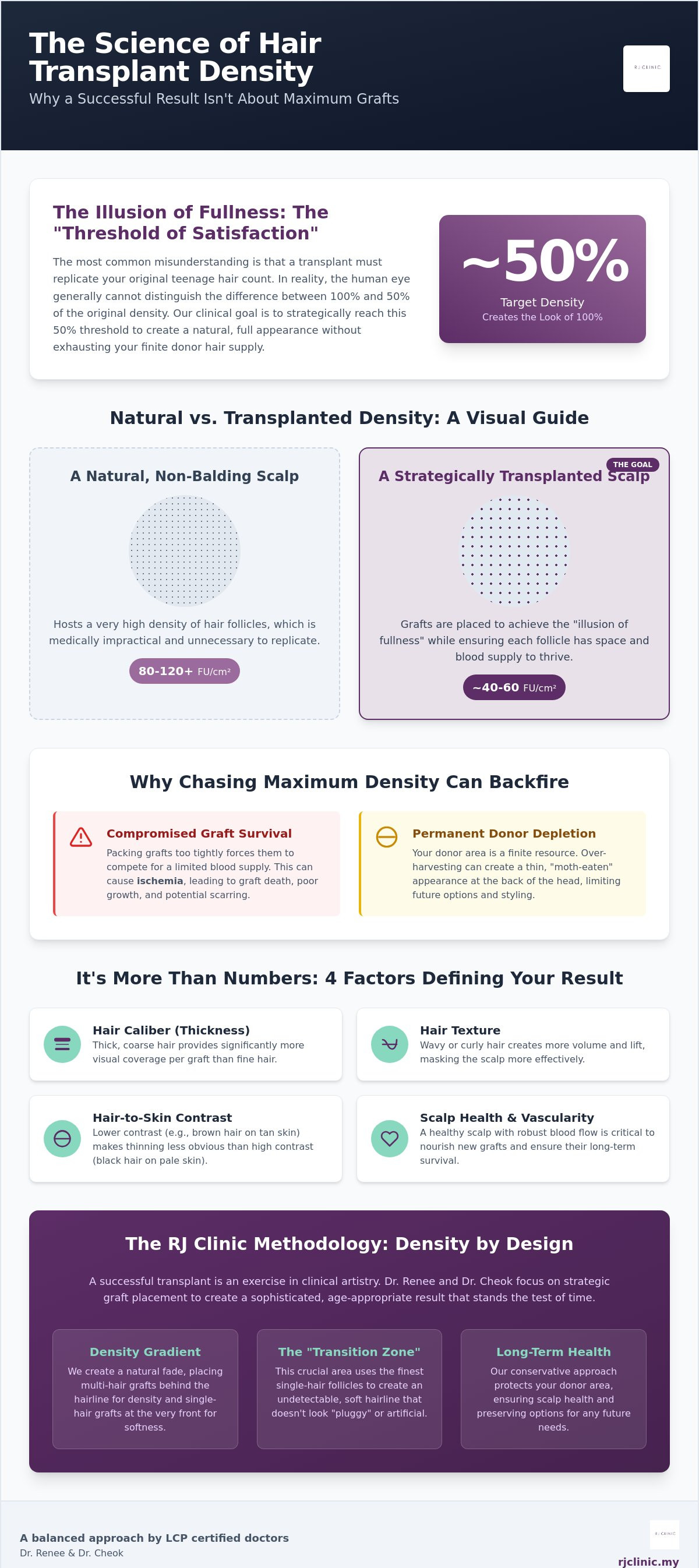
When patients inquire about hair transplant density, they often envision a complete return to the thick, lush hair of their youth. In clinical terms, hair density is defined as the number of follicular units (FUs) per square centimetre. A healthy, non-balding scalp typically hosts between 80 and 120+ FU/cm². However, attempting to replicate these numbers through surgery is not only impractical but often medically ill-advised. A transplant is essentially a zero-sum game; we aren't growing new hair, but rather redistributing a finite supply of follicles from the back of the head to the thinning areas.
The success of modern FUE hair transplant procedures relies on a clinical observation known as the "Threshold of Satisfaction." Research indicates that the human eye generally cannot distinguish the difference between 50% of original density and 100% density. By strategically placing grafts to reach this 50% threshold, we can create the appearance of a full head of hair without exhausting your limited donor resources.
Natural vs. Transplanted Density
A follicular unit is a natural grouping of 1 to 4 hairs that grows together as a single entity. Attempting to pack these units too tightly to match 100% natural density often leads to poor results. When grafts are placed too close together, they compete for a limited blood supply, which can lead to lower survival rates. Dr. Renee and Dr. Cheok prioritize the long-term health of the scalp, ensuring that each graft has enough "biological real estate" to thrive. We must treat the donor area as a finite bank account that needs to last a lifetime, especially if further hair loss occurs as you age.
The Logic of the Donor-Recipient Equation
Clinical planning involves a precise calculation of the area requiring coverage versus the available healthy grafts. During your consultation, Dr. Renee and Dr. Cheok will identify your "safe donor zone," which is the area at the back and sides of the head where hair is genetically programmed to resist balding. Modern hair transplantation techniques allow for high precision, but we must avoid "over-harvesting." If too many grafts are removed, the donor area can look thin or moth-eaten, a permanent complication that limits your future styling options. We focus on a balanced approach that ensures both the front and the back of your head look naturally refined.
Clinical Factors That Dictate Your Achievable Density
The final aesthetic outcome of a procedure isn't determined solely by the number of grafts extracted. Instead, it's a complex interplay of several biological variables that Dr. Renee and Dr. Cheok evaluate during your initial consultation. Understanding the hair transplant density achievable for your specific case requires looking beyond the raw numbers and considering the physiological environment of your scalp. Several clinical factors of hair transplantation, such as skin health and follicle quality, set the hard limits on what a surgeon can safely accomplish.
Scalp Vascularity and the 'Crowding' Risk
Every follicular unit we transplant is essentially a living tissue graft that requires an immediate blood supply to survive. Your scalp has a specific "vascular limit," which is the maximum number of grafts a square centimetre of skin can nourish at once. If we attempt to pack grafts too tightly, a condition called ischemia can occur. This is where the local blood supply is insufficient to feed the newly implanted hair, leading to graft death and potential scarring. While the industry often markets "mega-sessions" with massive graft counts, these aren't always in your best interest. We prioritize proper spacing to ensure optimal oxygenation and nutrient delivery, which is why we often suggest a personal clinical assessment to determine your scalp's unique capacity.
Individual Hair Characteristics
Visual fullness is often more about hair caliber and texture than actual graft count. A patient with thick, coarse hair strands will achieve significantly more coverage with 2,000 grafts than a patient with fine, wispy hair using the same amount. Texture also plays a vital role; wavy or curly hair creates a natural "lift" that adds visual volume, effectively masking the scalp. We also consider hair-to-skin contrast. Dark hair on very light skin makes thinning more obvious, whereas a lower contrast between your hair and scalp colour allows for a more forgiving result with fewer grafts. For those exploring their options, our guide on Hair Transplant Malaysia provides broader context on how we tailor FUE techniques to these diverse individual traits. Ultimately, your hair transplant density is a bespoke calculation designed to balance your current desires with the biological reality of your donor supply.
Strategic Grafts: Creating the Illusion of Fullness
Achieving a convincing result requires more than just high numbers; it demands an artistic understanding of how light interacts with the scalp. Since we've established that replicating 100% of your original hair transplant density is physiologically impossible, we focus on creating a strategic illusion. This is achieved through a "Density Gradient," where we concentrate the thickest grafts in the central forelock area. This zone provides the most visual impact when you look in the mirror or engage in face-to-face conversation.
To ensure the result looks organic, we design a "Transition Zone" at the very front of the hairline. This area consists of single-hair follicles placed with intentional, soft irregularities. If a hairline is too straight or too dense right at the edge, it looks manufactured. Behind this soft edge, we employ the "Shingling Effect." By layering hairs at specific angles, much like tiles on a roof, we can cover more of the scalp surface using fewer grafts. The exit angle of each hair is critical; if the hair stands too vertically, the scalp remains visible. When angled forward and layered, the hair blocks light from reaching the skin, resulting in a much fuller appearance.
Prioritising the Frontal Third
The frontal third of the scalp is the most critical area for patient satisfaction because it frames the face. While many patients worry about the crown, we often describe the crown as a "black hole" for grafts; it requires a vast number of follicles to look dense because of the circular hair whorl. We prioritize the frontal view to ensure you see an immediate, transformative change. For patients who also seek to refine their facial features, we apply these same principles of precision to our Instabrow Eyebrow Transplant to achieve natural-looking facial hair density.
The Role of Supportive Therapies
Clinical success is often bolstered by how well the scalp environment supports the new grafts. We frequently integrate Platelet Rich Plasma (PRP) into our protocols. Platelet Rich Plasma acts as a biological fertiliser for the scalp environment, providing essential growth factors that encourage healing. Additionally, Exosome Therapies may be utilized to further support follicle health and improve the overall "take rate" of the transplanted units. These therapies are particularly useful when a patient's ideal donor density is on the lower end of the clinical spectrum.
If you're ready to see how these artistic techniques can be tailored to your unique features, consult with Dr. Renee or Dr. Cheok to begin your clinical planning.
The RJ Clinic Methodology: Balancing Density with Long-Term Donor Health
At RJ Clinic, we view hair restoration as a lifelong journey rather than a single event. Achieving the right hair transplant density today must be balanced against your potential hair loss ten or twenty years from now. Dr. Renee and Dr. Cheok emphasize a multi-year strategy that treats your donor area as a precious, finite resource. This is why we often advise younger patients against an aggressively low hairline. While a low hairline looks appealing in one's twenties, it can look unnatural as you age, and using too many grafts early on may leave you with insufficient donor supply if thinning continues behind the transplanted zone.
We utilize Follicular Unit Extraction (FUE) as our gold standard because it allows for the precise, individual selection of grafts with minimal downtime. It's vital to prepare for the "shedding phase," where transplanted hairs fall out a few weeks after the procedure. This is a normal part of the biological cycle. Your final, permanent density typically becomes visible between month 10 and month 12, as the follicles enter a new growth phase and the hair shafts thicken.
Clinical Consultation and Planning
Our planning process begins with a microscopic analysis of your scalp to count the number of hairs per follicular unit. This data allows us to predict exactly how much coverage we can achieve. We specifically customize our FUE Hair Transplant approach for Malaysian hair types, which often feature specific calibers and straight textures that require precise angulation to avoid a "pluggy" appearance. We set clear milestones, helping you understand what to expect at month 4 versus the final result at month 12.
Post-Operative Care for Density Retention
The first 72 hours after your procedure are the most critical for protecting the hair transplant density you've invested in. During this window, the newly implanted grafts are establishing their blood supply and are extremely vulnerable to trauma. We provide detailed protocols to help you avoid accidental rubbing or infection, ensuring a survival rate that typically reaches 90% to 95% in clinical settings. Long-term maintenance is equally important; we may recommend medical therapies to protect your non-transplanted hair, preventing a "gap" from forming between your new hairline and your original hair as time passes.
Designing Your Permanent Aesthetic Future
A sophisticated result is never the product of chance or aggressive graft counts. As we've explored, achieving a natural hair transplant density requires a meticulous balance between your scalp's biological capacity and the artistic placement of every follicle. By prioritizing the "Threshold of Satisfaction" and managing your donor area with a multi-year perspective, we ensure that your restoration remains as refined in a decade as it does on the day of your final reveal.
Dr. Renee and Dr. Cheok provide the clinical authority necessary to navigate these complex trade-offs. Our LCP-certified team (KKM approved) utilizes specialized FUE techniques to craft hairlines that mirror the subtle irregularities of nature. To further enhance your results, we integrate medical-grade post-care, including PRP and Exosome therapies, to foster the most supportive environment for graft survival. We're here to help you move beyond marketing claims toward a solution rooted in scientific integrity and personalized care.
If you're ready to move forward with a plan tailored to your unique hair caliber and facial structure, book a clinical density analysis with Dr. Renee or Dr. Cheok at RJ Clinic. It's time to restore your hair with the precision and excellence you deserve.
Clinical Insights: Frequently Asked Questions
How many grafts per cm2 is considered high density?
In clinical practice, high density is typically defined as 40 to 50 grafts per square centimetre. While a natural, non-balding scalp can exceed 80 units, the biological limit for graft survival usually peaks around 50. Pushing beyond this mark increases the risk of overcrowding and poor blood supply. Dr. Renee and Dr. Cheok focus on achieving the maximum sustainable hair transplant density while ensuring every follicle has the nourishment it needs to thrive permanently.
Can I have a second hair transplant if the first one isn't dense enough?
You can certainly undergo a second procedure provided you have sufficient donor hair remaining in the safe zone. This is often called a "density touch-up" or a second pass. It's usually performed at least 12 months after the first session once the initial grafts have fully matured. We carefully assess your donor area to ensure that extracting more follicles won't result in visible thinning at the back of your head.
Why does my hair look thinner under bright bathroom lights?
Bright, overhead lighting increases the contrast between your hair and your scalp, making any gaps more apparent. This is a common concern for patients, as direct light travels straight to the skin rather than being diffused by the hair shafts. Even with a successful transplant, the "illusion of density" is most challenged under harsh, vertical light. We use strategic angulation during surgery to minimize this effect and provide better coverage from multiple angles.
Will my transplanted hair be as thick as the hair on the back of my head?
The transplanted hair will retain the same thickness and caliber it had in the donor area. This is due to "donor dominance," where the hair follicle keeps its original genetic characteristics even after being moved. If the hair at the back of your head is coarse and thick, your new hairline will reflect that same quality. However, it's important to remember that the total number of hairs in the recipient area will still be lower than your original childhood density.
Does the FUE method result in higher density than the traditional strip method?
FUE doesn't inherently create higher density than the strip method, but it offers superior precision in graft placement. Because Dr. Renee and Dr. Cheok can select specific follicular units, we can refine the hair transplant density in critical areas like the frontal hairline with greater artistry. FUE also avoids the linear scar associated with the strip method, allowing you to wear your hair shorter while maintaining a look of natural fullness across the entire scalp.
How long after my transplant will I see the final density results?
You should expect to see the final, mature density between 12 and 18 months after your procedure. While new hairs begin to emerge around month four, they are initially very fine and wispy. As the months progress, the hair shafts thicken and the texture matures, providing the full visual impact of the transplant. We monitor your progress during follow-up appointments to ensure the grafts are thriving and the density is developing according to our clinical plan.


Comments