


Exosomes for Skin Rejuvenation: Benefits, Evidence and Safety

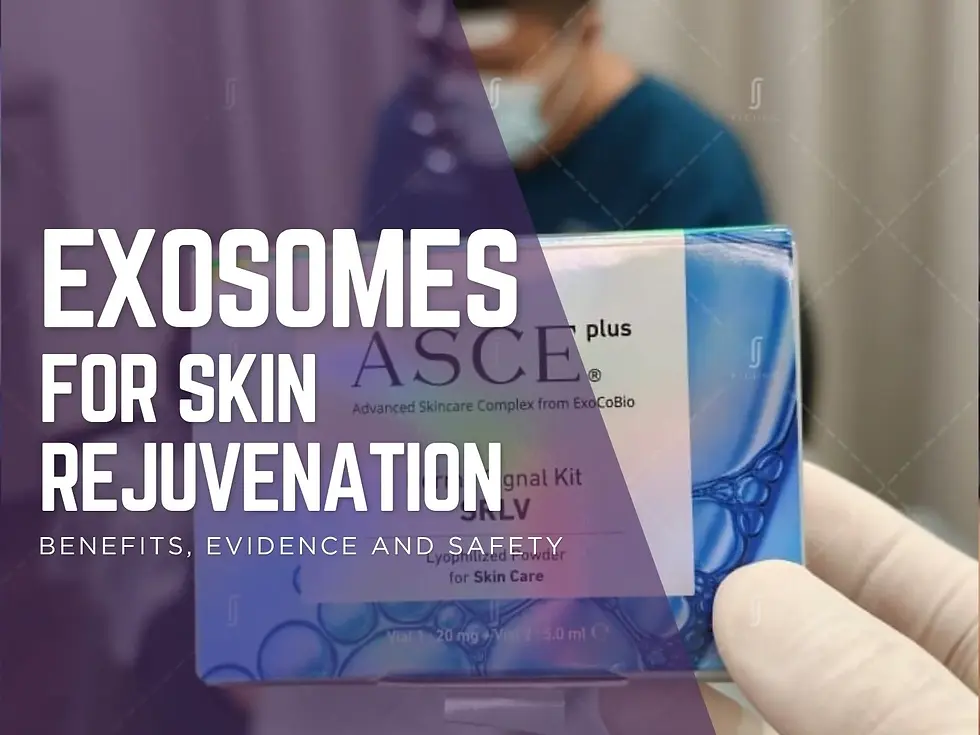
Can exosomes genuinely improve skin, or do results depend more on what is in the product and how it is used? Interest in exosomes skin rejuvenation is growing, but exosomes aren’t stem cells. Promising claims about collagen, glow or acne scars don’t establish whether a particular treatment is suitable or well supported.
It’s reasonable to want clearer skin and a more refreshed appearance while asking what evidence sits behind the promise. Research into exosomes for skin is encouraging but preliminary. Differences in products and treatment methods make results difficult to generalise.
This article explains what exosomes are, how they may be used in aesthetic treatments, and what current evidence can and can’t establish. It also covers why product source, preparation and delivery matter when considering potential benefits and safety. Before deciding, a doctor-led consultation can help you assess suitability and ask informed questions. RJ Clinic lists exosomes among its offerings, with consultations led by LCP-certified doctors Dr Renee and Dr J.
Table of Contents
What Are Exosomes for Skin Rejuvenation?
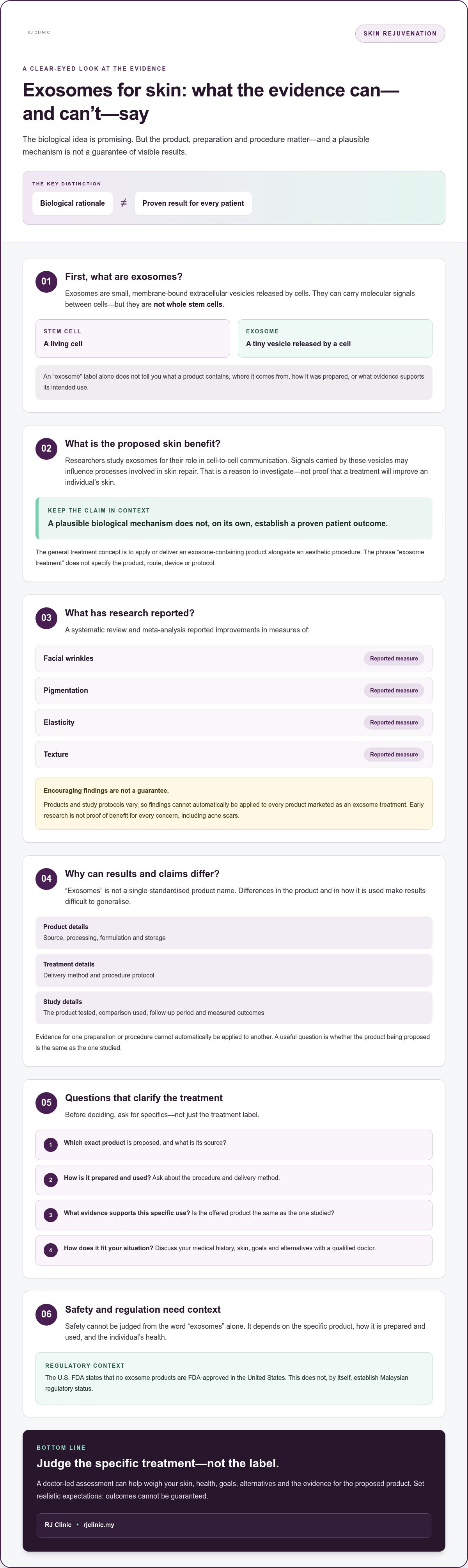
Exosomes are small, membrane-bound extracellular vesicles released by cells that can carry molecular signals between cells. They are not whole cells, and calling something an exosome treatment doesn’t show, by itself, that it will rejuvenate skin. The term describes a biological concept. A commercial product’s contents, source, preparation and intended use need to be assessed separately.
That distinction matters because products and marketing language vary. “Exosomes” alone doesn’t tell you what the material is derived from, how it has been processed, or what evidence supports its use for a particular skin concern. If you’re exploring exosomes skin rejuvenation, focus on three practical questions: which product is proposed, how will it be used, and what can reasonably be expected?
How do exosomes differ from stem cells?
A stem cell is a living cell. An exosome is a tiny vesicle released by a cell, not a cell that can grow or become another type of cell. Although exosomes may carry signals involved in cell communication, using them is not the same as receiving stem-cell therapy. Sources and preparation methods can differ between products, so ask for the exact product details rather than relying on broad terms such as “stem-cell-derived.”
What does an exosome skin treatment involve?
The general concept is to apply or deliver an exosome-containing product in connection with an aesthetic procedure. The method can vary, and the phrase “exosome treatment” doesn’t specify a device, route or protocol. Ask the treating doctor which product is proposed, where it comes from, how it is prepared, how it will be used, and what evidence supports that particular use. Those details help distinguish a defined treatment plan from a broad claim.
If dullness is your main concern, discuss possible causes and suitable options with a doctor rather than assuming exosomes are the answer. RJ Clinic also provides information about dull skin concerns. A careful assessment should connect the treatment choice to your skin, goals and the available evidence, without promising a particular result.
How Might Exosomes Support Skin Rejuvenation, and What Does Evidence Show?
Exosomes are studied for their role in cell-to-cell communication. The proposed biological rationale is that signals carried by these vesicles may influence processes involved in skin repair. That mechanism is a reason to investigate them, not proof that a treatment will improve your skin. A plausible biological mechanism does not, on its own, establish a proven outcome for patients.
Research findings need context. Laboratory studies can suggest how a substance might behave, but they can’t establish how well a treatment works in people. Human studies are more directly relevant, yet their findings still depend on the product and procedure tested, the comparison used, the length of follow-up, and how outcomes were measured.
Which skin concerns are discussed in exosome research?
A systematic review and meta-analysis published in March 2026 reported improvements in measures including facial wrinkles, pigmentation, elasticity and texture. The review searched studies published up to February 2025. These pooled findings are encouraging, but they don’t establish that every product marketed as an exosome treatment has the same effects. Products and study protocols vary. Early research shouldn’t be treated as a guarantee for an individual patient or as proof that exosomes address every concern, including acne scars.
Why can results and claims vary between treatments?
“Exosomes” isn’t a single standardised product name. Source, processing, formulation, storage and delivery may differ, so evidence for one preparation or procedure can’t automatically be applied to another. When reviewing a study, check whether it identifies the product clearly, describes how it was used, includes a suitable comparison group, follows participants for an appropriate period and measures outcomes that matter to patients. Then ask whether the product being offered is the same as the one studied.
Regulatory status also depends on jurisdiction and intended use. The U.S. FDA’s public safety notification states that no exosome products are FDA-approved in the United States. That does not, by itself, establish Malaysian regulatory status. For clinic-specific information, review RJ Clinic’s exosome therapy information and ask a doctor to clarify the exact product and evidence relevant to your proposed treatment.
Are Exosomes Safe, and Who Should Consider Them in Kuala Lumpur?
Safety depends on the specific product, how it is prepared and used, and your individual health, so it can’t be judged from the word “exosomes” alone. A qualified doctor should review your medical history, examine your skin and understand your goals before discussing whether this treatment is appropriate. If you have active skin irritation, an infection, or a health condition that may affect healing, raise it during the assessment rather than assuming the treatment is suitable.
For people considering care in Kuala Lumpur, including Mont Kiara, Bangsar, Damansara Heights, Sri Hartamas, TTDI, Segambut, Kepong, Desa ParkCity, Solaris Dutamas, Publika, Bandar Sri Damansara, Mutiara Damansara and Bandar Utama, ask for clear answers before deciding. You should understand what product is proposed, how the procedure is performed, what risks are relevant to you, and what follow-up or aftercare is advised. If a regulatory claim is made, check it against current official Malaysian sources rather than relying on a general assurance or an overseas approval claim.
What should you ask about the product and procedure?
Use the consultation to clarify practical details, not just the treatment name. Ask for the product identity and source, how it is prepared and stored, its intended use, and what evidence supports that use. Ask who will assess and perform the procedure, what training or credentials they hold, what potential side effects to watch for, and whom to contact if you have a concern afterward. Take time to consider the answers before proceeding.
RJ Clinic lists exosomes among its offerings and is led by LCP-certified doctors Dr Renee and Dr J. For details specific to its service, you can review RJ Clinic’s exosome therapy information and discuss product-specific questions with a doctor.
When might another skin treatment be a better fit?
The right option depends on the cause of your concern, your skin condition and the change you’re seeking. Dullness or uneven-looking skin, for example, may have different causes and may call for a different approach. A doctor can assess whether an option such as a skin booster or an energy-based treatment is more relevant. Explore dull skin treatment information as a starting point, not a substitute for diagnosis.
If you’re considering exosomes skin rejuvenation, ask for an individual medical assessment before deciding. Discuss realistic expectations, including what remains uncertain and which alternatives may better match your needs.
How to Decide Whether Exosome Skin Rejuvenation Is Right for You
A measured decision starts with your skin concern, not the treatment name. For exosomes skin rejuvenation, work through four questions: What are you hoping to improve? What evidence supports that use? What exact product and procedure are proposed? Are there alternatives with evidence and trade-offs that better fit your needs? A consultation should help you examine these points without pressure to proceed.
Keep expectations realistic. Evidence may not apply to every product or method, and no clinician can guarantee an individual result. Take time to consider the information or decide that another approach, or no procedure, is the better choice.
What to bring up at a medical consultation
Describe what concerns you and when you first noticed it. Share previous procedures, your current skincare routine, medications, allergies and relevant medical history. These details can inform the assessment and help the doctor consider whether a treatment is appropriate.
Ask what evidence supports the exact product and approach being proposed, and whether that evidence relates to people with a concern like yours. Discuss potential risks, expected recovery, aftercare and follow-up. Ask what the alternatives are and what the doctor would recommend if exosomes aren’t suitable. A clear explanation should leave room for questions and a decision at your own pace.
How to compare exosomes with other rejuvenation options
Compare treatments by the concern they’re intended to address, the evidence behind that use, how they’re performed, and their risks and recovery, rather than by trend or terminology. Skin laxity, for example, may call for a different discussion from uneven tone or texture. The appropriate option depends on your skin assessment and goals, not on a treatment’s popularity.
For clinic-specific details, explore RJ Clinic’s exosome therapy information. Use it as a starting point for a discussion with a qualified doctor about suitability, product details, uncertainties and alternatives.
Make Your Next Step an Informed One
Exosomes are a developing area of skin research, but a proposed biological effect isn’t the same as a predictable result. For exosomes skin rejuvenation, look beyond the treatment name: ask what product and method are being considered, what evidence applies to that specific approach, and whether it suits your skin concern and medical history. Evidence is still evolving, so outcomes can’t be guaranteed.
A thoughtful consultation should leave you clearer about suitability, potential risks, alternatives and what to expect, including whether another option may be a better fit. RJ Clinic lists exosomes among its offerings, and LCP-certified doctors Dr Renee and Dr J can discuss treatment considerations. Explore RJ Clinic’s exosome therapy information and arrange a consultation to discuss the product, evidence and alternatives before deciding.
Frequently Asked Questions
What are exosomes in skin rejuvenation?
Exosomes are small extracellular vesicles released by cells that can carry signals between cells. They aren’t whole stem cells, and an exosome product isn’t the same as stem-cell therapy. For exosomes skin rejuvenation, the term describes a biological concept, not one standard treatment. Products may differ in source and preparation, so ask which specific product is proposed and how it will be used before drawing conclusions about its effects.
Do exosomes really improve skin?
Early research is promising, but it doesn’t establish that every exosome product improves skin or predict how an individual will respond. Laboratory findings can suggest a possible biological effect, while studies in people are more directly relevant but may still use different products, procedures and outcome measures. Ask whether evidence relates to the exact product and method being offered, and treat claims about glow, wrinkles, pigmentation or scars with appropriate caution.
Are exosome treatments approved in Malaysia?
Available information does not establish blanket Malaysian approval for exosome treatments for widespread cosmetic use. Regulatory status may depend on the specific product, its intended use and how it is supplied or administered. Don’t assume a treatment is approved because it’s offered by a clinic or described as medical-grade. Ask what applicable Malaysian requirements have been checked, and verify product-specific claims with current official sources such as the NPRA or Ministry of Health.
Are exosome skin treatments safe?
Safety can’t be confirmed from the word “exosomes” alone. It depends on the product’s source and preparation, its quality, the procedure and your health. Discuss potential risks, including contamination or infection, with a qualified doctor who can review your medical history and skin. If you’re comparing providers in Kuala Lumpur, ask each clinic the same questions about product details, the procedure and aftercare.
How many exosome treatments are needed to see results?
There isn’t a single established number that applies to every exosome product, procedure or skin concern. Treatment plans can vary, and the available evidence doesn’t support promising a particular result after a fixed number of sessions. Ask the doctor what schedule they propose, why it suits your concern, when progress would be assessed and what would prompt a change in plan. Be cautious if a specific outcome or timeline is presented as guaranteed.
Can exosomes be combined with microneedling or other skin treatments?
Some approaches apply an exosome product alongside procedures such as microneedling, but that doesn’t mean every product is intended or suitable for combination use. The product, delivery method, skin condition and procedure-specific risks all matter. Ask the treating doctor whether evidence supports the exact combination, what recovery to expect and whether another treatment should be avoided or delayed. Don’t combine procedures based solely on a general claim that they enhance one another.


Comments