


Can Collagen Stimulators Be Dissolved? What to Know Before Treatment


The presence of a "reversal agent" is often the safety net that gives patients the confidence to begin their aesthetic journey. However, a significant clinical misunderstanding involves the assumption that all injectables can be undone with a quick enzyme shot. If you are asking if can collagen stimulators be dissolved, the direct answer is no; they cannot be erased with hyaluronidase in the same way as hyaluronic acid fillers. While HA fillers exist as a reversible gel, biostimulators like Sculptra, Radiesse, and Ellansé work by integrating with your tissue to trigger a regenerative response.
It's understandable to feel anxious about the perceived permanence of these treatments or the risk of overfilling. You deserve a clear understanding of how these advanced products behave once injected. We'll examine the science behind collagen induction and the specific protocols Dr Renee and Dr Cheok use to ensure safety and precision. This guide explains the management options for potential complications like nodules and why a meticulous, "prevention-first" approach is essential for achieving the subtle, organic-looking results you expect from a premium clinical environment.
Table of Contents
The Science of Reversibility: Collagen Stimulators vs. Hyaluronic Acid Fillers
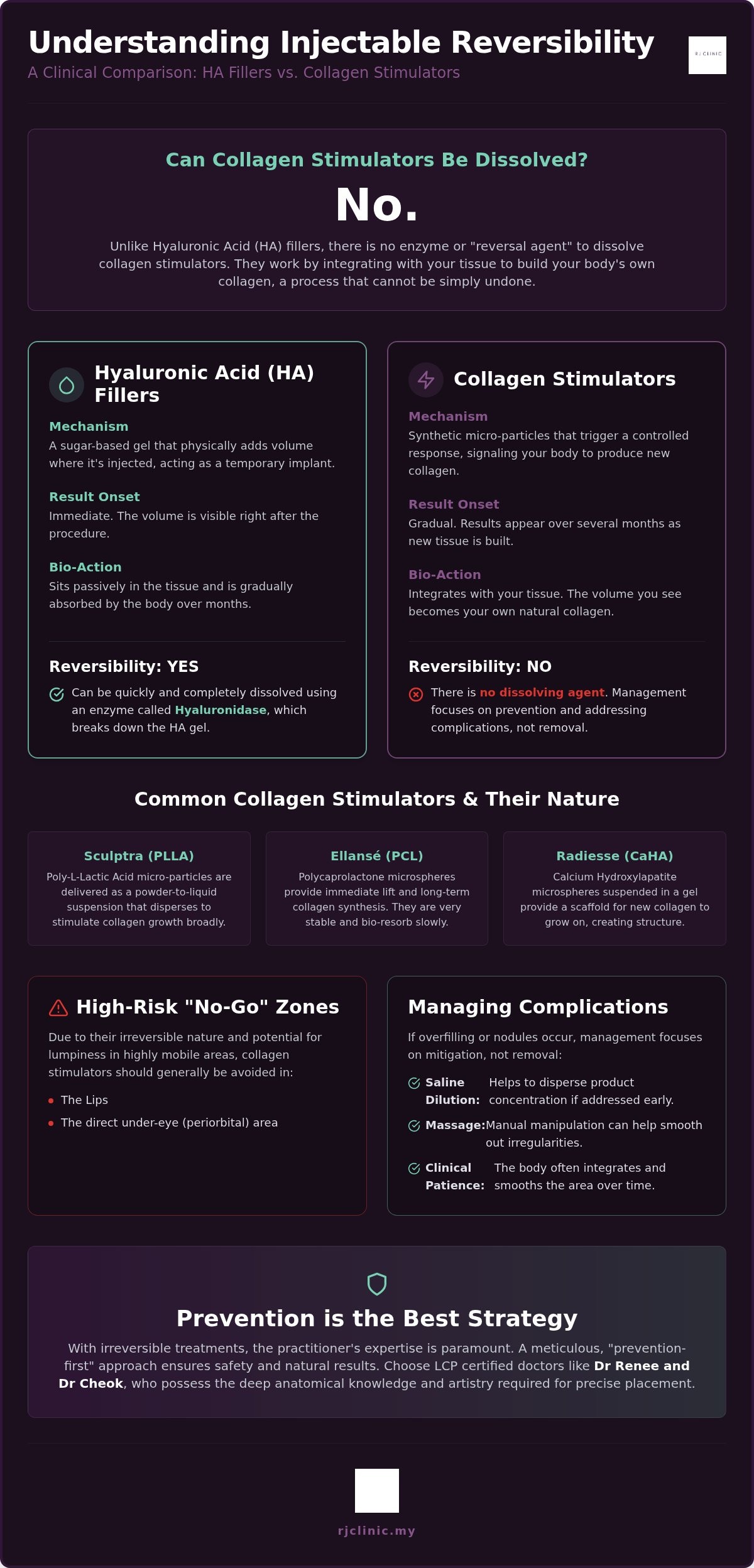
Patients often ask if can collagen stimulators be dissolved during the same consultation where we discuss traditional fillers. It's a vital distinction to make before any needle touches the skin. Traditional dermal fillers are typically composed of Hyaluronic Acid (HA), which is a naturally occurring sugar molecule. Because HA is held together by specific chemical cross-links, we can use an enzyme called hyaluronidase to instantly break those bonds. This acts as a biological "undo" button, allowing for the immediate removal of the product if the result is suboptimal or if a complication occurs.
Collagen stimulators, such as Radiesse (Calcium Hydroxylapatite) or Sculptra (Poly-L-lactic acid), operate on an entirely different premise. These are not simple gels that sit passively in the tissue. Instead, they are composed of synthetic micro-particles or minerals designed to provoke a controlled response from your immune system. This response signals your fibroblasts to produce new, organic collagen. A standard injectable filler made of HA is essentially a temporary implant, whereas a biostimulator is a catalyst for cellular change.
The Role of Hyaluronidase and Its Limitations
Hyaluronidase is highly substrate-specific; it only recognizes and acts upon the molecular structure of hyaluronic acid. When we inject this enzyme into an HA filler, it liquefies the product almost immediately. However, this enzyme has zero effect on the crystalline structure of PLLA or the microspheres found in PCL. Dr Renee and Dr Cheok often explain to patients that claiming you can "dissolve" a biostimulator is a clinical misnomer. These materials don't have the sugar-based bonds that hyaluronidase is designed to cut, making the chemical "dissolving" mechanism physically impossible for non-HA substances.
Bio-Integration: When Your Body Becomes the Filler
The goal of a biostimulator is to eventually disappear, leaving behind your own natural tissue. This is why the question of whether can collagen stimulators be dissolved becomes more complex over time. Once the initial carrier gel is absorbed, the volume you see is actually your own flesh. Bio-integration is the process where synthetic materials are replaced by natural Type I and Type III collagen. Because this new volume is a living part of your skin's architecture, there is no exogenous product left for an enzyme to target, requiring a different management strategy altogether.
Why Different Collagen Stimulators Cannot Be Simply Dissolved
Understanding why can collagen stimulators be dissolved is not a clinical reality requires looking at their physical state. Unlike the cohesive, sugar-based gel of an HA filler, biostimulators are composed of solid micro-particles suspended in a liquid or gel carrier. While the carrier itself might be absorbed by your body relatively quickly, the active particles remain embedded in the dermis to do their work. This is a primary reason why FDA guidance on dermal fillers emphasizes that certain materials are considered non-reversible and difficult to remove once integrated into the tissue.
Poly-L-Lactic Acid (PLLA) and Sculptra
Sculptra uses Poly-L-Lactic Acid (PLLA), which is delivered as a powder-to-liquid suspension. Once injected, these micro-particles disperse throughout the tissue layers like fine dust. Because they aren't bound in a single, localized gel mass, they can't be targeted for extraction or chemical dissolution. The volume is created through gradual tissue thickening over several months. If you're unhappy with the placement, there is no enzyme that can halt the collagen-building process once it has been triggered by these dispersed particles.
Polycaprolactone (PCL) and Ellansé
For those seeking a dual-action effect, the Ellansé biostimulator page details how Polycaprolactone (PCL) provides immediate lift followed by long-term collagen synthesis. PCL is a semi-permanent option because the microspheres take significantly longer to degrade than HA. Dr Renee and Dr Cheok often remind patients that this longevity is a significant benefit for the right candidate, but it necessitates absolute precision during the initial procedure. The chemical stability of PCL means it remains in place until it naturally bio-resorbs over several years.
Calcium Hydroxylapatite (CaHA) and Radiesse
Radiesse is mineral-based, utilizing Calcium Hydroxylapatite (CaHA) microspheres. As explained on our Radiesse page, these particles act as a scaffold for both collagen and elastin. Your body eventually metabolizes the calcium over 12 to 18 months via natural metabolic pathways. While this is a predictable timeline, the structure remains firm until the body's own processes break it down at a biological pace. If you're concerned about your suitability for these long-wear options, consulting with an LCP-certified doctor is the best way to ensure your facial anatomy is suited for biostimulation.
Managing Unwanted Results: Clinical Options When You Can’t Dissolve
Since we have established that can collagen stimulators be dissolved is not a chemical possibility, clinical management focuses on physiological modulation. When a patient is dissatisfied with a biostimulator result, the approach shifts from immediate removal to expert intervention designed to influence how the product integrates with the tissue. Dr Renee and Dr Cheok prioritize a "prevention-first" philosophy, but they also possess the clinical depth required to manage cases where the initial placement was suboptimal or the body's response was unexpected.
For recently injected PLLA, such as Sculptra, we can sometimes perform a saline or lidocaine dilution. This involves injecting a sterile solution into the treated area to further disperse the micro-particles before they become firmly embedded. This intervention is highly time-sensitive and typically most effective within the first 48 hours. Beyond this window, we may utilize mechanical or thermal therapies. Heat-based devices like Density RF or Potenza RF Microneedling can help by increasing local blood flow and softening the carrier gel, which may refine the overall contour.
Treating Nodules and Lumps
It is essential to differentiate between early-onset lumps and late-onset granulomas. Early lumps are often just small clusters of product that haven't dispersed properly; these can frequently be resolved with vigorous, professional-grade massage. Late-onset nodules, however, are inflammatory responses where the body overreacts to the stimulant. In these instances, we use intralesional steroid injections or 5-Fluorouracil (5-FU) to suppress the inflammation and soften the firm tissue. Early detection is the key to success here. If you notice persistent firmness, consulting with an LCP-certified doctor for a corrective assessment is the safest next step.
Metabolic Breakdown and Timeframes
Clinical patience is often the most difficult but necessary part of the process. While the question of whether can collagen stimulators be dissolved remains a common concern, understanding the metabolic timeline helps alleviate patient anxiety. Most biostimulators have a predictable degradation cycle. PLLA typically metabolizes over 12 to 18 months, while PCL can remain for up to 24 months. Often, what appears as "overfilling" in the first few weeks is actually temporary edema or the volume of the carrier gel. As these subside, the final, more subtle collagen structure reveals itself, often resolving the patient's initial concerns without invasive intervention.
Preventing Aesthetic Regret: The Critical Role of Practitioner Expertise
Because the answer to whether can collagen stimulators be dissolved is a definitive no, the margin for error is significantly narrower than with traditional fillers. This lack of a "reversal agent" demands a practitioner who understands facial anatomy at a microscopic level. Dr Renee and Dr Cheok approach biostimulators with a "conservative first" mindset. It's far easier to add more product in a follow-up session than to manage the overgrowth of tissue from an aggressive initial treatment. Precision is not just a preference; it is a clinical necessity.
Certain areas of the face are anatomically unsuitable for collagen induction. The lips and the delicate infraorbital under-eye skin are high-risk zones. Injecting biostimulators here often leads to visible nodules or uneven texture because the skin is too thin to hide the product's integration. For these regions, we typically recommend dermal fillers or specialized eyebag treatments that offer safer, more predictable results. In Malaysia, verifying a doctor’s Letter of Credentialing and Privileging (LCP) is the most critical step a patient can take. This certification ensures that your doctor has met the rigorous standards set by the Ministry of Health for aesthetic medical practice, acting as your primary safeguard against improper injection techniques.
Subtle Refinement over Dramatic Change
Our philosophy at RJ Clinic centers on the "less is more" approach. Biostimulators are designed to enhance your natural features by restoring lost structural integrity, not by creating an artificial mask. Choosing between HA and a stimulator depends on your long-term goals; HA offers immediate gratification and reversibility, while stimulators provide a durable, organic foundation. For a deeper comparison of these two paths, you can explore our detailed guide on Ellansé vs Hyaluronic Acid Filler.
What to Ask Your Doctor Before Injection
A transparent consultation is the foundation of a safe outcome. You should always confirm your suitability for PLLA or CaHA based on your skin quality and medical history. Ask about the product’s batch authenticity and the doctor’s specific experience in managing potential nodules. If you are ready to explore a personalized, medically-backed aesthetic plan, book a consultation with our LCP-certified doctors at RJ Clinic. We prioritize your safety and the longevity of your results above all else.
Securing Your Aesthetic Future Through Precision
Choosing a biostimulator is a commitment to your skin's regenerative future. While we've addressed the technical reality that can collagen stimulators be dissolved, clarifying that they cannot be chemically erased like HA fillers, this shouldn't be a source of anxiety. It simply underscores the necessity of choosing a practitioner who prioritizes facial harmony and structural integrity. By selecting FDA-approved technologies like Sculptra or Radiesse, you can achieve a refined, organic look that evolves gracefully with your natural features.
The ultimate safety net isn't a reversal agent; it is the clinical judgment of an LCP-certified doctor. At RJ Clinic, we specialize in custom-designed approaches that favor subtle enhancement over artificial transformation. If you're ready to discuss a tailored plan for long-term volume and skin health, consult Dr Renee or Dr Cheok about your biostimulator options. We are dedicated to ensuring your aesthetic journey is grounded in medical excellence and artistic precision, helping you feel confident and refreshed at every stage.
Frequently Asked Questions
Is there any way to reverse Sculptra if I don’t like it?
Sculptra cannot be reversed with a chemical agent. Unlike hyaluronic acid fillers, PLLA particles don't react to hyaluronidase. If you're asking if can collagen stimulators be dissolved, the answer is no. Early intervention with saline dilution or professional massage by Dr Renee or Dr Cheok can help disperse the product. Otherwise, you must wait for your body to naturally metabolize the PLLA over 12 to 18 months.
How long does it take for collagen stimulators to wear off naturally?
The duration depends on the specific biostimulator used and your individual metabolism. Radiesse typically lasts between 12 and 18 months, while Sculptra follows a similar timeline. Ellansé offers longer-lasting results, often remaining visible for up to 24 months. It's important to remember that while the synthetic particles eventually disappear, the natural collagen your body produced during the treatment remains as a permanent part of your skin’s architecture.
Can heat treatments like Ultherapy or Thermage melt collagen stimulators?
Heat-based treatments like Ultherapy Prime or Potenza RF don't "melt" the particles in a biostimulator. These technologies actually work in harmony by further stimulating collagen production. While high heat could theoretically affect a fresh carrier gel, it isn't a viable method for reversing a treatment. At our Kuala Lumpur clinics, we often combine these modalities to enhance skin tightening rather than using them as a corrective tool for overfilling.
What happens if a collagen stimulator causes a lump?
Lumps are manageable but require clinical expertise. Early-onset lumps are usually just product clusters that respond well to vigorous massage. If a firm nodule appears months later, it might be an inflammatory granuloma. Dr Renee and Dr Cheok treat these with intralesional steroid injections or 5-Fluorouracil to soften the tissue. Most minor irregularities resolve as the carrier gel subsides, making a "wait-and-see" approach appropriate for many patients in Bangsar or Mont Kiara.
Are collagen stimulators permanent?
Collagen stimulators are considered semi-permanent because they are bio-resorbable. They aren't permanent like a surgical implant; your body will eventually break down materials like PCL and CaHA through natural metabolic pathways. However, the regenerative effects are long-lasting. This distinguishes them from HA fillers, which degrade faster. Because they stay in the tissue for 12 to 24 months, the precision of an LCP-certified doctor is vital during the initial injection process.
Can I get HA fillers if I already have a collagen stimulator in the same area?
Yes, layering different injectables is a common practice in advanced facial contouring. We often use a structural biostimulator like Radiesse for jawline definition and then layer a soft HA filler for refined surface smoothing. This combination provides both long-term support and immediate refinement. It's crucial that your doctor understands the depth of previous injections to ensure the materials integrate safely without causing unnecessary inflammatory responses or tissue displacement.


Comments