


Collagen Stimulator vs Skinbooster: What's the Difference?


Investing in a skinbooster to lift sagging jowls is like painting a house with a cracked foundation; the finish might look momentarily brighter, but the structural integrity remains compromised. This common misunderstanding regarding a collagen stimulator vs skinbooster often leads to a cycle of wasted investment and the "overfilled" look that many patients rightly fear.
It's entirely understandable to feel overwhelmed when navigating the choice between these two distinct technologies. You want a result that feels organic and age-appropriate, yet the distinction between deep-layer structural repair and superficial hydration isn't always clear. At RJ Clinic, Dr. Renee and Dr. Cheok focus on a diagnostic approach that prioritises your long-term skin health over temporary fixes. By matching the right biostimulatory agent to your specific facial anatomy, we can achieve a more sophisticated, natural-looking rejuvenation.
Identifying whether your skin requires cellular repair or structural reinforcement is the first step toward a successful, refined outcome. We will examine the biological mechanisms, clinical longevity, and anatomical suitability of each option to help you build a foundation for lasting skin health.
Table of Contents
Defining the Difference: Hydration vs. Structural Regeneration
In our clinical practice, Dr. Renee and Dr. Cheok frequently observe a specific pattern: patients often seek "hydration" when their underlying concern is actually a loss of structural support. While both treatments involve injections, the biological objective of a collagen stimulator vs skinbooster is fundamentally different. One polishes the surface. The other reinforces the foundation.
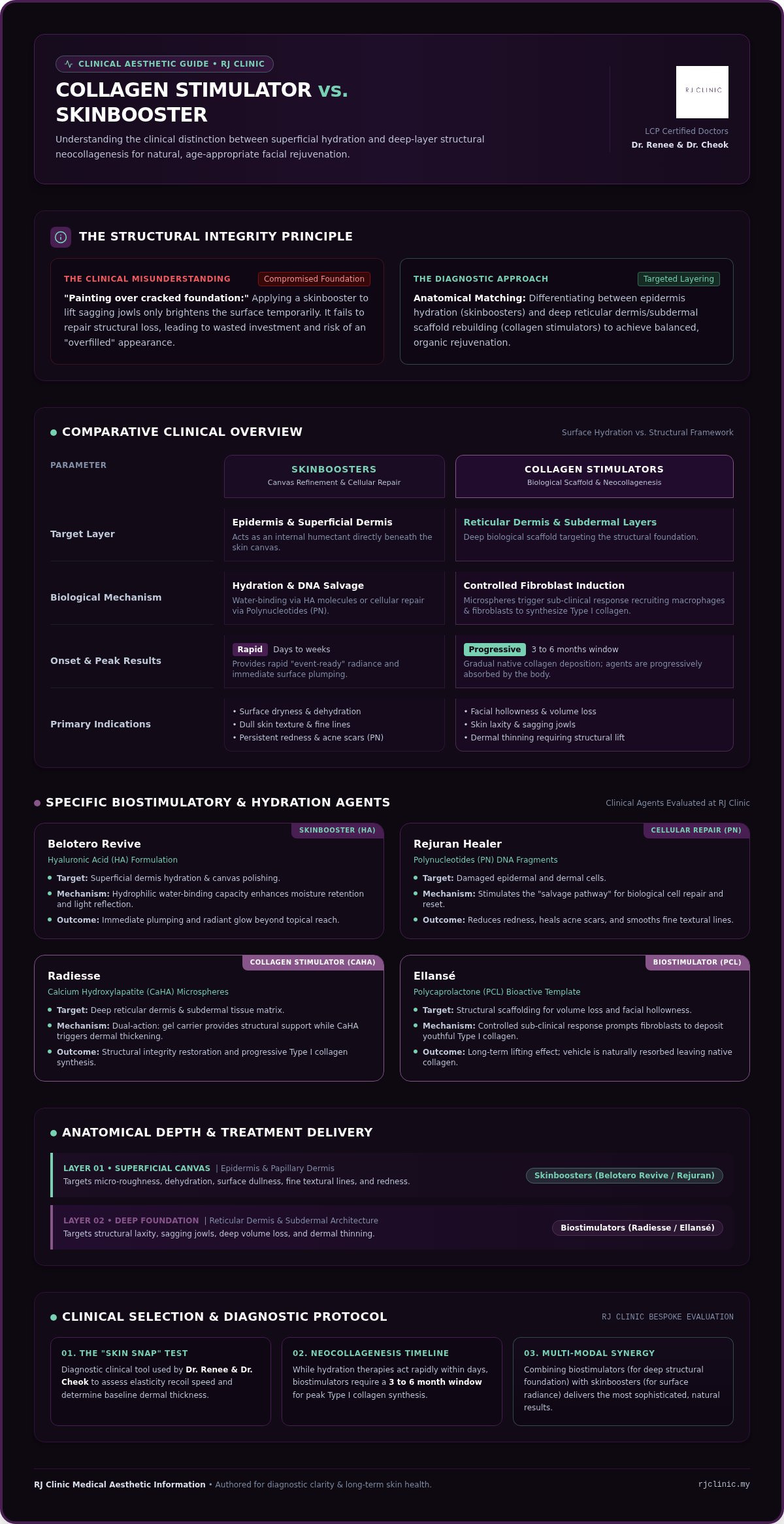
The key to choosing the right treatment lies in identifying which layer of the skin has been compromised. Skinboosters primarily target the epidermis and superficial dermis. They act like an internal moisturiser to improve texture. Collagen stimulators reach deeper into the reticular dermis and subdermal layers. They don't just sit there. They trigger a biological response that rebuilds the skin's framework. Choosing between a collagen stimulator vs skinbooster requires a professional assessment of your skin's elasticity and volume.
What Are Skinboosters Exactly?
Skinboosters are essentially high-performance tools for refining the skin's "canvas." They utilise substances like hyaluronic acid, a molecule naturally found in the body that's prized for its intense water-binding capacity. By delivering these micro-injections, we enhance moisture retention and create a visible "glow" that topicals simply cannot reach. At RJ Clinic, we often recommend Belotero Revive for its hydrating properties or Rejuran Healer, which uses Polynucleotides (PN) to repair damaged cells and smooth fine lines.
The Role of Collagen Stimulators
While boosters focus on the surface, collagen stimulators are non-HA injectables that function as a biological scaffold. Instead of simply providing temporary hydration, they incite a controlled healing response. This prompts your fibroblasts to produce new, native collagen over several months. This process is essential for addressing facial "hollowness" and skin laxity rather than just surface dryness. We frequently utilise Ellansé and Radiesse to restore structural integrity. These agents provide a lifting effect and dermal thickening that a skinbooster alone cannot achieve.
The Biological Mechanism: How Your Skin Responds
The way your tissue interacts with an injectable determines whether you see a temporary glow or a lasting transformation. When we evaluate the biological impact of a collagen stimulator vs skinbooster, we are choosing between two distinct cellular pathways. One replenishes the fluid within the skin's matrix, while the other fundamentally remodels the architecture of the dermis itself.
Hyaluronic Acid vs. Polynucleotides (PN)
Standard skinboosters rely on the hydrophilic properties of hyaluronic acid. These molecules possess an extraordinary ability to bind water, creating an immediate plumping effect that improves light reflection on the skin's surface. However, patients with more significant cellular damage often benefit more from Polynucleotides. Unlike HA, PN treatments like Rejuran Healer utilise DNA fragments to stimulate the "salvage pathway" for cell repair. This bio-regeneration is particularly effective for reducing redness and healing acne scars, providing a level of biological "reset" that simple hydration cannot achieve.
Biostimulators: Beyond Simple Filling
Collagen stimulators function as more than just volume replacements. Materials like Polycaprolactone (PCL) in Ellansé or Calcium Hydroxylapatite (CaHA) in Radiesse act as a bioactive template. Once injected, these microspheres trigger a controlled, sub-clinical inflammatory response. This process recruits macrophages and fibroblasts to the site, which then begin the labour-intensive task of depositing new Type I collagen. This is the same high-quality collagen found in youthful skin. According to FDA guidance on soft tissue fillers, these stimulatory agents are progressively absorbed by the body, leaving only your natural collagen behind.
The clinical timeline is where many patients feel the most difference. While a skinbooster provides that "event-ready" radiance within days, a biostimulator requires a 3 to 6 month window for full collagen synthesis to peak. Radiesse offers a unique middle ground; its gel carrier provides an immediate lift, while the CaHA microspheres work in the background to induce long-term dermal thickening. The longevity is often the deciding factor. Boosters typically require maintenance every 6 to 9 months. In contrast, the structural reinforcement from a stimulator can last between 1 to 2 years. If you are looking for a sustainable way to address thinning skin, you might consider how bespoke injectable plans can bridge the gap between hydration and structural support.
Clinical Selection: Which Treatment Matches Your Skin Concerns?
Choosing between a collagen stimulator vs skinbooster isn't about which product is "better" in a vacuum. It's about matching the clinical indication to your skin's current biological state. During a consultation, Dr. Renee and Dr. Cheok often perform a "Skin Snap" test. We gently pinch the skin on the cheek or jawline; if it takes more than a second to retract, it indicates a loss of structural elastin and collagen. This diagnostic marker usually shifts the recommendation from simple hydration toward regenerative support.
Environmental factors in Malaysia play a significant role in this decision. Chronic exposure to high UV levels leads to solar elastosis, where the skin's natural collagen becomes fragmented and dysfunctional. For patients with significant sun damage, a surface-level booster might provide a temporary sheen, but it won't address the underlying dermal thinning. In these cases, a biostimulator is necessary to restart the production of healthy, organised tissue layers. The choice of a collagen stimulator vs skinbooster ultimately depends on whether we are treating a lack of water or a lack of structural scaffolding.
The Best Candidate for Skinboosters
We typically recommend skinboosters for patients in their 20s and 30s as a form of preventative maintenance. If your primary frustrations are "crepey" texture under the eyes, enlarged pores, or a persistent dullness that makeup cannot hide, a booster is the logical choice. It offers a refined "red carpet" glow with virtually no downtime. For those experiencing the very first signs of fine lines, Belotero Revive serves as an excellent entry point to maintain dermal density and luminosity.
When to Choose a Collagen Stimulator
As we enter our 40s and beyond, the concern usually shifts from texture to "sinking." If you notice early jowls or a loss of volume in the mid-face, a biostimulator acts as a non-surgical "liquid lift." It provides the internal tension needed to support sagging tissue without the heavy, artificial look of traditional high-volume fillers. For patients seeking comprehensive rejuvenation, we often combine these injectables with energy-based devices. You can read more about Ultherapy Prime to understand how we layer treatments for maximum lifting results.
Ultimately, your roadmap depends on whether you need to polish the surface or rebuild the foundation. If you're unsure which path suits your anatomy, book a clinical skin assessment with our LCP-certified doctors to design your bespoke treatment plan.
Longevity, Results, and the RJ Clinic Bespoke Approach
At RJ Clinic, we believe rejuvenation is a diagnostic journey rather than a simple transaction. The choice between a collagen stimulator vs skinbooster is rarely an either-or decision; instead, it's about creating a sequence that respects your biology. Dr. Renee and Dr. Cheok prioritise a multi-modal approach because ageing is three-dimensional. It involves the loss of skeletal support, fat pad migration, and dermal thinning. Addressing only one layer with a single product often leads to an incomplete, less-than-natural result.
Managing expectations is a vital part of our consultation. In the world of biostimulation, "more" is certainly not "better." Over-injecting stimulatory agents can lead to an exaggerated inflammatory response, resulting in stiff-looking skin or palpable nodules. We aim for precision. By using the minimum effective dose of high-quality, FDA-approved agents, we ensure your results remain subtle and sophisticated. This meticulousness extends to post-treatment care, where we advise on specific massage techniques and strict sun protection to support the delicate window of neocollagenesis.
The Importance of LCP Certification
In Malaysia, aesthetic injectables are strictly regulated under the Ministry of Health's LCP framework. This certification is your primary trust signal. Dr. Renee and Dr. Cheok are LCP-certified physicians who understand the complex anatomy of the face. The risks of improper placement in collagen stimulation are significant; if the product is injected too superficially or in the wrong plane, it can lead to visible lumps. Our commitment to medical ethics means we never compromise on safety, using only genuine, certified technological advancements to ensure smooth integration with your native tissue.
Layering for the Ultimate Result
The "RJ Clinic Signature" often involves layering different modalities to achieve a harmonious outcome. We might begin with Ultherapy to lift the deep SMAS layer, followed by a collagen stimulator to thicken the dermis. To finish, a skinbooster provides the final "polish" for surface radiance. For patients needing immediate volume correction alongside long-term repair, we may combine Dermal Fillers with biostimulators. This tailored blend ensures you look refreshed today while banking collagen for tomorrow. Long-term skin maintenance is a marathon. By understanding the timeline of a collagen stimulator vs skinbooster, you can make an informed investment in your future self.
Designing Your Path to Lasting Radiance
Choosing between a collagen stimulator vs skinbooster is essentially a decision between immediate luminosity and long-term structural resilience. While skinboosters excel at refining texture and restoring a youthful glow, collagen stimulators offer the biological scaffolding necessary to address deeper laxity and volume loss. The most successful outcomes aren't found in a single syringe; they emerge from a diagnostic strategy that respects your unique facial architecture.
At RJ Clinic, we prioritize subtle, natural-looking outcomes. By utilizing FDA-approved technologies and a bespoke layering approach, Dr. Renee and Dr. Cheok ensure that your treatment roadmap is both safe and effective. Whether you need to replenish hydration or bank collagen for the years ahead, your journey should begin with a clinical assessment that places your long-term skin health at the center of the plan.
Refining your aesthetic is a personal evolution. We invite you to consult our LCP-certified doctors at RJ Clinic to find your ideal treatment plan. Together, we can restore your confidence through precision, artistry, and scientific integrity.
Frequently Asked Questions
Is a collagen stimulator the same as a dermal filler?
A collagen stimulator isn't the same as a traditional dermal filler, although both are injectables. Standard fillers use hyaluronic acid to physically take up space and provide instant volume. In contrast, stimulators like Ellansé or Radiesse act as a bioactive scaffold. They prompt your body to grow its own Type I collagen. This means the results are your own tissue, offering a more natural-looking restoration of facial contours over several months.
How long do the results of a skinbooster last compared to Ellansé?
Longevity is a key differentiator when comparing a collagen stimulator vs skinbooster. Skinboosters like Belotero Revive focus on hydration and typically require maintenance every 6 to 9 months. Ellansé is a biostimulator designed for long-term structural integrity, often maintaining its lifting effects for 1 to 2 years. Choosing between them depends on whether your goal is temporary surface radiance or a lasting biological foundation for your skin's health and resilience.
Can I do both skinboosters and collagen stimulators in the same session?
Combining both treatments in a single session is a common clinical practice at RJ Clinic. This layering technique allows us to address different skin depths simultaneously. We use a collagen stimulator to reinforce the deeper dermal layers and a skinbooster to polish the epidermis. This approach provides a comprehensive rejuvenation that addresses both sagging and dullness, giving our patients in Kuala Lumpur a more balanced and sophisticated result than a single product could.
Which treatment is better for acne scars—Rejuran or a biostimulator?
Rejuran is often the preferred choice for acne scar repair because its polynucleotides focus on cellular healing and reducing inflammation. It's particularly effective for textural irregularities and shallow scarring. However, if you have deep, tethered rolling scars, a biostimulator might be necessary to provide the structural lift needed to level the skin's surface. Dr. Renee and Dr. Cheok will determine the best fit based on a physical examination of your specific scar tissue.
Is there any downtime associated with collagen stimulators?
Downtime for these procedures is generally very low, making them ideal for busy professionals in areas like Bangsar or Mont Kiara. You may notice slight redness, pinpoint bruising, or mild swelling at the injection sites, but these typically resolve within 48 to 72 hours. We use advanced injection techniques to minimize discomfort and ensure you can return to your social or professional commitments with minimal interruption to your daily schedule and personal routine.
How many sessions are typically required for optimal results?
The session count varies based on the product and your skin's starting point. Skinboosters often yield the best results after an initial series of three treatments spaced one month apart. Collagen stimulators are more progressive; while you might only need one primary session, the full effect peaks at the six-month mark. We schedule follow-up assessments to monitor how your skin is banking collagen and to decide if a subtle touch-up is required to maintain the outcome.


Comments