


PRP Treatment in Malaysia: Benefits, Results & Who Is It Suitable For?


What if the most effective solution for your thinning hair or tired eyes wasn't a synthetic filler or a chemical compound, but a concentrated version of your own biology? In my clinical practice, I often see patients who are hesitant about artificial additives, leading them to ask if prp treatment can truly deliver the restorative results they seek. You might feel a sense of confusion when comparing the varying prices and quality standards across clinics in Kuala Lumpur. It's a valid concern because the efficacy of this therapy depends entirely on the precision of the protocol and the quality of the equipment used.
This article offers an expert-led exploration into the biological mechanisms of Platelet-Rich Plasma, moving beyond simple marketing claims to explain how platelet concentration and clinical artistry dictate your final outcome. Whether you're looking to stabilize hair loss or improve skin texture without a heavy, artificial look, we'll provide the clarity you need to make an informed decision. We will examine the specific aesthetic applications for skin and hair, the clinical standards held by practitioners like Dr Renee and Dr Cheok, and the realistic results you can expect from a customized treatment plan.
Table of Contents
The Science of Autologous Healing: What is Platelet-Rich Plasma?
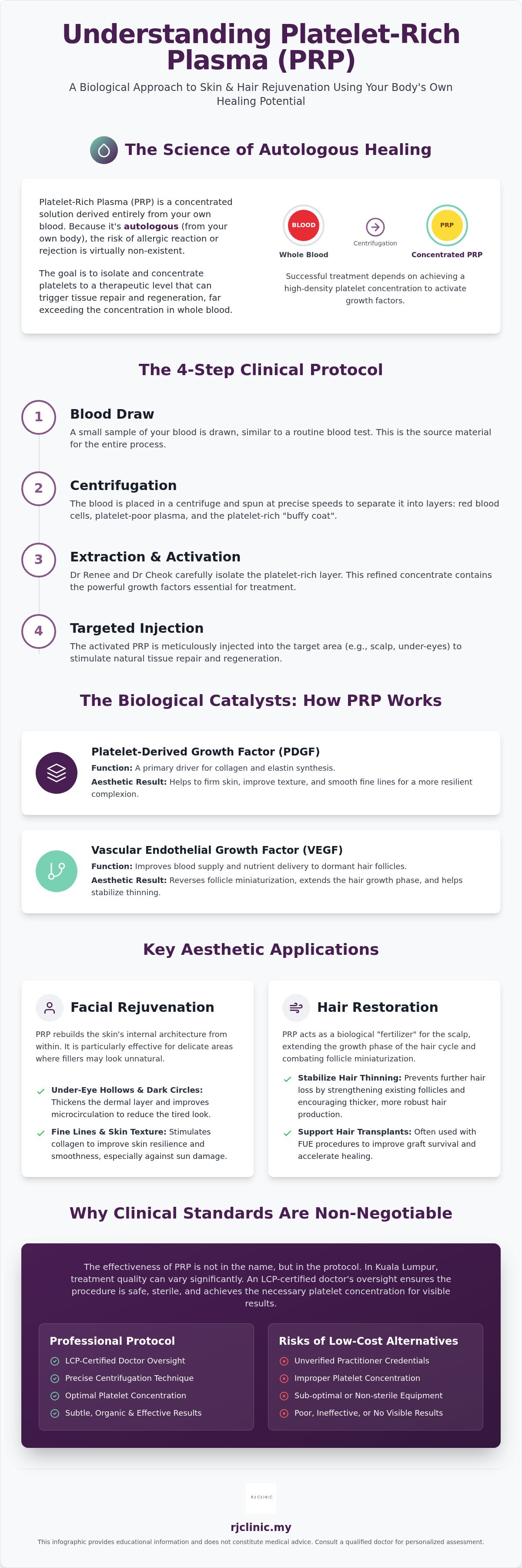
In clinical terms, your blood is much more than a transport system for oxygen; it's a complex reservoir of regenerative potential. When we discuss Platelet-Rich Plasma (PRP), we're referring to a concentrated solution derived entirely from your own body. This "autologous" nature is why many patients prefer prp treatment over synthetic alternatives. Since the material is yours, the risk of allergic reaction or rejection is virtually non-existent. It's a bio-compatible intervention that works in harmony with your natural healing cycles.
There's a fundamental difference between whole blood and therapeutic-grade PRP. Whole blood contains a baseline concentration of platelets, red blood cells, and white blood cells. To achieve a therapeutic effect for skin or hair, we must isolate and concentrate the platelets. A successful prp treatment isn't just about injecting plasma; it's about reaching a specific platelet threshold that can actually trigger tissue repair. Without this high-density concentration, the procedure is unlikely to yield the visible results you're looking for.
The Role of Growth Factors in Tissue Repair
The efficacy of this therapy lies in the growth factors stored within platelet alpha-granules. Once injected, these proteins act as messengers. Platelet-Derived Growth Factor (PDGF) is a primary driver for collagen synthesis, helping to firm skin and smooth fine lines. Another critical component is Vascular Endothelial Growth Factor (VEGF). This factor is essential for hair restoration because it improves blood supply to dormant follicles, providing the nutrients needed to reverse miniaturization. For patients dealing with skin laxity or thinning hair, these biological catalysts are the foundation of the rejuvenation process. This biological approach is mirrored in the philosophy of Pellis Medispa, where advanced skin revision treatments are used to restore natural function and support the body's regenerative capabilities.
The Centrifugation Process: Concentrating Potential
To create a potent solution, we use a meticulous centrifugation process. First, a small amount of your blood is drawn and placed into a specialized centrifuge. We then spin the sample at precise speeds and durations to separate it into distinct layers. This isn't a one-size-fits-all step. Dr Renee and Dr Cheok emphasize that the technical precision of this separation determines the final outcome. We specifically isolate the "buffy coat," a thin layer rich in platelets and leukocytes, while removing the red blood cells that can cause unnecessary inflammation. This refined concentrate is what allows us to deliver high-impact results in a clinical setting.
Aesthetic Applications: PRP for Facial Rejuvenation and Hair Restoration
While dermal fillers provide immediate structural volume, prp treatment serves a distinct clinical purpose by focusing on cellular health and skin quality. Instead of introducing foreign substances, we use your own growth factors to rebuild the skin's internal architecture. This biological approach is particularly effective for addressing the "hollow" look under the eyes, where the skin is exceptionally delicate and prone to showing early signs of fatigue.
Revitalizing the Face: Beyond Surface-Level Care
In Malaysia, the intense tropical sun causes significant oxidative stress, leading to a premature breakdown of collagen and elastin. This often manifests as fine lines and a loss of skin elasticity. By precisely injecting concentrated platelets into the dermis, we trigger a natural repair response that improves texture and resilience. It's a highly effective, natural dark eye circle treatment. Rather than simply masking the darkness, the therapy works to thicken the dermal layer and improve microcirculation, addressing the root cause of the discoloration.

Combatting Hair Loss: Stabilizing the Follicle
For patients dealing with androgenetic alopecia, the primary challenge is follicle miniaturization. Over time, hair follicles shrink, producing thinner and shorter strands until they eventually become dormant. PRP acts as a biological "fertilizer" for the scalp. It extends the Anagen (growth) phase of the hair cycle, which encourages the follicle to produce thicker, more robust hair. This stabilization is crucial for preventing further thinning and maintaining existing hair density.
We frequently integrate PRP with hair loss treatments such as FUE transplants. In these scenarios, the platelets provide essential support to newly transplanted grafts, helping them settle and thrive in their new environment. It's a comprehensive way to protect your investment in hair restoration. If you're noticing a widening part or a receding hairline, a consultation with Dr Renee or Dr Cheok can determine if your follicles are still active enough to respond to this regenerative stimulus.
The Clinical Protocol: Suitability, Procedure, and Recovery
Not every patient is an ideal candidate for prp treatment. During your initial consultation, we evaluate systemic factors that could compromise your platelet function. For instance, heavy smoking significantly impairs the regenerative capacity of your growth factors, often leading to sub-optimal outcomes. Similarly, patients with specific blood disorders or platelet dysfunction syndromes may find better results with alternative therapies. This is why a pre-treatment assessment with an LCP-certified doctor is non-negotiable.
Dr Renee and Dr Cheok prioritize clinical precision over generic treatment packages. We generally recommend a series of 3 to 6 sessions, spaced four weeks apart, to achieve cumulative results. This allows the biological signaling to build upon itself, ensuring a more durable transformation. It's a journey that requires commitment to the protocol to see the full potential of autologous healing.
Step-by-Step: What to Expect During Your Visit
The process begins with a routine blood draw, which is no more invasive than a standard health check. Your sample is then processed in an automated centrifuge system to maintain absolute sterility and reach the required platelet concentration. Depending on your specific goals, we use different delivery methods. For scalp rejuvenation, direct syringe injections target the follicular depth. For facial texture, we may utilize microneedling to distribute the serum across a broader surface area, ensuring even coverage.
Recovery and Results: The Patient Journey
Expect some mild swelling or redness immediately after the procedure. This is a natural inflammatory response, indicating that the growth factors are beginning their work. While you might notice an improvement in skin texture within two to three weeks, hair restoration requires more patience. It typically takes three to six months to see visible improvements in density as the hair follicles transition through their growth cycles.
Post-procedure care is vital in Malaysia's environment. We advise strict sun protection and a gentle skincare regimen for at least 48 hours to protect the treated area. Avoiding anti-inflammatory medications is also crucial, as we want to encourage the natural healing cascade we've just initiated. Ready to see if you're a candidate? Schedule a clinical consultation for prp treatment with our LCP-certified team to discuss your personalized plan.
Why Clinical Standards Matter for PRP in Kuala Lumpur
In Malaysia, the Ministry of Health (MOH) issues the Letter of Credentialing and Privileging (LCP) to ensure practitioners meet rigorous safety and skill benchmarks. Choosing an LCP-certified doctor like Dr Renee or Dr Cheok isn't just about prestige; it's about clinical accountability. When you undergo prp treatment, you're entrusting a provider with your own blood. This requires a sterile, controlled environment that a typical beauty salon simply cannot provide. "Budget" packages often compromise on centrifuge technology or collection kits, resulting in a solution that's mostly plasma with very few platelets. This renders the procedure ineffective because it fails to hit the therapeutic threshold necessary for tissue repair.
Safety and Regulatory Compliance in Malaysia
Medical clinics are bound by strict MOH regulations regarding blood handling and infection control. We use only sterile, single-use kits to eliminate any risk of cross-contamination. This is a non-negotiable standard for patient safety. Differentiating between a medical clinic and a beauty salon is critical. Only a licensed medical facility is authorized to perform injectable regenerative therapies under professional supervision. We maintain these high standards to ensure that every step of your journey is safe and predictable.
Synergistic Treatments for Enhanced Outcomes
We often find that prp treatment works best as part of a multi-disciplinary strategy rather than a standalone miracle. For instance, combining it with Rejuran Healer can significantly enhance skin repair by pairing platelets with polynucleotides for deeper hydration and healing. For those undergoing FUE hair transplants, we use PRP to prime the recipient site. This has been shown to improve graft survival rates and speed up the healing of the donor area.
We also sequence PRP with Ultherapy for non-surgical lifting. In this protocol, the PRP improves the skin's surface texture and tone while the ultrasound energy targets the deeper structural layers. A one-size-fits-all "package" rarely yields professional results. Instead, Dr Renee and Dr Cheok design personalized regenerative protocols that respect your unique biology. This tailored approach ensures we address your specific concerns with the most effective combination of medical technologies.
Restoring Your Natural Vitality with Precision
Choosing a path toward regenerative aesthetics means prioritizing the quality of the biological material and the expertise of the practitioner. We've explored how the success of prp treatment hinges on more than just a blood draw; it requires meticulous centrifugation and a customized clinical protocol. By opting for autologous healing, you're leveraging your body's own growth factors to achieve subtle, organic outcomes that synthetic additives often cannot replicate.
At RJ Clinic, we bridge the gap between advanced medical science and personalized care. Our LCP-certified aesthetic physicians, Dr Renee and Dr Cheok, utilize FDA-approved regenerative technology across our multiple locations in KL and Selangor to ensure your safety and satisfaction. Whether you're addressing early hair thinning or seeking to refresh your skin texture, the journey begins with a nuanced, professional assessment.
Book a clinical consultation with Dr Renee or Dr Cheok at RJ Clinic to discover how a tailored regenerative plan can help you regain your confidence. We look forward to partnering with you on your journey toward refined, natural beauty.
Frequently Asked Questions
Is PRP treatment painful, and do I need anesthesia?
Most patients describe the sensation as a series of mild pinpricks rather than significant pain. We prioritize your comfort by applying a high-strength topical numbing cream to the treatment area for about 30 to 45 minutes before the procedure begins. For more sensitive areas like the scalp, we may use local anesthesia to ensure the experience is as tranquil as possible. You can return to your daily activities immediately without lingering discomfort.
How many sessions of PRP do I need for visible hair regrowth?
Visible results in hair density typically require a series of 3 to 6 sessions spaced one month apart. While initial stabilization of hair loss can occur sooner, the biological process of reversing follicle miniaturization takes time. You'll likely notice the first signs of improvement after the third session as the follicles transition into the growth phase. We monitor your progress closely to adjust the frequency of your prp treatment based on your scalp's specific response.
Can PRP replace dermal fillers for hollowing under the eyes?
PRP isn't a direct replacement for dermal fillers but rather a complementary therapy that addresses different clinical concerns. While fillers provide immediate structural volume to fill deep hollows, PRP focuses on thickening the skin and improving microcirculation. If your primary concern is thin, crepey skin or dark circles, PRP is the superior choice. For significant volume loss, Dr Renee or Dr Cheok may recommend a multi-layered approach combining both modalities for a balanced result.
Are there any risks of allergic reactions with PRP injections?
There's virtually no risk of an allergic reaction with this procedure because the solution is autologous, meaning it's derived entirely from your own blood. Unlike synthetic additives or cross-linked compounds, your body recognizes the concentrated platelets as its own. This high bio-compatibility is one of the primary reasons patients choose prp treatment for sensitive areas like the eyes or scalp. We maintain a sterile, clinical environment to eliminate any external risks of infection.
What is the difference between a 'vampire facial' and clinical PRP?
The term "vampire facial" is often used as a marketing label for microneedling with plasma, whereas clinical PRP refers to a medical-grade protocol focused on specific platelet concentrations. In a clinical setting, we use FDA-approved centrifuge technology to isolate the buffy coat, ensuring the platelet count is high enough to trigger actual tissue regeneration. Beauty salon versions often lack this technical precision, resulting in a lower-quality plasma that provides only surface-level hydration rather than deep repair. This commitment to medical-grade standards is also found in specialized veterinary care, where pet owners can explore 犬貓皮膚病中西醫整合醫療 to learn how integrated medical protocols address chronic skin conditions in animals.
The regenerative effects of a completed PRP cycle generally last between 12 to 18 months. Because the therapy stimulates your natural collagen and elastin production, the results degrade much more slowly than temporary surface treatments. To maintain the improved skin texture and luminosity, we typically suggest a single maintenance session every 6 to 12 months. Your lifestyle, sun exposure, and skincare regimen in Malaysia's climate will also influence the longevity of your rejuvenated appearance.


Comments