


Cheek Filler Malaysia vs Midface Lift: Which Is Better?

Updated: Aug 19

You might assume that a surgical midface lift is the only definitive solution for significant sagging, but for many, the clinical precision of cheek filler Malaysia offers a more refined, architecturally sound restoration. While surgery addresses skin laxity, it often fails to replace the underlying fat loss that causes the face to appear hollow or tired—a concern often addressed by specialists like Dr. Leonard Grossman through advanced fat grafting. Choosing between these two paths isn't just about the duration of the result; it's about understanding which method restores your unique facial structure with the least amount of trauma.
We recognize the hesitation many patients feel when considering injectables, particularly the fear of an overfilled "pillow face" that obscures natural expressions. It's a valid concern that stems from seeing poorly executed procedures rather than the subtle, sophisticated work of experienced practitioners. This analysis provides a comprehensive medical look at how we use premium dermal fillers to provide structural support to the midface, comparing these outcomes directly with surgical alternatives.
By the end of this discussion, you'll have a clear understanding of the safety standards practiced by LCP-certified doctors like Dr Renee and Dr Cheok, the anatomical factors that dictate your suitability for each treatment, and how we achieve a lifted, symmetrical profile that looks entirely like you, only refreshed.
Table of Contents
The Anatomy of Midface Aging: Why Cheek Volume Matters
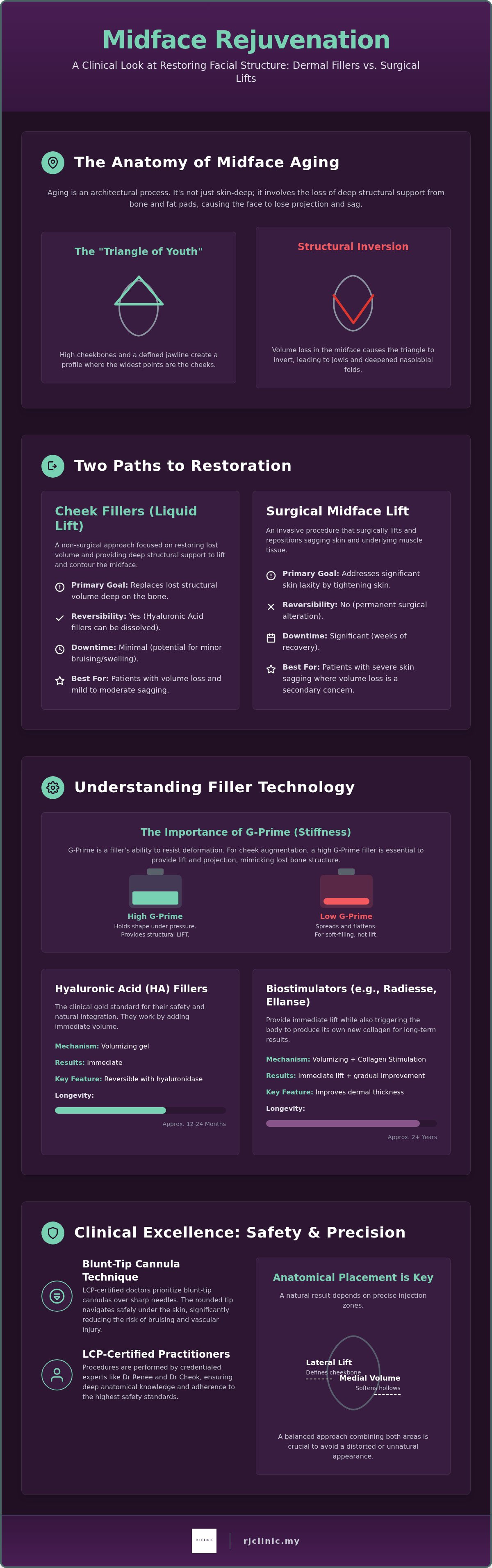
Facial aging is an architectural process that begins deep beneath the surface. It isn't merely a matter of fine lines; it's the result of bone resorption and the gradual descent of the malar fat pads. As these structural foundations shift, the midface loses its projection. This collapse creates a cascading effect, where the lack of cheek support directly contributes to the deepening of nasolabial folds and the formation of jowls along the jawline.
When patients seek cheek filler malaysia at our clinic, they're often looking to restore the "Triangle of Youth," a clinical term for the high cheekbones and defined jawline associated with a youthful profile. Modern aesthetic medicine focuses on using sterile, high-viscosity injectable substances to provide the structural scaffolding that the face has lost. The goal is a subtle restoration of volume that looks organic rather than artificial.
Medial vs. Lateral Cheek Volumization
Precise placement is what distinguishes a professional result from an unnatural one. Lateral injections along the zygomatic arch, the cheekbone, are designed to create a lifting effect, pulling the skin tauter and refining the facial contour. Conversely, medial injections address the anterior cheek, softening the hollow transition between the lower eyelid and the midface. A balanced approach is essential; focusing solely on one area often leads to the "flat" or distorted appearance seen in poorly executed procedures.
Anatomical Assessment: The First Step in Consultation
Every face is asymmetrical, and every aging pattern is unique. During a consultation, Dr Renee and Dr Cheok evaluate your bone structure and the degree of skin laxity. It's vital to distinguish between a loss of volume and a loss of skin elasticity. If the primary issue is severe sagging rather than hollowing, we might suggest a combination of dermal fillers and skin tightening treatments like Ultherapy Prime. This ensures the filler acts as support rather than just adding weight to already loose tissue.
Selecting the Right Dermal Filler for Cheek Contouring
The success of midface rejuvenation depends largely on the rheology of the product chosen. For a cheek filler malaysia treatment to be effective, the substance must have a high G-Prime. G-Prime is the ability of a filler to resist deformation and provide lift, which is essential when placing product deep against the bone to mimic lost structural volume. Using a filler with low viscosity in this area would result in a soft, spreading effect that fails to provide the necessary projection or support for the overlying skin.
HA Fillers: Precision and Reversibility
Hyaluronic Acid (HA) fillers remain the clinical gold standard for many patients because they offer immediate results with a high safety profile. Premium brands like Juvederm and Belotero are engineered for natural integration, ensuring the filler moves with your facial expressions rather than appearing static. One of the most reassuring aspects of using dermal fillers based on HA is their reversibility. If a patient desires a change or if adjustments are needed, the product can be safely dissolved using hyaluronidase, providing a level of control that surgery cannot match.
Biostimulators: Radiesse and Ellanse
For patients seeking a more progressive and long-term result, biostimulators offer a different clinical mechanism. Unlike HA fillers that simply occupy space, products like Radiesse provide an immediate mechanical lift while simultaneously triggering the body's fibroblasts to produce new collagen. Similarly, Ellanse is recognized as a revolutionary biostimulator in Malaysia for its ability to provide sustained volumization that often outlasts traditional HA options. These stimulators are particularly effective for patients with thinner skin who require both volume and a boost in dermal thickness.
The choice between HA and collagen stimulators often comes down to your personal aesthetic goals and the current state of your skin's architecture. While HA provides instant gratification, biostimulators are excellent for those who prefer a gradual, long-term refinement of their contours. If you're unsure which technology aligns with your needs, a detailed clinical assessment of your midface structure can help determine the most effective roadmap for your rejuvenation.
The Clinical Procedure: Safety, Pain Management, and Longevity
Clinical excellence begins with a sterile environment and a meticulous approach to facial mapping. Before the first injection, the treatment area is thoroughly sanitized and marked to identify key anatomical landmarks. We apply a high-potency topical numbing cream to ensure your comfort throughout the process. This preparation phase is vital for achieving the symmetry we discussed in the anatomical assessment section, ensuring every placement serves a structural purpose.
Technical precision is paramount when performing cheek filler malaysia procedures. Dr Renee and Dr Cheok often utilize blunt-tip cannulas instead of traditional sharp needles for deep volumization. Cannulas are flexible and have a rounded end, allowing them to navigate around blood vessels and nerves rather than piercing them. This technique significantly reduces the risk of bruising and, more importantly, minimizes the potential for vascular complications. While needles are sometimes used for fine-detail work, the cannula remains our preferred tool for structural midface support.
After the procedure, it's normal to experience mild swelling as the filler integrates with your tissues. Fillers are hydrophilic, meaning they attract water, so the final result usually settles within two weeks. We always recommend a follow-up session to assess facial harmony once this initial "settling" period has passed. If you are ready to explore a safer path to rejuvenation, you can schedule a clinical consultation with our LCP-certified team at any of our Klang Valley locations.
Longevity and Factors Affecting Result Duration
The duration of your results depends on your individual metabolic rate and lifestyle factors. On average, high-viscosity cheek fillers last between 12 to 24 months. Patients with faster metabolisms or those who engage in high-intensity exercise may find the product absorbs slightly sooner. Maintenance isn't about starting from scratch; a strategic "top-up" every 12 to 18 months helps sustain the structural scaffolding without overfilling the face.
Why LCP Certification is Non-Negotiable in Malaysia
In Malaysia, the Ministry of Health issues a Letter of Credentialing and Privileging (LCP) to doctors who have met rigorous standards in aesthetic medicine. This certification is your primary signal of trust. It guarantees that your practitioner possesses the deep anatomical knowledge required for vascular mapping, which is essential to prevent serious complications like skin necrosis. Budget clinics often cut costs by using unregulated substances or employing non-medical staff, which significantly increases the risk of permanent scarring or infection.
Achieving Facial Harmony: Combining Fillers with Advanced Modalities
True facial rejuvenation rarely relies on a single procedure. The "Liquid Lift" is a clinical philosophy where we use a combination of strategic injectable placements to restore the face's natural architecture. When you opt for a cheek filler malaysia treatment, we often look at how that volume supports adjacent areas. For instance, restoring the midface is often the essential foundation for treating dark circles, as it reduces the hollow "tear trough" effect by providing structural support from below. Similarly, creating midface projection helps achieve a refined V-shape when paired with jawline slimming, ensuring the face looks contoured rather than just thin.
Clinical judgment is the most important tool during this process. Our goal is to avoid the "overfilled" look that occurs when practitioners prioritize volume over harmony. By focusing on the restoration of lost support rather than just inflation, we maintain your natural expressions. Dr Renee and Dr Cheok emphasize that knowing when to reach the point of optimal correction is just as vital as the injection technique itself.
Synergy with Ultherapy and Skin Tightening
We frequently recommend Ultherapy before administering fillers. Tightening the skin's foundation first creates a firmer, more resilient canvas. This means we often need less filler to achieve a visible lift, which prevents the midface from appearing heavy. For those using biostimulators, adding radiofrequency treatments such as Density RF can further enhance the skin's structural integrity. This multi-modality approach ensures that we are treating both the volume loss and the skin laxity simultaneously.
Beyond Volume: Enhancing Skin Quality
Injectables can be a core component of a medical slimming protocol for facial contouring. Beyond just adding projection, a well-structured midface improves overall skin radiance by reflecting light more evenly across the cheekbones. Long-term maintenance involves a customized timeline of minor refinements rather than waiting for the filler to fully dissipate. This proactive strategy preserves the "Triangle of Youth" and ensures your results remain consistent, subtle, and sophisticated over time.
Restoring Structural Integrity for Natural Results
Rejuvenating the midface is a task of anatomical precision rather than simple volume addition. Restoring structural integrity involves understanding the complex interplay between fat pad descent and bone resorption. Whether you opt for the immediate projection of high G-prime HA fillers or the sustained collagen production offered by biostimulators like Radiesse and Ellanse, the goal is a balanced, organic restoration of the "Triangle of Youth."
When planning your cheek filler malaysia procedure, the clinical judgment of your doctor is the most significant variable in ensuring a natural outcome. At RJ Clinic, Dr Renee and Dr Cheok provide personalized treatment plans that prioritize your unique facial symmetry and long-term skin health. By utilizing FDA-approved premium fillers and advanced cannula techniques, we focus on safety and precision at every stage of your transformation. Our status as LCP-certified practitioners by the Ministry of Health Malaysia ensures that your care meets the highest medical standards.
If you're ready to address midface hollowing with a medically sound, sophisticated approach, the next step is a detailed anatomical assessment. Schedule a Clinical Consultation with Our LCP-Certified Doctors to begin your journey toward a more refreshed and confident version of yourself. We look forward to partnering with you in your aesthetic refinement.
Frequently Asked Questions
How many syringes of filler are typically needed for the cheeks?
Most patients require between two to four syringes in total to achieve a visible yet natural lift. The exact amount depends on the degree of midface hollowing and bone resorption identified during your consultation. We prioritize a conservative approach, often starting with a minimal volume and adding more during a follow-up session to ensure facial harmony and prevent an overfilled appearance.
What are the most common side effects of cheek fillers?
Minor swelling, redness, and localized tenderness are the most common observations following a cheek filler malaysia treatment. These effects are typically transient and resolve within three to seven days. While bruising can occur, our use of blunt-tip cannulas significantly reduces this risk compared to traditional needle injections. Serious complications remain rare when the procedure is performed by LCP-certified doctors who prioritize vascular mapping.
Is it possible to dissolve cheek fillers if I am unhappy with the result?
Hyaluronic Acid (HA) fillers can be completely dissolved using an enzyme called hyaluronidase if you're unsatisfied with the aesthetic outcome. This provides a safety net and flexibility that surgical midface lifts cannot offer. It's important to remember that biostimulators like Radiesse or Ellanse aren't reversible in the same manner, which is why Dr Renee and Dr Cheok conduct thorough assessments to ensure the chosen product aligns with your goals.
Does the cheek filler injection process hurt?
Discomfort is minimal because we utilize high-potency topical numbing agents and fillers that contain integrated lidocaine. Most patients describe the sensation as a light pressure or a series of brief pinpricks rather than actual pain. The use of a cannula further enhances the experience as it requires fewer entry points to distribute the product across the midface, making the process much more tolerable than many expect.
How soon can I return to exercise after my filler treatment?
You should wait at least 24 to 48 hours before returning to strenuous exercise. Intense physical activity increases your heart rate and blood flow, which can exacerbate initial swelling or increase the likelihood of bruising. While light walking is acceptable immediately, we advise against high-impact workouts or heat-inducing activities like saunas until the product has properly integrated with your facial tissues.
What is the ideal age to start considering cheek fillers?
There isn't a specific age to start, as structural aging depends on genetics and lifestyle factors. Many patients begin considering cheek filler malaysia in their early 30s to mid-40s when they notice the first signs of volume loss or deepening nasolabial folds. Early intervention with smaller volumes can often serve as a preventative measure, maintaining the facial scaffold and delaying the need for more invasive surgical procedures later in life.


Comments