


Who Is a Good Candidate for Ultherapy Prime—and Who Is Not?

Updated: 1 day ago

What if the success of your non-surgical lift depends less on your age and more on the specific depth of your SMAS layer? Many patients visit Dr Renee and Dr Cheok expressing a desire for a sharper jawline but harbor a deep anxiety about looking "plastic" or wasting an investment on ineffective technology. You likely want a result that looks like a rested version of yourself rather than a surgical transformation. Understanding whether you are a truly suitable ultherapy prime candidate requires a clinical assessment of your skin's current laxity and its remaining collagen-producing potential.
We believe in transparency over trends, which is why we focus on biological readiness rather than chronological age. You will learn how to evaluate if your skin can support the regenerative demands of micro-focused ultrasound. We will examine the clinical indicators that separate a successful lift from a poor outcome, clarify the technical distinctions between Ultherapy Prime and generic HIFU devices, and identify the specific contraindications that might make another treatment a better fit for your aesthetic goals.
Table of Contents
The Clinical Profile of an Ultherapy Prime Candidate
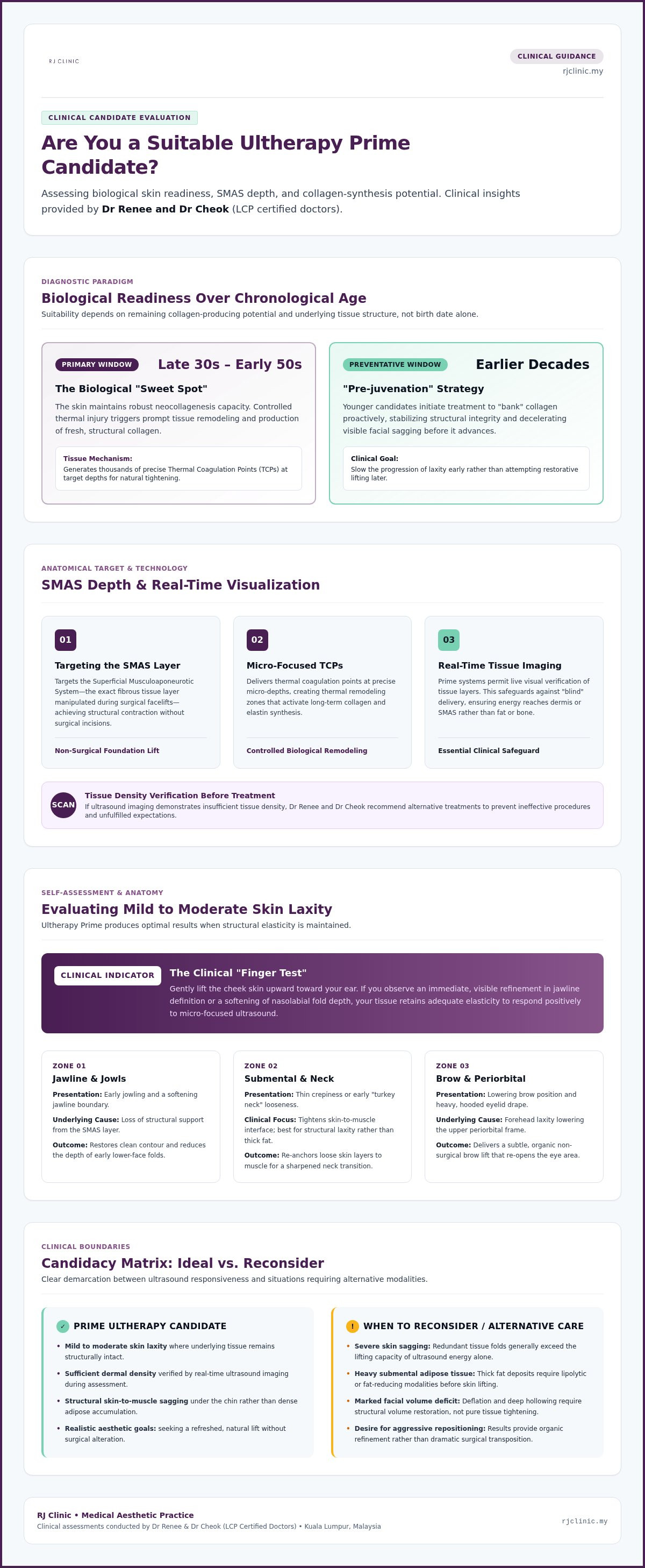
Identifying a suitable ultherapy prime candidate involves more than checking a birth date. We look for mild to moderate skin laxity, where the skin has begun to feel less firm but still retains its underlying structure. This treatment specifically targets the Superficial Musculoaponeurotic System (SMAS) layer. This is the same deep fibrous tissue that surgeons manipulate during a facelift. By using high-intensity focused ultrasound technology, we can achieve structural lifting without incisions. The Prime system is particularly effective for busy individuals in Kuala Lumpur because it delivers energy with greater speed and precision than previous generations.
The Biological "Sweet Spot" for Collagen Synthesis
Success depends on your body's ability to respond to controlled thermal injury. Patients between their late 30s and early 50s typically sit in the biological "sweet spot" for this procedure. At this stage, the skin still possesses robust neocollagenesis potential. During the session, the device creates thousands of tiny Thermal Coagulation Points (TCPs) at precise depths. These points trigger a natural healing response, leading to tissue remodeling and the production of fresh, high-quality collagen. Younger patients often seek out Ultherapy Prime as a "pre-juvenation" strategy. They aim to "bank" collagen early, effectively slowing the visible progression of sagging before it becomes severe.
The Role of Real-Time Visualization in Suitability
Clinical suitability is confirmed through the Prime system's advanced imaging capabilities. Dr Renee and Dr Cheok utilize this feature to see exactly which layers of tissue they are treating in real time. This ensures the ultrasound energy reaches the SMAS or deep dermis where it's most effective, rather than being wasted on fat or bone. If the imaging reveals insufficient tissue density, we might suggest alternative treatments to ensure you don't spend money on a procedure that won't yield results. Real-time visualization serves as the essential clinical safeguard against "blind" energy delivery, ensuring every pulse is purposeful and safe.
Identifying Signs of Mild to Moderate Skin Laxity
How do you determine if you are a suitable ultherapy prime candidate at home? A simple "finger test" often provides the first clinical clue. If you can slightly lift the skin of your cheek toward your ear and see a visible improvement in your jawline or the depth of your nasolabial folds, your skin likely retains enough elasticity to respond to ultrasound energy. We look for these subtle shifts in the lower face, where early jowling and a softening jawline indicate that the SMAS layer is no longer providing its former structural support. If you are noticing these changes, a personalized assessment can help map out your specific treatment depths.
The neck and submental area also offer clear indicators. We often look for "crepiness" or a loss of definition in the jaw-to-neck transition. This early sagging, sometimes referred to as a "turkey neck" in its nascent stages, is often where the Prime system excels by tightening the skin-to-muscle interface that other treatments might miss.
Anatomical Markers: The Jawline and Submental Region
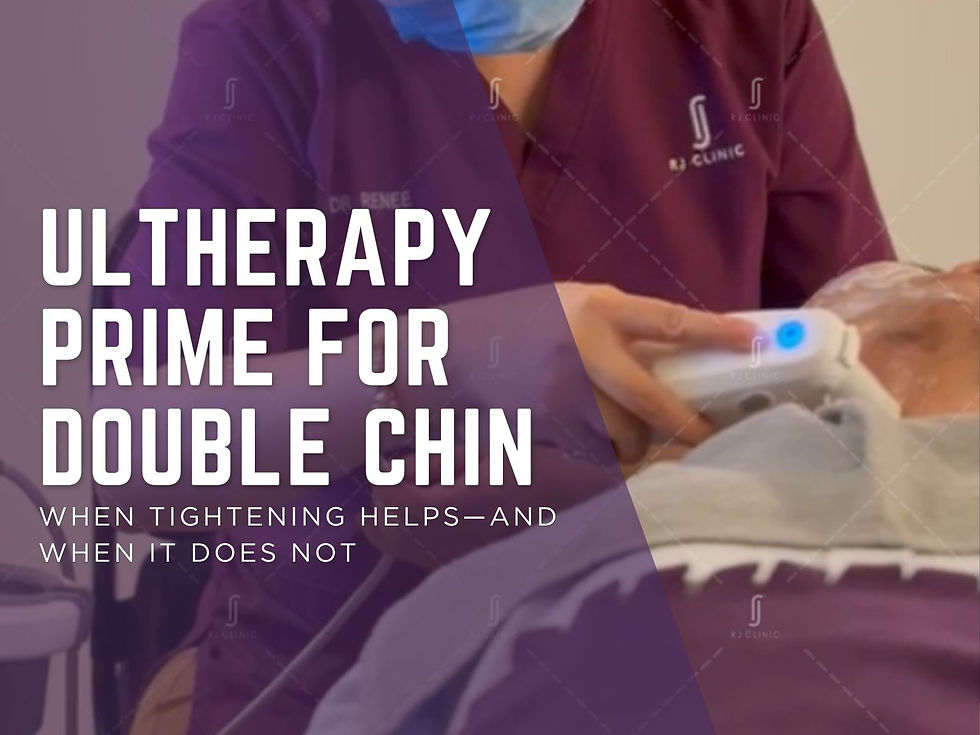
In the submental region, Dr Renee and Dr Cheok distinguish between excess adipose tissue and true skin laxity. While ultherapy double chin protocols target the deep muscle and tissue layers to create a tighter profile, they are most effective when the concern is structural sagging rather than significant fat volume. If your skin feels thin or "loose" under the chin, Ultherapy Prime can help re-anchor those layers to the underlying muscle, restoring a sharper, more youthful contour.
Upper Face Rejuvenation: The Non-Surgical Brow Lift
The brow and eye area provide another diagnostic indicator. Heavy eyelids or a lowering brow line often result from forehead laxity rather than just excess eyelid skin. By delivering ultrasound energy to the forehead, we can achieve a non-surgical brow lift that subtly opens the eye area. For patients seeking total periorbital rejuvenation, we often discuss how this approach complements laser eyebag removal to address both skin position and under-eye texture. It's vital to maintain realistic expectations; the lift is noticeable and organic, providing a refinement of your features rather than the aggressive repositioning of a surgical brow lift.
Clinical Limitations: Who Should Reconsider Ultherapy Prime?
While the Prime system offers significant advancements, an ideal ultherapy prime candidate must have realistic expectations about the biological limits of non-surgical energy. If you have severe skin laxity, often characterized by "hanging" skin or deep folds that don't shift during the finger test mentioned earlier, the results of ultrasound lifting may feel too subtle. Ultherapy Prime is designed to lift and tighten existing tissue, not to remove excess skin. Safety is our priority; we can't perform the treatment over active skin infections, cystic acne, or open wounds. These conditions compromise the inflammatory response required for successful collagen production and increase the risk of adverse reactions.
When Volume Loss Outpaces Skin Laxity
A common misunderstanding is that Ultherapy can fix "hollow" features. It's a lifting treatment, not a volumizing one. If your primary concern is sunken temples or cheeks, you might not be the ideal ultherapy prime candidate for a standalone procedure. In these cases, you'll likely benefit more from dermal fillers to restore lost structure. Dr Renee and Dr Cheok often see patients where the best results come from a combination approach. We might use biostimulators like Radiesse to address volume while using Ultherapy to refine the jawline. Choosing the right tool depends on whether your face needs more "foundation" or more "lift."
Surgical vs. Non-Surgical: The Tipping Point
There's a threshold where non-invasive technology reaches its limit. Patients over 65 with significant photo-damage often have a diminished collagen response because their biological regenerative capacity has slowed. In these cases, we must evaluate the clinical logic behind non-surgical lifting versus a surgical facelift. If the goal is a dramatic repositioning of heavy tissue, surgery remains the gold standard. Our role is to identify if your skin still has the "spring" to respond to ultrasound. If it doesn't, we'll be honest about the trade-offs. If you're unsure where your skin sits on this spectrum, book a clinical consultation for a detailed tissue mapping.
Optimizing the Journey: Consultation and Maintenance
The journey to a successful lift begins with a precise diagnostic session rather than a generic treatment plan. During your visit, we map your specific tissue depth and identify the exact energy requirements needed to stimulate your unique collagen profile. While you may notice an immediate "glow" due to temporary tissue contraction, the primary results of the treatment develop over a three to six-month window as new collagen matures. To sustain these structural improvements, we often recommend a yearly "touch-up" session for many patients. Your lifestyle choices also play a critical role; chronic UV exposure and smoking are the two primary factors that can prematurely degrade the new collagen fibers and shorten the longevity of your results.
The RJ Clinic Consultation Process
Dr Renee and Dr Cheok utilize the advanced Ultherapy Prime system to visualize your subcutaneous landscape and create a bespoke treatment map. This technology allows us to adjust energy delivery in real time, significantly improving the comfort factor compared to older ultrasound devices. We prioritize precision over volume, ensuring that every pulse is delivered to the exact depth where it will be most effective. The consultation is as much about excluding unsuitable patients as it is about planning the procedure. By accurately identifying if you are a true ultherapy prime candidate, we protect your investment and ensure your aesthetic goals remain achievable.
Complementary Treatments for Enhanced Results
For a comprehensive rejuvenation, we often combine ultrasound lifting with other clinical modalities. We might use Botox to relax the downward-pulling depressor muscles in the neck and jaw, which allows the Ultherapy lift to appear more pronounced. While ultrasound addresses deep structural layers, surface-level concerns like pigmentation or texture can be refined through chemical skin peels. This multi-layered approach ensures that the "lift" is supported by healthy, vibrant skin. We carefully schedule these sessions to allow your tissue to recover and respond, resulting in a natural-looking transformation that avoids the "overdone" appearance of more aggressive interventions.
Determining Your Path to Structural Refinement
Choosing the right aesthetic intervention is a decision rooted in biological reality rather than fleeting trends. As we've explored, a successful ultherapy prime candidate is defined by their skin's regenerative capacity and the specific structural needs of their SMAS layer. While mild to moderate laxity provides the ideal foundation for this technology, the most critical step is a diagnostic mapping to ensure your tissue density can support new collagen growth. By prioritizing clinical suitability over treatment volume, we help you avoid the disappointment of ineffective results or an artificial appearance.
At RJ Clinic, Dr Renee and Dr Cheok bring over a decade of experience as LCP-certified aesthetic physicians. We utilize FDA-cleared Ultherapy Prime technology combined with real-time imaging to ensure every pulse of energy is delivered with surgical precision. This personalized methodology ensures your outcome is both organic and enduring. We invite you to schedule a clinical assessment with Dr Renee or Dr Cheok to find out if you are a prime candidate. Taking this first step allows us to partner with you in restoring your natural definition with confidence and scientific integrity.
Frequently Asked Questions
Is there a specific age when I should start Ultherapy Prime?
Biological readiness matters more than your birth year. Most patients begin treatment between their late 30s and early 50s when the first signs of sagging appear. Younger patients in Kuala Lumpur often use it as a preventative measure to maintain high collagen levels before laxity becomes visible. If your skin still responds well to thermal stimulation, you're likely a suitable ultherapy prime candidate regardless of your chronological age.
Can I be a candidate for Ultherapy Prime if I have already had dermal fillers?
You can certainly receive this treatment if you have fillers, but the sequence must be managed carefully. We generally recommend waiting at least four to six weeks after filler injections before undergoing ultrasound lifting. This ensures the filler has integrated properly and won't be affected by the thermal energy. During your consultation, Dr Renee or Dr Cheok will assess your existing facial work to create a safe, effective timeline for your rejuvenation.
How do I know if my skin laxity is "moderate" enough for this treatment?
Moderate laxity is often visible when you notice your jawline losing its sharp definition or your neck skin feeling thinner and less resilient. You can perform a simple check by gently lifting the skin on your cheek toward your temple. If this movement creates a significant, natural looking improvement, your laxity is likely in the ideal range. If the skin doesn't move or requires a heavy pull, your concerns might be too mild or too advanced.
What happens if I am not a good candidate for Ultherapy Prime?
If you aren't an ideal ultherapy prime candidate, we will explore alternative clinical pathways that better suit your anatomy. For those with significant volume loss, dermal fillers or biostimulators may be more effective. If your skin laxity is severe, we might discuss surgical options or thread lifts. Our goal is to ensure you achieve a visible result, even if it means recommending a different technology than the one you initially considered.
Are the results of Ultherapy Prime permanent for suitable candidates?
While the new collagen produced is your own and remains in the skin, the results aren't permanent because the natural aging process continues. Most patients enjoy the lifting effects for twelve to eighteen months. Factors like sun exposure in Malaysia and your individual metabolic rate will influence how long the lift lasts. We often suggest maintenance sessions every year or two to keep your structural foundations firm and counteract ongoing collagen depletion.
Can Ultherapy Prime help with a double chin if I have excess fat?
Ultherapy Prime is primarily a skin tightening tool rather than a fat reduction treatment. If your double chin is caused by excess adipose tissue, we may recommend laser lipolysis or other fat reduction methods first. However, if you have both fat and sagging skin, we often combine treatments. Once the fat is reduced, ultrasound energy is essential to tighten the remaining skin and prevent a "deflated" appearance under the jawline.


Comments