


Density RF vs XERF: How Do the Technologies Differ?

Updated: Sep 1

Patients often arrive at our clinic in Kuala Lumpur feeling overwhelmed by the sheer number of non-surgical skin tightening treatments available. Brand names like Density RF and XERF are frequently discussed, but the marketing materials can create more confusion than clarity, often boiling down complex science to simple claims of being "next-generation" or "more advanced." This approach fails to answer the most important question: which technology is clinically appropriate for your specific skin laxity, facial structure, and desired outcome?
The choice between two modern radiofrequency (RF) systems is not about which one is universally "better," but about understanding their fundamental mechanisms. The real distinction lies in how they deliver energy to the skin's different layers to stimulate collagen. One system uses a combination of two different energy modes, while the other uses two different frequencies of the same energy mode. Understanding this difference is key to making an informed decision with your doctor.
Table of Contents
The Evolution of Non-Surgical Lifting: Understanding Density RF and XERF
The field of non-surgical aesthetics has moved beyond simple radiofrequency devices to highly sophisticated systems designed for multi-level tissue remodelling. Both Density RF and XERF represent significant advancements in this area, offering effective alternatives to surgery for individuals with early to moderate skin laxity. However, they achieve their results through distinctly different technological principles.
What is Density RF?
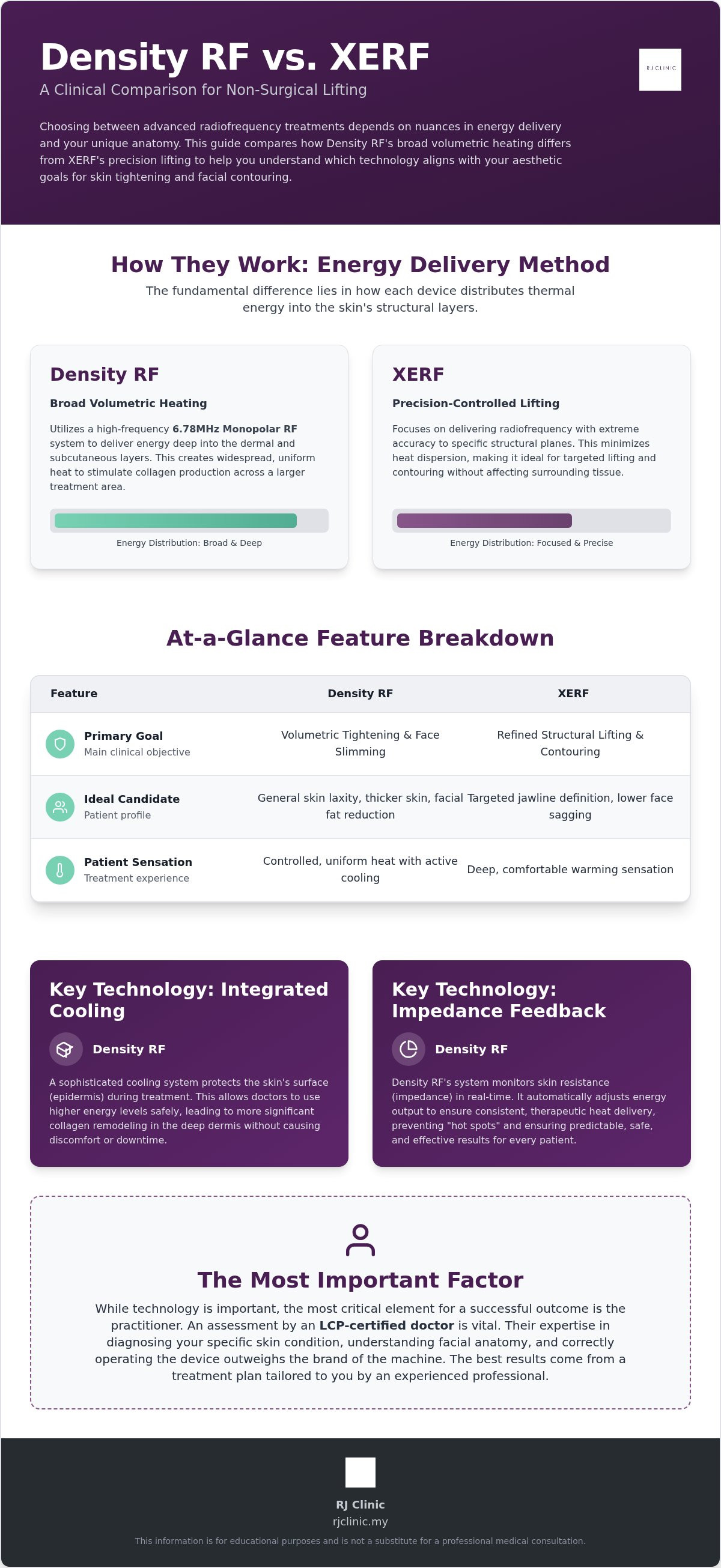
Density RF, developed by Jeisys, is a powerful dual-mode radiofrequency system. Its primary technological advantage is the ability to sequentially deliver both monopolar and bipolar RF energy in a single pulse. This is a crucial distinction. The 6.78 MHz monopolar RF energy penetrates deeply, generating volumetric heat in the dermis and subcutaneous layers to remodel collagen and firm the skin's foundational structure. Immediately following, the bipolar RF energy targets the more superficial layers of the skin, helping to refine texture and tighten the surface. This dual action provides a comprehensive, multi-level treatment. To ensure patient comfort and protect the epidermis during this high-energy delivery (up to 400W), Density RF incorporates a sophisticated gas-spray cooling system with five adjustable levels, along with real-time temperature and impedance monitoring.
What is XERF?
XERF is a modern dual-frequency monopolar RF system. It operates exclusively in monopolar mode but utilizes two different frequencies—6.78 MHz and 2 MHz—to target different tissue depths. The higher frequency generally targets more superficial layers, while the lower frequency reaches deeper. While this provides a level of customisation, the energy delivery remains entirely monopolar. The system allows the practitioner to select from three depth settings to focus the treatment on specific concerns. It also includes integrated cooling and real-time impedance feedback to maintain safety and efficacy during the procedure.
Dual-Mode vs Dual-Frequency RF: What Is the Difference?
The central difference between these two technologies lies in their approach to treating multiple layers of the skin. While both aim to stimulate collagen, their methods—dual-mode versus dual-frequency—have distinct clinical implications for the breadth and type of results that can be achieved in a single session.
How Energy Delivery Affects Treatment Depth and Scope
The primary distinction is how each system addresses different tissue depths. A dual-mode system like Density RF technology uses two different types of RF energy. Its monopolar mode creates a deep, uniform heating effect that is ideal for remodelling the foundational collagen structures and addressing concerns like jowl formation and overall skin laxity. The bipolar mode concentrates energy more superficially, making it effective for improving skin texture, fine lines, and dermal thickness. By delivering both sequentially, Density RF provides a comprehensive treatment that addresses the skin from its foundation to its surface.
A dual-frequency system like XERF uses only one type of energy—monopolar RF—but varies its frequency to influence the depth of penetration. While this allows for targeted treatment at different levels, the mechanism of action remains the same across all depths. The clinical effect is focused on the deep volumetric heating characteristic of monopolar RF, with adjustments for depth, but it does not incorporate the distinct, surface-focused tightening effect of bipolar RF.
This means the trade-off isn't just about depth, but about the nature of the treatment itself. Density RF's approach is designed to be multi-faceted, simultaneously addressing deep structural support and superficial skin quality. XERF’s approach is designed to precisely target different depths using a single, consistent energy mode.
The Critical Role of Safety and Comfort Technologies
Delivering powerful RF energy deep into the skin requires robust safety mechanisms to protect the epidermis (the outermost layer) from heat. Both systems incorporate real-time impedance monitoring, a crucial safety feature. Impedance is the skin's resistance to electrical current. By measuring this in real-time, the device can automatically adjust its energy output to prevent overheating or burns, ensuring a safe and consistent treatment for different skin types and areas.
Patient comfort is another critical factor. Density RF is equipped with a powerful, five-level adjustable gas-spray cooling system that actively cools the skin's surface just before, during, and after each RF pulse. This allows the practitioner to deliver higher energy levels into the deeper tissues for more effective collagen stimulation while keeping the patient comfortable and the epidermis safe. Furthermore, Density RF includes real-time temperature monitoring, adding another layer of safety by ensuring the skin's surface stays within a precise, controlled temperature range. XERF also features an integrated cooling mechanism to enhance comfort and protect the skin during treatment.
Clinical Suitability: Matching Skin Concerns to the Right Technology
The most advanced technology is only effective if it matches the patient's unique anatomy and clinical needs. An LCP-certified doctor's assessment is essential to determine whether a patient's concerns stem from deep tissue laxity, superficial texture issues, or a combination of both. This diagnosis dictates which technology is most appropriate.
Suitability for Different Skin Laxity Patterns
Patients in Malaysia often present with a variety of skin types and laxity patterns. Some may have thicker skin with significant sagging in the lower face, while others may have thinner skin with more widespread fine lines and texture concerns. A patient who needs significant deep-tissue tightening for jowls but also wants to improve superficial skin quality could be an ideal candidate for Density RF's dual-mode approach. Its ability to treat both deep and superficial layers in one session makes it a versatile tool for comprehensive rejuvenation.
This versatility is particularly relevant for those seeking face slimming solutions, where both tightening the skin envelope and remodelling the underlying supportive structures are important. Because non-ablative RF treatments like Density do not disrupt the skin's surface, they are a safe and effective option for tightening various skin types with minimal downtime, a significant advantage in Kuala Lumpur's humid climate where post-procedure recovery requires careful management.
Jawline Definition vs. Full-Face Rejuvenation
A defined jawline is a common aesthetic goal, but achieving it requires a tailored approach. For some, the issue is primarily skin laxity along the jaw, while for others, it may involve a combination of sagging skin and excess volume or an overactive masseter muscle. Density RF's customisable tips and dual-mode energy allow a practitioner to address both deep structural firming and superficial skin tightening, helping to create a sharper, more contoured V-shape. In many cases, RF treatments are combined with other modalities, such as jaw slimming injections, to achieve the best possible outcome.
The decision to use RF technology, and which one, depends on a thorough evaluation. It's not about one device being "for the jawline" and another "for the cheeks." It's about a doctor understanding the patient's unique facial anatomy and using the most versatile and appropriate tool to achieve a natural, harmonious result.
The RJ Clinic Approach: Why Practitioner Expertise Outweighs the Device
At RJ Clinic, we believe that the best outcomes are the result of a partnership between advanced technology and clinical expertise. The most sophisticated device in the world can deliver poor results in untrained hands. That is why the entire process, from initial consultation to the final treatment pulse, is managed by our LCP-certified doctors, Dr Renee and Dr Cheok.
Why RJ Clinic Chose Density RF
After a thorough evaluation of the available technologies, RJ Clinic selected Density RF as its preferred system for multi-level RF skin tightening. The decision was based on its distinct technological advantages that align with our philosophy of providing comprehensive, customised care. At RJ Clinic, we consider Density RF the more comprehensive option for patients who may benefit from treating both deeper and more superficial tissue levels. Its sequential monopolar and bipolar delivery distinguishes it from dual-frequency systems that remain monopolar.
This dual-mode capability provides the versatility to address a wider spectrum of patient concerns in a single treatment platform—from deep structural laxity to superficial skin texture. Complemented by its powerful output, advanced cooling system, and dual safety monitoring, Density RF allows our doctors to design highly effective and comfortable treatment protocols tailored to each patient's unique needs.
Customised Protocols for Subtle, Natural Results
Our goal is to produce results that are both noticeable and natural. We avoid a "one-size-fits-all" approach. Dr Renee and Dr Cheok meticulously plan the treatment, mapping out specific vectors on the face to direct the RF energy for optimal lifting and tightening, avoiding an "over-pulled" or unnatural look. Energy levels, cooling intensity, and the number of passes are all adjusted based on the patient's skin thickness, laxity, and real-time tissue response.
For some patients, a multi-modal approach yields the best results. Depending on the clinical assessment, Density RF may be used as a standalone treatment or integrated with other technologies like Ultherapy Prime for multi-level lifting, which targets the even deeper SMAS layer. This ability to create a synergistic treatment plan is the hallmark of a medically-led aesthetic practice.
What to Expect During Your Consultation in KL
Your journey begins with a comprehensive consultation. This involves a detailed skin analysis, a review of your medical history, and an in-depth discussion about your aesthetic goals. We believe in complete transparency regarding the recommended treatment, the number of sessions required, and the expected outcomes. Our focus is on providing a clear clinical pathway, not on selling packages.
Ultimately, the choice between Density RF and other technologies is a medical decision. While both Density RF and XERF are effective modern systems, we believe Density RF's unique dual-mode technology offers a more comprehensive and versatile solution for multi-level skin rejuvenation. To determine which approach is best suited for your unique skin concerns, we invite you to schedule a professional evaluation with our experienced doctors.
Frequently Asked Questions
Is there any downtime after a Density RF or XERF treatment?
Both treatments are non-invasive with minimal downtime. Patients typically experience mild redness and slight swelling in the treated area, which usually subsides within a few hours to a day. You can generally resume normal activities immediately. Given the humid climate in KL, our doctors provide specific post-care instructions to ensure a smooth recovery.
How many sessions are typically required to see visible skin tightening?
While some patients may notice an initial tightening effect shortly after treatment, the full benefits appear gradually over two to six months as the body produces new collagen. For moderate laxity, most patients achieve their desired results with a single session. However, depending on your skin condition and aesthetic goals, your doctor may recommend a course of two or three sessions spaced several months apart.
Can Density RF be combined with dermal fillers or Botox in the same visit?
It is generally recommended to space out RF treatments and injectables. RF treatments generate heat, which could potentially affect the longevity or integration of freshly injected fillers or neurotoxins. Your doctor will advise on the optimal scheduling for your treatments, typically recommending waiting a few weeks between procedures to ensure the best results from each.
Is the treatment painful, and do I need numbing cream?
Patient comfort is a priority. For Density RF, the combination of its advanced, multi-level cooling system and smooth energy delivery makes the treatment very tolerable for most patients. While you will feel a deep warming sensation, it is typically not described as painful. A topical numbing cream is applied before the procedure to ensure maximum comfort.
How long do the collagen-stimulating results of RF treatments last?
The results can last for a year or more, as the treatment stimulates your body's own collagen production. However, the natural ageing process continues. To maintain results, many patients opt for a maintenance session every 12 to 18 months. A healthy lifestyle and consistent skincare regimen can also help prolong the benefits.
Am I a better candidate for Ultherapy or a radiofrequency treatment like Density?
This is a common and important question. Ultherapy uses micro-focused ultrasound to target the deep SMAS layer of the skin, the same layer addressed in a surgical facelift. Density RF uses radiofrequency to provide bulk heating to the dermis and subcutaneous tissue. They work at different depths and via different mechanisms. The best choice depends on your specific pattern of ageing, skin thickness, and primary concern. Often, they can be used together for a comprehensive, multi-layer lift. A consultation with an experienced doctor is the only way to determine the right plan for you.



Comments