


How Many Ultherapy Prime Shots Do You Need for Face, Chin and Neck?

Table of Contents
Understanding Ultherapy 'Shots': Lines, Pulses, and Clinical Protocols
One of the most frequent questions patients ask during a consultation is, "How many Ultherapy shots will I need?" This question often stems from seeing various clinics in Kuala Lumpur advertising treatments by the 'shot' count, leading to the assumption that more is always better, or that a lower number is a better deal. However, from a clinical perspective, this focus on a single number misses the entire point of the treatment. An effective Ultherapy session is not a commodity sold by the shot; it is a precise medical procedure where the strategic distribution of energy across specific anatomical layers determines the final result.
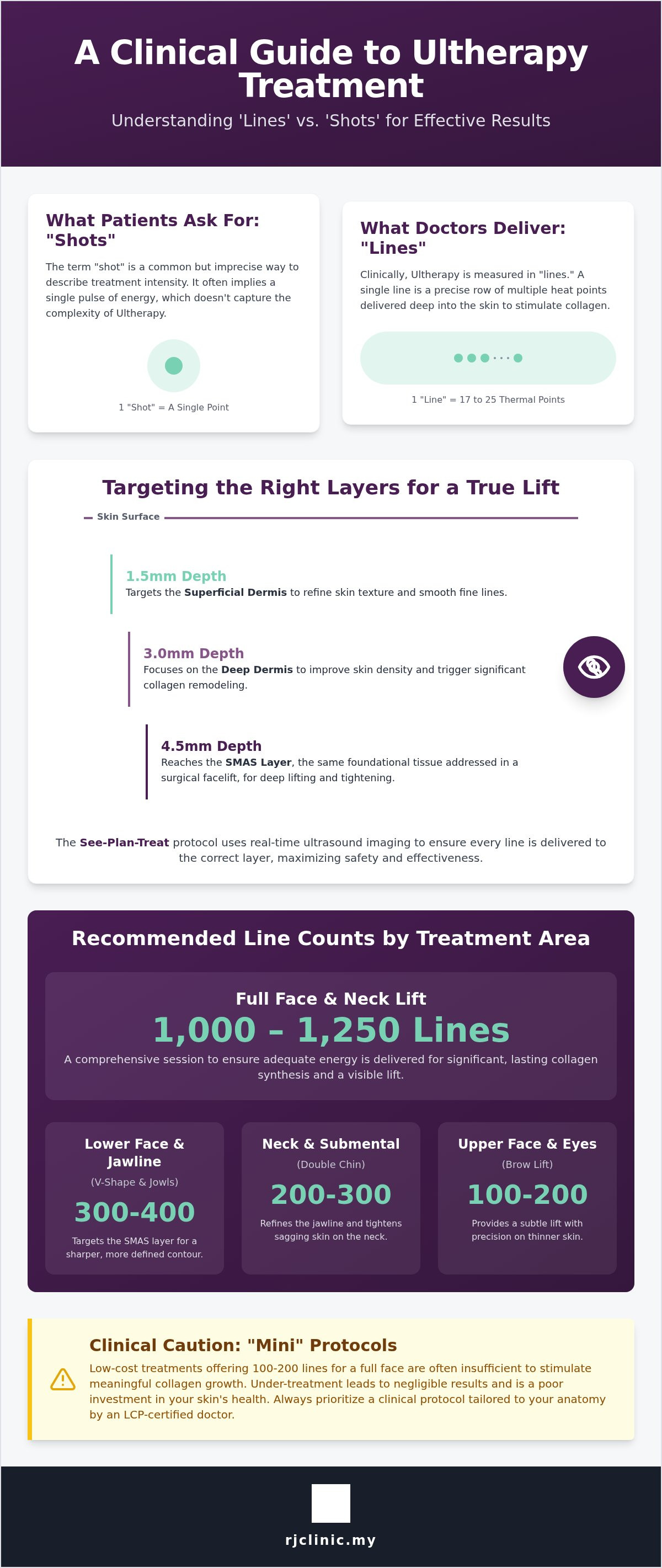
In the medical community, we refer to 'lines' rather than 'shots'. This distinction is more than just semantics. Each 'line' is a single, linear application of Micro-Focused Ultrasound with Visualization (MFU-V). As the transducer glides across the skin, it delivers a row of dozens of tiny, individual thermal coagulation points (TCPs) at a predetermined depth. These TCPs are dots of thermal energy that heat the tissue to the optimal temperature for stimulating new collagen production, a process known as neocollagenesis. It is this network of TCPs, meticulously placed line by line, that creates the foundational support for a visible, natural-looking lift.
The true artistry and science of Ultherapy lie in targeting the correct depths. The system uses multiple transducers—typically 1.5mm, 3.0mm, and 4.5mm—to deliver energy to different layers of the facial anatomy. The 4.5mm transducer targets the deepest foundational layer, the Superficial Muscular Aponeurotic System (SMAS), which is the same layer addressed in a surgical facelift. The 3.0mm transducer targets the deep dermis to address laxity, while the 1.5mm transducer works on the superficial dermis to improve fine lines and skin texture. A successful lift depends entirely on delivering the right amount of energy, at the right depth, across the entire treatment area to create a comprehensive, multi-layered scaffolding of new collagen.
What Exactly Is a 'Line' in Ultherapy?
A single Ultherapy 'line' is the complete sequence of focused ultrasound energy delivered in a linear path, typically about 25mm long. Within this one line, the device creates a series of evenly spaced TCPs—up to 25 of them. This is fundamentally different from other High-Intensity Focused Ultrasound (HIFU) devices that may deliver energy in a 'stamping' motion or as a single 'pulse'. The linear delivery of Ultherapy allows for broader, more consistent coverage and a more integrated thermal effect, which is crucial for stimulating a robust collagen response across a wide area.
The Importance of Real-Time Visualization
What sets Ultherapy apart from all other energy-based skin tightening devices is its patented DeepSEE® real-time ultrasound imaging. This technology allows the practitioner to see the precise tissue layers being treated on a screen throughout the entire procedure. At RJ Clinic, LCP-certified doctors like Dr. Renee and Dr. Cheok adhere to the 'See-Plan-Treat' protocol. We first visualize your unique anatomical structure—the skin, the fat, the SMAS layer, and even the bone. This allows us to create a bespoke treatment map, ensuring every single line is delivered to the correct depth where it will be most effective. This visualization prevents 'wasted' energy on structures like bone, where it has no benefit, or superficial fat, where it could cause unwanted volume loss. It guarantees that the prescribed number of lines is contributing directly to the structural lift.
Recommended Ultherapy Line Counts by Treatment Area
While every treatment plan is customized, established clinical protocols provide a baseline for the number of lines required to achieve a meaningful and visible result in different facial zones. These protocols are based on extensive clinical data and an understanding of the energy density needed to initiate significant neocollagenesis. Treating a broad, thick-skinned area like the lower face requires a different energy plan than a delicate area like around the eyes.
At RJ Clinic, we have refined these protocols based on our experience with Malaysian skin types and facial anatomy. Below is a breakdown of our standard Ultherapy Prime treatment plans, which serve as the foundation for a comprehensive, non-surgical lift. These numbers reflect a full, corrective treatment designed for optimal outcomes, not a 'mini' or preventative session.
Protocol Breakdown by Facial Zone
To achieve a balanced and harmonious result, the face and neck are divided into distinct aesthetic units, each with its own specific line count prescription. Our approach ensures that each area receives the appropriate energy density to address its unique signs of ageing.
Lower Face & Jawline: This is the cornerstone of facial lifting, addressing jowls, marionette lines, and loss of jawline definition. Our standard protocol for this area is 440 lines. This high count is necessary to deliver sufficient energy to the SMAS layer and deep dermis to create a powerful vector of lift and contouring.
Upper Face & Eyes: To achieve a non-surgical brow lift and tighten the skin around the periorbital area, a precise application of energy is needed. We typically administer 220 lines to lift the brows, open up the eyes, and create a more refreshed appearance.
Submental (Double Chin): Targeting the fat and skin laxity under the chin requires a focused approach. Our protocol for the double chin area is 220 lines, designed to tighten the skin and improve the contour of the chin and neck junction.
Neck: Addressing horizontal neck lines and "turkey neck" laxity is crucial for a youthful profile. The standard protocol for the full neck is 300 lines, which helps to smoothen and tighten the delicate skin in this region.
Based on these protocols, a comprehensive 'full face' treatment (upper and lower face) consists of 660 lines. A complete 'full face and neck' treatment would involve approximately 960 lines. If the submental area is also included, a full rejuvenation can approach 1,180 lines. This is why you may see international guidelines mentioning protocols of up to 1,200 lines for a complete face and neck procedure; it reflects the clinical reality of what is needed for a significant, lasting result.
Why 'Mini' Protocols Often Fall Short
The market is saturated with low-cost Ultherapy offers promising a 'full face' treatment for just 200 or 300 lines. Based on established clinical protocols, this number is simply insufficient to generate the thermal energy required for a noticeable lift. Administering 200 lines across the entire face spreads the energy too thin, failing to reach the necessary threshold for stimulating robust collagen growth in any single area. This often leads to patient disappointment and the perception that "Ultherapy doesn't work." The issue is not the technology, but the under-treatment. A properly dosed Ultherapy treatment is an investment in your 'collagen bank'; a sufficient number of lines ensures a significant deposit is made, leading to results that can last over a year or more.
Factors That Influence Your Personal Shot Prescription
The protocols listed above are clinical starting points. A truly personalized treatment plan, however, must consider several individual factors that are assessed during your initial consultation. A 35-year-old with good skin quality seeking prevention will not require the same energy density as a 55-year-old with significant skin laxity.
Key factors that influence the final line count include your skin age versus your chronological age, the thickness and density of your facial tissue, and the overall degree of skin laxity. For instance, individuals with 'heavier' lower faces, characterized by thicker skin and more subcutaneous tissue, often require a higher number of lines or increased energy settings at the 4.5mm depth to effectively contract the SMAS layer. Conversely, a patient with thinner, more delicate skin may need a greater focus on the 3.0mm and 1.5mm depths to improve dermal integrity without affecting volume.
Assessing Skin Quality and Laxity
During the assessment, we differentiate between superficial concerns like fine lines and deep structural sagging. While Ultherapy is the gold standard for lifting, it does not replace lost volume. Patients with significant volume depletion in areas like the mid-cheeks or temples may achieve the best results with a combination approach. For these individuals, we might first restore foundational volume with dermal fillers, and then use Ultherapy to tighten and lift the overlying skin envelope. This synergistic approach addresses both key aspects of facial ageing—volume loss and gravity-induced laxity—for a more complete and natural-looking rejuvenation.
The Role of Physician Expertise
This is where the expertise of an LCP-certified doctor becomes invaluable. An experienced physician does not just follow a template. They use real-time ultrasound imaging to adjust the treatment plan on the fly, responding to your unique anatomy. They strategically place each line to create specific vectors of lift, essentially custom-designing the direction of the pull to best suit your facial structure. They also modulate the energy levels based on tissue feedback and patient comfort. A 'one-size-fits-all' menu offering 500 lines for everyone is clinically unsound because it ignores the fundamental principle of medical aesthetics: personalization is key to achieving exceptional, natural results.
The RJ Clinic Approach: Precision with Ultherapy Prime
At RJ Clinic, we utilize Ultherapy Prime, the latest advancement in this gold-standard technology. This system offers several key advantages that enhance both the treatment experience and the final outcome, particularly for the high-line-count protocols necessary for significant lifting.
The primary benefit of Ultherapy Prime is its faster energy delivery. The system can lay down lines of TCPs more rapidly without compromising on precision or energy output. This significantly reduces the overall treatment time. A comprehensive 800-line session that might have taken 90 minutes with older technology can now be completed much more efficiently, greatly improving patient comfort. This allows us to deliver the clinically appropriate number of lines without subjecting our patients to prolonged discomfort.
The Benefits of Ultherapy Prime in KL
Beyond speed, Ultherapy Prime features enhanced imaging resolution. This gives our doctors an even clearer view of the targeted tissue layers, allowing for more accurate planning and placement of every single line. This heightened precision ensures that the maximum therapeutic benefit is derived from each pulse of energy. During these high-count sessions, Dr. Renee and Dr. Cheok prioritize patient comfort, combining the efficiencies of the Prime system with their gentle technique to make the experience as manageable as possible. For those interested in understanding how this compares to other technologies, we have detailed the differences in our guide on Density RF vs Ultherapy Prime.
Your Journey to a Lifted Profile
After the treatment, the process of collagen regeneration begins. While some patients may notice an immediate, subtle lift due to thermal contraction of existing collagen, the full results unfold gradually over three to six months as the body produces new, stronger collagen. This slow, natural progression is a hallmark of Ultherapy, ensuring the final result never looks 'done' or artificial.
To maintain this foundational lift, many patients opt for touch-up sessions every 12 to 18 months. The line count for a maintenance treatment is typically lower than the initial corrective procedure and is determined by your skin's response and ongoing ageing process. The first step, however, is always a thorough consultation to develop a plan tailored to your specific goals and anatomy. We encourage you to schedule a personalized skin tightening consultation to receive an accurate assessment and a treatment plan designed for a truly effective and lasting lift.
Frequently Asked Questions
Is 300 shots of Ultherapy enough for a full face lift?Based on established clinical protocols, 300 lines (or 'shots') is not sufficient for a full-face corrective lift. Our standard protocol for the lower face alone is 440 lines, and the upper face requires 220 lines. A 300-line treatment would significantly under-treat the area, leading to minimal or negligible results. It may be suitable for a very targeted area or a minor touch-up, but not for a comprehensive lift.
What is the difference between Ultherapy shots and lines?The terms are often used interchangeably by patients, but in a clinical context, 'line' is the more accurate term. A single 'shot' or 'line' refers to the linear delivery of multiple focused ultrasound energy points (TCPs) beneath the skin. Thinking in terms of 'lines' helps understand that the treatment is about creating a broad, even scaffold of collagen stimulation, not just delivering a certain number of 'zaps'.
Can you have too many Ultherapy shots in one session?An experienced, certified practitioner will not over-treat you. The number of lines is determined by a pre-assessed protocol and guided by real-time ultrasound imaging to ensure energy is delivered only where it's needed. The risk is not in having too many shots, but in having them delivered by an untrained operator who might target the wrong tissue depth or fail to protect sensitive structures like major nerves.
How many shots are needed to treat a double chin?At our clinic, the standard protocol for treating skin laxity and contouring the submental (double chin) area is 220 lines. This provides the necessary energy density to tighten the skin and improve the definition of the jawline and neck junction. For more information on various approaches, you can read our guide on non-surgical double chin removal.
Does a higher shot count mean the treatment will be more painful?A higher line count means the treatment will take longer, but it doesn't necessarily mean it will be more painful moment-to-moment. Discomfort is typically felt only when the energy is being delivered. The Ultherapy Prime system we use delivers energy faster, which significantly shortens the duration of high-count sessions, improving overall patient comfort. We also employ pain management strategies to ensure the experience is as tolerable as possible.
How many lines are typically used in a full face and neck protocol?A comprehensive full face and neck protocol at our clinic would combine the line counts for each zone. This includes 440 lines for the lower face, 220 for the upper face, and 300 for the neck, totalling 960 lines. If the submental area (220 lines) is also addressed, the total can reach 1,180 lines. This is consistent with international standards for a full, corrective treatment designed to produce significant, lasting results.



Comments