


What to Expect After Double Eyelid Stitching: A Clinical Recovery Guide


Many patients assume that the symmetry of their new double eyelid crease is determined the moment the final suture is placed, but the reality of the healing process is far more dynamic. Understanding what to expect after double eyelid stitching is the difference between a stressful recovery and a confident one, especially when you realize that early swelling often masks the precision of the underlying work. You've likely chosen this non-incisional technique for its reputation for subtle, organic-looking results and a swifter return to your social life, yet it's common to feel a sense of unease when the initial mirror reflection doesn't yet match your aesthetic goal.
I've found that clinical clarity is the best antidote to post-procedure anxiety. In this guide, we'll walk through the physiological stages of tissue settling and the specific aftercare protocols Dr Renee and Dr Cheok recommend to optimize your healing. You'll learn how to distinguish between normal inflammatory responses and genuine red flags, ensuring you feel empowered throughout your journey. We'll also cover the timeline for when your creases will reach their final, refined position, allowing you to plan your social calendar with absolute certainty.
Key Takeaways
Understand why post-procedure tightness and mild swelling are necessary physiological responses during the first 48 hours of your recovery.
Discover exactly what to expect after double eyelid stitching as the suture-induced adhesions settle into a refined, natural-looking crease over the first week.
Learn the clinical hygiene protocols and the safe timeline for resuming your skincare and makeup routine without compromising the suture sites.
Identify the milestones for final results at the three-month mark and the factors that ensure the enduring success of your enhancement.
Table of Contents
Immediate Aftermath: The First 48 Hours Post-Stitching
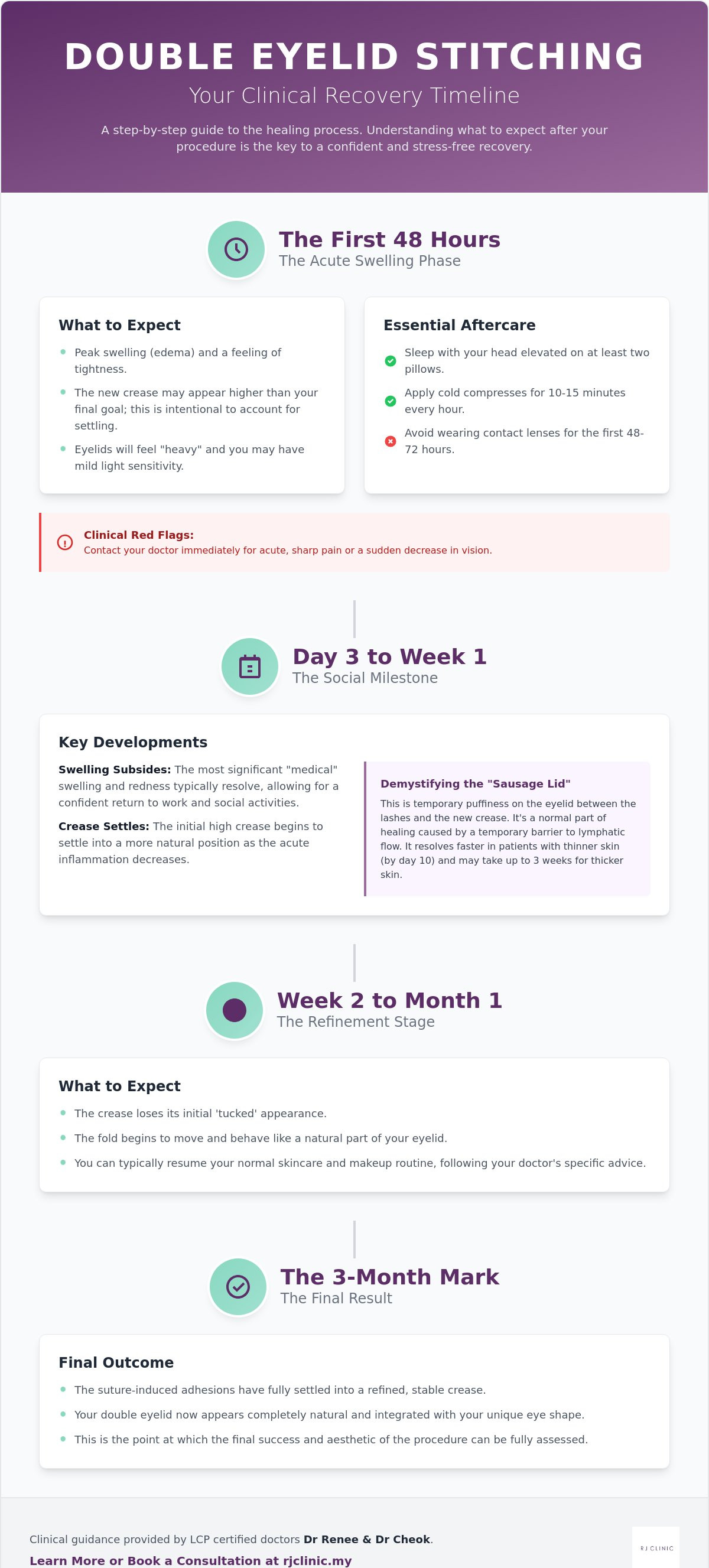
The first two days following your procedure are characterized by the body's acute response to the placement of precision sutures. Unlike a traditional Blepharoplasty, which involves skin excision and significant tissue disruption, the non-incisional technique relies on creating internal adhesions. When considering what to expect after double eyelid stitching, you should anticipate a localized physiological reaction rather than a systemic one. The primary response is edema, or swelling, as the delicate eyelid tissue reacts to the foreign material of the medical-grade sutures and the minor trauma of their placement.
During this window, many patients observe an apparent 'over-correction' where the new crease appears significantly higher than discussed during the consultation. This is a normal part of the process. Dr Renee and Dr Cheok intentionally design the initial placement to account for the settling that occurs as inflammation subsides. You will also experience a distinct sensation of tightness when blinking. This isn't a sign that the sutures are too tight; rather, it's the result of the internal anchoring points engaging with the levator muscle for the first time. This sensation typically softens as the tissue adapts to its new configuration.
Managing the Peak Swelling Phase
Swelling typically reaches its maximum intensity between 24 and 48 hours post-procedure. This occurs because the initial inflammatory markers peak during this timeframe before the lymphatic system begins to efficiently clear the excess fluid. To manage this, we recommend sleeping with your head elevated on at least two pillows. Gravity is a simple yet effective tool for facilitating lymphatic drainage and preventing fluid from pooling in the orbital area. Additionally, applying cold compresses for 10 to 15 minutes every hour is clinically beneficial. The cold induces vasoconstriction, which limits the amount of fluid leaking into the surrounding tissues and provides a soothing, analgesic effect.
Vision and Comfort Expectations
It's common for the eyelids to feel 'heavy' or for your vision to seem slightly obscured by the swelling of the upper lid margins. While your actual eyesight remains unaffected, you may experience mild light sensitivity. We advise patients to avoid wearing contact lenses for the first 48 to 72 hours. The act of pulling on the eyelid to insert or remove lenses can stress the fresh double eyelid suture sites and potentially disrupt the early adhesion process. While mild discomfort is expected, it should be easily managed with standard over-the-counter relief. If you experience acute, sharp pain or a sudden decrease in vision, these are clinical red flags that require immediate communication with your doctor.
The Healing Timeline: From 'Sausage Lids' to Natural Creases
By the third day, the acute inflammatory response begins to pivot toward tissue remodeling. Understanding what to expect after double eyelid stitching involves recognizing that the initial 'look' is merely a scaffolding for the final result. Most patients reach a significant social milestone by the end of the first week. By day seven, the 'medical' swelling, characterized by redness and significant puffiness, typically subsides. This allows you to return to work or social engagements with confidence, as any remaining residual puffiness is often only noticeable to you and your practitioner. At RJ Clinic, Dr Renee and Dr Cheok prioritize a philosophy of subtle, organic-looking outcomes, ensuring the crease settles into a position that enhances your natural eye shape rather than overriding it.
Demystifying the 'Sausage Eyelid' Effect
Patients frequently express concern regarding the 'sausage lid' appearance, which is the localized swelling of the skin between the suture line and the lashes. This is a temporary physiological event caused by the suture creating a slight barrier to lymphatic flow in that specific tissue strip. It's a common misconception that a high crease at day five indicates a permanent error; in reality, this is simply the peak of tissue tension. Your unique skin thickness dictates the speed of this settling. Thinner skin often resolves this puffiness by day ten, while thicker skin may require a full three weeks. Adhering to the clinical guidance on What to Expect at Home will help you manage these expectations during the first critical week.
Week 2 to Month 1: The Refinement Stage
The window between week two and the end of the first month is the refinement stage. This is when the crease loses its 'tucked' appearance and begins to behave like a natural fold of skin. You might notice slight asymmetry during this period, as the left and right eyes rarely heal at an identical pace. This is perfectly normal. The crease will gradually descend and soften, moving toward the precise measurements planned during your consultation. If you're curious about how this timeline compares to more invasive alternatives, reviewing the details of Double Eyelid Surgery in KL can clarify why many choose the stitching method for its elegant, low-downtime profile. If you're ready to explore a customized design, our double eyelid suture procedure offers a sophisticated path to eye rejuvenation.
Professional Aftercare Protocols for Optimal Results
The longevity of your results depends heavily on the integrity of the suture tension during the initial healing phase. Maintaining a sterile environment around the entry points is paramount to preventing localized infection. We recommend a structured hygiene routine involving a sterile cotton swab dipped in saline solution to gently dab the lid margins twice daily. This removes any minor crusting without disturbing the underlying stitches. While standard skincare can often be resumed on the lower face immediately, you should wait at least seven days before applying products to the upper orbital area. When considering what to expect after double eyelid stitching, realize that the skin requires this undisturbed window to seal the micro-entry points completely.
Returning to eye makeup, particularly waterproof liners or heavy shadows, should be deferred for two full weeks. The mechanical stress of applying and, more importantly, removing makeup can prematurely loosen the internal knots. Throughout this period, Dr Renee and Dr Cheok provide LCP-certified oversight during scheduled follow-ups to ensure the tissue is responding correctly to the suture material. This professional monitoring allows for early detection of any minor inflammatory issues that could affect the final symmetry of your creases.
The Essential 'Don'ts' During Early Recovery
The most critical restriction is the absolute avoidance of eye rubbing. Even a reflexive rub during sleep can compromise the delicate anchoring of the stitch. Similarly, we advise patients to pause strenuous exercise for the first 14 days. High-intensity workouts spike your blood pressure, which directly increases ocular pressure and localized swelling, potentially distorting the settling crease. You should also avoid environments with high bacterial counts or extreme temperatures, such as public swimming pools, saunas, and steam rooms, for at least two weeks to ensure the suture sites remain pristine.
Environmental Considerations in Malaysia
The tropical climate in Kuala Lumpur presents unique challenges for post-procedure care. High humidity and heat often lead to increased perspiration, which can irritate the suture sites if not managed. We recommend staying in climate-controlled environments as much as possible during the first 72 hours. Wearing oversized, UV-protective sunglasses is not just a matter of privacy; it's a clinical necessity. The intense Malaysian sun can cause post-inflammatory hyperpigmentation at the suture entry points if they aren't shielded. For those seeking comprehensive rejuvenation, combining this care with Laser Eyebag Removal can address both the upper and lower eye areas for a truly refreshed aesthetic. If you have concerns about your specific healing progress, you can book a clinical review to ensure your recovery remains on track.
Long-Term Success and When to Contact Your Doctor
While the first month brings the most visible change, the three-month mark is when we define the clinical 'final result.' By this stage, the medical-grade sutures have become fully integrated into the surrounding tissue, and the internal adhesions are stable. When understanding what to expect after double eyelid stitching, you'll notice that the crease no longer feels like a 'procedure result' but behaves exactly like a natural fold. The longevity of this non-incisional technique is influenced by several factors, including your skin's inherent elasticity and the absence of mechanical trauma. This is why we emphasize the long-term avoidance of aggressive eye-rubbing, which can gradually compromise suture tension over several years.
During this final settling phase, you might occasionally notice a tiny, painless bump at a suture entry point. These are often just the body's way of remodeling the microscopic entry site and usually resolve without intervention. However, if a bump becomes persistent or inflamed, it could be a suture granuloma. Unlike the generic scarring risks associated with incisional surgery, these are suture-specific and easily managed with professional oversight. Dr Renee and Dr Cheok adopt a partnership-based approach to your recovery, ensuring that even minor textural changes are monitored with clinical precision.
Identifying Clinical Red Flags
While the recovery path is typically predictable, you should remain vigilant for specific clinical indicators that require a review. Localized heat, increasing redness that spreads beyond the crease, or any yellowish discharge are signs of a potential infection. A sudden, noticeable change in crease height or a 'dropping' of the fold may suggest that a suture has lost its tension or shifted. Additionally, it's important to distinguish between the common, mild itchiness of healing tissue and a genuine allergic reaction. An allergy is usually characterized by persistent hives, significant swelling that returns after initially subsiding, or a spreading rash around the orbital area.
Maintaining Your Aesthetic Investment
To ensure the enduring success of your refined look, prioritize high-quality eye care that supports collagen production and maintains skin elasticity. Protecting the delicate orbital skin from UV damage remains a lifelong necessity to prevent premature sagging that could eventually obscure your new crease. For many patients, the new double eyelid is the foundation for a total eye rejuvenation. You might consider an Instabrow Eyebrow Transplant to frame your new creases and create a more youthful, lifted appearance. We view your aesthetic journey as a continuous relationship. To ensure your results continue to meet our rigorous standards, we invite you to schedule a follow-up consultation with Dr. Renee or Dr. Cheok for a personalized assessment.
Embracing a Refined, Natural Gaze
The journey from the initial 48-hour swelling phase to the refined results at three months is a predictable physiological process. By following a structured aftercare protocol and understanding what to expect after double eyelid stitching, you can navigate the settling period with complete confidence. This non-incisional technique is specifically designed for those who value minimal downtime and subtle, organic-looking enhancements that respect the unique anatomy of your eyes. It's a procedure where patience in the first week yields an elegant, long-lasting result.
At RJ Clinic, Dr Renee and Dr Cheok provide the LCP-certified expertise necessary to ensure your recovery is seamless and your results are symmetrical. Professional oversight transforms a standard procedure into a personalized aesthetic experience, bridging the gap between medical precision and artistic refinement. If you're ready to explore how this custom-designed approach can enhance your natural beauty, book a consultation for RJ Double Eyelid Stitching today. We look forward to partnering with you on a transformation that feels as authentic as it looks.
Frequently Asked Questions
How long does the swelling last after double eyelid stitching?
Most visible swelling typically lasts for five to seven days. While the peak occurs within the first 48 hours, the majority of patients find their eyelids look natural enough for social activities after one week. When considering what to expect after double eyelid stitching, keep in mind that minor residual puffiness may persist for three to four weeks before the final, refined crease is fully established.
Can I wash my face normally after the procedure?
You should avoid splashing water directly onto your upper eyelids for at least 72 hours. It's best to clean the rest of your face using a damp cloth or facial wipes while keeping the eye area dry. After the initial three days, you can gently wash your face with a mild cleanser, but avoid any scrubbing or pressure on the suture sites until they've fully sealed.
When can I start wearing eye makeup again?
We recommend waiting a full 14 days before applying any eye makeup, including eyeliner, mascara, or eyeshadow. The mechanical stress of applying these products and the friction required to remove them can disrupt the early adhesion process of the sutures. Once you resume your makeup routine, use gentle, non-waterproof formulas that are easier to cleanse without tugging on the delicate eyelid skin.
Is it normal for my eyelids to look asymmetrical during the first week?
Temporary asymmetry is a common clinical observation during the first week of recovery. Your left and right eyes rarely swell or heal at the exact same rate, which can make the creases appear uneven in height or shape. This usually resolves as the inflammation subsides. Dr Renee and Dr Cheok typically advise waiting at least one month for the tissue to settle before making any final assessment of symmetry.
Will the stitches eventually disappear or be removed?
The stitches used in this non-incisional technique are permanent, medical-grade sutures that aren't meant to be removed. They're designed to stay within the eyelid tissue to maintain the internal adhesion that creates your new crease. Over time, these sutures become integrated into the tissue and are virtually undetectable to the touch once the healing process is complete.
What should I do if I accidentally rubbed my eyes after the stitching?
Don't panic, but immediately check for any sudden changes in the crease shape or any new bleeding. While a single light rub is unlikely to dislodge a professionally placed stitch, aggressive friction can compromise suture tension. If you notice the crease has dropped or if you experience sharp pain, contact the clinic for a review to ensure the internal anchors remain secure.


Comments