


Double Eyelid Surgery Regrets: A Clinical Perspective on Prevention and Correction

Updated: Jun 27
Many patients assume that a "sausage lid" or an uneven crease is a sign of a failed procedure, but more often than not, double eyelid surgery regrets arise from a fundamental mismatch between a patient's unique orbital anatomy and the surgical technique employed. It is distressing to look in the mirror and see results that feel heavy or artificial, especially when you were seeking a subtle enhancement to your natural features. You are likely wondering if your current appearance is a permanent outcome or simply a protracted recovery phase that requires more patience.
Table of Contents
The Anatomy of Regret: Swelling vs. Permanent Surgical Issues
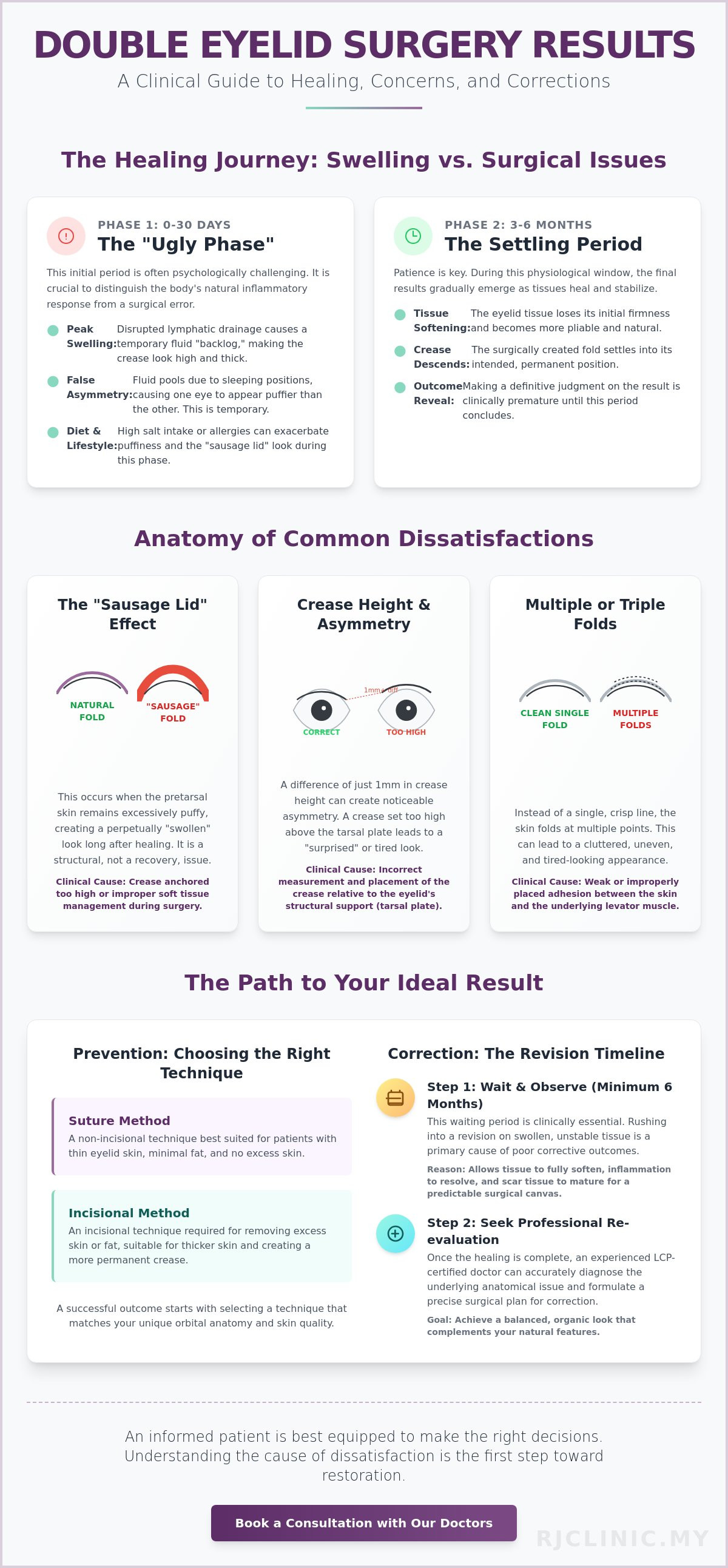
The first thirty days following a blepharoplasty are often the most challenging from a psychological perspective. During this window, double eyelid surgery regrets frequently peak as patients confront a reflection that appears distorted, asymmetrical, or overly bold. It's common to mistake the body's natural inflammatory response for a surgical error. The eyelid possesses a highly specialized and delicate lymphatic drainage system that is easily disrupted during any form of East Asian blepharoplasty. Because these vessels are responsible for clearing fluid, any surgical intervention leads to a temporary "backlog" of edema, causing the crease to look significantly higher and thicker than the intended design.
The settling period is a physiological window, usually lasting three to six months, during which the eyelid tissues soften and the crease descends into its intended, permanent position. Until this period concludes, making a definitive judgment on the surgical outcome is clinically premature.
The 'Ugly Phase' and Post-Operative Edema
During the initial weeks, swelling is rarely uniform. You might wake up with one eye looking significantly more "puffy" than the other, which can create a false impression of permanent asymmetry. This is often due to gravity; if you sleep primarily on one side, fluid tends to pool in the lower eye. High salt intake or even minor allergies can exacerbate this puffiness, making the crease appear like a "sausage lid." Clinical signs of normal settling include a gradual softening of the tissue and a crease that looks more natural by the evening compared to the morning. If the height of the crease is slowly decreasing week by week, the healing process is likely on the right trajectory.
When Regret is Valid: Signs of a Clinical Mismatch
While patience is vital, there are instances where dissatisfaction is rooted in a clinical issue rather than just swelling. If you notice a persistent drooping of the eyelid that interferes with your vision, this may indicate ptosis caused by accidental trauma to the levator muscle. Another sign of a mismatch is a crease that remains rigidly high and immobile even after four months, which might suggest it was anchored too high on the tarsal plate. Persistent, raised redness or hypertrophic scarring that doesn't fade after the initial healing phase also warrants a professional evaluation. In these cases, the concern isn't just about aesthetics; it's about the functional integrity of the eyelid structure. Dr Renee and Dr Cheok often emphasize that early identification of these issues allows for a more strategic approach to future correction.
Common Clinical Reasons for Dissatisfaction in Asian Blepharoplasty
While major medical complications are statistically rare, the majority of double eyelid surgery regrets stem from subtle aesthetic mismatches that disrupt facial harmony. One of the most frequent complaints we see is the "sausage lid" effect. This occurs when the pretarsal skin remains excessively puffy, often because the crease was anchored too high or the underlying soft tissue was not properly managed during the procedure. This creates a perpetually "swollen" look that persists long after the healing phase should have concluded. It's a structural issue, not a recovery one, where the skin fold is too thick for the patient's orbital frame.
Precision is vital because the eyes are the focal point of the face. A difference of just 1mm in crease height between the left and right eye can be enough to create a noticeable sense of asymmetry. Similarly, triple folds or multiple creases can occur when the surgical adhesion between the skin and the levator muscle is weak or improperly placed. This causes the skin to fold at multiple points rather than along a single, crisp line, leading to a cluttered and tired appearance.
Crease Height and the Tarsal Plate
The tarsal plate is the firm connective tissue that provides structural support to the eyelid. Clinically, the most stable and natural-looking creases are those anchored at or near the superior border of this plate. When a crease is placed significantly higher than the tarsal plate, it creates an unnatural tension that often results in a "surprised" or "tired" look. Dr Renee and Dr Cheok meticulously measure the height of the tarsal plate during the planning phase to ensure the fold complements your specific anatomy rather than fighting against it.
The Role of Excess Skin and Fat Removal
Successful blepharoplasty requires a delicate balance of tissue management. Over-resection, or removing too much orbital fat, may look acceptable in the short term but often leads to "sunken eyes" as the face naturally loses volume over time. Conversely, if too little skin is removed, the new crease can become "hooded" or hidden by sagging tissue, especially in the outer corners. For patients seeking a comprehensive rejuvenation, combining eyelid surgery with laser eyebag removal can address the entire periorbital area, ensuring the upper and lower lids look refreshed and age harmoniously. If you feel your results lack this balance, a clinical evaluation can help identify whether the issue is tissue-related or structural.
Preventing Regret: Choosing Between Suture and Incisional Techniques
Prevention of long term dissatisfaction begins in the consultation room, long before the first intervention is performed. Choosing a surgical technique based on social media trends rather than anatomical suitability is a primary driver of double eyelid surgery regrets. Many patients arrive requesting the "scarless" suture method because they fear a permanent incision, yet their eyelid anatomy may be better suited for a more robust approach. Clinical success depends on the surgeon's ability to match the procedure to the patient's skin thickness, fat volume, and the strength of the levator muscle.
If a suture method is forced upon an eyelid with thick skin or significant fat deposits, the results are almost inevitably temporary. The tension required to maintain the fold in heavy tissue often causes the internal stitches to cheese-wire through the tissue or snap entirely. When this happens, the crease may become shallow or disappear within months, leading to frustration and the need for a second, more invasive procedure. Dr Renee and Dr Cheok utilize their clinical experience as LCP-certified doctors in KL to guide patients toward the technique that offers the highest probability of a stable, long lasting result.
The Suture Method: Reversibility and Natural Logic
For patients with thin eyelid skin and minimal fat, the RJ Double Eyelid Suture technique offers an elegant, scarless solution. This method creates a fold by placing specialized sutures through the eyelid to create an adhesion between the skin and the underlying muscle. One of the significant psychological benefits of this approach is its relative reversibility. For a hesitant first-time patient, knowing that the procedure can be adjusted or reversed provides a sense of security. Because it involves no skin removal, the recovery is swift and the outcome typically looks very organic, avoiding the "operated" appearance that some patients fear.
The Incisional Choice: For Permanent Structural Change
When the eyelid presents with significant drooping, excess skin, or thick fat pads, a full incisional surgery is the only path to a stable crease. This method allows the surgeon to physically remove obstructing tissue and anchor the skin directly to the tarsal plate. While this requires a longer recovery period and leaves a fine linear scar, the results are permanent and provide the most dramatic improvement in eye shape. Experienced surgeons minimize scarring through meticulous suturing techniques that allow the incision to hide within the new fold. If you are uncertain which method fits your anatomy, you can explore our approach to eyelid stitching to see if a non-incisional path is right for you.
The Path to Revision: What to Do If You Are Unhappy
The most difficult advice for a patient experiencing double eyelid surgery regrets is often the most critical: you must wait. The "Golden Rule" of revision surgery dictates a minimum waiting period of six months before any corrective intervention is performed. This isn't an arbitrary delay. It takes approximately half a year for the internal tissues to complete the remodeling phase of healing and for the inflammatory edema to fully subside. Attempting to fix a result while the tissues are still firm and "woody" significantly increases the risk of further scarring and unpredictable outcomes.
Revision surgery is fundamentally different from a primary procedure. While the first surgery works with "virgin" tissue and clear anatomical planes, a revision involves navigating through fibrosis, or scar tissue, from the previous operation. This requires a much higher level of surgical precision and a deep understanding of how different tissues respond to secondary trauma. In some instances of minor asymmetry or visible scarring, non-surgical "tweaks" like specialized lasers can help refine the texture or soften a scar without the need for a second trip to the operating room. However, structural issues usually require a surgical correction led by an LCP-certified doctor who specializes in complex eye cases.
Correcting the 'Sausage Lid' or High Crease
Lowering an excessively high crease is clinically more demanding than raising a low one. To correct a "sausage lid" or a high fold, the surgeon must carefully release the old adhesions and scar tissue that are tethering the skin too high on the levator muscle or tarsal plate. Once released, a new, lower anchor point is established. It's vital to manage expectations for this second journey; because the tissue has been previously altered, the swelling during a revision can sometimes be more persistent than the first time. Patience remains your most important tool during this restorative phase.
Consultation and Moving Forward
The first step in resolving your dissatisfaction is a comprehensive clinical assessment. During a consultation with Dr Renee or Dr Cheok, we don't just look at the current fold; we evaluate your skin elasticity, muscle function, and the health of the surrounding periorbital area. To help us build a precise revision plan, it's incredibly helpful if you can provide your previous surgical notes or photos of your eyes before your first procedure. This historical context allows us to understand what was changed and how to best restore balance. For a broader perspective on maintaining the health and aesthetics of the entire eye area, you can read our guide on eye rejuvenation in Kuala Lumpur. Taking the time to choose a specialist with the right credentials and aesthetic philosophy is the best way to move from regret to a result you can finally enjoy.
Restoring Your Confidence Through Clinical Precision
Understanding that many double eyelid surgery regrets stem from temporary postoperative swelling or a mismatch in surgical technique is the first step toward peace of mind. Whether you are navigating the early "ugly phase" of healing or addressing long term structural concerns like asymmetry or the "sausage lid" effect, the path to correction requires patience and expert guidance. As we've discussed, the six month window for tissue softening is a non-negotiable clinical requirement that ensures any subsequent intervention is both safe and predictable.
Dr Renee and Dr Cheok are LCP-certified physicians who specialize in subtle, organic looking eyelid enhancements. With multiple locations across Kuala Lumpur and Selangor, our team provides the meticulous clinical assessment needed to refine your results and restore facial harmony. You don't have to settle for an outcome that feels artificial or creates daily anxiety. Schedule a clinical assessment with our LCP-certified doctors to discuss your eyelid concerns. We are here to help you achieve the refined, natural aesthetic you originally envisioned.
Frequently Asked Questions
Can double eyelid surgery be reversed if I regret it?
Reversibility depends entirely on the surgical technique used. Suture-based procedures are generally reversible within the first few weeks by removing the internal stitches. However, incisional surgery involves the removal of skin and fat, making a full reversal to your original eye shape clinically impossible. In these cases, we focus on refinement and corrective surgery to achieve a more natural appearance rather than a true reversal.
How long should I wait before deciding I need revision surgery?
Clinical protocols mandate a waiting period of at least six months before undergoing a revision. Eyelid tissues require this time to fully resolve internal inflammation and for the scar tissue to soften. Attempting a correction too early often results in unpredictable healing and may lead to further double eyelid surgery regrets due to the instability of the underlying structures during the remodeling phase.
Why do my eyelids look so thick and 'sausage-like' 3 months after surgery?
While much of the initial swelling subsides by 12 weeks, the eyelid's lymphatic drainage is often slow to recover. If the crease was anchored too high or if there is significant soft tissue volume, the "sausage lid" appearance can persist. At the three month mark, it's often a combination of residual edema and the way the skin fold settles over the tarsal plate, which can take longer to flatten in some patients.
Is it possible to fix asymmetrical eyelids without another surgery?
Minor asymmetries can sometimes be addressed with non-surgical interventions like dermal fillers to balance volume or medical lasers to refine scar texture. However, if the asymmetry is caused by the height of the surgical fold or muscle trauma, a secondary surgical procedure is usually necessary. A clinical assessment is required to determine if the issue is skin deep or rooted in the structural placement of the crease.
What are the most common causes of an 'unnatural' look after blepharoplasty?
An unnatural result often stems from a crease that is placed too high for the patient's orbital bone structure or the excessive removal of orbital fat, which creates a hollowed look. Other factors include a "static" crease that doesn't move naturally during blinking or a lack of proper tapering at the inner corner. These aesthetic mismatches are a leading cause of double eyelid surgery regrets among patients seeking subtle enhancement.
Can I switch from a suture crease to an incisional crease later?
You can certainly transition from a suture method to an incisional method if you desire a more permanent or defined result. Many patients start with stitching and choose to undergo incisional surgery later as their skin loses elasticity or if the original suture crease begins to fade. This transition allows for the removal of excess skin and fat that the suture method is unable to address.


Comments