


What to Do If Ultherapy Doesn't Work: A Clinical Roadmap for Non-Responsive Skin


If you have invested in a premium skin tightening treatment only to see your reflection remain unchanged months later, the issue is rarely a failure of the technology itself; it is usually a mismatch between your skin’s biological capacity and the specific intensity of the ultrasound energy. Many patients visit our clinic feeling frustrated after a significant financial investment, searching for a clear answer on what to do if ultherapy doesn't work for their specific concerns. While Ultherapy Prime is a highly effective tool for non-invasive lifting with over 3 million treatments performed globally, its success depends entirely on the body’s internal regenerative response, which can vary significantly between individuals.
We recognize that persistent facial sagging after a major procedure can lead to a loss of confidence in aesthetic medicine. This clinical roadmap moves beyond generic advice to identify why your skin may have been non-responsive and how Dr Renee and Dr Cheok pivot a treatment plan toward more effective, medically sound alternatives. We will examine how a shift toward targeted bio-stimulation, dermal fillers, or precision contouring can finally provide the refined, natural results that ultrasound alone could not achieve.
Key Takeaways
Understand the 180-day clinical rule to determine if your skin is simply a slow responder or if a genuine pivot in your treatment strategy is required.
Identify the biological factors, such as the Elasticity Threshold and subcutaneous fat volume, that dictate what to do if ultherapy doesn't work for your specific facial structure.
Learn how to transition from ultrasound energy to bio-stimulators or skinboosters to restore structural integrity when collagen induction requires a more direct catalyst.
Explore the strategic use of "sandwich" treatments and combination therapies to address laxity that exists across multiple tissue depths simultaneously.
Recognize when to move beyond non-invasive lifting toward precision contouring like Accusculpt to effectively resolve persistent concerns such as heavy jowls.
Table of Contents
Auditing the 'Failed' Ultherapy Result: Clinical Realities vs. Timing
Patients often arrive for their six-week follow-up feeling disheartened because they don't yet see the "snapped back" look they expected. This is the most common clinical misunderstanding we encounter in practice. Real biological tightening isn't an instant mechanical pull; it's a physiological response to micro-focused therapeutic ultrasound technology. If you are wondering what to do if ultherapy doesn't work, the first step is actually to wait for the body's internal clock to catch up with the procedure.
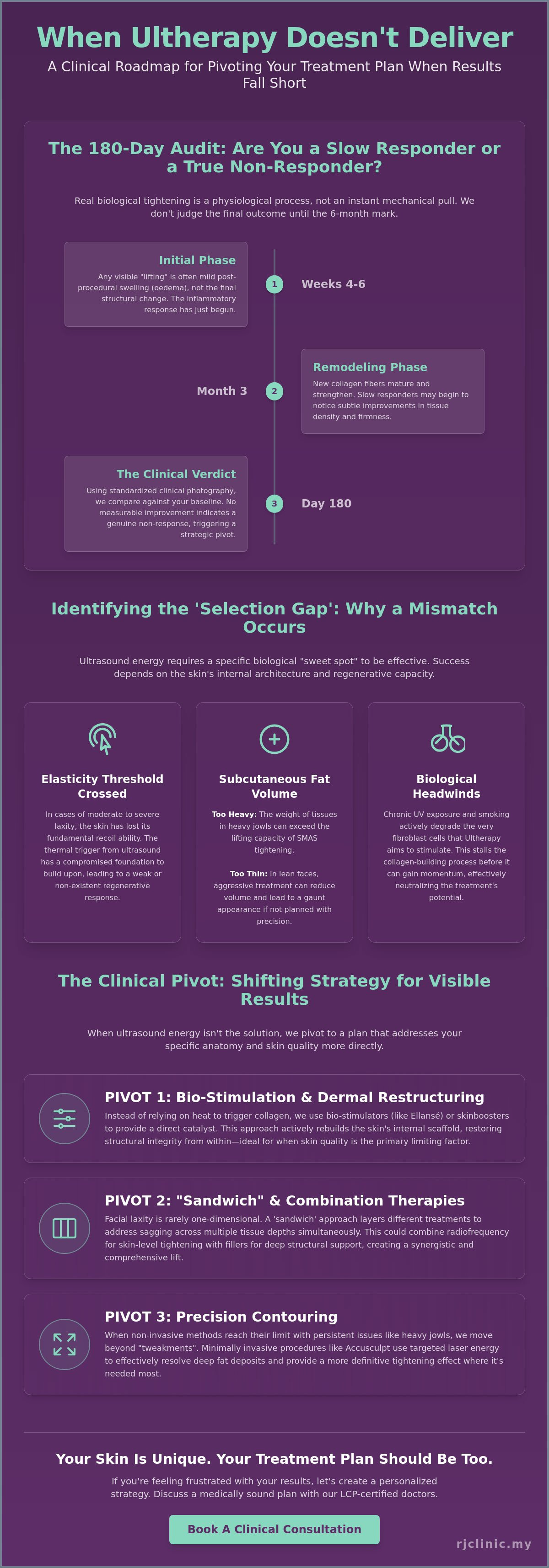
Dr Renee and Dr Cheok frequently have to distinguish between a "slow responder" and a true "non-responder." A true non-responder lacks the regenerative capacity to react to the thermal injury, while a slow responder simply requires more time for their cellular machinery to ramp up. During follow-up consultations, we look for subtle markers of SMAS layer response—such as improved tissue density or a slight shift in the malar fat pad—that a patient might miss when checking their reflection daily. We don't judge the final outcome until the 180-day mark has passed.
The Biological Timeline of Collagenesis
Collagenesis begins with an acute inflammatory phase where tissue contracts slightly, followed by a long remodeling phase where new collagen fibers mature and strengthen. Visible "lifting" at week four is often just mild post-procedural oedema rather than actual tightening. True structural change requires approximately 180 days to reach peak efficacy. Your age and metabolic health play a decisive role here. A younger patient’s skin typically reorganizes its matrix faster, whereas older skin may require the full six months to show any measurable refinement.
When to Formally Declare a Treatment Unsuccessful
We only categorize a case as a non-responder after a formal six-month audit. Relying on mirror checks is notoriously unreliable because the brain adapts to gradual changes. Dr Renee and Dr Cheok utilize standardized clinical photography under controlled lighting to compare the baseline against the 180-day result. We assess skin quality versus structural lift, looking at specific laxity grades. If no measurable change is found by this stage, we then formulate a plan for what to do if ultherapy doesn't work, which usually involves shifting from ultrasound to bio-stimulators or precision contouring.
Why Ultherapy Doesn't Work for Everyone: The Selection Gap
When a patient asks what to do if ultherapy doesn't work, the answer often lies in the initial clinical assessment. Ultrasound energy requires a specific biological "sweet spot" to be effective. If the skin’s internal architecture is too compromised, the thermal triggers have nothing to build upon. Success isn't just about the device; it's about the "Elasticity Threshold." Once skin laxity passes a certain point, the regenerative response is too weak to produce a visible lift. Lifestyle factors also play a silent but significant role. Chronic UV exposure and smoking degrade the very fibroblasts that Ultherapy Prime aims to stimulate, effectively stalling the collagen-building process before it starts.
Subcutaneous fat volume is another critical variable. High-Intensity Focused Ultrasound (HIFU) technology, while effective for many, can be problematic for those with very high or very low facial fat. In patients with heavier jowls, the weight of the tissue may exceed the lifting capacity of the SMAS tightening. Conversely, in very thin faces, an aggressive or poorly planned treatment can lead to a gaunt appearance if the practitioner doesn't navigate the tissue layers with extreme precision. Dr Renee and Dr Cheok prioritize a customized depth strategy for every patient to avoid these pitfalls.
Anatomical Constraints and Skin Laxity Grades
We categorize skin aging into mild, moderate, and severe laxity grades. Patients with mild to moderate sagging are the ideal candidates for ultrasound energy. However, patients over 60 often present with severe laxity that has crossed the Elasticity Threshold. At this stage, the skin has lost its fundamental recoil ability. For those facing the "thin face" dilemma, where sagging is compounded by volume loss, relying solely on tightening won't restore a youthful contour. In these instances, we often recommend Ellanse bio-stimulators to replenish structural support alongside energy-based treatments.
The Protocol Factor: Lines, Depth, and Energy Levels
The technical execution of the procedure is just as vital as patient selection. "Budget" or discounted treatments often compromise on the number of lines delivered to the tissue. A full-face protocol requires a specific density of energy to trigger meaningful collagenesis; using fewer lines results in an under-powered treatment that fails to meet expectations. Real-time imaging is the cornerstone of a successful outcome. It allows us to see the exact depth of the SMAS layer, ensuring energy is delivered precisely where it can do the most good rather than being wasted in the fat or bone layers.
The Non-Surgical Pivot: Strategic Alternatives for Non-Responders
When the 180-day clinical audit confirms that ultrasound energy hasn't yielded the expected lift, we don't simply repeat the same protocol. We pivot. Understanding what to do if ultherapy doesn't work requires a shift in perspective from "shrinking" tissue to "rebuilding" it. While ultrasound targets the deep SMAS layer, it cannot address significant volume depletion or a biologically exhausted dermal matrix. In these cases, we transition from energy-based tightening to a strategy centered on structural biostimulation and multi-layered "sandwich" treatments.
Dr Renee and Dr Cheok often find that a lack of response indicates the skin has reached its biological limit for heat-induced repair. Instead of applying more energy, we introduce materials that provide immediate mechanical support. This approach addresses the structural "gap" that ultrasound occasionally leaves behind, particularly in patients with thinner skin or more advanced chronological aging. By treating different tissue depths with complementary technologies, we can often achieve the refinement that a single-modality treatment could not provide.
Bio-stimulators: Sculptra and Ellansé
Ellansé represents a significant shift in how we manage non-responsive skin. Unlike the "heating" effect of ultrasound, which relies on your body’s existing collagen bank, bio-stimulators act as a scaffold. Ellansé provides an immediate lifting effect through its gel carrier, while the PCL microspheres "seed" the tissue to trigger long-term collagen induction. This is a superior option for patients with volume loss, as it restores the youthful "plumpness" that ultrasound tightening alone cannot replicate. It’s about building new architecture rather than just tightening old foundations.
Advanced RF Technology and Skinboosters
If the issue lies in the superficial dermis rather than the deep SMAS, Potenza RF Microneedling offers a more targeted solution. It combines physical microneedling with radiofrequency to improve skin texture and elasticity from the outside in. We also emphasize the role of Polynucleotides or Rejuran in repairing the skin barrier. If your skin's cellular health is poor, it won't respond to any lifting device. Optimizing the skin's internal environment with these regenerative boosters is often the essential first step before any energy-based lifting will truly take hold.
If you're ready to move beyond ultrasound for a more comprehensive approach, you can consult with our team to design a multi-layered pivot strategy tailored to your skin's unique biology.
When to Stop Tweakments: Moving Toward Precision Contouring
There comes a point where continuing with non-invasive energy treatments transitions from proactive maintenance to a cycle of diminishing returns. If you have explored various modalities and are still asking what to do if ultherapy doesn't work, it may be because your concerns are driven by deep fat pads or advanced structural sagging that ultrasound energy simply cannot overcome. Recognizing these limits is a hallmark of an informed patient and an ethical practitioner. When the weight of the tissue exceeds the skin’s biological lifting capacity, precision contouring becomes the most predictable path to a refined appearance.
In our Kuala Lumpur clinic, Dr Renee and Dr Cheok focus on identifying the "Point of Diminishing Returns," which we define as the threshold where the cumulative cost and frequency of non-surgical treatments outweigh the definitive results of a one-time surgical or minimally invasive intervention. Moving toward more precise procedures doesn't mean a loss of natural aesthetics; rather, it allows us to address the root cause of aging, such as displaced fat or severe muscle laxity, that "tweakments" can only temporarily mask. Understanding what to do if ultherapy doesn't work involves accepting that some anatomical changes require a more direct mechanical solution.
Laser Lipolysis: The Intermediate Solution
For many, the ideal solution lies in the space between a non-invasive laser and a full surgical lift. Accusculpt Face Slimming utilizes a specialized laser wavelength to precision-melt stubborn fat deposits in the jowls and double chin that ultrasound cannot reach. This procedure offers a unique "shrink-wrap" effect, where the internal heating of the dermis triggers a much more aggressive tightening response than external devices. Removing the actual weight from the lower face often creates a more lifted and youthful profile than simply attempting to tighten the skin over existing fat volume.
Surgical Eye and Face Lifting
When addressing the periorbital area, Eyebag Surgery is often a more cost-effective and permanent solution than repeated rounds of under-eye Ultherapy. While ultrasound can thicken the skin, it cannot remove the herniated fat pads that cause persistent puffiness. A successful surgical referral depends on your overall health, skin quality, and the specific anatomical goals discussed during your consultation. Transitioning to a surgical option requires a shift in expectations regarding recovery, but the trade-off is a result that remains stable for many years, finally resolving the frustration of non-responsive skin.
Restoring Your Aesthetic Vision Beyond Ultrasound
Determining what to do if ultherapy doesn't work is a clinical process that requires a nuanced understanding of your skin’s regenerative potential. We've explored how the 180-day biological window is essential for an accurate assessment and why anatomical factors like the elasticity threshold might necessitate a shift in strategy. Whether your path involves the structural support of bio-stimulators or the targeted refinement of precision contouring, the goal remains a natural, sophisticated enhancement. A lack of response to one modality isn't the end of your journey; it's simply a signal to refine the medical approach.
At our clinic, we combine FDA-approved Ultherapy Prime technology with a comprehensive suite of surgical and non-surgical alternatives to ensure your results match your expectations. As LCP-certified aesthetic physicians, Dr Renee and Dr Cheok are dedicated to bridging the gap between rigorous clinical standards and your personal aesthetic goals. We invite you to book a clinical assessment with Dr Renee or Dr Cheok to audit your results and rediscover confidence in a plan designed specifically for your skin's unique needs. There is always a medically sound path forward to the results you deserve.
Clinical Perspectives: Frequently Asked Questions
How long should I wait after Ultherapy to try another treatment?
You should wait a minimum of six months before initiating another major skin tightening procedure. This 180-day window allows your body to complete the full cycle of collagen synthesis and remodeling. Starting a new treatment too early can lead to over-inflammation or interfere with the results of the initial session. Dr Renee and Dr Cheok typically advise waiting for this formal clinical audit before deciding on a pivot strategy.
Can Ultherapy actually make my face look worse or thinner?
Ultherapy can occasionally cause a gaunt or "thinner" appearance if the ultrasound energy is inadvertently delivered into the subcutaneous fat layers rather than the SMAS or deep dermis. This typically happens when real-time imaging isn't used correctly to distinguish between tissue types. While it doesn't "dissolve" fat in the traditional sense, the thermal effect can cause fat cell volume to decrease, which is why precise depth targeting is vital for thin-faced patients.
Is Thermage better than Ultherapy if I didn't see results?
Thermage isn't necessarily better; it simply uses a different energy source, radiofrequency, to tighten the skin's surface rather than the deep SMAS. If you are researching what to do if ultherapy doesn't work for deep lifting, switching to a radiofrequency technology like Density RF may be more effective for treating superficial skin laxity and "crepiness." We often find that patients who don't respond to ultrasound benefit more from the bulk heating provided by RF devices.
Why did my friend get great results from Ultherapy but I didn't?
Variations in results are usually down to differences in biological age, baseline collagen density, and lifestyle habits. A friend with high regenerative capacity and minimal UV damage will naturally produce more new collagen in response to the thermal triggers than someone with more advanced chronological aging. When patients ask what to do if ultherapy doesn't work for them specifically, we often look at metabolic factors or whether their "Elasticity Threshold" was already exceeded before treatment.
Are there any supplements I can take to help Ultherapy work better?
Optimizing your intake of Vitamin C, zinc, and high-quality collagen peptides can provide the essential building blocks your skin needs for repair. Since ultrasound lifting relies on your body’s ability to heal itself, a deficiency in these nutrients can stall the collagen-building process. We recommend starting these supplements at least four weeks before your procedure and continuing them throughout the six-month remodeling phase to ensure your fibroblasts have the raw materials required for success.
What is the most effective alternative to Ultherapy for a saggy neck?
Accusculpt laser lipolysis is often the most effective medical alternative for a saggy neck when non-invasive ultrasound isn't enough. While Ultherapy tries to tighten skin from the outside, Accusculpt works internally to remove excess fat and "shrink-wrap" the skin around the jawline. For patients in Kuala Lumpur with significant "turkey neck" or heavy jowls, removing the weight of the fat provides a much more noticeable and long-lasting lift than energy-based tightening alone.


Comments