


Ultherapy vs. Filler for Face Lifting in KL: A Doctor’s Clinical Comparison (2026)


Adding volume to a sagging face can sometimes make it look heavier rather than younger, yet many patients still request fillers as their first line of defense against gravity. When evaluating ultherapy vs filler for face lifting kl, patients often struggle to distinguish between skin that has lost its elasticity and a face that has simply lost its structural volume. Choosing the wrong modality doesn't just waste your investment; it can lead to the overfilled look that many sophisticated clients in Kuala Lumpur rightfully fear. It's understandable to feel hesitant when the technical difference between ultrasound energy and hyaluronic acid remains unclear, especially when you're seeking a result that looks like you, only refreshed.
This clinical comparison clarifies how we use Ultherapy Prime to repair the SMAS layer versus how dermal fillers restore the internal scaffolding of the mid-face. You'll gain a clear understanding of which treatment addresses your specific anatomical needs, the realistic ROI of each procedure, and how Dr Renee and Dr Cheok design bespoke plans to achieve a refined, natural elevation. By the end of this guide, you'll be empowered to choose a strategy that treats the root cause of aging rather than just masking the symptoms, ensuring a restored jawline and mid-face without the tell-tale signs of an artificial transformation.
Key Takeaways
Understand why Ultherapy acts on the deep SMAS layer to tighten foundations, while dermal fillers provide mechanical lift by replacing lost mid-face volume.
Differentiate between the immediate contouring results of fillers and the gradual, three-to-six-month collagen journey required for Ultherapy.
Learn how your specific facial anatomy, such as fat volume and skin laxity, dictates the most effective choice when weighing ultherapy vs filler for face lifting kl.
Discover the RJ Clinic protocol of synergistic lifting, which combines energy-based tightening with precision injectables for a refined, natural outcome.
Identify the clinical markers that signal whether your facial aging is caused by a failing foundation or a loss of internal scaffolding.
Table of Contents
The Clinical Mechanism: How Ultherapy and Fillers Create a "Lift"
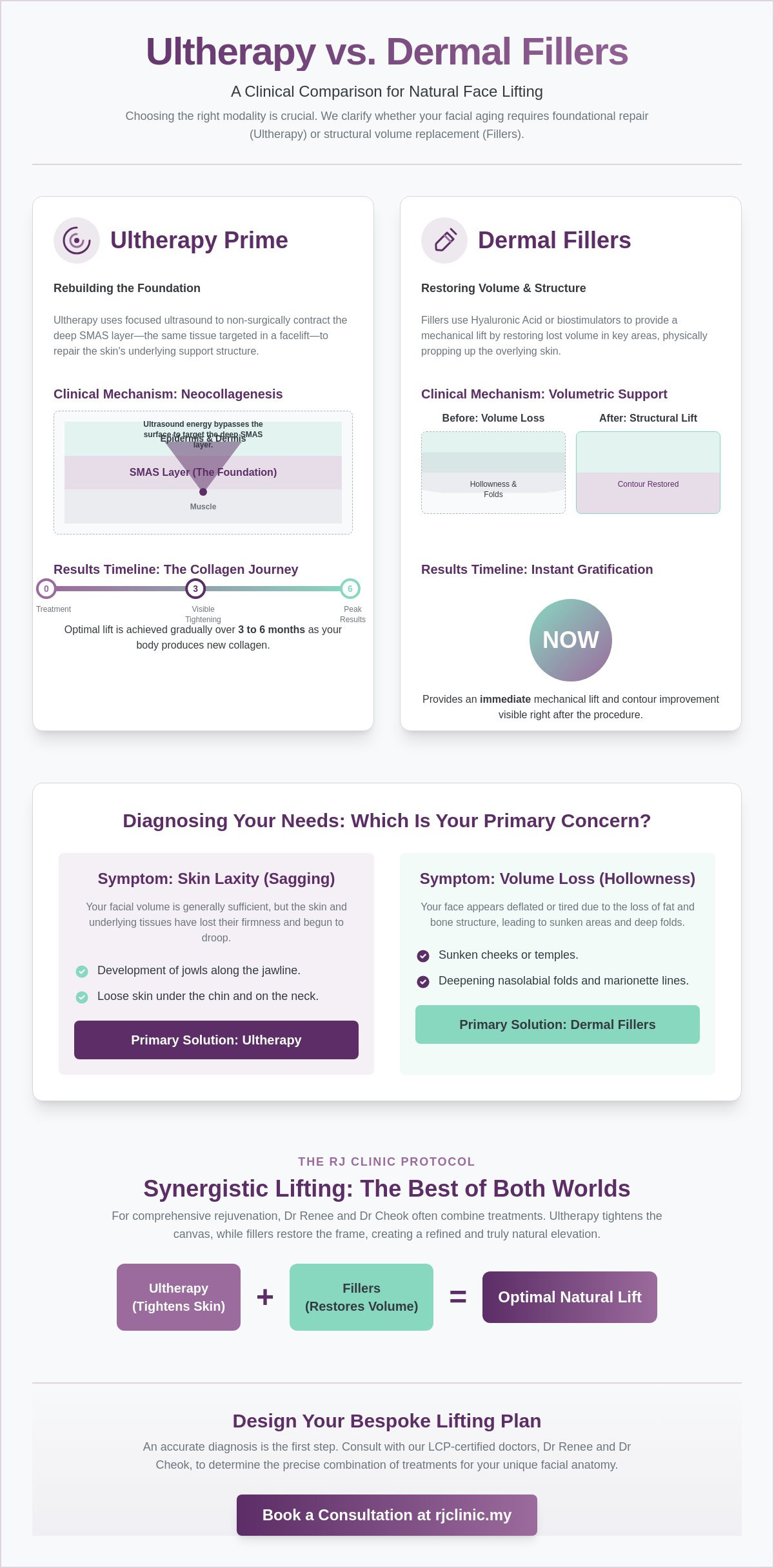
Patients often use the word "lift" as a catch-all term for looking younger, but in a clinical setting, we must distinguish between tissue that has become loose and tissue that has simply lost its internal support. When evaluating ultherapy vs filler for face lifting kl, the choice depends on whether we are repairing a foundation or refilling a container. While both treatments result in a more elevated appearance, they achieve this through entirely different biological pathways. One contracts the skin from within, while the other provides a mechanical scaffold to hold the skin in a higher position.
Ultherapy Prime and the Foundation of the Face
Ultherapy Prime utilizes focused ultrasound technology to bypass the skin's surface and deliver heat to the SMAS (Superficial Muscular Aponeurotic System). This is the same fibrous layer that surgeons manipulate during a traditional facelift. By creating thousands of microscopic thermal coagulation points, the treatment triggers a process called neocollagenesis. Over several months, your body produces new, organized collagen fibers that physically contract the tissue. Ultherapy Prime serves as a structural repair tool for skin laxity by addressing the deep tissue layers often missed by surface treatments. For our patients in Kuala Lumpur, Dr Renee and Dr Cheok utilize the system's real-time ultrasound imaging to ensure energy is delivered precisely where your tissue density is highest, avoiding bone or blood vessels for a safer, more effective result.
The "Liquid Lift" Mechanics of Dermal Fillers
Dermal fillers don't tighten the skin itself; instead, they restore the volumetric support that has dissolved due to bone resorption and fat loss. By using high-G prime hyaluronic acid, we can create a "liquid lift" by strategically placing product in the mid-face and temples. This repositions the malar fat pad, which naturally slides downward as we age, causing jowls and nasolabial folds. When we support the cheekbones or the lateral face, it creates a subtle upward pull on the overlying skin. In cases where we want both immediate volume and long-term tissue quality, we may use biostimulators like Ellansé. This provides an instant mechanical lift while simultaneously encouraging the body to grow its own Type I collagen around the filler microspheres. This dual-action approach ensures the lift remains natural as the initial gel carrier is absorbed by the body.
Understanding these mechanisms is vital. If you have significant skin laxity but no volume loss, fillers may lead to a heavy, overfilled appearance. Conversely, if your face looks "hollow" rather than "saggy," Ultherapy alone won't provide the youthful plumpness you desire. A successful ultherapy vs filler for face lifting kl strategy often involves identifying which of these two biological deficits is more prominent in your unique facial anatomy.
Immediate vs. Gradual Results: Expectations for the KL Patient
Patients often visit our clinic seeking a visible change before a major event, such as a wedding or a corporate gala in Kuala Lumpur. This is where the choice of ultherapy vs filler for face lifting kl becomes a matter of timing. Fillers offer what we call "instant gratification." The moment the gel is placed, structural support is restored. You can see the jawline sharpen and the cheeks lift before you even leave the chair. This makes fillers the preferred choice for those who need immediate contouring or have a tight deadline for their rejuvenation.
Ultherapy, by contrast, is a "long game" investment. There is no immediate lift because your body requires time to synthesize new collagen. We call this the collagen journey. While you might feel a slight "zing" or temporary tightness immediately after the procedure, the real transformation happens deep within the SMAS layer over the next three to six months. According to FDA Information on Dermal Fillers, injectables are approved for correcting folds and volume loss, but they don't provide the biological tissue contraction that ultrasound energy achieves. If you're planning your aesthetic calendar, you must account for this biological lead time.
Timeline of Transformation
The first 48 hours differ significantly between these two modalities. Fillers carry a minor risk of swelling or bruising at the injection sites, which might require a day or two of "social downtime" for busy professionals. Conversely, Ultherapy is virtually a "no-trace" procedure. You can return to a board meeting immediately without anyone knowing you've had a treatment. Peak results for fillers are usually visible within two weeks once the product integrates with your tissue. For Ultherapy, we evaluate the final success at the six-month mark. To sustain a sharp V-shape face, we typically suggest repeating Ultherapy every 12 to 18 months, whereas fillers may require a touch-up every 9 to 15 months depending on your metabolism and the product used.
Cost and ROI Considerations in Kuala Lumpur
When weighing the investment of ultherapy vs filler for face lifting kl, you have to look beyond the initial receipt. There is a common myth that fillers are always the cheaper entry point. While a single syringe costs less than a full-face Ultherapy session, achieving a significant "lift" often requires multiple syringes across the mid-face and jawline. When you calculate the cost per month of a "lifted" appearance, Ultherapy often yields better long-term value. One session provides a foundational lift that lasts up to 18 months, whereas the volumetric lift from fillers may soften sooner. For many of our patients, the best ROI comes from using Ultherapy Prime as an annual foundational treatment, then using fillers for refined, localized "tweakments." If you're unsure which timeline fits your schedule, a quick assessment with Dr Renee or Dr Cheok can help map out your treatment calendar.
Suitability and Selection: Diagnosing Your Facial Anatomy
Choosing between ultherapy vs filler for face lifting kl requires more than just a preference for needles or ultrasound; it demands a clinical diagnosis of your facial fat volume and skin density. We often see patients with a "heavy face" profile, characterized by significant malar fat descent and prominent jowls. In these cases, adding more volume via fillers can actually backfire, making the lower face look heavier and more aged. For these individuals, tightening the deep SMAS layer with Ultherapy is the priority to provide a firmer foundation before any volumisation is considered.
Conversely, the "thin face" dilemma involves skeletalisation, where sunken temples and hollow cheeks create a tired appearance. Energy-based devices alone cannot replace the lost fat or bone that once supported the skin. If your skin feels "crepey" or lacks its youthful "snap," this Clinical Review of Micro-Focused Ultrasound highlights how MFU technology is uniquely effective at improving skin density through targeted thermal injury. In some instances, the most refined profile is achieved by first utilizing face slimming treatments to debulk the lower face, followed by a precision lift to sharpen the jawline.
The Clinical Diagnostic Process
During a consultation, Dr Renee and Dr Cheok perform a "Vector Analysis" to determine exactly where your tissue has drifted. We use the pinch test to evaluate skin laxity versus volume depletion. This level of scrutiny is why LCP-certified doctors are essential; we prioritize natural, organic-looking outcomes that respect your original bone structure. We don't believe in "one-size-fits-all" packages because your facial aging pattern is as unique as your fingerprint. Our goal is to ensure you look refreshed, not "done."
Risk Profiles and Patient Safety
Safety in aesthetic medicine is often about anatomical precision. We've encountered many patients seeking corrections for filler migration, which often occurs when product is placed too superficially or in excessive quantities. This is a common side effect of "budget" filler deals in KL that prioritize volume over artistry. Regarding Ultherapy, our 2026 comfort protocols have significantly improved the patient experience. We manage sensitivity through precise energy delivery, ensuring you reach the necessary thermal thresholds for a successful lift without unnecessary discomfort. If you're ready to identify the root cause of your facial sagging, book a clinical facial analysis with our team to design your personalized lifting roadmap.
The RJ Clinic Protocol: Synergistic Lifting for Natural Results
In our clinical experience, the debate of ultherapy vs filler for face lifting kl often resolves not by choosing one over the other, but by determining how to sequence them. We've found that the most sophisticated results come from treating the face as a multi-layered structure. While a single treatment can offer improvement, a synergistic approach ensures that every depth of the tissue is addressed, from the deep SMAS foundation to the superficial dermis. This methodology prevents the "artificial" look that occurs when one modality is pushed beyond its biological limits.
Our signature "Sandwich Technique" begins with Ultherapy to establish a firm, contracted foundation. Once the deep tissue has been tightened, we use dermal fillers for refinement, much like an architect adds finishing details to a reinforced building. These fillers act as support "hooks" that complement the structural tightening of the ultrasound. We also emphasize the importance of "Customised Vectoring," where we map out the lift based on your unique facial expressions and bone structure. This ensures that your face looks natural not just in a still photo, but while you are laughing, speaking, and moving.
For patients in their 30s, we often recommend Ultherapy as a preventative tool to "future-proof" the face. By stimulating collagen production before significant laxity occurs, we can delay the need for more invasive interventions later in life. This proactive approach relies heavily on the expertise of LCP-certified doctors. At RJ Clinic, Dr Renee and Dr Cheok combine medical safety with aesthetic artistry, ensuring that every millimetre of lift respects your natural anatomy.
Multi-Modality Roadmaps
Achieving a truly refreshed appearance often requires addressing skin texture alongside structural sagging. We frequently integrate Potenza RF Microneedling into our roadmaps to refine the "skin envelope" while the deeper layers are being lifted. RJ Clinic views face lifting as a 3D architectural project, not a single-step fix. By layering these technologies, we can resolve crepey skin texture on the surface while simultaneously lifting the jowls and mid-face from within. This comprehensive strategy ensures that the glow of your skin matches the tightness of your jawline.
Your Consultation at RJ Clinic
Every journey begins with a clinical facial analysis at our KL or Selangor branches. During this session, we don't just look at wrinkles; we evaluate the health of your fat pads, the density of your skin, and the integrity of your underlying SMAS layer. We'll develop a 12-month aesthetic plan that fits your lifestyle, social calendar, and budget, ensuring your results are both sustainable and subtle. If you're ready to move beyond the confusion of choosing between technologies and want a plan designed for your specific anatomy, schedule a professional facial assessment with our LCP-certified doctors today.
Designing Your Personalised Lifting Roadmap
Choosing the right strategy for facial rejuvenation is a clinical decision that requires a nuanced understanding of your unique anatomy. Whether you prioritise the deep structural tightening of FDA-approved Ultherapy Prime or the immediate volumetric support of premium dermal fillers, the goal remains the same: a refreshed, natural appearance that respects your original features. By distinguishing between skin laxity and volume depletion, you can invest in a treatment plan that addresses the root cause of aging rather than simply masking its symptoms. The clinical comparison of ultherapy vs filler for face lifting kl highlights that the most enduring results often stem from a synergistic approach, where foundation and refinement work in harmony. It's about building a sustainable aesthetic future that ages gracefully with you.
At RJ Clinic, Dr Renee and Dr Cheok provide the medical expertise and aesthetic artistry needed to navigate these choices safely. As LCP-certified aesthetic physicians, they prioritise subtle, organic-looking enhancements that ensure you look like a more rested version of yourself. We invite you to Book a Clinical Consultation for Face Lifting at RJ Clinic to begin your journey toward a more defined jawline and elevated mid-face. You're in expert hands, and we look forward to partnering with you to achieve a result that inspires lasting confidence and reflects your inner vitality.
Frequently Asked Questions
Which is better for jowls: Ultherapy or Fillers?
Ultherapy is generally the superior choice for treating the root cause of jowls because it contracts the SMAS layer that has drifted downward over time. While fillers can disguise the "pre-jowl sulcus" by smoothing the transition between the cheek and chin, they don't fix the underlying laxity. For a true lift, we often start with ultrasound energy to pull the tissue upward before using minimal filler for refinement and contouring.
Can I do Ultherapy if I already have fillers in my face?
You can certainly undergo Ultherapy if you have existing fillers, but the timing must be managed carefully by your doctor. We typically recommend waiting at least four to six months after a filler injection before performing Ultherapy in the same anatomical area. This precaution prevents the ultrasound energy's heat from potentially accelerating the breakdown of the hyaluronic acid gel, ensuring you get the full longevity from both treatments.
Is a non-surgical lift with fillers painful compared to Ultherapy?
Most patients find fillers less intense because modern premium gels contain lidocaine, a built-in anaesthetic that numbs the area during the injection. Ultherapy involves a deep, prickly heat sensation as the ultrasound energy reaches the structural layers of the skin. While it isn't an unbearable pain, it's a distinct internal zing. We use specific comfort protocols in 2026 to ensure both procedures remain well within a tolerable range for our patients.
What is the average cost of a full face lift using Ultherapy vs Fillers in KL?
In the Kuala Lumpur market, a full-face Ultherapy session typically ranges from RM 9,000 to RM 15,000 depending on the intensity and number of lines required for your anatomy. Dermal fillers are usually priced between RM 1,500 and RM 3,500 per syringe. When comparing ultherapy vs filler for face lifting kl costs, remember that a "liquid lift" often requires multiple syringes to achieve a result comparable to one foundational Ultherapy session.
How soon can I see the final results of an Ultherapy Prime treatment?
You'll see the final, peak results of an Ultherapy Prime treatment approximately three to six months after your session. While some patients notice an immediate "glow" or temporary tightness due to initial tissue contraction, the biological process of neocollagenesis is gradual. Your body needs this time to build and strengthen the new collagen fibers that provide the actual lifting effect. The results are entirely your own tissue and look completely natural.
Will fillers make my face look wider or "puffy" if I want a lift?
Fillers only cause a puffy or wide appearance if they're over-injected or placed without considering your natural facial vectors. We use high-G prime fillers to provide structural lift rather than just "filling" empty space. By focusing on the lateral points of the face and the cheekbones, we create an upward and inward pull. This strategy sharpens your features and restores a V-shape rather than widening the face, maintaining a sophisticated and refined profile.


Comments