


Temple Filler in Malaysia: Can Treating Hollow Temples Rejuvenate the Face?

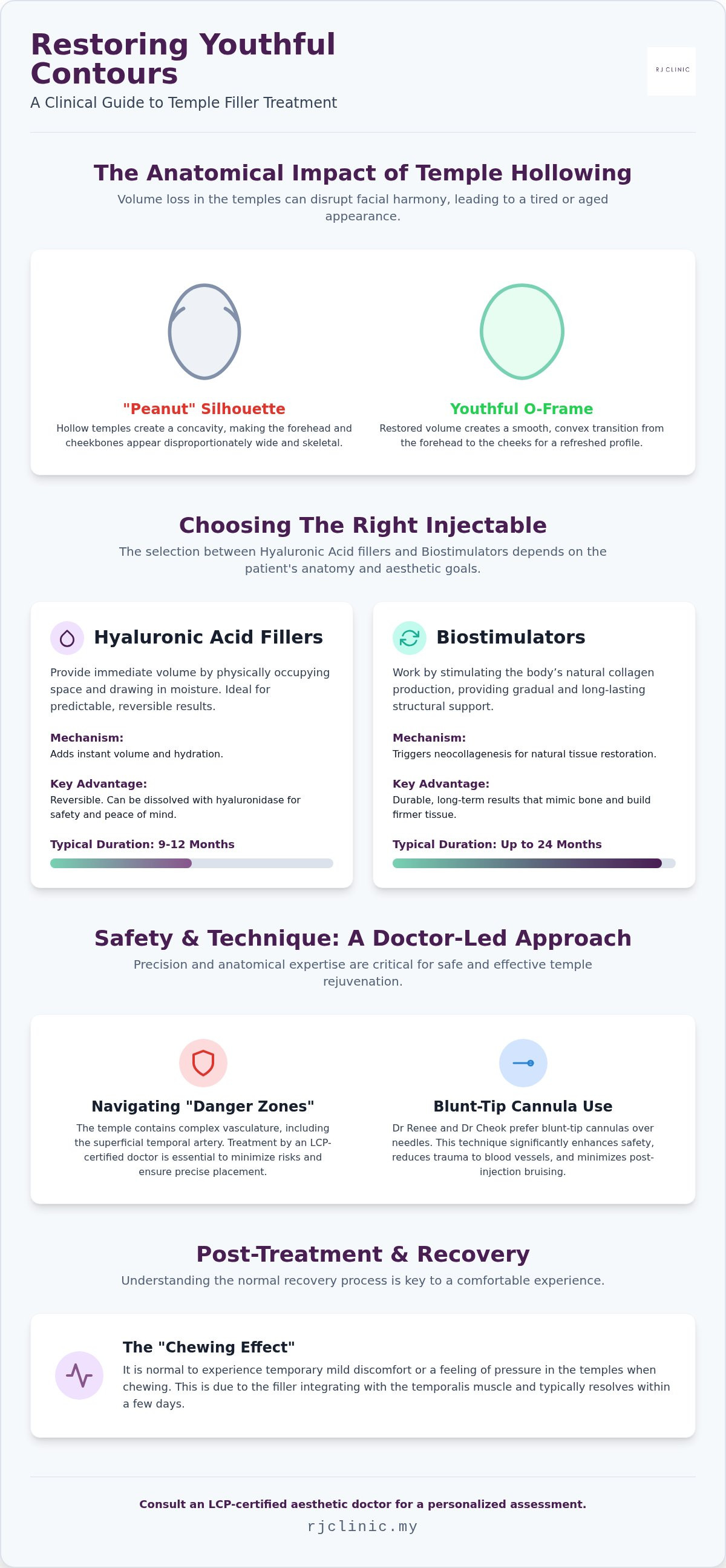
The most significant indicator of facial aging is often not a visible wrinkle, but the structural collapse of the temples that creates a gaunt, "peanut-shaped" silhouette. In clinical practice, we find that the demand for temple filler Malaysia is driven by a desire to correct this hollowing, which can make the brow bone and cheekbones appear harsh and skeletal. This volume loss disrupts the smooth transition of the upper face, often making individuals look perpetually tired or sickly. While the goal is to restore a youthful, heart-shaped contour, many patients are rightly cautious about the vascular complexity of this specific region.
Achieving a natural result requires a sophisticated understanding of deep-plane anatomy to ensure both safety and aesthetic harmony. This clinical analysis explains how Dr Renee and Dr Cheok use precise techniques to restore volume while mitigating risks. We will examine the distinct roles of hyaluronic acid and biostimulators like Radiesse or Ellanse, providing you with the technical reasoning used to select the right material for your unique bone structure. You'll learn how a methodical, doctor-led approach can transform a hollowed appearance into a refreshed, organic-looking profile.
Table of Contents
The Clinical Anatomy of Temple Hollowing: More Than Just Aging
The temporal fossa is a shallow depression on the side of the skull that serves as a critical structural anchor for the upper and mid-face. In aesthetic medicine, we view this area as the "frame" of the face. When volume here is lost, the underlying bone structure becomes overly prominent, leading to what is clinically described as the "peanut head" deformity. This occurs when the mid-temple narrows, making the forehead and zygomatic arches (cheekbones) appear disproportionately wide, which gives the face a skeletal, gaunt appearance. For patients considering temple filler malaysia, recognizing this structural shift is the first step toward effective rejuvenation.
This hollowing isn't a surface-level skin issue; temple hollowing is a multi-layered depletion of bone, muscle, and fat. Specifically, fat pad atrophy, bone resorption, and the thinning of the temporalis muscle all contribute to the loss of support. Because these changes happen deep within the facial architecture, topical creams are fundamentally incapable of addressing the concern. Only a targeted injectable filler can physically replace this lost volume and restore the smooth transition from the forehead to the cheeks.
The Impact on Facial Harmony and the Lateral Brow
Temple hollowing does more than just create a shadow. It directly affects the position of the lateral brow. As the underlying support for the skin disappears, the tail of the eyebrow often begins to droop, creating a look of persistent fatigue. Dr Renee and Dr Cheok frequently observe that patients come in complaining of sagging cheeks or heavy eyelids, when the root cause is actually the loss of the "temple pillar." Restoring this volume helps re-establish the youthful V-shape facial contour and provides a subtle, organic-looking lift to the outer eye area.
Identifying the Degree of Hollowing
Clinical assessment at RJ Clinic involves evaluating the temple silhouette against the surrounding bony landmarks. A youthful temple is typically straight or slightly convex. Once it becomes concave, the degree of hollowing is classified as mild, moderate, or severe. In cases of mild depletion, a single syringe of dermal fillers might suffice to bridge the gap. However, for significant bone resorption or muscle thinning, Dr Renee and Dr Cheok find that multiple syringes or specific biostimulators may be required to achieve a visible, lasting correction that looks natural from every angle.
Choosing the Injectable Material: HA Fillers vs. Biostimulators
The choice of material for temple filler malaysia depends largely on the depth of the hollowing and your long-term aesthetic goals. Because the temple is a high-pressure area covered by the temporalis muscle, the injectable must possess high structural integrity. Soft, thin gels often dissipate too quickly or fail to provide the necessary projection. Instead, we prioritize materials with high "G-prime", which is a clinical measure of a filler's stiffness, to mimic the underlying bone and provide a visible lift to the lateral face.
Hyaluronic Acid Options: Juvederm and Belotero
Hyaluronic Acid (HA) remains the gold standard for many first-time patients. These Dermal Fillers offer immediate volumization and high levels of tissue hydration. We often select high-cohesivity options from the Juvederm or Belotero ranges because they integrate seamlessly into the deep tissue layers without migrating. A significant advantage of using FDA-approved dermal fillers based on HA is their reversibility. If a patient feels the result is too prominent, the material can be dissolved with hyaluronidase. This provides a safety net that biostimulators don't offer. Results typically last between 9 to 12 months in this relatively static area of the face.
Long-term Restoration: Ellanse and Radiesse
For patients seeking more durable results, biostimulators offer a different clinical logic. Unlike HA, which simply occupies space, Ellanse acts as a bio-resorbable scaffold that triggers your body's own collagen production. This results in a firmer, more structural feel that can last up to two years. Similarly, Radiesse, which is composed of calcium hydroxylapatite microspheres, is exceptionally effective at mimicking bone support. These materials are non-reversible. Consequently, they require the high-level expertise of LCP-certified doctors like Dr Renee and Dr Cheok to ensure precise placement from the start.
The trade-off between HA and biostimulators usually comes down to the balance of longevity versus immediate flexibility. If you're unsure which material suits your facial structure, a personalized clinical assessment can help determine the most appropriate viscosity for your specific anatomical needs.
Safety and Technique: Navigating the Temple Danger Zones
The temple is clinically regarded as a high-risk region due to the presence of the superficial temporal artery and its intricate branches. A profound understanding of anatomical considerations for temple fillers is vital to avoid vascular complications. Dr Renee and Dr Cheok typically prioritize patient safety by employing specific injection techniques tailored to the individual's vascular map. For most temple filler malaysia procedures, we prefer using blunt-tip cannulas rather than sharp needles. Cannulas glide through the tissue layers and are significantly less likely to pierce blood vessels, which reduces the risk of bruising and intravascular injection.
The depth of placement is equally critical. We often utilize a "one-point" deep injection technique, where the material is placed directly onto the bone (periosteum) to provide maximum structural lift. Alternatively, a more superficial fanning technique may be used to smooth out surface-level hollows. The choice between these methods depends on whether the patient's gauntness is primarily due to bone resorption or the atrophy of the overlying fat pads.
The Role of LCP-Certified Doctors
In Malaysia, choosing an LCP-certified physician is a non-negotiable safety standard for high-risk aesthetic procedures. This certification ensures the doctor has met the Ministry of Health's rigorous requirements for competency and safety. Medical doctors can manage potential complications immediately with hyaluronidase; this is a luxury of safety that non-medical practitioners cannot provide. This clinical oversight is essential when integrating temple restoration into a broader plan for facial balancing, such as Face Slimming in KL, to ensure the upper face remains in proportion with the jawline.
What to Expect During the Procedure
We manage discomfort through a combination of topical anesthetic creams and fillers that contain lidocaine for internal numbing. You'll likely experience a distinct "pressure" or "crunching" sensation during the injection. This is a normal physical response as the filler is placed near the temporalis muscle. Temple fillers are often a "silent" treatment. The results are obvious, but the filler itself is impalpable once it has integrated into the tissue. After the procedure, you can immediately observe a smoother transition from the forehead to the cheekbones.
To ensure your treatment is performed with the highest medical standards, book a consultation with our LCP-certified doctors to discuss a personalized safety plan.
Recovery, Results, and Long-term Upper Face Rejuvenation
Post-treatment recovery for temple filler malaysia is generally straightforward, though it involves specific sensations unique to this anatomical region. Immediately following the procedure, you may experience a feeling of "fullness" or tightness at the sides of your head. Minor swelling and bruising are common, particularly if a needle was used for deep placement. One clinical observation we frequently share with patients is the "chewing effect." Because the filler is placed in close proximity to the temporalis muscle, you might feel temporary discomfort or a dull ache when eating or clenching your jaw. This usually subsides within a few days as the material integrates into the tissue.
The final aesthetic result is best evaluated at the two-week mark. This timeline allows any initial edema to resolve and the filler to settle into its definitive position. While the volumizing effect is immediate, the secondary benefit of skin hydration (in HA fillers) or collagen stimulation (in biostimulators) becomes more apparent as the weeks progress. We always schedule a follow-up session to assess symmetry, as the temples are rarely perfectly symmetrical by nature.
Aftercare in the Malaysian Climate
The tropical humidity and heat in Malaysia require diligent aftercare to ensure optimal results. We advise patients to avoid prolonged sun exposure and high-temperature environments, such as saunas or steam rooms, for at least one week. Heat can exacerbate swelling and potentially interfere with the initial settling of the filler. To prevent migration and ensure that your temple filler malaysia results remain stable, you should avoid vigorous exercise or heavy lifting for the first 48 hours. Consistent use of sun protection is also vital to prevent post-inflammatory hyperpigmentation at the injection sites.
Synergy with Other Treatments
For a comprehensive upper face lift, temple fillers are often combined with Ultherapy. While fillers address structural volume loss, Ultherapy focuses on tightening the overlying skin and lifting the brow line through focused ultrasound energy. This combination addresses both the "hollow" and the "sag," creating a more youthful, rested appearance. Dr Renee and Dr Cheok often recommend treating the forehead and brow area simultaneously to ensure a seamless transition across the entire upper third of the face. Our final clinical advice is always rooted in moderation; subtle enhancement that respects your natural bone structure is invariably superior to over-correction, which can lead to an unnaturally wide upper face.
Restoring Balance through Structural Rejuvenation
Correcting temple hollowing is about more than filling a gap; it's about restoring the structural integrity of your facial frame. By addressing the multi-layered loss of bone and fat, we can eliminate the "peanut-shaped" silhouette and provide a subtle, organic-looking lift to the lateral brow. Whether you opt for the immediate reversibility of hyaluronic acid or the long-term collagen stimulation of biostimulators, the success of your temple filler malaysia treatment depends on anatomical precision and clinical expertise.
At RJ Clinic, we prioritize your safety by utilizing specialized cannula techniques and FDA-approved premium filler brands to navigate the complex vascular landscape of the temporal region. Our LCP-certified medical aesthetic doctors, Dr Renee and Dr Cheok, focus on creating a smooth, balanced transition that enhances your natural features without over-correction. Achieving a refreshed, youthful appearance starts with a thorough understanding of your unique facial architecture. We invite you to consult Dr Renee or Dr Cheok for a personalised temple assessment at RJ Clinic. Taking this step ensures your journey toward facial rejuvenation is grounded in medical excellence and meticulous care.
Common Questions Regarding Temple Rejuvenation
Is temple filler painful compared to other facial fillers?
Temple fillers are generally well-tolerated and often described as a sensation of "pressure" rather than sharp pain. We apply a high-strength topical numbing cream before the procedure, and most premium fillers contain lidocaine to ensure internal comfort. Because the injection is performed in deeper tissue layers with fewer sensory nerves than the lips or nose, many patients find the process surprisingly comfortable. You may simply hear a slight "crunching" sound during the placement.
How many syringes of filler are typically needed for hollow temples?
Most patients require one to two syringes in total to see a visible improvement in facial proportions. For mild hollowing, a single 1ml syringe shared between both sides may suffice for a subtle transition. However, significant volume loss often requires one full syringe per side to properly restore a smooth, convex silhouette. During your consultation for temple filler malaysia in our KL clinics, Dr Renee or Dr Cheok will provide a precise estimate based on your anatomy.
Can temple fillers cause blindness, and how is this risk mitigated?
While vascular complications are a documented risk in aesthetic medicine, the likelihood of such an event is extremely low when treated by LCP-certified doctors. We mitigate these risks by using blunt-tip cannulas, which glide around blood vessels rather than piercing them. Our doctors also utilize deep-plane injection techniques, placing the material far below the superficial temporal artery. At RJ Clinic, we always have hyaluronidase on standby to immediately manage any rare vascular concerns.
Will temple fillers make my face look wider?
No, correctly placed temple fillers will not make your face look wider; instead, they restore a balanced, heart-shaped contour. Hollowing actually makes the forehead and cheekbones look disproportionately sharp, creating a skeletal appearance. By filling the "dip" between these two points, we create a smoother, more youthful line that frames the face properly. Dr Renee and Dr Cheok focus on subtle enhancement to ensure the upper face remains in perfect proportion with the mid-face.
How long does the swelling last after temple filler injections?
Minor swelling typically peaks within 48 hours and resolves almost completely within five days. Because the temple is a relatively static area, bruising is usually minimal, particularly when we use a cannula technique. You might experience a dull ache or tightness when chewing for the first few days, which is a normal response as the filler integrates near the temporalis muscle. We recommend avoiding high-heat environments in Kuala Lumpur, like saunas, during this initial settling period.
Can I combine temple fillers with Botox for a brow lift?
Yes, combining temple filler malaysia with Botox is a highly effective strategy for a comprehensive, non-surgical brow lift. While the filler provides the structural volume needed to support and "lift" the tail of the eyebrow, Botox works by relaxing the muscles that pull the brow downward. This dual-action approach results in a more open, refreshed eye area. Many of our patients in Mont Kiara and Bangsar choose this combination to address both volume loss and dynamic wrinkles.



Comments