


Ellansé vs Hyaluronic Acid Filler: Collagen, Volume and Reversibility

Updated: 5 days ago
What if the key to a natural, youthful contour isn't found in how much filler we inject, but in how your skin is encouraged to rebuild its own foundation? In our Kuala Lumpur practice, the debate of Ellanse vs hyaluronic acid filler often starts with a simple question about longevity, but the clinical reality involves a much deeper look at your facial anatomy and long-term aesthetic goals. It's understandable to feel caught between the immediate flexibility of a reversible gel and the enduring, structural benefits of a collagen stimulator.
You likely want the reassurance that your results will look like you, only refreshed, without the anxiety of an overfilled appearance. We'll provide a clinical comparison to help you understand the structural and biological differences between these two distinct technologies. We will examine how Polycaprolactone (PCL) microspheres and Hyaluronic Acid (HA) interact with your tissue, covering the safety implications of reversibility and the specific anatomical zones where Dr Renee and Dr Cheok utilise each technology to achieve a sophisticated, natural-looking result.
Table of Contents
Composition and Mechanism: How PCL Microspheres Differ from Hyaluronic Acid
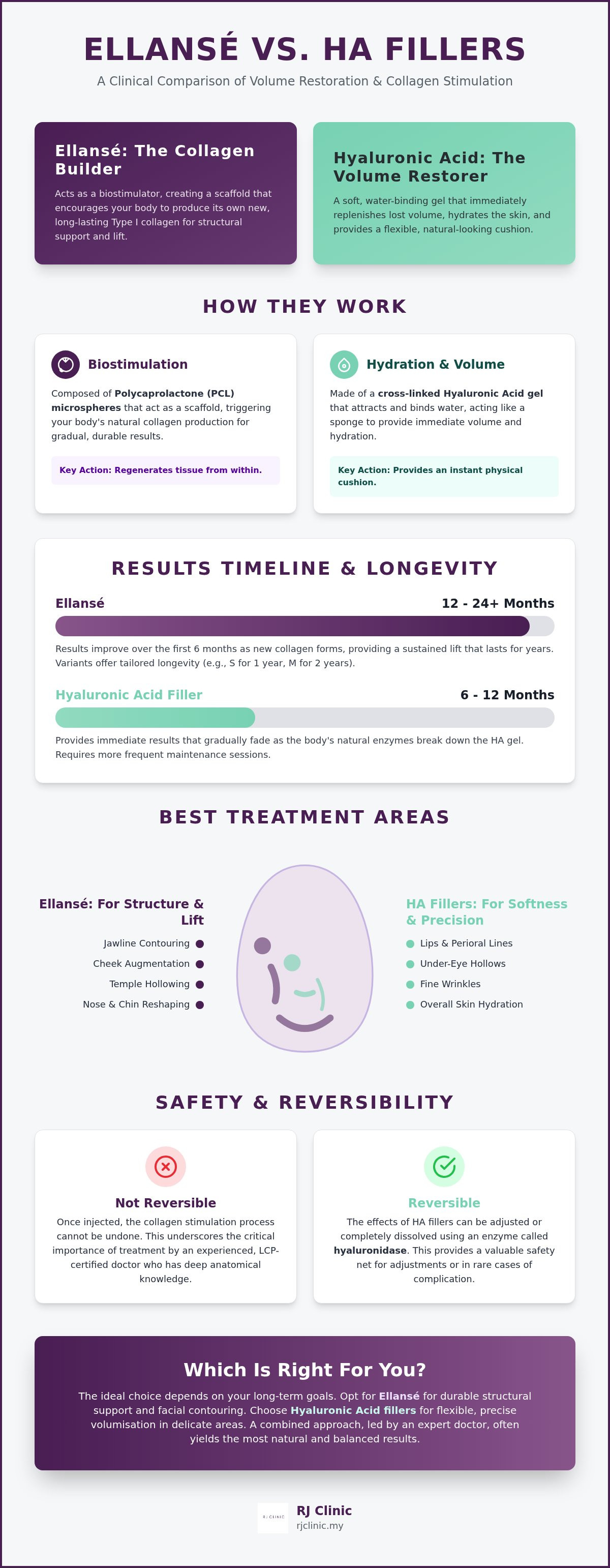
Understanding the chemical profile of Ellanse vs hyaluronic acid filler is the first step in deciding which treatment aligns with your skin's needs. While both are used to restore volume, they function through entirely different biological pathways. One provides a temporary physical cushion, while the other acts as a catalyst for your body's own regenerative capabilities.
Hyaluronic Acid (HA) is a naturally occurring sugar molecule found within your skin that acts as a hydrophilic sponge. It attracts and binds water molecules to create immediate hydration and volume. In contrast, Ellansé is composed of Polycaprolactone (PCL) microspheres suspended in a carboxymethyl cellulose (CMC) gel carrier. This combination offers a dual-action result: the CMC gel provides an immediate lift, while the PCL microspheres begin the longer process of collagen induction. Biostimulation is the body's natural regenerative response to PCL microspheres.
Hyaluronic Acid: The Gold Standard for Hydration
Modern dermal fillers utilise sophisticated cross-linking technology to transform liquid HA into a stable gel. This process determines the filler's "rheology," or how it flows and resists deformation under pressure. Because HA is soft and pliable, it remains the preferred choice for areas requiring high mobility and a delicate touch, such as the lips or the fine lines around the mouth. Beyond simple volumisation, HA significantly improves skin quality by maintaining moisture retention in the dermis, resulting in a dewy and refreshed complexion that looks entirely natural.
Ellansé: The Architecture of Collagen Stimulation
Ellansé is often categorised as a biostimulator rather than a traditional filler because its primary goal is structural regeneration. The PCL microspheres act as a microscopic scaffold that encourages the skin to produce new Type I collagen. As the microspheres undergo bio-resorption, the body gradually replaces the synthetic material with its own healthy tissue. This transition ensures that the volume stays even after the original gel has dissipated. For patients seeking a firmer, more lifted facial contour without the need for frequent touch-ups, this internal "re-architecture" provides a durable foundation that HA simply cannot match.
Longevity and the Regenerative Timeline: Beyond the 12-Month Cycle
The endurance of your results is often the deciding factor when comparing Ellanse vs hyaluronic acid filler. While both provide aesthetic refinement, their lifespans follow very different trajectories. HA fillers offer immediate gratification but rely on a gel that the body naturally absorbs over time. In contrast, Ellansé initiates a biological process that builds a lasting foundation within the skin's layers.
Why Hyaluronic Acid Requires More Frequent Maintenance
Standard HA fillers typically maintain their visible effect for 6 to 12 months. This timeline is dictated by the body's natural production of hyaluronidase, an enzyme that gradually dissolves the HA gel. Clinical observations in our Kuala Lumpur practice show that local factors can accelerate this process. Patients with high metabolic rates or those who frequent high-heat environments, common in the Malaysian climate, often see faster degradation. Facial movement also plays a significant role; areas with high kinetic activity, such as the mouth, tend to process filler more quickly than static areas like the temples or jawline.
The Sustained Impact of Biostimulation
Ellansé operates on a more predictable timeline by offering specific variants like Ellansé S, which lasts up to 1 year, and Ellansé M, which provides results for up to 2 years. Unlike HA, which peaks at injection and slowly fades, Ellansé results often look better at 6 months than at day one due to peak collagen production. This "long-tail" benefit means that even as the PCL microspheres are resorbed, the new Type I collagen remains, improving skin elasticity long-term.
This structural support is particularly effective for face slimming, as it provides a firm lift that resists the "sagging" effect sometimes seen as HA fillers lose their volume. While the longevity is a major advantage, safety remains our priority. A retrospective study on PCL filler complications highlights the importance of precise placement to ensure these long-lasting results remain smooth and natural. If you're looking for a more permanent structural change, discussing these timelines with Dr Renee or Dr Cheok can help you decide which variant suits your specific goals.
Clinical Indications: Strategic Application for Face Contouring and Slimming
Selecting between Ellanse vs hyaluronic acid filler isn't a matter of which product is superior; it's about which one possesses the correct physical properties for the specific anatomical layer. Dr Renee and Dr Cheok use a concept called rheology, the study of how a material flows and resists deformation, to determine suitability for each patient. For superficial layers or high-movement zones, a soft and pliable gel is necessary. For deep structural support against bone, a more robust material that stimulates tissue growth is often more effective.
Where Hyaluronic Acid Excels: Lips, Under-eyes, and Fine Lines
In regions where the skin is exceptionally thin or the anatomy is complex, the safety profile of dermal fillers made from HA is unmatched. The tear trough area, for instance, requires a material that can be instantly reversed if needed. HA fillers act as soft cushions, providing the hydration and delicate volumisation required for natural lip augmentation without a rigid feel. Low-viscosity HA variants also function as skin boosters, improving surface texture and fine lines by drawing moisture directly into the upper dermis.
Where Ellansé Outperforms: Temples, Cheeks, and Jawlines
When the goal is a liquid facelift or a sharper V-shape profile, Ellansé provides a distinct advantage. It offers deep structural lifting that resists the heavy or puffy appearance sometimes associated with large volumes of HA. For temple filler, PCL microspheres provide a firm scaffold that maintains its position without migrating. This makes it ideal for projecting the chin and defining the jawline, creating a contour that remains sharp and resists sagging over time. When evaluating Ellanse vs hyaluronic acid filler for a sharper jawline profile, the choice often comes down to the desired longevity and the need for structural rigidity.
Dr Renee and Dr Cheok frequently employ a hybrid approach, using Ellansé for the foundational bone-deep lift and HA for refined surface-level smoothing. This bespoke methodology ensures that your facial architecture is restored from the inside out. If you are ready to explore a personalised contouring plan, you can book a face slimming consultation to discuss which technology best suits your unique features.
Reversibility and Risk Management: Navigating the Safety Profiles
One of the most frequent points of discussion regarding Ellanse vs hyaluronic acid filler is what happens if you change your mind or if the result needs adjustment. Hyaluronic acid fillers are often described as having a built-in "safety net" because they are reversible. If a patient is dissatisfied or if a rare complication occurs, we can inject an enzyme called hyaluronidase to dissolve the gel almost instantly. This provides a significant level of reassurance, especially for those treating sensitive areas like the lips or under-eyes for the first time.
Ellansé requires a different clinical perspective. While Ellansé is non-reversible, it is fully bio-resorbable and biocompatible. This means that although we cannot "undo" the injection with a secondary enzyme, the material is not permanent. Your body naturally processes and resorbs the PCL microspheres over your chosen timeline, whether that is one or two years, replacing them with your own natural collagen foundation. Safety in this context is managed through preventative precision rather than reactive reversal.
Managing Expectations with Non-Reversible Fillers
Because biostimulators cannot be dissolved, Dr Renee and Dr Cheok utilise a "conservative first" approach to every treatment. This process begins with meticulous facial mapping during your consultation to identify the exact vectors that require support. We often find it's better to under-correct initially, as the collagen-stimulating effects of Ellansé will continue to develop and peak around the six-month mark. It is vital to remember that non-reversible does not mean permanent; it simply means the results are designed to be stable and long-lasting, requiring the body to resorb them at a natural, biological pace.
Choosing Your Injector: The Ultimate Safety Factor
In Malaysia, the benchmark for safety in aesthetic medicine is the Letter of Credentialing and Privileging (LCP) certification. Choosing an LCP-certified doctor ensures that your practitioner possesses the advanced anatomical knowledge required to perform deep-plane injections safely. Technical precision is the most effective way to avoid complications, such as vascular compromise, which is why we prioritise placement in the correct tissue layers. For some patients, we may recommend a multi-modality plan where Ultherapy is used to tighten the skin foundation first. This allows us to use less filler overall to achieve the desired lift, further enhancing the safety and subtlety of the final outcome.
Refining Your Path to Natural Facial Restoration
Choosing between Ellanse vs hyaluronic acid filler is ultimately a decision about your long-term aesthetic vision. While HA fillers provide the flexibility of immediate, reversible hydration, Ellansé offers a unique opportunity to rebuild your skin's internal architecture through sustained collagen production. The most successful outcomes aren't determined by the product alone, but by a strategic, anatomical approach that matches the right technology to your specific facial vectors.
At RJ Clinic, Dr Renee and Dr Cheok prioritise a philosophy of subtle enhancement, ensuring that every treatment plan is as unique as your own features. By utilising FDA-approved and CE-marked technologies, our LCP-certified practitioners bridge the gap between clinical safety and artistic refinement. Whether you seek the soft volumisation of HA or the enduring lift of a biostimulator, the goal remains a refreshed version of yourself that feels entirely organic.
We invite you to schedule a clinical consultation with Dr Renee or Dr Cheok to discuss your facial contouring options. Taking this professional step allows us to design a custom roadmap for your facial rejuvenation, ensuring results that are both safe and sophisticated.
Frequently Asked Questions
Can Ellansé be dissolved if I am unhappy with the result?
No, Ellansé cannot be dissolved with an enzyme like hyaluronidase. Unlike the reversible nature of the Ellanse vs hyaluronic acid filler comparison, Ellansé is a biostimulator that stays until your body naturally resorbs the PCL microspheres. Because it isn't reversible, Dr Renee and Dr Cheok prioritise a conservative approach during your initial treatment. This highlights why choosing an LCP-certified doctor in Kuala Lumpur is essential for managing your aesthetic outcome safely.
Which filler is better for a non-surgical nose job or chin augmentation?
Ellansé is frequently the preferred choice for chin augmentation and non-surgical nose reshaping due to its superior structural integrity. Its firm composition provides the necessary projection and bone-like support that soft HA fillers sometimes lack. While HA is excellent for precision, the biostimulating properties of Ellansé ensure your new profile remains sharp and defined for a longer duration; it effectively resists the spreading effect that can occur with softer gels.
Is there more downtime with Ellansé compared to Hyaluronic Acid fillers?
The downtime for both treatments is remarkably similar, involving minor swelling or potential bruising at the injection sites. You can typically resume your daily activities in Mont Kiara or Bangsar immediately after the procedure. Some patients might experience slightly more initial redness with Ellansé as the biostimulation process begins. We recommend avoiding strenuous exercise and high-heat environments like saunas for the first 24 to 48 hours to ensure optimal settling.
Can I have Ellansé injected if I already have HA fillers in the same area?
It is possible to have Ellansé injected in an area previously treated with HA, provided the previous filler has settled or mostly resorbed. In some cases, we might recommend dissolving the old HA filler first to create a clean foundation for the biostimulator. Dr Renee and Dr Cheok often use a hybrid technique, using Ellansé for deep structural support and HA for fine-tuning surface textures, ensuring a layered and natural-looking result.
Is Ellansé more expensive than traditional dermal fillers in Malaysia?
When evaluating the cost of Ellanse vs hyaluronic acid filler in Malaysia, it's important to look at the value over time. While the initial investment for a syringe of Ellansé may be higher than a standard HA filler, its longevity often makes it more economical. Since results last between one to two years, you require fewer maintenance visits compared to the six to twelve month cycle typical of most hyaluronic acid treatments.
Who is the ideal candidate for a biostimulator like Ellansé?
The ideal candidate is someone seeking long-term volume restoration and improved skin quality without the frequent need for touch-ups. If you are looking for a natural-looking lift in the cheeks, temples, or jawline and are comfortable with a non-reversible treatment, a biostimulator is an excellent option. It's particularly suited for patients in their 30s and beyond who are beginning to notice structural sagging and want to stimulate their own collagen naturally.


Comments