


Skin Tightening Laser Price in TTDI: A Clinical Perspective on Technology and Value


Why does one aesthetic clinic charge four times more than another for what appears to be the same treatment? When you're researching the skin tightening laser price ttdi, it's easy to feel overwhelmed by a sea of acronyms like RF, Ultherapy Prime, and various laser technologies. Many patients assume they're paying for the neighborhood or the clinic's decor, but the reality is far more clinical. The price usually reflects the precision of the energy delivered, the authenticity of the medical consumables, and the specialized skill of the LCP certified doctor performing the procedure.
It's completely normal to feel anxious about overpaying or, worse, compromising your safety for a deal that sounds too good to be true. You want a lifted, natural appearance without the risks associated with unverified equipment. In this guide, we'll break down the clinical variables that dictate treatment costs and explain why certain technologies offer superior long-term value. We'll examine how Dr Renee and Dr Cheok approach skin laxity to ensure you invest in a procedure that delivers subtle, medically backed results rather than just a temporary fix.
Key Takeaways
Learn why "laser" is often a misnomer for skin lifting and how to identify the specific technologies that target deep structural layers for genuine rejuvenation.
Understand the clinical variables, including medical-grade consumables and anatomical complexity, that determine the skin tightening laser price ttdi.
Evaluate the distinct roles of Ultherapy Prime and Potenza RF to determine which modality best addresses your concerns, from structural jawline contouring to surface texture improvement.
Discover why prioritizing LCP-certified physicians like Dr Renee and Dr Cheok is essential for achieving safe, natural-looking results in the competitive TTDI landscape.
Table of Contents
Why Laser Skin Tightening is Often a Misnomer
Patients often enter our consultation rooms asking for "laser skin tightening" because the term has become a ubiquitous marketing shorthand. However, from a clinical perspective, a laser is a light-based device primarily designed to address surface concerns like pigmentation, pore size, or fine texture. If your goal is to lift a sagging jawline or reduce the appearance of jowls, a traditional laser might not be the tool you actually need. This confusion over terminology often complicates the search for a transparent skin tightening laser price ttdi, as patients frequently find themselves comparing the costs of surface-level treatments with deep-tissue lifting procedures that involve entirely different technologies.
While a surgical facelift, technically known as a rhytidectomy, remains the definitive solution for severe skin laxity, modern energy-based devices offer a sophisticated middle ground for those seeking subtle, natural-looking enhancement without the downtime of surgery. These non-surgical options typically rely on ultrasound or radiofrequency energy rather than light to reach the structural layers of the face. Understanding which layer of your skin needs attention is the first step in determining which technology is right for you.
Light vs. Sound vs. Radiofrequency
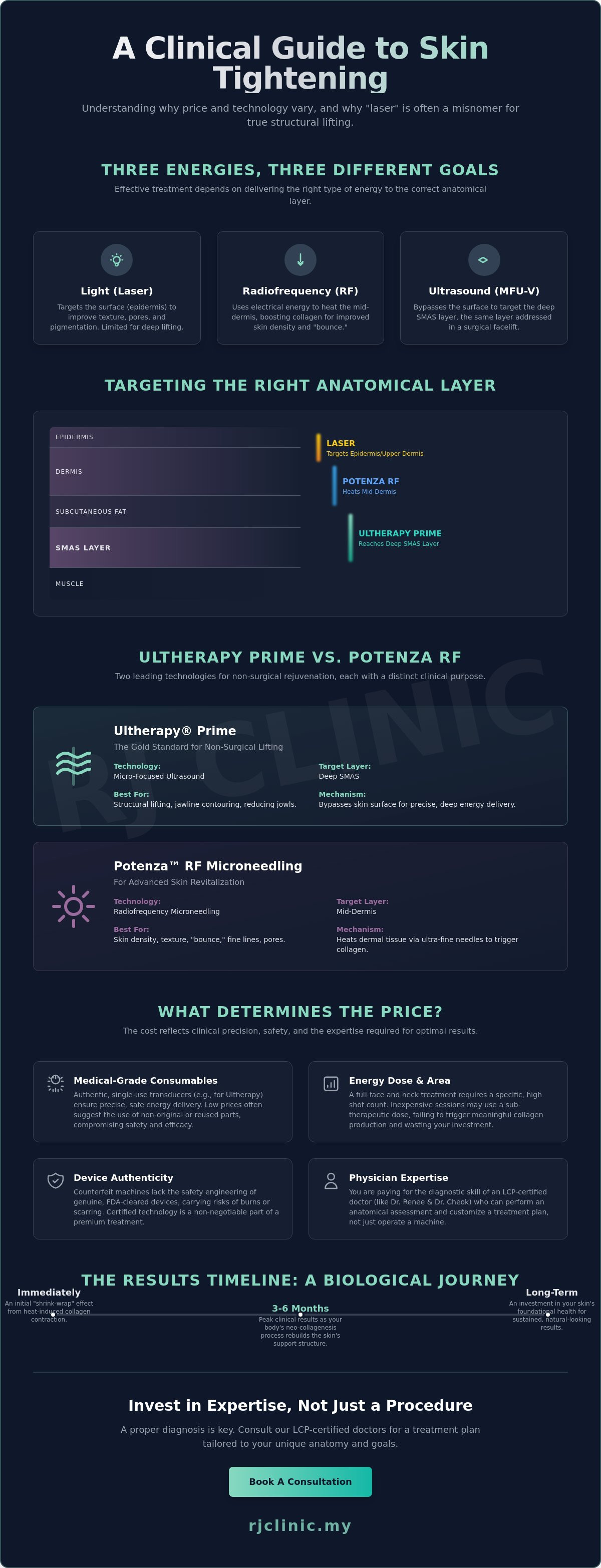
To choose the right treatment, you must understand how different energies interact with your anatomy. Lasers focus on the epidermis and upper dermis, making them excellent for a "glowing" finish but limited in their lifting capacity. In contrast, Micro-Focused Ultrasound, the technology utilized in Ultherapy Prime, bypasses the skin's surface entirely to reach the SMAS (Superficial Musculoaponeurotic System). This is the same deep fibrous layer that surgeons tighten during a rhytidectomy. Radiofrequency (RF) devices, such as Potenza RF Microneedling, use electrical energy to heat the mid-dermis, stimulating collagen to improve skin density and "bounce."
The Role of Collagen Stimulation
Real structural lifting isn't an overnight event; it's a biological journey. The process, known as neo-collagenesis, involves your body building new structural proteins in response to controlled thermal energy. While you might notice an immediate "shrink-wrap" effect due to temporary heat-induced collagen contraction, the true clinical result typically peaks between three to six months. We find that the most successful outcomes occur when patients understand that they are investing in long-term skin health. When evaluating the skin tightening laser price ttdi, it's vital to consider whether the procedure is simply refreshing the surface or fundamentally rebuilding your skin's internal support structure.
Decoding Skin Tightening Laser Price in TTDI
When patients compare the skin tightening laser price ttdi across various clinics, they often notice a wide discrepancy. This isn't arbitrary. In a clinical setting, the cost is largely dictated by the "consumable" factor. For instance, medical-grade systems like Ultherapy Prime utilize sophisticated transducers that are single-use and programmed for a specific number of shots. These components ensure that every pulse of energy is precise and safe. When a clinic offers a price that seems significantly lower than the market average, it often suggests a compromise on these essential components or the use of non-original parts.
The complexity of the treatment area also plays a major role in the final investment. Treating the full face and neck requires a higher energy density and a greater shot count compared to focusing solely on the lower face. A session that appears inexpensive often achieves its low price point by delivering a sub-therapeutic dose of energy. If the shot count is too low, the biological trigger for collagen production isn't sufficiently activated, leading to disappointing results and a poor return on investment.
There is also the critical issue of device authenticity. The aesthetic market has seen an influx of counterfeit machines that mimic the appearance of premium brands but lack the engineering to control heat depth. Using non-certified devices carries risks of thermal burns or irregular scarring. According to an FDA Safety Communication, even legitimate technologies like RF microneedling require careful clinical oversight to manage potential risks. Choosing a clinic that prioritizes certified technology ensures your safety isn't sacrificed for a discount.
What You Are Paying For in a Premium Clinic
Beyond the device, you're investing in the expertise of LCP-certified doctors like Dr Renee or Dr Cheok. They perform detailed anatomical assessments to identify whether your concerns stem from skin laxity, fat loss, or muscle changes. This diagnostic step is crucial; it determines the exact depth and intensity needed for your unique face. Premium clinics also provide real-time imaging during procedures to visualize the tissue layers being treated, ensuring the energy hits the target layer every single time.
The Investment vs. Maintenance Logic
It's helpful to view these treatments through the lens of long-term value rather than a one-time expense. High-intensity procedures like Ultherapy Prime usually require only a single session every 12 to 18 months to maintain a lifted appearance. Conversely, lower-intensity radiofrequency treatments might require a series of three to six sessions to achieve comparable structural changes. While the initial skin tightening laser price ttdi for a premium session is higher, the annual cost often balances out when you factor in the reduced frequency of visits and the superior outcome. If you're unsure which technology aligns with your goals, a personalized skin assessment can clarify the most cost-effective path for your specific skin type.
Ultherapy Prime vs. Potenza RF: Choosing the Right Modality
Deciding between ultrasound and radiofrequency is rarely a matter of which technology is "better" in a vacuum. Instead, it depends on whether your aesthetic goal is structural lifting or dermal densification. While the skin tightening laser price ttdi often influences a patient's initial inquiry, the clinical decision should rest on your specific skin laxity grade. If we're addressing a heavy jawline or sagging jowls, we must reach the structural foundation of the face. If the concern is "crepey" skin or enlarged pores, we focus our energy on the mid-to-surface layers.
Targeting the SMAS Layer with Ultherapy
Ultherapy Prime stands as the clinical gold standard for non-invasive lifting because it targets the Superficial Musculoaponeurotic System (SMAS). This is the deep tissue layer that provides the framework for your entire face. One of the most critical safety features of this technology is real-time ultrasound imaging. This allows Dr Renee or Dr Cheok to see exactly where the energy is being delivered, ensuring it bypasses nerves and bone to hit the collagen-rich SMAS precisely. For patients specifically looking for Ultherapy in Kuala Lumpur, this visualization is what justifies the investment over less sophisticated alternatives that lack a visual guide.
Skin Density and Texture with Potenza
When the primary issue is skin quality and "bounce" rather than deep structural sagging, Potenza RF Microneedling offers a distinct advantage. By combining ultrafine microneedling with bipolar and monopolar radiofrequency, this device creates a "shrink-wrap" effect on the skin's surface. It's particularly effective for the fine, crepey texture and widened pores that ultrasound alone might miss. In our practice, we often find that a patient's search for a skin tightening laser price ttdi leads them to discover that a combination approach is most effective. For instance, Dr Renee may recommend combining these modalities to achieve comprehensive face slimming, addressing both the deep structural lift and the surface refinement.
Downtime expectations vary between these two approaches. Ultherapy is virtually a "no-downtime" procedure; while internal healing and neo-collagenesis begin immediately, there's rarely any outward sign of treatment. Potenza may involve 24 to 48 hours of mild social downtime due to slight redness, which most patients find easily manageable. If you're ready to determine which modality aligns with your facial anatomy, you can schedule a personalized skin assessment to discuss your options.
Navigating the Aesthetic Landscape in TTDI
TTDI has established itself as a premier hub for aesthetic medicine in Kuala Lumpur, but the high density of clinics can make the decision process surprisingly difficult. While it's tempting to simply compare the skin tightening laser price ttdi and choose the most accessible option, clinic density doesn't always correlate with clinical quality. In Malaysia, the most critical trust signal you should look for is the LCP (Letter of Credentialing and Privileging) certification issued by the Ministry of Health. This ensures that your practitioner, such as Dr Renee or Dr Cheok, has the formal medical training required to operate high-energy devices safely and effectively.
Safety Standards and Physician Expertise
The primary risk with high-energy tightening treatments isn't just a lack of results; it's the potential for complications when anatomy isn't properly understood. One common concern in the clinical community is unintended facial fat loss. If a practitioner lacks deep anatomical knowledge, they might apply excessive heat to the wrong tissue layers, melting the essential fat pads that provide youthful volume. A custom-designed approach is the only way to avoid this. By assessing your unique bone structure and skin thickness, an LCP-certified doctor ensures that the energy stimulates collagen in the SMAS or dermis without compromising your facial contours.
You should also be wary of "one-size-fits-all" package deals that treat medical procedures like retail commodities. A professional clinic focuses on an individualized strategy rather than a predetermined number of sessions sold at a discount. During your consultation, ask the doctor how they verify machine authenticity and how they determine the specific energy density for your skin type. Authentic devices like Ultherapy Prime or Potenza require genuine, single-use consumables to maintain safety standards, which is a major factor in the legitimate skin tightening laser price ttdi.
Final Considerations Before Booking
Before committing to a procedure, take a moment to assess the clinic's environment and professional standards. The atmosphere should reflect clinical integrity and a commitment to patient care rather than a high-pressure sales environment. We believe that the most successful aesthetic interventions are those that produce subtle, organic-looking outcomes. The goal is never to look "done," but rather to look well-rested and naturally lifted. If you value a medically-backed approach that prioritizes your long-term skin health, the next logical step is booking a clinical assessment to receive a professional diagnosis tailored to your specific facial anatomy.
Investing in Your Skin’s Structural Future
Selecting the right treatment involves looking past marketing labels to understand the clinical logic of deep-tissue lifting versus surface refinement. You now know that the skin tightening laser price ttdi is fundamentally an investment in medical-grade precision, FDA-approved technology like Ultherapy Prime, and the specialized expertise of an LCP-certified physician. Whether you require structural lifting at the SMAS layer or a density boost through radiofrequency, the goal is always a result that feels organic and uniquely yours. Choosing a path based on anatomical needs rather than just equipment names ensures that your investment yields visible, long-lasting value.
At our boutique clinics in TTDI and KL, Dr Renee and Dr Cheok prioritize a custom-designed approach that respects your natural facial anatomy while maintaining the highest safety standards. We invite you to move beyond general research and receive a professional diagnosis tailored specifically to your skin's unique requirements. Schedule a clinical skin assessment with our LCP-certified doctors to begin your journey toward a more refined and confident version of yourself. We look forward to partnering with you in your aesthetic care.
Frequently Asked Questions
Is the skin tightening laser price in TTDI inclusive of consultation fees?
Most medical aesthetic practices in the area treat the clinical consultation as a separate, essential diagnostic step. While the skin tightening laser price ttdi typically refers to the procedure itself, your initial assessment with Dr Renee or Dr Cheok involves a detailed anatomical review to ensure you're a suitable candidate. It's common for clinics to charge a separate fee for this professional expertise, though some may offer to deduct it from the final cost of your treatment plan.
How many sessions of laser skin tightening are usually required?
The number of sessions depends on the specific technology used and the degree of skin laxity being addressed. High-intensity treatments like Ultherapy Prime are generally designed as a single annual session because they target the deep structural layers of the face. Conversely, radiofrequency-based treatments often require a cumulative approach, usually involving a series of three to six sessions spaced several weeks apart to achieve a significant improvement in skin density and firmness.
Can I combine skin tightening with face slimming treatments?
Combining structural tightening with face slimming treatments is often the most effective way to achieve a contoured, youthful profile. Clinical experience shows that addressing skin laxity while simultaneously refining facial volume provides a more comprehensive result than either treatment alone. We frequently design custom plans that pair energy-based lifting with masseter injections or fat-reduction modalities to ensure the skin remains taut as the lower face becomes more streamlined.
What is the difference between Ultherapy and cheaper HIFU alternatives in TTDI?
The primary distinction is the presence of real-time ultrasound imaging, which is a hallmark of Ultherapy Prime. This technology allows the doctor to visualize the specific tissue layers being treated, ensuring energy is delivered precisely to the SMAS layer while avoiding nerves and bone. Many alternative ultrasound devices lack this visual guidance, which can lead to inconsistent results or increased safety risks. Choosing certified technology ensures you're paying for medical precision rather than just a generic energy delivery.
Is there any downtime for skin tightening lasers?
Most modern tightening procedures are considered "no-downtime" treatments that allow you to return to your normal activities immediately. You might notice some mild redness or slight swelling for a few hours following the procedure, but these effects are typically subtle and easily manageable. Because the treatment stimulates internal collagen production, there's no surface wounding or prolonged recovery period, making it an ideal option for those with busy professional schedules.
How long do the results of a skin tightening laser last?
You can generally expect the structural lifting and firming results to last between 12 and 18 months. Since the treatment triggers your body's natural collagen-building process, the longevity of the outcome is influenced by your individual biological response and natural aging rate. To maintain a consistently refreshed and lifted appearance, many patients schedule a maintenance session once every year to stay ahead of the gradual decline in skin elasticity.


Comments