


Face Filler vs Fat Reduction in KL: A Doctor’s Guide to Choosing Your Contour

Updated: May 4

Achieving a narrower, more contoured face often requires adding volume rather than taking it away. While it sounds counterintuitive, strategic placement of volume can frequently create a more refined, "lifted" appearance than fat removal alone. In our practice, we find many patients are caught in the debate of face filler vs fat reduction because they fear the "puffy" look or confuse fat reduction with fat grafting. It's a common concern for those navigating the high standards of beauty in Kuala Lumpur, where the desire for a slim profile must be balanced with the need for a natural, rested appearance.
You likely want a jawline that looks sharp and cheekbones that catch the light, but you're understandably cautious about downtime or looking "overdone." This guide clarifies the clinical differences between the structural support of fillers and the targeted removal of adipose tissue to help you make an informed decision for your aesthetic journey. We'll examine the science behind each method, the reality of recovery times in a local context, and how Dr Renee and Dr Cheok approach these treatments to ensure natural-looking symmetry and maximum safety.
Key Takeaways
Distinguish between age-related volume loss and genetic structural heaviness to determine if your facial profile requires lifting or slimming.
Evaluate the clinical mechanisms of face filler vs fat reduction, comparing the precision of hyaluronic acid for volume restoration against permanent fat cell removal.
Learn how the "Pinch Test" and skin laxity assessments prevent the common mistake of adding filler to a face that already carries excess structural weight.
Understand the role of 3D facial mapping in designing a bespoke treatment plan that prioritizes natural-looking facial harmony and long-term refinement.
Discover how Dr Renee and Dr Cheok balance medical science with Asian aesthetic ideals to achieve a sophisticated V-shape contour.
Table of Contents
Restoring or Refining? The Clinical Logic of Facial Contouring in Kuala Lumpur
Face Filler vs. Fat Reduction: A Breakdown of Mechanisms and Results
How to Decide: A Physician’s Framework for Facial Harmony
The Consultation: Designing Your Bespoke Treatment Plan
Restoring or Refining? The Clinical Logic of Facial Contouring in Kuala Lumpur
Patients often enter our clinic with a specific goal, such as achieving a slimmer jawline or looking less tired, but they're frequently unsure whether they need to add volume or take it away. The choice between face filler vs fat reduction isn't about which procedure is better in a general sense. It's about a clinical diagnosis of your facial anatomy. In our practice, we see a clear distinction between volume loss, which is the hallmark of aging, and structural heaviness, which is often tied to genetics or weight distribution. If we add filler to a face that's already heavy with fat, we risk creating an overfilled, unnatural look. Conversely, if we remove fat from a face that's actually hollow, we accelerate the appearance of aging.
In Malaysia, the 'V-Shape' ideal heavily dictates how we approach these treatments. This aesthetic prioritizes a wide, youthful upper face tapering down to a sharp, defined chin. Achieving this silhouette in the tropical KL climate presents unique challenges. High UV index levels and humidity can contribute to premature skin laxity. When skin loses its "snap," the fat pads in the cheeks begin to slide downward. This often leads patients to believe they've gained fat in their lower face, when they've actually just lost the structural support higher up. Our role is to determine if we need to "substract" the descended fat or "add" volume to pull the tissue back into its original position.
When to Add: The Case for Dermal Fillers
We recommend addition when the primary concern is a "skeletal" or tired appearance. This usually manifests as hollowing in the temples, deep tear troughs under the eyes, or a flat mid-face. Using an injectable filler allows us to mimic the density of bone or deep fat pads, providing an immediate lift that surgery often can't replicate with the same precision. This structural reinforcement is particularly effective for the central face. For instance, many patients find that combining mid-face restoration with nose filler and contouring creates a harmonious balance that makes the entire face appear more lifted and refreshed without a single incision.
When to Subtract: The Case for Fat Reduction
Subtraction becomes the priority when the lower face appears "bottom-heavy." This is common in cases of prominent jowls, a soft jawline, or a persistent double chin that doesn't respond to traditional weight loss. In these instances, adding filler would only increase the bulk. We instead focus on medical slimming techniques to reduce the volume of the buccal fat or submental area. By utilizing specialized face slimming treatments in KL, we can refine the jawline's edge. This process of subtraction reveals the underlying bone structure, providing a crispness to the profile that is essential for a truly contoured, athletic, or youthful appearance.
Face Filler vs. Fat Reduction: A Breakdown of Mechanisms and Results
Patients often enter our consultation rooms asking for a sharper jawline, assuming they need filler to "pull" the skin back. In reality, the decision between face filler vs fat reduction depends on whether the clinical concern is a lack of structural support or an excess of soft tissue. One adds volume to create highlights, while the other removes biological weight to reveal the underlying bone structure. Understanding how these mechanisms differ is the first step in avoiding an "overfilled" look that many patients in Kuala Lumpur fear.
Dermal Fillers: Precision and Instant Gratification
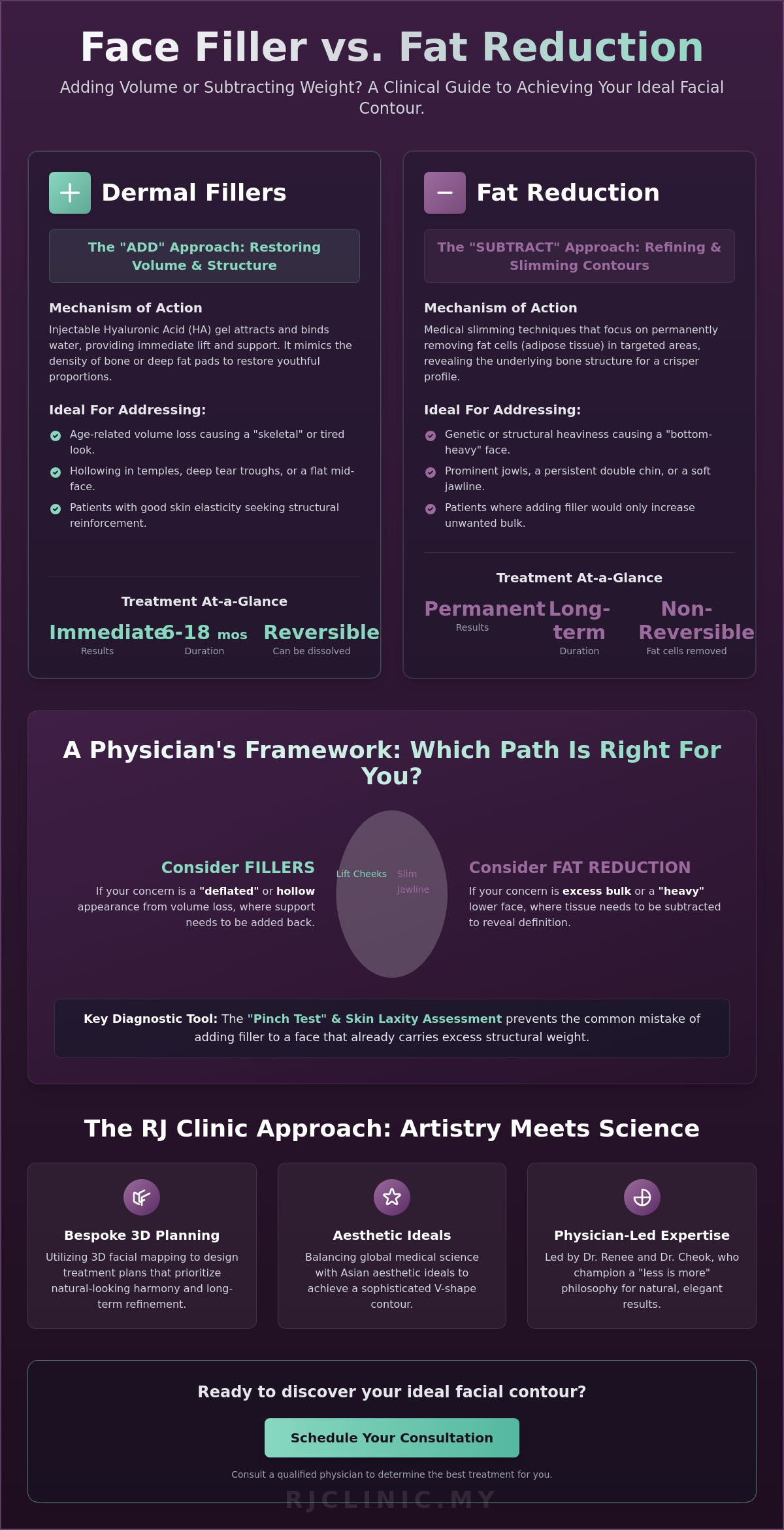
Hyaluronic Acid (HA) fillers function as a hydrophilic gel. They attract and bind water molecules within the dermis to provide an immediate lift. This process replaces lost fat pads or mimics bone density in areas like the chin or cheeks. We exclusively use FDA-approved dermal fillers to ensure the highest safety profile and predictable degradation. This treatment is ideal for patients with good skin elasticity who struggle with minor volume deficits or shadows.
Dr Renee and Dr Cheok prioritise a "less is more" philosophy. By placing small, precise amounts of filler in deep tissue planes, they restore youthful proportions without compromising natural movement. Results are visible immediately and typically last between 6 and 18 months, depending on your metabolic rate and the specific product used. Because HA is naturally occurring, it can be dissolved if adjustments are ever needed, offering a level of flexibility that permanent procedures do not.
Fat Reduction: Sculpting the Lower Face
When the jawline is obscured by a double chin or heavy jowls, adding filler can sometimes make the face look heavier rather than more contoured. This is where fat reduction technologies become essential. Laser lipolysis (Accusculpt) utilizes a 1444nm wavelength to specifically target and melt fat cells while simultaneously tightening the overlying skin. It's a highly effective tool for those who want a permanent change to their facial silhouette.

For patients with smaller, stubborn pockets of submental fat, fat-melting injections (mesolipo) such as RJ Slimshot offer a non-surgical alternative. These treatments break down the fat cell membrane, allowing the body to naturally flush out the lipids over several weeks. These methods are discussed extensively in our medical slimming guide, which outlines how we address facial and body contouring holistically.
Longevity: Fillers require maintenance every 6 to 18 months. Fat reduction results are considered long-term as the destroyed fat cells are physically removed.
Downtime: Fillers are "lunchtime" procedures with minimal recovery. Fat reduction via Accusculpt or injections may involve mild swelling or tenderness for 3 to 7 days.
Precision: Fillers allow for millimetre-perfect adjustments to facial symmetry. Fat reduction provides broader sculpting and debulking of the lower face.
Choosing the right approach requires a nuanced understanding of facial anatomy. If you are uncertain whether your face needs more volume or less weight, a personalized facial analysis can help determine the most effective strategy for your unique features.
How to Decide: A Physician’s Framework for Facial Harmony
Patients often arrive at our Kuala Lumpur clinic requesting mid-face fillers to lift sagging cheeks, but adding volume to an already heavy lower face frequently backfires. If the underlying issue is excess adipose tissue rather than volume loss, adding hyaluronic acid can lead to a "pillow face" effect. When evaluating face filler vs fat reduction, we first assess skin laxity. If the skin has lost its elastic recoil, fillers might provide a temporary lift but will eventually contribute to a weighted, unnatural appearance. In these cases, removing the weight of the fat is the more logical clinical step.
We utilize the "Pinch Test" during consultations to determine the primary concern. If you can pinch more than 2cm of soft tissue along the jawline or submental area, the concern is likely fat-based. However, if the tissue feels thin and the "heaviness" is actually a lack of structural support, filler is the superior tool. For many, the gold standard involves a bespoke combination. We might use Accusculpt laser lipolysis to debulk the jowls followed by strategic filler to sharpen the mandibular angle. This hybrid approach ensures the face remains contoured rather than simply "filled."

Budgetary considerations in Malaysia also play a role in long-term planning. While a single syringe of filler is more affordable upfront, the cumulative cost of maintenance every 9 to 12 months adds up. Fat reduction procedures often carry a higher initial price in RM, yet they offer a permanent solution to localized fat deposits, frequently proving more cost-effective over a five-year horizon. We always encourage patients to view these treatments as an investment in their long-term facial architecture rather than a quick fix.
Your Anatomy Dictates the Procedure
Clinical outcomes depend heavily on your foundational bone structure. A recessed chin can make a normal amount of neck fat look like a double chin; here, filler provides the projection needed to stretch and smooth the area. Conversely, if your facial width is caused by hypertrophic muscles, botox for jawline slimming serves as a vital alternative to both filler and fat removal. Dr Renee and Dr Cheok focus on these anatomical nuances to avoid "filler fatigue," a condition where over-filled tissues become distended over time.
The Importance of LCP Certification in Malaysia
Choosing a practitioner in KL should be based on medical credentials rather than social media following. Non-surgical does not mean "no risk." FDA guidance on dermal fillers warns of serious complications like vascular occlusion if the product is injected into a blood vessel. At RJ Clinic, our LCP-certified doctors use ultrasound-guided techniques and FDA-approved technologies to ensure safety. Avoiding "budget" clinics is essential to prevent irreversible complications such as skin necrosis or chronic granulomas that often arise from unverified products.
Ready to discover the right balance for your features? Schedule a professional facial assessment with our LCP-certified doctors today.
The Consultation: Designing Your Bespoke Treatment Plan
The choice between face filler vs fat reduction isn't one you should make in front of a bathroom mirror. It requires a clinical eye to distinguish between a genuine lack of volume and the descent of facial fat pads. At RJ Clinic, Dr Renee and Dr Cheok begin every session with detailed facial mapping and 3D analysis. This technology allows us to identify specific volume gaps and structural shifts that the naked eye might miss, ensuring the treatment plan addresses the root cause of your concern rather than just the symptoms.
During your consultation, we examine your bone structure, skin elasticity, and medical history. We select the specific technology based on these unique variables. For instance, we might recommend Juvederm fillers to revolumise the temples or cheeks, while Accusculpt laser lipolysis is often the superior choice for refining a heavy jawline or reducing a double chin. Our follow-up schedules are tailored for the fast-paced KL lifestyle, providing clear protocols that allow you to return to your professional commitments with confidence.
What to Expect During Your Visit
Patient comfort is a priority in our clinical practice. Most non-invasive procedures begin with the application of high-grade numbing creams, while more targeted treatments like laser fat reduction may use local anaesthesia. You might experience minor swelling or bruising for 3 to 5 days, which is a normal part of the healing process. Our aesthetic philosophy rejects the 'overdone' look; we focus on subtle, natural results that enhance your existing features rather than altering your identity.
Next Steps for Your Transformation
Preparing for your appointment involves a few simple lifestyle adjustments to ensure the best outcome. We recommend avoiding blood-thinning supplements, such as fish oil or ginkgo biloba, for at least 7 days prior to your visit to minimize the risk of bruising. You can book a comprehensive assessment at either our Mont Kiara or Bangsar branches to discuss your goals in a private, professional setting.
If you're ready to define your contour with precision, consult our LCP-certified doctors at RJ Clinic to begin your journey.
Refining Your Silhouette With Clinical Precision
Choosing between face filler vs fat reduction isn't about finding a one-size-fits-all solution; it's about identifying whether your face needs structural support or streamlined refinement. Fillers excel at restoring the lost volume and bone-like scaffolding that keeps skin looking lifted, whereas fat reduction targets the stubborn pockets that can weigh down a profile. It's a clinical decision that balances the restoration of youth with the precision of contouring to achieve true facial harmony.

At RJ Clinic, Dr Renee and Dr Cheok utilize their expertise as LCP-certified doctors to design bespoke treatment plans tailored to your specific anatomy. By employing FDA-approved technologies across our Mont Kiara, Bangsar, and TTDI locations, we ensure that every enhancement is both safe and sophisticated. We don't believe in overdone results, but rather in the subtle artistry that highlights your natural beauty. Taking the next step toward your ideal contour starts with a professional assessment of your unique facial proportions. We're ready to help you discover the most refreshed and confident version of yourself.
Common Questions Regarding Facial Contouring
Is face filler better than fat grafting for under-eye hollows?
Hyaluronic acid fillers provide more predictable precision for the delicate tear trough area compared to fat grafting. While fat is a permanent autologous tissue, its survival rate varies between 30% and 70%, which can lead to lumps or unevenness in thin-skinned areas. Dr Renee often recommends fillers for patients seeking an immediate, refined lift without the surgical downtime associated with harvesting fat from a donor site.
Can I do fat reduction and fillers in the same session?
You can combine fat reduction and fillers in a single appointment to achieve a more comprehensive facial contour. This bespoke approach allows us to debulk areas like the jowls or double chin while simultaneously restoring volume to the cheeks or temples. By addressing both volume loss and fat accumulation at once, patients often see a more harmonious result that a single modality cannot achieve alone.
How long does fat reduction last compared to a filler injection?
Non-surgical fat reduction treatments permanently destroy fat cells, meaning those specific cells won't return once they're metabolized by the body. In contrast, the results of a face filler vs fat reduction comparison show that fillers typically last between 6 to 18 months before the body naturally breaks down the gel. While fat reduction offers longevity, maintenance may still be required if significant weight fluctuations occur after the procedure.
Which treatment is safer for sensitive skin in Malaysia's humidity?
Both treatments are generally safe for sensitive skin because they target deeper subcutaneous layers rather than the epidermis. However, filler injections often involve fewer entry points, which reduces the risk of localized irritation or post-inflammatory hyperpigmentation in Malaysia’s tropical climate. Dr Cheok ensures all post-procedure protocols include medical-grade recovery creams to protect the skin barrier from the high humidity and heat common in Kuala Lumpur.
What is the average downtime for face slimming in KL?
Most patients undergoing non-surgical face slimming in our KL clinic return to work within 24 to 48 hours. You might experience mild swelling or bruising at the injection sites, but these typically resolve within 3 to 5 days. We advise avoiding strenuous exercise or saunas for at least 72 hours to ensure the product settles correctly and to minimize any risk of increased inflammation or prolonged swelling.
Will fat reduction leave my skin sagging?
Fat reduction won't necessarily cause sagging if your skin has good baseline elasticity and the volume removal is gradual. Modern technologies often incorporate a skin-tightening component, such as radiofrequency or heat, to stimulate collagen during the fat-melting process. If a patient has significant skin laxity, Dr Renee might suggest a bespoke combination of fat dissolving and ultrasound-based lifting to ensure the remaining skin remains firm and contoured.


Comments