


Renuvion After Liposuction: When Is Skin Tightening Considered?

Updated: 3 days ago

Renuvion after liposuction may be considered when loose skin remains a concern, because liposuction removes fat but isn’t designed to tighten skin. The skin-tightening effect develops gradually as collagen regenerates, and full results may take several months to appear. That’s the time needed to see the result, not a fixed promise of how long it will last.
It’s understandable to want a clear timeline before considering Renuvion after liposuction. Outcomes and recovery depend on the treated area and individual healing, so distinguish early swelling and discomfort from changes that develop over time. A doctor assessment is required before proceeding, and not every treatment is appropriate for every patient. Learn what may affect how long results last, what recovery can involve, and how to plan for work, activities, compression garments, and support at home.
Table of Contents
Managing post-operative discomfort
Local anaesthesia temporarily reduces sensation during and after surgery. With Renuvion and liposuction, its effect usually lasts approximately 4-8 hours after surgery. As it wears off, discomfort may become more noticeable. Keep your discharge instructions accessible, and follow the medication schedule provided for your recovery. Don’t adjust doses based on another person’s experience or advice.
Pain and tenderness can occur during early healing, as can swelling and redness. Note where symptoms appear and whether they change, such as tenderness near an incision or across a wider treated area. These details can help you explain what you’re experiencing to your surgical team.
Rest, ice packs, and medication may help manage discomfort. Use them according to your post-operative instructions, particularly around incision sites and compression garments. If pain remains uncontrolled despite these measures, contact your surgical team. Explain when the pain began, where you feel it, and what you have tried.
By the second day after Renuvion and liposuction surgery, most patients transition to Tylenol and Advil. Follow the medication plan provided for your recovery rather than assuming the same schedule is right for everyone. Keeping a written record of medication times and changes in pain can help you describe whether discomfort is improving, staying the same, or becoming harder to manage.
Compression garments support recovery after these combined procedures, but their fit and use should follow your instructions. Have two well-fitting garments available before surgery. Follow the guidance on wearing and adjusting them, and don’t alter the fit yourself. If the garment seems to cause discomfort, note when it happens and where you feel pressure, then share that with your surgical team.
Pay attention to changes in swelling and redness rather than relying on a general impression. Contact your surgical team if swelling is significantly greater on one side than the other. Also contact them about bleeding that continues without slowing, or that requires changing dressings more often than every few hours after surgery. Describe what changed and when you first noticed it.
When reporting pain or another post-operative concern, specific details are more useful than a general description. Note where it is, when it started, and whether rest, ice packs, or medication changed it. Keep your care instructions nearby, and contact your surgical team if pain remains uncontrolled or you notice ongoing bleeding or uneven swelling.
How soon can I return to normal activities after a Renuvion treatment?
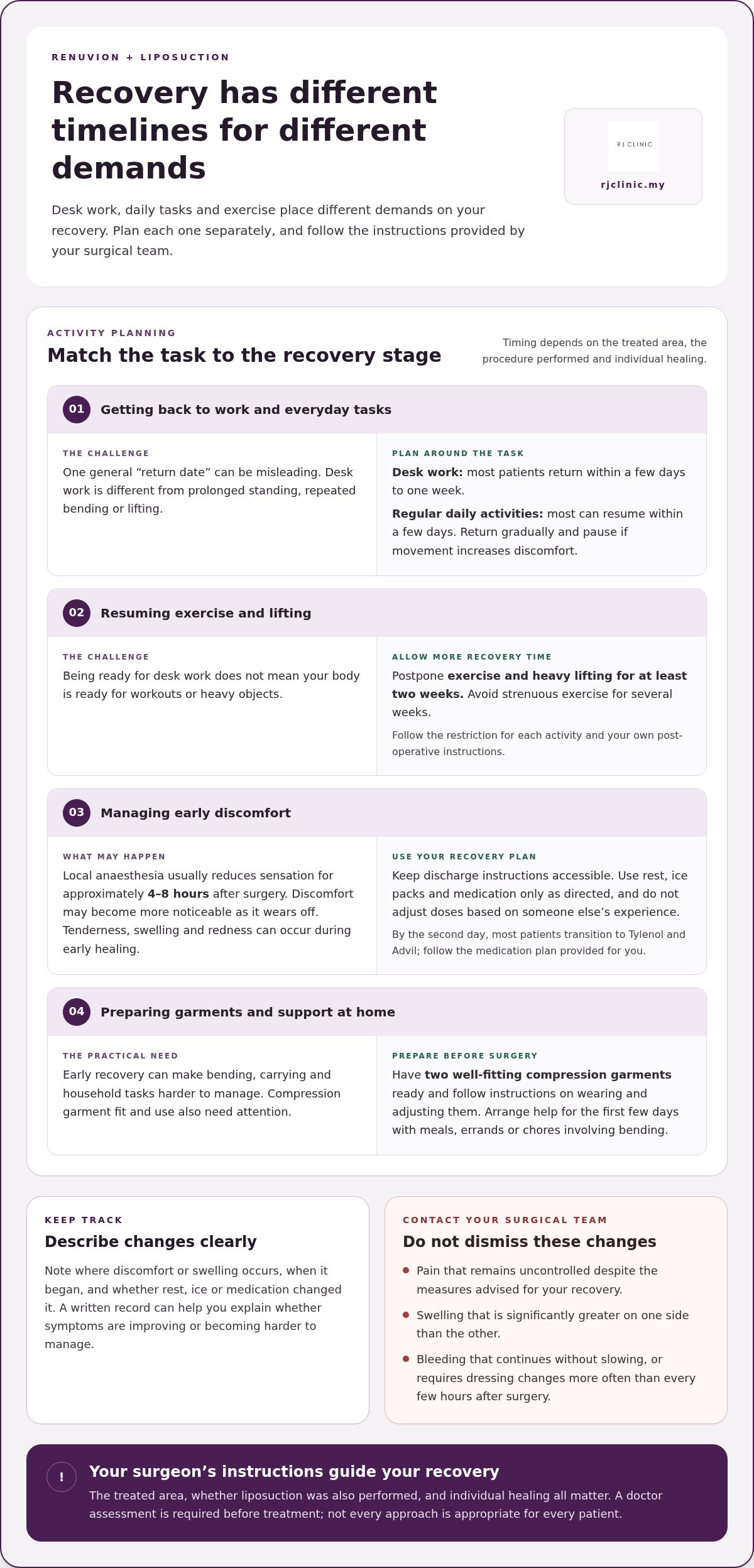
When you can return to activities depends on the task, the treated area, and whether liposuction was also performed. Desk work and exercise have different timelines, so plan around specific activities rather than one general return date.
Returning to work and daily activities
Returning to work means resuming your job when its physical demands suit your recovery. Most patients return to desk work within a few days to one week after Renuvion and liposuction. Most can resume regular daily activities within a few days. Desk-based work may be less physically demanding than a job involving prolonged standing, repeated bending, or lifting.
Consider each task separately when planning your routine. Before surgery, prepare for meals, travel, and household responsibilities, especially if they involve reaching or carrying. A gradual return helps you notice how movement affects the treated area. If a task increases discomfort, pause and follow your post-operative instructions before trying again.
Recovery and activity restrictions
Activity restrictions are temporary limits on exertion that support healing. Postpone exercise and heavy lifting for at least two weeks. Avoid strenuous exercise for several weeks. These timelines differ because gentle daily tasks place different demands on your body than vigorous training or moving heavy objects.
After Renuvion with liposuction, you may need to wear compression garments while healing. Follow the instructions for your recovery, including when returning to routine activities. Returning to desk work earlier does not mean you can restart workouts or lifting. Follow the restriction for each activity.
Renuvion uses helium gas and radiofrequency energy to tighten skin, while skin excision surgically removes excess skin. The appropriate approach depends on the amount and distribution of loose skin, the treatment area, and the intended result.
A definitive answer about approval for cosmetic use in Malaysia requires the product’s Malaysian registration and authorized intended use. Approval in another country alone does not establish its status for cosmetic use in Malaysia.
Before surgery, prepare for recovery by arranging practical support and having two well-fitting compression garments available. After treatment, follow garment and activity instructions, return to daily activities gradually, and delay exercise and heavy lifting for at least two weeks. Most patients return to desk work within a few days to one week.
To plan your return to work, write down your usual duties before surgery. Separate desk tasks from lifting, prolonged standing, and exercise. Use the list to plan time away and a gradual return. With Renuvion and liposuction, both the treated areas and the physical demands of your routine matter when mapping activity restrictions.
At-home support after surgery
At-home support means practical help and routines that make early recovery more manageable. Arrange assistance for the first few days after Renuvion and liposuction surgery. For example, ask someone to prepare meals, run errands, or handle household tasks involving bending. Keep discharge instructions and your medication schedule within easy reach, without stretching or lifting.
A compression garment is a supportive garment worn during healing after treatment. Have two well-fitting garments ready before surgery, so one is available while the other is being washed. Wear them consistently for the first 6 weeks after surgery, following the instructions provided for fit and use. If the garment shifts or feels uncomfortable, follow your care instructions rather than changing how it fits yourself.
Showering means washing under running water, while bathing means soaking in a tub. You may begin showering the day after Renuvion and liposuction surgery. Follow your wound-care instructions when washing and drying treated areas. Avoid baths, hot tubs, and pools until your surgeon confirms they are safe. Permission to shower does not mean you can submerge healing areas.
Medication support means following your post-operative plan for pain relief. Most patients transition to Tylenol and Advil by the second day after surgery. Follow the medication instructions for your recovery, and keep a written record of doses and times. Don’t add, stop, or change medication based on someone else’s experience. Contact your surgical team if pain remains uncontrolled despite rest, ice packs, and medication.
Wound monitoring means watching dressings and treated areas for changes during recovery. Contact your surgical team about bleeding that continues without slowing, or that requires changing dressings more often than every few hours after surgery. Note when it began and how often you changed the dressing. Also report swelling that’s significantly greater on one side than the other. Clear observations help explain what has changed.
Preparing your home before surgery can reduce avoidable strain during the first few days. Place frequently used items within easy reach, arrange transport, and plan who can help with meals or dressing changes. Keep your surgeon’s post-operative instructions accessible, particularly the guidance on bathing, compression garments, and warning signs. If you have a concern during recovery, use the contact instructions you received rather than waiting until you resume an activity.
Combining Renuvion with liposuction
Liposuction removes fat, while Renuvion addresses loose skin that fat removal does not treat. Combining them takes both contour and skin laxity into consideration.
Renuvion after liposuction may suit people whose concern includes loose skin in an area treated for fat. Common treatment areas include the abdomen, thighs, arms, and back. Suitability depends on whether skin looseness is part of the concern, alongside excess fat. A consultation should assess the area and the change you want to address.
Treatment combinations
Combined treatment involves removing fat with liposuction and using Renuvion to help tighten skin. Renuvion delivers helium gas and radiofrequency energy through small incisions to deeper skin layers. The energy stimulates collagen production, supporting gradual tightening. For example, treatment of the abdomen may address fat and loose skin in the same area.
The procedures address different concerns, so one does not replace the other. Liposuction targets fat; Renuvion targets skin tightening. Full Renuvion results may take several months to appear as collagen regenerates and the skin tightens. This gradual change matters when setting expectations: the early appearance is not the final result.
Risks and complications
Post-treatment effects are changes you may notice during recovery, such as swelling, redness, or discomfort. These can occur after Renuvion, and liposuction also affects recovery when both procedures are performed. Track where symptoms occur and how they change so you can describe them clearly during follow-up.
Contact your surgical team if pain remains uncontrolled despite rest, ice packs, and medication. Report bleeding that continues without slowing, particularly if dressings need changing more often than every few hours. Also report swelling that’s significantly greater on one side. These changes need attention rather than being treated as routine recovery sensations.
Energy delivery and fat removal happen in different steps, even when the procedures are planned together. Renuvion uses small incisions to deliver helium gas and radiofrequency energy beneath the skin. Liposuction removes fat from the treatment area. The combination is intended to address both concerns in a coordinated plan, rather than assuming fat removal alone will tighten loose skin.
Before deciding, identify the main concern in each area: excess fat, loose skin, or both. For example, someone concerned about abdominal fullness and loose skin needs those concerns assessed separately. The treatment plan depends on the assessment and the desired contour. Renuvion is considered for skin tightening, not as a substitute for liposuction’s role in removing fat.
When the procedures are performed together, recovery involves both. Swelling, redness, and discomfort may occur after Renuvion, while activity and compression instructions guide healing after the combined treatment. Discuss the planned treatment areas and how each procedure addresses them. This helps keep the decision grounded in the difference between reducing fat and treating loose skin.
RJ Clinic: Face Slimming Treatments
RJ Clinic offers Face Slimming Treatments for patients seeking a more refined facial contour. If your concern is loose skin rather than facial fullness, Ultherapy Prime (Skin Tightening) may be a more relevant option to discuss. The right approach depends on the area and the concern you want addressed, since facial treatments aren’t substitutes for body contouring after liposuction.
A consultation can help clarify whether your priority is facial definition or skin firmness, and which treatment aligns with that goal. RJ Clinic also offers Eyebag Treatment (Laser & Surgery) and Hair Loss Treatment & FUE Hair Transplant for concerns in those areas. For a considered discussion of your aesthetic goals and suitable options, contact RJ Clinic or visit rjclinic.my.
Choose the next step around your goals
The decision about Renuvion after liposuction should start with the concern you want to address, not the device name alone. Consider which areas matter most and what kind of change feels natural to you. A focused discussion can help clarify whether skin tightening, facial contouring, or another concern deserves attention first.
RJ Clinic offers Face Slimming Treatments, Ultherapy Prime (Skin Tightening), and Eyebag Treatment (Laser & Surgery). These options address different concerns, so the most relevant conversation depends on the area you want to refine. Bring your priorities and questions to a consultation, and use them to guide a considered treatment plan rather than feeling rushed into a decision.
To discuss your aesthetic goals and possible next steps, contact RJ Clinic. A thoughtful decision starts with understanding what matters to you, and you can take that step at your own pace.
Frequently Asked Questions
How long do results last after a Renuvion treatment?
There is no single duration that applies to everyone, and no fixed end date can be promised. The visible contour can change as your body and skin change over time. For a useful review, compare the treated area with your original photographs and discuss any changes during follow-up. This gives you a clearer basis for discussing the result than relying on memory alone.
Is the Renuvion procedure painful?
Patients generally report mild discomfort during the procedure, which uses local anaesthetics. If you’re concerned about pain, raise this before treatment and describe any previous difficulties with local anaesthesia or procedures. Ask what sensations to expect during your planned treatment and how discomfort will be addressed. A doctor assessment is required before proceeding, and not every treatment is appropriate for every patient. A clear discussion beforehand can help you understand the procedure without assuming another person’s experience predicts yours.
What is Renuvion and how is it used after liposuction?
Renuvion is used to address loose skin after liposuction, rather than to remove additional fat. It may be considered when skin laxity is a concern in an area where fat has been removed. Before deciding, identify whether the appearance you want to change is mainly due to remaining fullness, loose skin, or both. This distinction helps clarify the purpose of each treatment in a plan.
What results can Renuvion after liposuction achieve, and how long do they last?
Renuvion may help refine the appearance of loose skin in a treated area, with the aim of creating a smoother contour. The amount of visible change depends on the area and the skin’s response; it does not remove residual fat. Discuss the specific change you hope to see, such as improved definition along the abdomen, so expectations focus on a clear, observable goal rather than a general promise of tightening.
How long is recovery after liposuction with Renuvion, and when can you return to work?
Desk-based work may be possible before physically demanding duties, but your role matters. Think through a typical workday: commuting, sitting for long periods, standing, bending, or carrying items may place different demands on your routine. Share these tasks when planning time away and a gradual return. Being able to work at a desk does not necessarily mean you are ready to resume every usual activity.


Comments