


Rejuran vs Skinbooster: Which is Best for Your KL Skin?

Updated: Jul 17

Choosing between Rejuran vs Skinbooster isn't simply a matter of picking a popular brand name; it's a clinical decision between providing temporary hydration and initiating genuine cellular repair. While both treatments are frequently requested in our KL clinic, they serve fundamentally different roles in your skin's health. You might find it frustrating when expensive topical serums fail to improve persistent acne scars or large pores, leading to a sense of confusion about which injectable actually delivers results.
We agree that the sheer variety of 'boosters' available today can make the decision feel transactional rather than medical. This doctor-led analysis explores the nuances of polynucleotides versus hyaluronic acid, ensuring you understand how each affects your skin's structural integrity. You'll learn which treatment provides immediate radiance and which offers the long-term thickening required to soften fine lines and scarring. This clinical comparison provides the reasoning needed to choose the most effective path for your unique skin profile.
Table of Contents
Understanding the Mechanism: Biostimulation vs. Deep Hydration
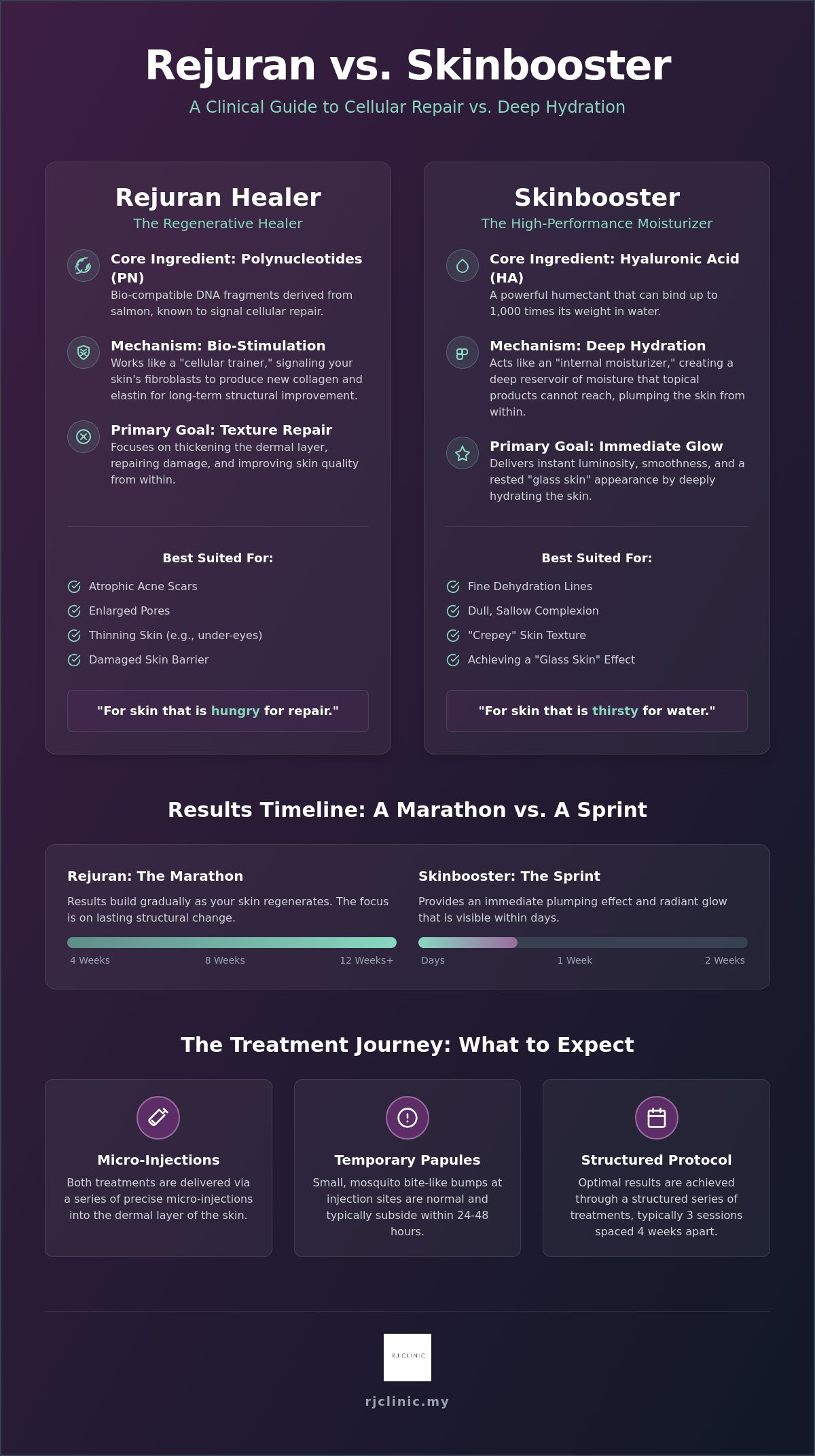
Patients often arrive at our practice requesting a "glow," yet a clinical assessment frequently reveals that the underlying issue isn't just dryness, but a thinning dermal layer. Distinguishing between Rejuran vs Skinbooster is the first step in a successful treatment plan. While both are delivered via micro-injections into the dermis, one functions as a regenerative healer while the other acts as a high-performance moisturizer. We've observed that many individuals seek hydration when their skin actually requires the structural repair that only biostimulation can provide.
How Rejuran Healer Triggers Cellular Repair
Rejuran is formulated with polynucleotides (PN), which are long-chain DNA fragments. These molecules are bio-compatible and derived from salmon DNA, known for its remarkable similarity to human DNA. Unlike dermal fillers that provide immediate mechanical volume, PN is a biostimulator. It works by sending specific signals to your fibroblasts, the essential cells responsible for producing collagen and elastin. This isn't a temporary fix; it's a fundamental change in how your skin behaves.
This process is closely related to the science of Polydeoxyribonucleotide (PDRN), which has been used in medical settings for wound healing and tissue repair for years. In an aesthetic context, Rejuran reduces inflammation and thickens the skin barrier. It's particularly effective for patients dealing with acne scars and structural damage, as it physically repairs the skin from the inside out rather than just masking imperfections with fluid.
The Role of HA Skinboosters in Dermal Hydration
Traditional skinboosters rely on non-crosslinked hyaluronic acid (HA). This substance is naturally occurring in our bodies and is famed for its ability to bind up to 1,000 times its weight in water. When we inject HA directly into the skin, we're essentially creating a deep-seated reservoir of moisture that topical creams simply can't reach. This improves skin turgor, which is the skin's ability to change shape and return to normal, effectively "bouncing back" from touch.
This treatment focuses on improving luminosity and smoothing out fine dehydration lines. It's the ideal choice for achieving the "glass skin" effect popular in KL, providing an immediate plumping that makes the skin look rested and vital. While it doesn't offer the same long-term cellular remodeling as Rejuran, it's unparalleled for restoring a tired, sallow complexion to a state of radiant health. We often tell patients that the choice comes down to whether the skin is "thirsty" for water or "hungry" for repair.
Once you have achieved that radiant glow, maintaining a polished overall look with professional nail and lash care is the next logical step. To explore premium styling options, you can discover fingerSPA and their range of aesthetic services.
Comparing Clinical Outcomes: Texture Repair vs. The Glow
When evaluating Rejuran vs Skinbooster, the timeline for visible results is often the deciding factor in our clinical recommendations. Patients in Kuala Lumpur frequently present with skin compromised by intense UV exposure and high humidity, which can exacerbate post-inflammatory hyperpigmentation (PIH) and visible texture issues. Rejuran is a marathon; it requires patience as the skin rebuilds itself over several weeks. In contrast, a skinbooster is more of a sprint, offering that luminous "glass skin" finish within days of the procedure. Understanding whether you need to rebuild your foundation or simply polish the surface is key to a satisfying outcome.
Rejuran for Scars, Pores, and Skin Thinning
Dr. Renee and Dr. Cheok frequently recommend Rejuran for patients struggling with atrophic acne scars or thinning skin around the periorbital area. Because PN molecules physically signal tissue regeneration, they are a cornerstone of our acne and scars treatment protocols. By increasing dermal thickness and restoring the barrier, Rejuran effectively "shrinks" the appearance of large pores that don't respond to traditional topical primers. It's a structural intervention. We've found it particularly useful for the delicate skin under the eyes, where it improves elasticity without the risk of the "puffy" look sometimes associated with traditional fillers.
Skinboosters for Immediate Radiance and Fine Lines
If your primary concern is a "crepey" texture or a sallow complexion that looks tired despite adequate sleep, a skinbooster is likely the superior choice. These treatments use hyaluronic acid to provide an "internal moisturizer" effect that smooths out fine dehydration lines. According to the FDA on hyaluronic acid fillers, these materials are well-documented for their ability to hydrate and smooth the dermal layer effectively. While Rejuran focuses on tightening and healing, HA boosters focus on plumping. This makes them the gold standard for achieving a dewy finish before major events. If you're looking for a subtle, organic-looking enhancement to your natural radiance, a bespoke skin analysis can help determine if your skin is simply thirsty for moisture or in need of deeper repair. The choice in the Rejuran vs Skinbooster debate ultimately rests on your specific clinical needs and desired recovery timeline.
Practical Considerations: Downtime, Technique, and Frequency
One of the most frequent questions we receive during consultations involves the immediate aftermath of the procedure. Patients are often surprised to learn that the physical experience of Rejuran vs Skinbooster differs significantly due to the viscosity of the products. While both involve intradermal delivery, the recovery profile is a critical factor for anyone with a busy social or professional calendar in Kuala Lumpur. Ensuring your treatment is performed by an LCP-certified doctor is the first step in managing these practicalities safely; this certification guarantees that your practitioner has met the Ministry of Health's rigorous standards for aesthetic medical practice.
The delivery method itself impacts your results. While injector guns offer speed and consistency, many experienced practitioners prefer manual micro-injections for their precision. This "point-by-point" technique allows us to target specific atrophic scars or fine lines with greater accuracy. This level of detail is supported by a clinical review comparing polynucleotides and hyaluronic acid, which highlights how the placement of these bio-active materials influences the eventual quality of tissue remodeling.
What to Expect During and After Your Session
We prioritize patient comfort by applying a high-strength topical numbing cream for approximately 30 minutes prior to injection. Most patients describe the sensation as a minor stinging or pressure. The most notable difference in the Rejuran vs Skinbooster experience is the appearance of papules. Because Rejuran is a more viscous polynucleotide, it creates small, raised bumps at each injection site that resemble mosquito bites. These typically resolve within 24 to 48 hours as the product integrates into the dermis. Skinboosters, being more fluid, usually result in less visible downtime, with any minor swelling or redness subsiding within a few hours.
The Long-Term Protocol for Sustained Results
Achieving a meaningful change in skin thickness or hydration isn't a one-off event. For both treatments, we recommend an initial "loading dose" of three sessions, spaced roughly three to four weeks apart. This frequency allows the cumulative effects of collagen stimulation or deep hydration to reach a peak. Once this foundation is established, maintenance treatments every six to twelve months are usually sufficient to sustain the results. For patients seeking specific types of biostimulation beyond polynucleotides, we may also discuss Deusaderm treatment as a tailored alternative. If you're ready to design a schedule that fits your lifestyle, book a clinical assessment to determine your ideal treatment frequency.
The RJ Clinic Approach: Tailoring Your Protocol
In aesthetic medicine, the most sophisticated results are rarely achieved through a single product. A one-size-fits-all approach often fails because it ignores the unique biological state of your skin. During a consultation, our primary objective is to distinguish between skin "hunger"—a need for deep hydration—and skin "damage," which requires structural repair. The choice between Rejuran vs Skinbooster is not always binary; instead, we often design a sequential strategy that addresses both the foundation and the surface.
For many patients in Kuala Lumpur, a hybrid protocol offers the most comprehensive rejuvenation. By combining the regenerative signals of polynucleotides with the immediate moisture-binding properties of hyaluronic acid, we can thicken the dermis while simultaneously achieving a luminous finish. This dual-action method ensures that your skin isn't just temporarily plumped, but is fundamentally healthier and more resilient against environmental stressors.
Synergistic Treatments for Enhanced Outcomes
Clinical observation shows that patient satisfaction is highest when we prioritize structural repair before layering on cosmetic enhancements. To achieve a more pronounced lifting effect, we frequently combine Rejuran with Ultherapy Prime. While the polynucleotides repair the skin's texture and thickness, the micro-focused ultrasound targets the deeper foundational layers to tighten and lift. For patients requiring both volume restoration and biostimulation, we may also integrate Ellansé into the treatment plan. This allows us to match the treatment to the specific anatomy of your face, ensuring that enhancements look subtle and organic rather than overdone.
Why Professional Assessment Matters in Kuala Lumpur
The success of these injectable treatments relies heavily on the clinical judgment of your practitioner. At RJ Clinic, our LCP-certified doctors, Dr. Renee and Dr. Cheok, focus on the balance between medical science and aesthetic artistry. This expertise is vital for avoiding complications and ensuring that you don't receive unnecessary over-treatment. We believe in a measured, steady approach that values precision and long-term skin health over quick, artificial fixes. If you're uncertain whether your skin requires repair or hydration, the first step is a professional diagnostic session. We invite you to schedule a skin quality assessment with Dr. Renee or Dr. Cheok to begin your personalized journey toward refined, healthy skin.
Investing in Your Skin's Structural Future
Deciding between Rejuran vs Skinbooster is ultimately a choice between long-term tissue regeneration and immediate dermal hydration. While polynucleotides offer the structural repair needed to address acne scars and skin thinning, hyaluronic acid boosters provide the essential moisture for a radiant, dewy finish. Both technologies maintain high safety profiles and utilize FDA-approved materials, yet their clinical applications are distinct. Achieving an organic, refined result requires a nuanced understanding of these mechanisms rather than a generic approach.
For those seeking similar expertise in regional medical hubs like Bangkok, you can read more about the aesthetic protocols at MedConsult Clinic.
At RJ Clinic, we prioritize personalized clinical assessments to identify the specific needs of your skin. Our LCP-certified aesthetic physicians, Dr. Renee and Dr. Cheok, focus on creating bespoke protocols that may combine these advanced injectables with other medical modalities. This ensures that every intervention is tailored to your unique anatomy and aesthetic goals. We invite you to Book a Consultation for Rejuran or Skinboosters at RJ Clinic to determine the most effective path for your skin's health. We look forward to partnering with you on your journey toward lasting skin refinement.
Frequently Asked Questions
Is Rejuran Healer painful compared to HA Skinboosters?
Rejuran is generally considered slightly more uncomfortable than traditional skinboosters due to its higher viscosity. However, we mitigate this sensation by applying a medical-grade topical numbing cream for 30 minutes prior to the procedure. Most patients describe the feeling as a series of small, manageable pinpricks. The level of discomfort often depends on the injection technique; manual injections allow us to adjust the pace to ensure your comfort throughout the session.
How long do the bumps last after a Rejuran injection?
The small, raised bumps, known as papules, typically resolve within 24 to 48 hours after the treatment. These marks occur because the polynucleotides are placed in the superficial dermis and require time to integrate into the skin tissue. In patients with thinner skin, the bumps might persist for an additional day. You can easily conceal these spots with a light application of medical-grade concealer once the injection points have fully closed after 24 hours.
Can I do Rejuran and Skinboosters in the same session?
Yes, combining Rejuran vs Skinbooster in a single session is a common clinical practice that we call a hybrid protocol. This approach is highly effective because it addresses structural repair and surface hydration simultaneously. By layering the products at different depths within the dermis, we can maximize the synergistic effects. This is particularly beneficial for individuals in Kuala Lumpur who experience both environmental dehydration and structural skin thinning from UV exposure.
Which treatment is better for dark eye circles and under-eye hollows?
Rejuran is the superior choice for improving the quality of the delicate periorbital skin, while dermal fillers are better for correcting deep hollows. Polynucleotides work to thicken the thin skin under the eyes, which reduces the visibility of dark circles caused by underlying blood vessels. If your concern is primarily a deep tear trough, we may recommend a cross-linked filler to provide the necessary volume and support that a liquid booster cannot achieve.
How soon will I see results after my first Rejuran session?
You'll typically notice improvements in skin texture and oil-water balance within one to two weeks after your initial session. However, because the treatment relies on the biological process of collagen synthesis, the most significant structural changes appear after the second or third treatment. It takes time for your fibroblasts to remodel the dermal structure. We usually advise patients to evaluate the full outcome approximately three months after completing their initial loading series.
Are there any side effects to salmon DNA injections?
Salmon DNA injections are highly biocompatible and carry a very low risk of adverse reactions because the DNA fragments are purified and protein-free. The most common side effects are temporary and localized, such as minor bruising, swelling, or redness at the injection sites. Because the material is non-crosslinked and similar to human DNA, the risk of long-term allergic reactions is exceedingly rare when the procedure is performed by an LCP-certified physician like Dr. Renee or Dr. Cheok.



Comments