


Nose Thread Lift Recovery: Swelling, Aftercare and Results Timeline


What if the success of your profile refinement depends less on the minutes spent in the procedure room and more on the biological anchoring that happens while you sleep? Many patients approach their nose thread lift recovery with a sense of trepidation, often mistaking the immediate post-procedure inflammatory response for a permanent lack of symmetry. It's a common clinical observation that the first 48 hours can feel like a test of patience, especially when initial swelling masks the subtle artistry of the lift.
We recognize that seeing a distorted version of yourself in the mirror can be unsettling, yet this period is a necessary physiological stage where your tissue begins to integrate with the medical-grade threads. Dr Renee and Dr Cheok emphasize that understanding this timeline is the best way to alleviate anxiety and protect your aesthetic investment. The following analysis breaks down the peak swelling of day two, the critical window for thread stabilization, and the long-term collagen maturation that solidifies your results. You'll gain a clear understanding of social downtime, activity restrictions, and the precise markers of a healthy, organic-looking recovery.
Table of Contents
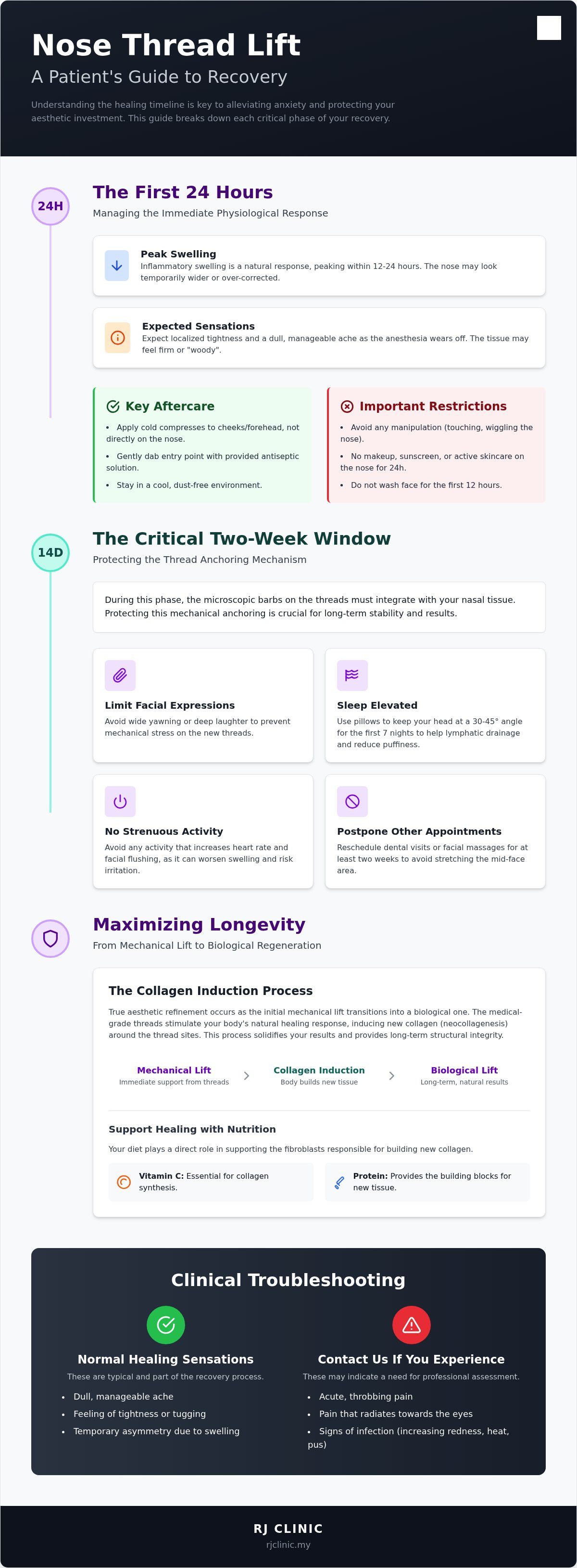
The First 24 Hours: Managing the Immediate Physiological Response
The initial day of your nose thread lift recovery is defined by the body's acute inflammatory response. As the local anesthesia wears off, you'll transition from a state of total numbness to a localized sensation of tightness and a dull ache. This is a standard clinical progression. The anesthesia used during the procedure often contains a vasoconstrictor to minimize bruising, which can leave the nasal tissue feeling firm or "woody" for several hours after you leave the clinic.
Swelling typically peaks between 12 and 24 hours post-treatment. This occurs because the insertion of the threads triggers a controlled healing cascade, prompting the body to send fluids to the area. While this might make the bridge of the nose look temporarily wider, it's a transient phase. Dr Renee and Dr Cheok recommend using cold compresses to manage this edema. However, you must apply them to the surrounding cheek area or forehead rather than directly on the nasal bridge. Direct pressure can potentially displace the threads before they've had a chance to settle.
Immediate Post-Procedure Sensations
It's common to feel that the nose looks "over-corrected" or the tip appears too high in the first few hours. This is rarely the final result. The elevation is often exaggerated by the volume of the injected anesthesia and the initial swelling. You should expect a dull, manageable ache; however, if you experience acute, throbbing pain that radiates toward the eyes, it's important to contact us for a clinical review. The most vital rule during this window is to avoid any manipulation. Don't "test" the firmness of the bridge or wiggle the tip of your nose, as the Thread lift mechanism requires total stillness to begin its integration with your facial soft tissue.
Initial Wound Care Protocol
The entry point, usually located at the tip of the nose, is the primary gateway we must protect from bacterial ingress. Keeping this site clean is paramount. We provide a specific antiseptic solution for dabbing the entry point gently. You can find more about how we prioritize safety and precision in our nose filler and nose thread lifting protocols. Regarding daily hygiene, you should follow these steps:
Cleansing: Avoid washing your face for the first 12 hours. After that, use a gentle, fragrance-free cleanser, but don't splash water directly onto the nose.
Makeup: Do not apply makeup, sunscreen, or active skincare products to the bridge of the nose for at least 24 hours.
Environment: Stay in a cool, dust-free environment to minimize the risk of irritation to the fresh entry wound.
The Critical Two-Week Window: Protecting the Anchoring Mechanism
The next 14 days represent the most significant phase of your nose thread lift recovery. While the threads are placed precisely by Dr Renee or Dr Cheok, their long-term stability depends on a process called mechanical anchoring. The microscopic barbs on medical-grade threads act like tiny hooks that must integrate with your nasal soft tissue. During this window, aggressive facial expressions, such as wide yawning or deep laughter, can put undue mechanical stress on these barbs. If a barb slips before the tissue has gripped it, you may lose some of the initial lift or notice a slight asymmetry.
Clinical success also relies on managing your internal environment. We advise patients to sleep with their head elevated at a 30 to 45-degree angle for at least the first seven nights. This posture uses gravity to facilitate lymphatic drainage, preventing interstitial fluid from pooling around the bridge and tip. This simple adjustment often drastically reduces the duration of post-operative puffiness.
Activity and Lifestyle Restrictions
We define "heavy exercise" not just by the weight lifted, but by any activity that induces facial flushing. When your heart rate rises, peripheral blood flow increases. This can exacerbate swelling and even lead to minor internal bleeding around the thread sites. In the specific climate of Kuala Lumpur, the high heat and humidity can cause excessive sweating. Sweat carries bacteria; if it reaches the entry point before it has fully sealed, it increases the risk of localized irritation. We also recommend postponing dental appointments or facial massages for two weeks to avoid prolonged stretching of the mid-face.
Dietary and Chemical Considerations
Your internal chemistry dictates the speed of your healing. Alcohol is a potent vasodilator; consuming it within the first week can prolong bruising and increase edema. Similarly, salty foods lead to water retention, which often manifests as significant morning swelling in the nose. We suggest a clean, low-sodium diet during this phase. If you have questions about specific supplements or medications that might thin the blood, a consultation with our clinical team can provide a personalized safety check. Following a structured thread lift aftercare protocol ensures that the biological integration of the threads remains undisturbed.
Clinical Troubleshooting: Normal Healing vs. Complications
Navigating the nuances of nose thread lift recovery requires a clinical eye to distinguish between expected healing and potential complications. One of the most common reports from patients is a sharp "tugging" or "pulling" sensation. This typically occurs during facial movements like smiling or eating. It's a normal physiological response caused by the thread barbs engaging with the nasal soft tissue. You can expect this sensation to peak in the first week and gradually subside as the threads begin their biological integration.
Bruising patterns also follow a predictable clinical arc. A transition from deep purple to a lighter yellowish hue is an encouraging sign that your body is metabolizing the minor trauma. However, you should monitor for an expanding hematoma, which presents as a hard, dark, and rapidly enlarging area. Similarly, while mild tenderness is expected, a persistent, rhythmic throb accompanied by localized heat or spreading redness may indicate an early-stage infection. Identifying these markers early ensures we can intervene with the appropriate clinical support.
When to Contact Dr Renee or Dr Cheok
While most recoveries are uneventful, certain scenarios require a sterile, professional environment for resolution. If you feel a sharp "poking" sensation at the entry point or notice a small piece of thread protruding from the skin, do not attempt to trim or pull it yourself. Dr Renee or Dr Cheok can easily manage thread protrusions through a minor adjustment in the clinic. Additionally, if you experience a sudden onset of swelling after the first week has passed, it's a signal that your healing process needs a clinical review.
Managing Patient Expectations on Symmetry
It's rare for both sides of the nose to heal at the exact same rate. Minor asymmetry in the first 14 days is frequently caused by internal edema rather than the placement of the threads. Your sleeping posture often dictates which side retains more fluid, leading to temporary irregularities in the bridge's contour. This "settling" period is a necessary bridge between the procedure and the final aesthetic outcome. Final results are usually assessed at the 4-week mark once the primary swelling has completely resolved. If you're concerned about your progress, it's best to schedule a follow-up assessment for a professional evaluation.
Maximizing Longevity: The Intersection of Aftercare and Collagen Induction
The transition from a mechanical lift to a biological one marks the final phase of your nose thread lift recovery. While the threads provide immediate structural support, their long-term value lies in their biostimulatory properties. As the PDO (Polydioxanone) material gradually breaks down, it triggers a controlled healing response that stimulates fibroblasts. These cells are responsible for synthesizing new collagen fibers around the thread scaffold, creating a natural internal support system that remains long after the threads have been resorbed by your body.
Supporting this process requires more than just clinical patience; it demands nutritional discipline. Collagen synthesis is a chemically intensive process for the body. We advise patients to increase their intake of Vitamin C, which acts as a vital cofactor in collagen stabilization, alongside high-quality protein to provide the necessary amino acids. Additionally, protecting the nasal skin from UV damage is paramount. Post-inflammatory healing makes the tissue more susceptible to hyperpigmentation, so a broad-spectrum sunscreen is essential to prevent darkening at the entry point. In some cases, nose fillers may be introduced months later to fine-tune the results, providing a synergistic effect that enhances both volume and definition.
The Long-Term Healing Timeline
At the 3-month mark, you'll typically reach the peak of collagen production. This is when the structural reinforcement is at its strongest, and the nasal profile appears most refined. As the threads undergo gradual resorption over the following months, this new collagen takes over the primary role of tissue support. Maintenance sessions are generally discussed toward the end of the first year, as preserving the nasal profile is more effective than waiting for the results to fully dissipate.
Building a Long-term Aesthetic Partnership
Successful outcomes aren't just about the procedure day; they're about the follow-up care provided at RJ Clinic. Dr Renee and Dr Cheok utilize these appointments to monitor how your specific tissue integrates with the medical-grade threads. Evaluating the success of the procedure beyond the initial 2-week window allows us to customize future enhancements based on your unique healing profile. This partnership ensures that your aesthetic journey remains grounded in safety and scientific integrity, favoring subtle, organic-looking results over artificial transformations.
The Path to Refined Symmetry
A successful nose thread lift recovery is a progressive journey that moves from initial clinical inflammation to long-term structural refinement. By understanding that early swelling is temporary and that the critical anchoring phase requires patience, you empower yourself to achieve the best possible aesthetic outcome. Protecting your investment through proper nutrition, UV protection, and adherence to activity restrictions ensures that the biological lift of new collagen replaces the mechanical support of the threads seamlessly.
At RJ Clinic, we view every procedure as a partnership. Our LCP-certified aesthetic physicians, Dr Renee and Dr Cheok, focus on delivering subtle, natural-looking results that enhance your unique features without looking overdone. With multiple locations across Kuala Lumpur, we provide the convenient, expert follow-up care necessary to monitor your tissue integration and address any clinical questions that arise during your healing process.
Consult with our LCP-certified doctors, Dr Renee or Dr Cheok, for a personalized nose contouring plan to begin your journey toward a more confident profile. We look forward to supporting you through every stage of your enhancement with meticulous, results-driven care.
Frequently Asked Questions
How long does the pain last after a nose thread lift?
Most patients experience a dull, manageable ache for approximately 3 to 5 days. This sensation is typically most noticeable when the local anesthesia first wears off and the body's inflammatory response begins. We recommend managing this with prescribed analgesics and avoiding any pressure on the treated area. If you experience sharp, throbbing pain that increases in intensity after the first 48 hours, please contact Dr Renee or Dr Cheok for a clinical review immediately.
Can I wear glasses or sunglasses during the recovery period?
We advise you to avoid wearing heavy glasses or sunglasses for at least two weeks post-procedure. The weight of the frames resting on the nasal bridge can interfere with the anchoring of the threads and potentially compromise the final contour. If you must wear corrective lenses, choose the lightest frames possible or switch to contact lenses. This precaution is a vital part of your nose thread lift recovery to ensure the threads remain perfectly positioned.
Is it normal to feel a "clicking" or "tugging" sensation in my nose?
Feeling a tugging or clicking sensation is a standard part of the healing process. This occurs when the microscopic barbs on the threads engage with the soft tissue during facial movements like smiling or eating. While it can feel unusual, it's a sign that the mechanical lift is functioning as intended. These sensations typically subside within one to two weeks as the threads begin to integrate and natural collagen production starts to provide structural support.
When can I resume my normal skincare routine and apply makeup?
You may resume basic facial cleansing and apply light makeup 24 hours after the procedure, provided you avoid the thread entry point entirely. It's crucial to keep the entry site clean and free of cosmetic products to prevent bacterial ingress. We suggest waiting at least five days before resuming a full skincare routine that involves active ingredients like retinols or AHAs. Always use gentle, upward motions and avoid putting any downward pressure on the nasal bridge.
Will my nose look crooked while the swelling is subsiding?
It is common for the nose to appear slightly asymmetrical or crooked during the first two weeks. This irregularity is usually caused by uneven swelling or localized edema rather than the actual placement of the threads. Your sleeping position can often cause one side of the nose to retain more fluid than the other overnight. You'll find that the true shape of your refined profile only becomes fully visible once the primary inflammatory response has completely subsided.
What should I do if I accidentally bumped my nose during the first week?
If you accidentally bump your nose, don't panic, but do monitor the area closely for the next 24 hours. Check for any sudden increase in swelling, sharp pain, or a visible shift in the nasal contour. While medical-grade threads are designed to be robust, a significant impact could potentially displace a barb before it has fully anchored. If you notice any of these signs, we recommend scheduling a quick assessment at one of our KL clinics for a professional evaluation.



Comments