


Thread Lift vs Ultherapy in KL: A Clinical Guide to Non-Surgical Lifting (2026)

Updated: Jul 21

Many patients arrive at our clinic requesting a thread lift to sharpen a heavy jawline, only to discover that their concerns stem from deep-seated skin laxity rather than just gravity. It's common to feel confused by the choice between mechanical tissue repositioning and deep structural tightening, particularly when you're balancing a high-profile career and cannot afford the recovery time associated with traditional surgery. You deserve a non-surgical facelift kl that respects your natural features while delivering a refreshed, sophisticated profile.
This doctor-led guide clarifies the clinical distinctions between thread lifts and Ultherapy, helping you decide which approach suits your specific needs. We'll explore how threads offer immediate, physical lifting for sagging tissue, while Ultherapy focuses on a biological rebuild of your skin's foundation. By the end, you'll understand why the most seamless results often involve a tailored synergy of both technologies.
Table of Contents
The Clinical Distinction: Repositioning Tissue vs. Rebuilding Foundation
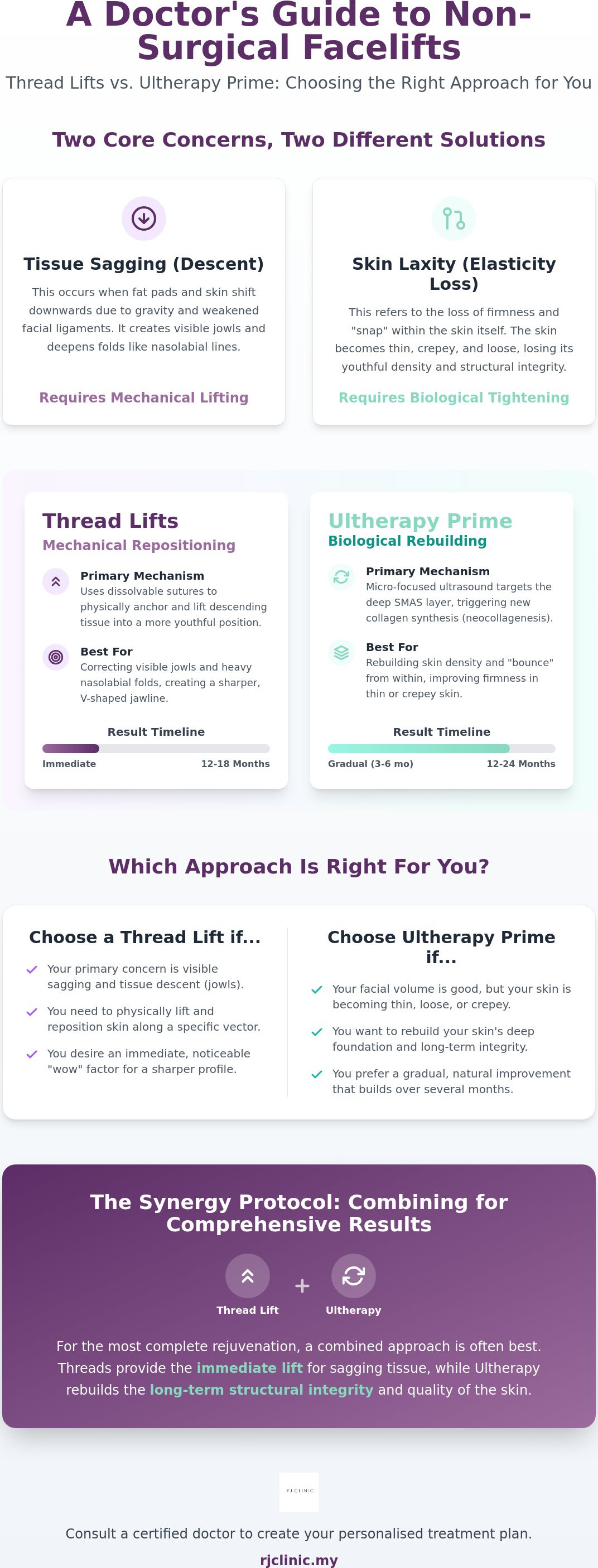
Patients often use the terms "lifting" and "tightening" interchangeably, but in a clinical setting, these words describe two distinct physiological challenges. Sagging, or tissue descent, occurs when fat pads shift downwards due to gravity and weakened ligaments. Skin laxity, conversely, refers to the loss of elasticity and "snap" within the dermal layers. Choosing the right non-surgical face lift depends entirely on which of these issues is more prominent in your profile. While one focuses on the architecture, the other focuses on the quality of the building materials.
When Mechanical Lifting with Threads is Essential
A thread lift is a mechanical intervention. We use dissolvable sutures, typically made of PDO (Polydioxanone) or PLLA (Poly-L-Lactic Acid), to physically anchor and reposition descending tissue. This is essential for addressing visible jowls or heavy nasolabial folds where the skin needs to be moved upwards along a specific vector. Energy-based devices cannot physically move tissue in this manner. Instead, threads create an immediate scaffold, providing a structural change that is visible the moment you leave the procedure room. It's the preferred choice for a non-surgical facelift kl when the goal is to restore a sharp, V-shaped jawline by lifting the skin rather than just firming it.
The Role of Ultherapy Prime in Structural Tightening
Ultherapy Prime represents the next evolution in biostimulatory care. Unlike threads, it doesn't "pull" the skin; it rebuilds the foundation from within. By targeting the SMAS (Superficial Muscular Aponeurotic System) layer, it triggers deep collagen synthesis through micro-focused ultrasound. A key advantage of Ultherapy Prime is the integrated ultrasound imaging. This allows us to see the tissue layers in real-time, ensuring we deliver energy precisely where it'll be most effective. This biological process, known as neocollagenesis, gradually improves skin density and "bounce" over several months. It's the gold standard for those who have good facial volume but notice their skin is becoming thin, crepey, or loose. While threads provide the immediate "lift," Ultherapy provides the long-term "integrity" that keeps the face looking youthful and naturally firm.
Comparing Outcomes: Immediate Gratification vs. Gradual Restoration
Understanding the trajectory of your results is as vital as the procedure itself. When patients seek a non-surgical facelift kl, they often weigh the desire for instant change against the benefits of long-term biological health. Threads and Ultherapy operate on entirely different timelines, and your choice should reflect whether you're preparing for an upcoming event or investing in your skin's future density.
The Timeline of a Thread Lift Result
The mechanical lift from threads is visible the moment you leave the clinic. This "wow" factor occurs because the barbs on the sutures physically grip the subcutaneous tissue, allowing us to shift it to a more youthful position. Over the next six to nine months, the threads slowly dissolve. During this period, they trigger a secondary healing response that deposits new collagen along the thread path. While the physical sutures disappear, this new structural support helps maintain the lift. An ideal thread lift candidate typically sees these results last for over a year before the natural aging process necessitates a maintenance session.
Ultherapy: The "Long Game" of Aesthetic Maintenance
Ultherapy is a "slow burn" treatment. While you might notice a slight initial contraction due to heat affecting the collagen fibers, the real transformation happens deep beneath the surface. It takes time for your body to synthesize new, organized collagen strands. Most patients report their best results around month four or five. The latest Ultherapy Prime system has significantly refined the patient experience, utilizing advanced transducers that deliver energy faster and with much higher comfort levels than previous generations. This technology ensures a more seamless journey toward a refreshed look. For those prioritizing a non-surgical facelift kl that evolves subtly without looking like "work" was done, this gradual restoration is often the preferred path. You can learn more about how we customize these timelines by exploring our approach to Ultherapy Prime.
Candidate Selection: Who Should Choose Which Treatment?
Deciding on the most effective non-surgical facelift kl isn't simply a matter of preference; it's a clinical decision dictated by your unique facial anatomy. We don't look at age as the primary factor. Instead, we analyze the distribution of your facial fat pads and the underlying bone density to determine which tool will yield the most natural result. Some faces require a change in direction, while others require a change in density.
Anatomy Check: Fat Pads and Bone Structure
Fleshy faces with more subcutaneous fat often benefit from the directional pull of threads. If there is significant weight in the lower third of the face, energy-based tightening alone might not provide enough lift to redefine a heavy jawline. Conversely, patients with "thin" faces must be approached with caution. Over-treating a lean face with high-intensity energy can sometimes lead to a hollowed appearance, whereas poorly placed threads in thin skin may cause visible dimpling or "puckering." During a face slimming consultation, Dr Renee and Dr Cheok meticulously map out facial vectors. This ensures the treatment respects your natural contours rather than fighting against them, maintaining the delicate balance of your facial architecture.
The Reality of Recovery and Social Downtime in KL
Lifestyle factors and your professional schedule in Kuala Lumpur also influence the choice. The intense Malaysian sun often accelerates dermal thinning, making Ultherapy an excellent foundation for restoring "skin bounce" and resilience in sun-damaged skin. Regarding downtime, Ultherapy is the clear winner for the busy professional. It offers zero social downtime, though you might feel a slight aching or tenderness along the jawline for a few days. Threads require more careful planning. You should expect minor bruising or swelling and a temporary restriction in wide facial movements for about five to seven days. In our tropical climate, we always emphasize strict sun protection and staying hydrated post-procedure to support the biological collagen synthesis process. To further support your skin's health and recovery at home, Luminous Touch provides advanced skincare solutions and high-tech wellness devices that complement clinical treatments. If your schedule doesn't allow for a week of "social caution," Ultherapy Prime is likely your best starting point.
If you're unsure which category your profile falls into, a clinical assessment is the most reliable way to avoid a mismatched treatment. You can book a structural skin analysis to determine the most effective path for your rejuvenation journey.
The Synergy Protocol: The Case for Combination Therapy
While many patients approach their aesthetic journey looking for a single "hero" treatment, clinical reality often suggests a multi-layered strategy. Most aging faces don't just experience skin laxity or tissue descent in isolation; they experience both. Relying on just one modality can sometimes lead to an "over-done" look where the skin is tight but the features remain displaced. A truly successful non-surgical facelift kl often utilizes a sequential approach that we call the Synergy Protocol.
In this methodology, Ultherapy is performed first to create the "canvas." By tightening the SMAS layer and densifying the dermis, we create a firm foundation. Once the skin has more structural integrity, we introduce threads weeks later to act as the "frame." These threads can then lift the now-firmer tissue more effectively and with greater longevity. To further refine the result, we may incorporate biostimulators like Ellanse, which restores lost volume in the mid-face while providing a third layer of collagen induction.
Designing a Personalized Rejuvenation Roadmap
A cookie-cutter approach has no place in high-end aesthetic medicine. Your facial architecture is unique, and your treatment plan should reflect that. We focus on sequencing these interventions to maximize collagen production without over-stressing the tissue. This careful timing ensures that each treatment builds upon the last, leading to a result that looks organic rather than artificial. Managing expectations is part of this partnership. While the results of a multi-modality lift are more comprehensive, they require patience as the biological "tightening" catches up with the mechanical "lifting."
This philosophy of personalized care is shared by leading aesthetic centers globally, such as Chirurgie Plastique Dr. Arie Benchetrit, which emphasizes tailored surgical and non-surgical solutions to achieve optimal, natural-looking results for every patient.
Safety and Credentials: Why LCP Certification Matters in KL
The Malaysian aesthetic market is sophisticated, yet it's not without risks. The presence of "cheap" threads or uncertified ultrasound machines can lead to complications like nerve injury, persistent granulomas, or ineffective results. Under the 2026 medical device regulations, the use of technologies like Ultherapy is strictly controlled. Choosing an LCP-certified doctor is the most critical variable in your safety and the quality of your outcome. An experienced physician’s hand understands the depth of facial nerves and the precise vectors required for a successful non-surgical facelift kl. We invite you to book a clinical consultation with Dr Renee or Dr Cheok to design a roadmap that prioritizes your safety and your aesthetic goals.
Reclaiming Your Profile with Clinical Precision
Investing in your skin's future requires a balance of immediate structural change and long-term biological health. As we've explored, the distinction between physically repositioning sagging tissue and rebuilding a thinning foundation is the key to a successful non-surgical facelift kl. Whether you opt for the instant lift of threads or the deep, restorative synthesis of Ultherapy Prime, the most sophisticated outcomes are those that remain subtle and entirely your own.
The expertise of LCP-certified physicians like Dr Renee and Dr Cheok ensures that your treatment roadmap is both safe and scientifically sound. By focusing on individualized facial contouring rather than one-size-fits-all packages, we bridge the gap between rigorous medical standards and your personal aesthetic goals. We look forward to helping you achieve a refreshed, confident version of yourself through precise clinical care and advanced technology.
Schedule a Clinical Assessment for Your Personalised Lift to discover the most effective combination for your unique facial architecture.
Frequently Asked Questions
Is a thread lift more painful than Ultherapy?
Both procedures involve different sensations, but neither should be described as agonizing. Thread lifts are performed under local anesthesia, so you'll feel a numbing injection followed by a sensation of pressure or tugging as we reposition the tissue. Ultherapy Prime feels like a series of tiny, hot prickles deep beneath the skin. Most patients find the latest Prime technology much more comfortable than older ultrasound systems, and we can adjust the energy levels to suit your personal tolerance.
Can I do Ultherapy if I already have threads in my face?
You can certainly combine these treatments, but the sequence and timing are vital for safety. It's generally advisable to wait at least three to six months after a thread lift before undergoing Ultherapy. This ensures the threads have settled and the initial healing phase is complete. Applying intense ultrasound heat too soon could potentially interfere with the integrity of the sutures or the early collagen scaffold they've created.
How much do thread lifts and Ultherapy cost in Kuala Lumpur?
The investment for a non-surgical facelift kl depends on the surface area and the complexity of your facial structure. Industry benchmarks in 2026 show that Ultherapy for a full face typically ranges from RM 6,000 to RM 12,000 in premium clinics. Thread lift procedures often range between RM 3,000 and RM 8,800 depending on the type and number of sutures used. We provide a definitive quote only after a clinical assessment of your skin's laxity and volume needs.
Will Ultherapy make my face look thinner or lose fat?
Ultherapy is designed to target the structural SMAS layer and the dermis, not to melt the subcutaneous fat pads that provide youthful volume. When performed by a physician using real-time ultrasound imaging, the energy is delivered precisely to avoid fat layers in the cheeks. While it can be used specifically to firm a double chin, its primary goal in the mid-face is tightening and densifying the skin to create a more lifted, resilient appearance.
How soon can I exercise after a thread lift in KL?
You should refrain from strenuous exercise or high-impact activities for at least one to two weeks. Intense physical exertion increases your heart rate and blood pressure, which can exacerbate swelling and potentially displace the threads before they've securely anchored. Light walking is acceptable after a few days, but avoid any movements that involve significant facial strain or inverted poses, such as those found in yoga, until your physician gives you the clear at your follow-up.
What happens if I don’t like the results of my thread lift?
It's reassuring to remember that modern threads are bio-absorbable and the results are not permanent. If there are minor asymmetries or puckering immediately after the procedure, these can often be adjusted during a follow-up visit. Because the materials naturally dissolve over several months, any effect you're unhappy with will gradually fade. In rare cases of significant discomfort, a physician can sometimes release or remove a thread, though this is seldom required when the initial vectors are correctly mapped.


Comments