


Lip Filler Before and After: What Actually Determines a Natural-Looking Result?

Updated: 3 hours ago

A natural lip filler before-and-after result depends on more than how much filler is used: your starting lip shape, where the filler is placed and how swelling changes the early appearance all matter. Swelling is often most noticeable in the first 24 to 48 hours and can take up to a week to settle. A photograph taken soon after treatment may therefore show temporary fullness rather than the settled result.
It’s understandable to judge lip filler before and after results by comparison photos, but images cannot tell the whole story. Lighting, camera angle, facial expression and photo timing can make lips look more or less projected. A still image also cannot show how they move when you speak or smile.
The details behind a natural-looking result are often subtle: how your lips relate to the rest of your face, whether filler is intended to refine the border or add volume, and how the result looks after swelling eases. This guide explains how these factors work together, what early swelling and bruising can change, and what before-and-after photos can realistically help you assess.
Table of Contents
Are lip fillers for thin lips a good idea?
Thin lips can be enhanced, but a natural-looking change depends on your starting shape and treatment plan. A subtle result may come from adding volume, defining the border, or balancing the upper lip with the lower lip. These goals differ, so the right plan isn’t simply the largest amount of filler. A typical treatment uses about 1 mL, while 0.5 mL can be a starting amount for more restrained enhancement. Distribution and lip proportions matter as much as the amount.
At consultation, describe the feature you want to change, such as a softer border or more central volume. The doctor can assess your lip shape at rest and in motion, then discuss an approach suited to your goal. When comparing before-and-after photos, look for examples with a similar starting shape and enhancement style. Use them to explain your preference, while recognising that your anatomy guides the treatment plan.
Juvederm Volbella and Revanesse Versa are product names you may encounter in treatment discussions. Ask which product is proposed and why it suits the planned area and desired appearance. Brand names do not determine placement or volume. A useful discussion links product choice to your lip shape, goals and the doctor’s proposed approach.
In Malaysia, product approval and regulation depend on local registration and intended use. Ask the doctor to identify the product and explain its Malaysian registration status before treatment. Choose a qualified doctor who can assess your lip anatomy, explain the plan and discuss risks clearly. RJ Clinic’s LCP-certified aesthetic doctors can assess your goals, medical history, proposed product, and the amount and placement being considered.
Preparation and timing affect when you can assess the appearance. Avoid alcohol for 24 to 48 hours before treatment to reduce the likelihood of bruising. Swelling can affect the early result, and the appearance is expected to settle at about the two-week mark. Allow at least two weeks before a major event rather than planning around the first few days.
Follow the aftercare instructions provided for your treatment. Avoid lipstick, lip balm and other products on the lips for at least 24 hours, and avoid exercise for at least 24 hours. Wait until the topical anesthetic or nerve block has worn off before eating, so you don’t accidentally bite your lips. These steps support early healing while swelling and bruising settle.
A follow-up appointment is scheduled about two weeks after treatment, when the settled appearance can be assessed. Maintenance timing varies with the product, your response and the look you want to maintain; touch-ups are commonly scheduled every 6 to 12 months. A review can help distinguish a lasting preference for more volume from a temporary reaction to early swelling.
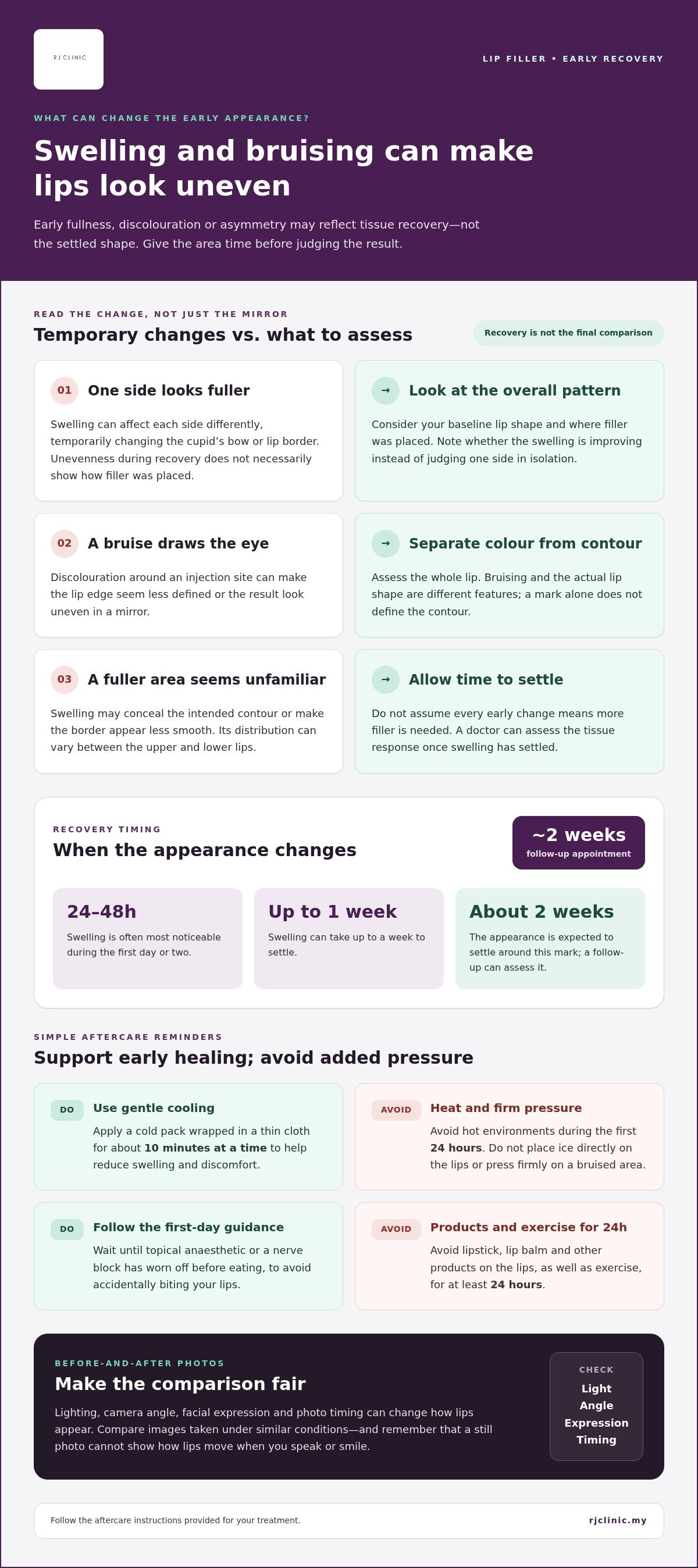
Swelling and bruising after injections
Swelling and bruising can change the apparent shape of each lip, not just its size. If one side reacts more strongly, the cupid’s bow or border may look temporarily uneven. That difference does not necessarily indicate how the filler was placed. A doctor considers the swelling pattern alongside the injection areas and your baseline lip shape when assessing symmetry.
Bruising appears as discolouration around an injection site and can make the lip edge look less defined. It may draw attention to one part of the mouth, making the overall result seem uneven in a mirror. Assess the whole lip rather than judging one mark in isolation. Discolouration and the actual contour are separate features.
Swelling is the tissue’s response to injections, and its distribution may vary between the upper and lower lips. A fuller-looking area can temporarily conceal the intended contour or make the border seem less smooth. Don’t treat every change in appearance as evidence that more filler is needed. The tissue needs time to settle before a doctor can assess the result.
During recovery, note whether the main change is swelling, bruising or discomfort, and whether it is improving. This gives your doctor more useful context than simply saying the lips look “wrong.” If a concern changes or becomes more noticeable, contact RJ Clinic for guidance rather than trying to massage or reshape the area yourself.
Follow the aftercare instructions provided for your treatment. A cold pack wrapped in a thin cloth can be applied for about 10 minutes at a time to help reduce swelling and discomfort. Avoid hot environments during the first 24 hours, since heat may make swelling more noticeable. Don’t press ice directly against the lips or apply firm pressure to a bruised area.
For a realistic comparison, separate temporary recovery changes from the shape you want to evaluate. A doctor can consider where the filler was placed, how the tissue has responded and whether bruising is affecting what you see. Before treatment, clarify how the lip filler treatment plan accounts for the areas you want refined and the changes swelling may temporarily create.
Before-and-after photographs and realistic expectations
Photographs are most useful when you assess a specific feature instead of asking whether the overall change looks “better.” A clear comparison can help you explain what you would like refined.
What Before-and-After Photos Can Show
A pair of images can show differences in lip outline, relative fullness and how the lips sit within the lower face. Look for the detail that matters to you, such as a more defined cupid’s bow or a softer transition between lip and skin. This makes a reference more useful at consultation than choosing a photo simply because the lips look fuller.
Images do not identify the filler used or explain how it was placed. A caption naming hyaluronic acid or Restylane may provide context, but it cannot tell you whether the same approach would suit your lips.
Taking Before-and-After Photos
Keep original photographs rather than relying only on edited or filtered versions. A softened lip edge or altered colour can change how you interpret definition and fullness. If you save a reference image, note the exact feature you like, such as the upper-lip outline or a restrained increase in volume.
For your own records, keep images in chronological order and label each with the treatment date or review stage. This creates a clearer visual record than relying on memory when discussing subtle changes later.
Setting Realistic Expectations
A reference image shows one person’s aesthetic preference, not a guaranteed outcome for someone else. Lip shape, facial proportions and the treatment plan all influence which features may be achievable. Use the image to start a conversation about your desired appearance, then discuss which elements suit your own features.
Compare the goal, not just the visible amount of change. A subtle improvement in definition may matter more to you than dramatic fullness. Clarifying that difference keeps the treatment discussion focused on your priorities.
Filler placement techniques
Placement determines whether filler emphasizes the lip border, adds body, or changes how the upper lip projects. The same volume can create different effects when distributed differently, so a natural-looking result depends on matching the injection plan to your facial proportions. The practical takeaway is simple: discuss the feature you want refined, not only how much volume you want.
Before choosing injection points, a doctor assesses your lips at rest and during movement. Someone seeking clearer definition, for example, may need a different plan from someone wanting more central fullness. The border, upper lip and lower lip all contribute to the overall shape. Adding volume without considering how these features relate can make the result look less balanced, even when the amount seems modest.
Depth is also part of placement. During a lip filler procedure, the needle does not go deeper than 2.5 millimeters into the skin. That figure describes a limit, not a universal target for every injection. The treatment area and the intended effect guide where filler is placed, while the doctor’s assessment of your lip tissue informs the plan.
Placement is not simply a choice between named techniques. It involves decisions about location, depth and distribution. A plan focused on the border aims to refine definition, while one focused on the body of the lips aims to increase fullness. Your facial proportions, existing asymmetry and desired appearance all matter. A photograph can help communicate your preference, but it cannot determine injection points.
Numbing cream typically takes about 15 to 30 minutes to numb the lips before injections. Once treatment begins, the doctor can place filler according to the agreed plan and assess how the lips respond. The conversation should make clear which areas are being treated and what change each area is intended to create. This helps you understand why the approach may differ from a reference photo.
Early swelling can temporarily disguise the effect of placement, particularly during the first 48 hours. Don’t judge whether the border looks too defined or the lips appear uneven from an immediate mirror check. Assessment after swelling settles gives a more useful view of how the filler sits within the tissue and how the shape looks in relation to your face.
If you’re considering lip filler, discuss your goals and proposed placement at a medical consultation. A consultation and treatment plan can help you understand how placement relates to the result you want. A doctor assessment is required before proceeding.
RJ Clinic: Face Slimming Treatments
RJ Clinic offers Face Slimming Treatments for people seeking to refine facial contours, a different concern from lip volume or filler placement. If looking at lip photos has also made you consider overall facial balance, a doctor assessment can help clarify your priority and whether a face-slimming approach is relevant.
For other goals, RJ Clinic also offers Ultherapy Prime (Skin Tightening) and Eyebag Treatment (Laser & Surgery). These address distinct concerns and are not alternatives to lip filler. Knowing the difference can help keep your treatment discussion focused on the feature you want to change.
Explore Face Slimming Treatments if facial contouring is your concern, or contact RJ Clinic to discuss your aesthetic goals.
Choose a result that feels like you
A lip filler before-and-after image can help you identify what you like. The next question is personal: which feature would you genuinely like to refine? Bring that preference to a consultation and discuss how it relates to your natural expression, proportions and comfort with change. A doctor assessment is required before treatment, and the intended effect should be clear without treating someone else’s photograph as a standard you must match.
Consider whether your priority is specifically your lips or a broader facial concern. Clear goals keep the conversation focused and help you decide whether treatment aligns with the appearance you want. Take the time you need to understand the approach and feel comfortable with the plan before proceeding.
If you’d like to discuss lip filler with RJ Clinic, contact the clinic to talk through your goals. A considered first conversation can help you move forward with clarity and confidence.
Frequently Asked Questions
What are lip fillers?
Lip fillers are injectable treatments used to add volume or refine lip contours. Hyaluronic acid filler is one material used for this purpose. The plan can focus on a particular feature, such as a less-defined border or uneven proportions, rather than increasing fullness everywhere. During consultation, describe the change you want and ask how the proposed placement relates to your natural lip shape and facial proportions.
What Happens on the Day of Your Treatment?
The appointment usually includes a discussion of your goals, preparation of the lips, injections and a brief review afterwards. A lip filler procedure may take from 30 minutes to two hours. Topical anesthetic typically needs 15 to 30 minutes to numb the lips, and the healthcare provider may monitor you for up to 15 minutes afterwards. You can use the consultation to clarify the planned areas before treatment begins.
What is the recovery time?
Visible recovery varies: some people feel socially ready two to four days after treatment, while swelling can take up to a week to resolve. That differs from assessing the settled shape, which is expected around the two-week mark. If you have an event or professional photo planned, allow recovery time beforehand rather than relying on how your lips look immediately after the appointment.
When can I eat or drink after having my lips filled?
Wait until the topical anaesthetic or nerve block has worn off before eating, so you do not accidentally bite your lips. During initial healing, avoid puckering, kissing and sipping through a straw, which can put pressure on the treated area. Follow the aftercare instructions provided at your appointment for eating and drinking, especially while your lips still feel numb.
What results can you expect from lip fillers before and after treatment?
Expect the result to reflect your starting anatomy, the areas treated and how filler is distributed. Defining the border, for example, creates a different visual effect from adding fullness through the body of the lips. Consider how you want your lips to look at rest and when smiling. Those details make the treatment discussion more precise than asking for a general increase in volume.
What types of lip fillers are available in Malaysia?
Juvederm Volbella and Revanesse Versa are product names you may encounter in treatment discussions. Ask the doctor to identify the proposed product and explain its Malaysian registration status and intended use.



Comments