


Laser Eyebag Removal in Malaysia: Recovery, Results & Common Questions

Updated: Aug 16
Most patients believe that once under-eye fat pads begin to bulge, a surgical scalpel is the only definitive solution. However, the assumption that surgical always equals better overlooks the precision of modern laser eyebag removal; this technology can often achieve a refreshed, natural contour without a single incision. It's frustrating to look exhausted even after a full night's rest because of persistent puffiness and skin laxity. You want a solution that addresses the root cause of the shadow under your eyes but understandably feel anxious about potential scars or long recovery times.
This article provides a clinical overview of how laser technology, specifically Acculift, treats both fat and skin laxity compared to traditional surgery. You'll gain a clear understanding of the recovery timeline you can expect in a Malaysian clinical setting, the specific differences between CO2 and lipolytic lasers, and how to determine if you're a candidate for this scarless approach. By the end, you'll have the technical knowledge needed to discuss your options with an LCP-certified doctor with confidence.
Table of Contents
Beyond Puffiness: Understanding the Anatomical Causes of Eyebags
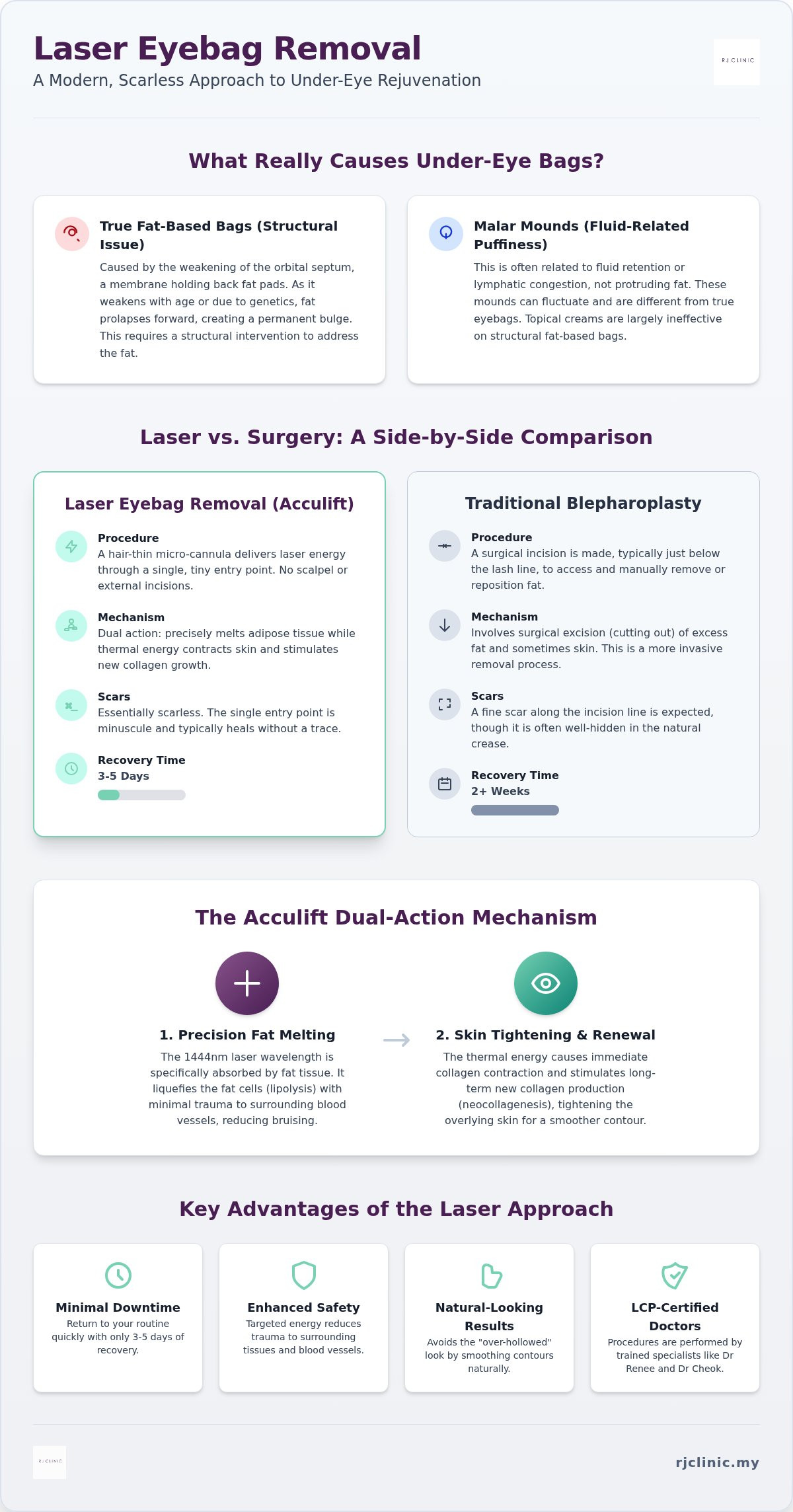
The lower eyelid is a complex anatomical zone where exceptionally thin skin meets delicate fat pads. To understand why laser eyebag removal is often the preferred clinical choice, we must first look at the orbital septum. This fibrous membrane acts as a retaining wall, keeping the infraorbital fat pads in place. When this wall weakens due to age or genetics, the fat prolapses forward, creating the characteristic bulge many patients mistake for simple tiredness. This is a structural change, not a skin-surface issue.
It's vital to distinguish these true fat-based bags from malar mounds, which are often fluid-related. While fat prolapse requires a structural intervention to melt or remove the adipose tissue, malar mounds are caused by lymphatic congestion or edema. Applying topical creams to structural bags is largely ineffective because no over-the-counter serum can penetrate deep enough to affect the underlying fat or tighten a lax septum. Additionally, as bone resorption occurs in the mid-face with age, the lack of support makes existing bags appear more pronounced.
Structural vs. Positional Eyebags
Shadows often deceive the eye. Positional bags may look severe under overhead office lighting but vanish when the light source is direct. To diagnose the cause, we use the "pinch test" to assess skin laxity. If the skin snaps back quickly, the issue is likely fat volume rather than just loose tissue. We also look for the tear trough deformity, a hollow groove that runs from the inner corner of the eye. This hollow creates a shadow that emphasizes the bag above it, often requiring a combination of fat reduction and volume restoration to achieve a smooth contour.
When Genetics Overrides Lifestyle
Many patients arrive at our Kuala Lumpur clinics frustrated that no amount of sleep or hydration has reduced their puffiness. This is because hereditary factors often dictate the strength of the orbital septum. Dr Renee frequently observes younger patients in their 20s with significant fat prolapse that has no correlation with lifestyle choices. In these cases, the anatomy is simply predisposed to early herniation. Lifestyle adjustments might reduce temporary fluid retention, but they cannot fix the structural prolapse that requires a targeted procedure like laser eyebag removal.
The Acculift Mechanism: Precision Fat Melting and Tissue Contraction
The effectiveness of laser eyebag removal relies on the specific wavelength of energy used to address sub-dermal fat. At RJ Clinic, we utilize the 1444nm Nd:YAG wavelength, which is uniquely optimized for its high absorption in adipose tissue. Unlike surface-level lasers that target water or pigment, this specific frequency is delivered interstitially through a hair-thin micro-cannula. By placing the laser fiber directly into the fat pad, we can melt the protruding tissue with extreme precision while preserving the surrounding structures. This targeted approach significantly reduces the risk of trauma to blood vessels, which is why patients often experience less bruising than with traditional surgical methods.
The Science of Laser Lipolysis
During the procedure, the laser energy disrupts the cell membranes of the fat cells, effectively liquefying them. This process, known as lipolysis, allows the body to naturally metabolize and clear the broken-down fat over the following weeks. A primary goal for Dr Renee and Dr Cheok is to ensure a smooth, aesthetic transition between the lower eyelid and the cheek. By carefully modulating the energy, we avoid the over-hollowed appearance that can sometimes occur with aggressive fat excision. This creates a refreshed look that maintains the natural volume necessary for a youthful contour.
Collagen Denaturation and Neocollagenesis
Beyond fat reduction, the thermal energy provides a secondary benefit: tissue tightening. As the laser heats the deep dermis, it causes immediate collagen denaturation, which leads to a visible contraction of the skin fibers. This is followed by neocollagenesis, a biological process where the skin produces new collagen over a three to six month period. This dual-action approach is similar to the technology used in Accusculpt Face Slimming, where precision and skin quality are equally prioritized. If you are noticing both puffiness and mild skin laxity, a clinical assessment can determine if this thermal mechanism will provide the refinement you seek. Consulting with an LCP-certified practitioner ensures the energy levels are tailored to your specific eyelid anatomy.
Laser vs. Traditional Blepharoplasty: Navigating the Trade-offs
Patients often weigh the "one-and-done" appeal of surgery against the lower morbidity of laser eyebag removal. Traditional transconjunctival blepharoplasty involves an incision inside the eyelid to remove fat, while laser lipolysis achieves a similar reduction through a tiny entry point that requires no sutures. Clinically, the trade-off is often found in the recovery period. Laser patients typically manage swelling and minor bruising within 3 to 5 days, whereas surgical patients must prepare for up to 2 weeks of downtime before they feel comfortable in social or professional settings in Kuala Lumpur.
Risk profiles also differ significantly. Surgery often requires general anesthesia or deep sedation, which carries its own set of clinical considerations. Aggressive skin excision in traditional surgery also carries a small but real risk of ectropion, where the lower eyelid pulls away from the eye. Because laser treatments focus on internal fat melting and thermal skin contraction, this particular complication is largely avoided. In terms of longevity, both methods permanently remove the targeted fat cells, though neither can stop the natural chronological aging of the remaining skin; for patients seeking high-level expertise in these procedures, the Capital Center® for Surgery serves as an example of how specialized care can optimize surgical outcomes.
Who is the Ideal Candidate for Laser Removal?
Laser intervention is most effective for individuals with mild to moderate fat protrusion who still possess reasonable skin elasticity. It's the preferred choice for those seeking a refreshed, "un-operated" look without the tell-tale signs of surgical intervention. It's also an excellent alternative for patients who prefer to avoid the systemic stress of general anesthesia or those with medical contraindications for invasive surgery.
When Surgery is the Superior Clinical Choice
If you present with severe skin laxity, deep "festoons" (malar mounds), or significant muscle weakness in the lower lid, laser energy alone may not provide sufficient structural support. In these advanced cases, Eyebag Surgery at RJ Clinic remains the gold standard. Surgery allows for the physical removal of redundant skin and the tightening of the underlying orbicularis oculi muscle, which a laser cannot achieve. If you're unsure which path fits your anatomy, schedule a clinical assessment at RJ Clinic to review your suitability for a scarless approach.
The Clinical Journey: Suitability, Recovery, and Longevity
Every successful outcome begins with a comprehensive anatomical assessment. At RJ Clinic, Dr Renee or Dr Cheok will evaluate your orbital structure to ensure that laser eyebag removal is the appropriate clinical path for your specific concerns. A common misunderstanding involves the difference between structural puffiness and vascular or pigmented dark circles. While the laser effectively reduces the fat pads, it doesn't necessarily resolve deep-seated pigmentation or thin skin that reveals underlying vessels. For patients primarily concerned with skin tone, we often integrate dark eye circle treatments into the broader management plan to achieve a truly refreshed appearance.
Managing the inflammatory response is critical for a smooth recovery. We advise patients to use cold compresses intermittently for the first 48 hours to minimize edema. Unlike invasive surgery, the micro-entry points heal rapidly, but avoiding strenuous activity for the first few days prevents unnecessary pressure on the delicate periorbital tissues. We may also recommend biostimulators like Rejuran post-procedure to enhance the skin's regenerative capacity and improve overall texture.
The Recovery Timeline
From Day 1 to 3, you'll likely experience a sensation of fullness or mild swelling in the lower lid area. This is a normal part of the healing process as the body begins to metabolize the liquefied fat. Most of our patients in Bangsar and Mont Kiara find they can return to social activities by Day 4. Makeup application is generally permitted once the micro-entry points have fully closed, allowing you to resume your professional routine with minimal disruption.
Maintaining Results in the Long Term
The longevity of your results depends heavily on skin quality and lifestyle choices. Chronic UV exposure and smoking accelerate collagen degradation, which can lead to premature skin laxity. To preserve the refined contour achieved through laser eyebag removal, maintaining skin health is paramount. For those requiring a more significant periorbital lift as they age, Ultherapy provides a non-invasive way to tighten the brow and upper cheek area. Our clinical philosophy at RJ Clinic prioritizes subtle, organic-looking outcomes that respect your natural anatomy rather than creating an over-tightened, artificial appearance.
Restoring a Refreshed and Natural Lower Eyelid Contour
Deciding how to address under-eye puffiness requires a careful balance between your aesthetic goals and your anatomical reality. As we've explored, laser eyebag removal using Acculift technology provides a precise, scarless alternative for patients with mild to moderate fat prolapse who wish to avoid the downtime of traditional surgery. By targeting the fat pads internally, this approach preserves the natural integrity of the eyelid while stimulating collagen for long-term skin firming. It's not just about removing volume; it's about refining the transition between the eye and the cheek for a subtle, organic result.
Success in periorbital rejuvenation depends on the clinical judgment of your practitioner. With over 10 years of collective experience in advanced aesthetic procedures, our LCP-certified doctors, Dr Renee and Dr Cheok, prioritize medical-grade safety and individualized care at every step. Whether you're a candidate for a laser-based approach or require a more comprehensive surgical intervention, a professional assessment is the first step toward reclaiming a rested appearance. We invite you to book a clinical consultation with Dr Renee or Dr Cheok at RJ Clinic to discuss a custom-designed treatment plan tailored to your needs. You deserve to look as vibrant as you feel.
Frequently Asked Questions
Is laser eyebag removal permanent, or will the fat return?
The fat cells destroyed during the procedure are permanently removed and won't regenerate. Once the 1444nm laser melts the adipose tissue, your body metabolizes and clears those cells for good. It's important to remember that while the fat is gone, the treatment doesn't stop the natural aging process. Your skin and remaining tissues will continue to age, so maintaining a healthy lifestyle is key to preserving your refreshed contour over the long term.
How much does laser eyebag removal cost in Malaysia for 2026?
The investment for this procedure is determined by the complexity of the case and the specific technology required for your anatomy. Factors such as the volume of fat prolapse and the degree of skin laxity influence the final treatment plan. Because we provide individualized care, we don't offer fixed price lists online. A clinical consultation allows us to provide an accurate quote that reflects the surgical or non-surgical precision needed for your specific periorbital rejuvenation.
Can laser treatment also fix dark circles under the eyes?
This treatment primarily addresses structural puffiness rather than skin pigmentation. If your dark circles are actually shadows caused by protruding fat, laser eyebag removal will make the area look significantly brighter. However, if the darkness is caused by thin skin or melanin, we may suggest complementary treatments. Combining fat reduction with skinboosters or pigment lasers often yields the best results for patients with multiple concerns in the eye area.
Is the procedure painful, and what type of anesthesia is used?
Patients typically experience very little discomfort because we use local anesthesia to numb the treatment zone. You'll remain awake during the process but shouldn't feel any sharp pain; most describe the sensation as a mild pressure or a localized feeling of warmth. This approach is much safer than general anesthesia and allows for a quicker recovery. Our priority is ensuring you feel calm and comfortable throughout the entire clinical experience.
What are the risks of laser eyebag removal if performed by a non-LCP doctor?
Undergoing treatment with a non-LCP certified practitioner carries significant medical risks, including skin burns, persistent lumps, or nerve damage. In Malaysia, LCP certification is a mandatory standard that ensures your doctor has the specific training and credentials to perform aesthetic procedures safely. Choosing a certified expert like Dr Renee or Dr Cheok minimizes these risks, as they possess the anatomical knowledge required to navigate the delicate structures around the eye with precision.
How many sessions are typically required to see a visible difference?
Visible improvement is usually achieved in just one session. Most patients see a significant reduction in puffiness once the initial swelling subsides within the first week. While the fat melting is immediate, the secondary benefit of skin tightening continues to develop over the next three to six months as new collagen forms. This single-session efficiency is one reason why laser intervention is a popular choice for those with busy professional schedules in Kuala Lumpur.


Comments