


Laser Eyebag Removal Recovery Timeline

Updated: Aug 19

What if the most intimidating aspect of addressing under-eye bags isn't the clinical technology itself, but the uncertainty of how you'll look during the first forty-eight hours? It's a common hesitation I hear during consultations; patients are often eager for a refreshed appearance but fear the "scary" post-operative bruising traditionally associated with invasive surgery. Understanding the laser eyebag removal recovery timeline is the first step in replacing that anxiety with a sense of control over your aesthetic journey.
The healing process for a modern, scarless procedure like Accusculpt is fundamentally different from traditional blepharoplasty or surface-level laser resurfacing. Because we utilize internal laser lipolysis to melt fat and tighten tissue from within, the recovery is generally predictable and manageable. In this breakdown, we'll examine the precise clinical protocols Dr Renee and Dr Cheok use to minimize inflammation and ensure safety. You'll gain a clear understanding of the day-by-day healing stages, including practical strategies to hide minor swelling so you can return to your routine with confidence and a naturally restored aesthetic.
Table of Contents
The First 48 Hours: Immediate Clinical Observations and Care
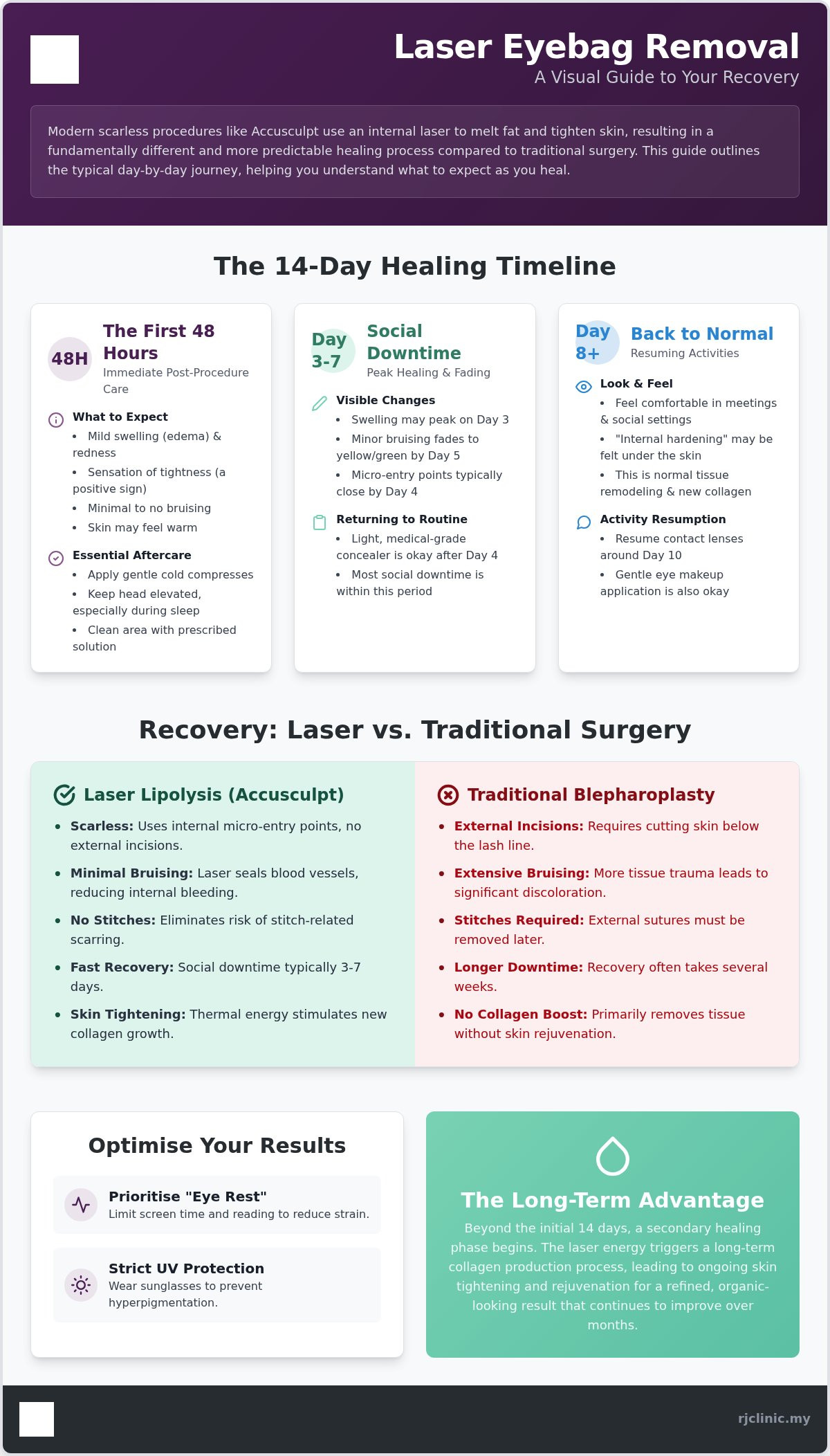
The immediate window following laser eyebag removal is characterized by a "scarless" transconjunctival or needle-entry approach. Unlike a traditional Blepharoplasty, which often involves external incisions and sutures, the Accusculpt protocol utilizes a fine laser fiber to liquefy fat deposits from within. During this initial stage of laser eyebag removal recovery, you'll likely observe mild edema (swelling) and erythema (redness). This is a normal inflammatory response to the thermal energy delivered by the laser. Instead of acute pain, most patients report a distinct sensation of tightness. This is actually a positive clinical sign. It indicates the laser energy is stimulating immediate collagen contraction in the dermal layers, providing an initial lift even as the body begins its deeper repair.
Managing Post-Laser Heat and Inflammation
Because the laser works by delivering controlled thermal energy to the fat pads, your skin may feel warm for several hours post-procedure. Dr Renee recommends a specific protocol of cold compresses to soothe this heat and minimize swelling. However, it's vital to avoid high-pressure contact on the lower lids. The tissue is delicate, and heavy pressure can disrupt the internal healing process. Keeping your head elevated during sleep for the first two nights is equally critical. This simple adjustment uses gravity to prevent fluid accumulation in the periorbital area, which significantly reduces the "puffy" look many patients fear during their laser eyebag removal recovery.
Why No External Stitches Changes the Recovery Profile
One of the most significant advantages of this modern approach is hemostasis. As the laser fiber melts the fat, it simultaneously seals blood vessels. This coagulation minimizes internal bleeding and bruising, which is why the recovery is typically much faster than incisional methods. There are no external stitches to remove. This means there's no risk of visible linear scarring or the "scary" look associated with traditional surgery. While the micro-entry points are nearly invisible, they do require basic hygiene. Dr Cheok advises keeping the area clean with a gentle saline solution or prescribed ointment for the first forty-eight hours to protect these tiny access sites as they close naturally.
The 14-Day Healing Timeline: What to Expect Socially
The window between day three and day fourteen is where the most visible transformations occur. While the general recovery time for eye bag surgery can vary between individuals, the laser-assisted approach typically offers a more accelerated path back to social normalcy. During this period, the body shifts from an acute inflammatory state to a remodeling phase. It's common to experience a range of sensations, from slight itching to a feeling of internal firmness, as the underlying tissues adapt to the removal of fat and the introduction of laser-induced thermal energy. This phase is less about clinical management and more about the patient's comfort in returning to their public routine.
Days 3–7: The Peak of Social Downtime
Many patients are surprised to find that swelling often peaks on day three rather than immediately after the procedure. This is a standard physiological response as the lymphatic system works to process the localized edema. By day five, you'll likely notice any minor bruising beginning to transition into a faint yellow or green hue; this is a sign that the hemoglobin is breaking down naturally. If your micro-entry points have closed completely, usually by day four, you may use a light, medical-grade concealer to mask residual discoloration. It's important to distinguish this from rare complications. While mild swelling is expected, any sudden or asymmetrical throbbing should be reported to Dr Renee or Dr Cheok for a clinical review.
Days 8–14: Transitioning Back to Normal Activity
By the second week, the social downtime associated with your laser eyebag removal recovery is largely behind you. Most patients feel comfortable attending meetings or social gatherings without feeling like they look "worked on." Clinical safety for resuming contact lenses and eye makeup is typically reached around day ten, though we advise a gentle touch during application and removal. You may still feel some "internal hardening" beneath the skin. This is not a complication but a normal part of the tissue remodeling process where new collagen fibers are being laid down. While you'll look refreshed to the outside world, the final settling of the periorbital contours will continue over the next few months. If you're curious about how this timeline fits your personal schedule, a tailored consultation for laser eyebag removal can provide a more specific outlook based on your skin's elasticity.
Optimising Your Results: Professional Aftercare and Pitfalls
Achieving a refined, long-lasting result depends as much on your post-procedure environment as it does on the precision of the laser itself. During your laser eyebag removal recovery, the treated tissues are in a heightened state of sensitivity. Dr Cheok often emphasizes that the first four weeks are a critical window for tissue stabilization. One common pitfall is the premature resumption of facial massages or "gua sha" routines. While these are excellent for general lymphatic drainage, applying mechanical pressure to the periorbital area too soon can disrupt the delicate internal healing and the newly formed collagen matrix. Beyond physical touch, managing your systemic fluid balance by reducing sodium intake can significantly minimize the residual puffiness that often lingers in the mornings.
Protecting the Periorbital Area in the Malaysian Climate
The intense UV index in Kuala Lumpur presents a specific challenge for post-laser skin. Standard protocols for eyelid surgery recovery usually highlight the importance of protecting the incision site, but with laser-assisted methods, the focus shifts toward preventing post-inflammatory hyperpigmentation (PIH). The heat and light can trigger melanin production in the healing area. You should wear UV-400 rated sunglasses even on overcast days. When selecting a sunscreen, opt for a physical mineral formula containing zinc oxide or titanium dioxide. These sit on top of the skin and reflect heat, whereas chemical filters can sometimes irritate the micro-entry points if you're prone to sweating in our humid climate.
Activities to Avoid: Exercise, Heat, and Alcohol
Vasodilation is the primary concern when discussing lifestyle choices during the first three weeks. Activities that increase blood flow to the face, such as hot yoga, saunas, or strenuous weightlifting, can exacerbate swelling and potentially lead to minor broken capillaries. Alcohol and smoking also have a direct clinical impact on your micro-circulation; alcohol dilates the vessels and increases bruising risk, while smoking restricts the oxygen supply necessary for efficient tissue repair. We also recommend "eye rest"—consciously reducing screen time for the first few days to prevent strain-induced blood flow to the lids. If you have concerns about specific lifestyle factors affecting your healing, you can book a professional assessment for laser eyebag removal to receive a personalized care plan tailored to your daily routine.
Laser vs. Surgical Recovery: Understanding the Trade-offs
When choosing between laser-assisted protocols and traditional surgery, the most immediate differentiator is the duration of social downtime. A standard surgical blepharoplasty typically requires ten to fourteen days before a patient feels comfortable in public settings, primarily due to external sutures and more extensive bruising. In contrast, laser eyebag removal recovery generally follows a much tighter window of three to seven days. This disparity exists because the laser approach is fundamentally less traumatic to the vascular network of the lower eyelid. While surgery excels at removing large volumes of tissue, the laser offers a "Collagen Factor" that surgery alone cannot match. The thermal energy delivered during the procedure triggers a secondary healing phase that continues for months, gradually tightening the skin from within as new collagen fibers mature.
A common clinical misunderstanding is that laser recovery involves more pain or a "burning" sensation due to the heat involved. In reality, the procedure is performed under local anesthesia, and the post-operative period is characterized by a dull tightness rather than acute pain. Because the laser cauterizes as it works, there's often less internal bleeding than in traditional "cold steel" surgery. However, Dr Renee often explains that the choice isn't always about the shortest recovery. If a patient presents with severe skin laxity or significant "festoons" that require physical excision, surgery remains the superior clinical choice despite the longer healing period.
Why Accusculpt Offers a Faster Social Recovery
The accelerated timeline of the laser approach is largely due to the precision of the instruments used. We utilize a 300-micron laser fiber, which is roughly the thickness of a few strands of hair. This allows for extreme accuracy in melting fat pads while minimizing trauma to the surrounding blood vessels and nerves. Because there are no external incisions, the risk of "railroad" scarring or permanent stitch marks is eliminated. Daily hygiene is also simplified; you don't have to worry about cleaning around delicate sutures or the anxiety of a stitch being pulled. To understand the technology behind this precision, you can learn more about Accusculpt Laser Lipolysis and its role in periorbital rejuvenation.
When Surgery is Clinically Superior
Despite the benefits of a shorter laser eyebag removal recovery, there are specific anatomical presentations where Dr Renee or Dr Cheok will recommend a surgical route. Patients with significant "hanging" skin or advanced age-related tissue descent often need the structural repositioning that only an incisional approach can provide. The trade-off is a more intensive recovery period, but the result is a more dramatic correction of severe structural defects. When evaluating your options, it's essential to weigh the convenience of a five-day recovery against the long-term requirements of your specific anatomy. For a deeper dive into these clinical distinctions, consider comparing laser vs. surgical eyebag removal to see which methodology aligns with your aesthetic goals.
Refining Your Vision for Post-Procedure Success
Navigating the laser eyebag removal recovery doesn't have to be a journey of uncertainty. By understanding the physiological stages of healing, from the initial thermal contraction to the final settling of periorbital contours, you can approach your treatment with clinical clarity. The transition from the peak of inflammation on day three to a refreshed, social-ready appearance by the end of the first week is a testament to the precision of modern laser lipolysis. While the body does the work of remodeling tissue, your adherence to professional aftercare, specifically UV protection and rest, ensures the longevity of your results.
At RJ Clinic, Dr Renee and Dr Cheok combine their expertise as LCP-Certified Aesthetic Physicians with FDA-approved laser technology to provide a tailored, scarless approach to periorbital rejuvenation. As specialists in scarless periorbital rejuvenation, we focus on subtle, organic-looking outcomes that respect your natural anatomy. If you're ready to move beyond temporary concealers and address the root cause of under-eye concerns, we invite you to schedule a clinical consultation with Dr Renee or Dr Cheok. A refreshed, more confident version of yourself is closer than you think.
Frequently Asked Questions
How long does swelling last after laser eyebag removal?
Most visible swelling subsides within three to seven days, which is the standard window for laser eyebag removal recovery. While the most prominent edema peaks around the forty-eight-hour mark, any residual micro-swelling is typically so subtle that it isn't noticeable to others. Most patients find they can return to their social and professional obligations by the end of the first week without needing heavy concealment.
Can I drive myself home after the laser eyebag procedure?
You should arrange for a driver or a ride-sharing service to take you home after the treatment. Although the procedure is performed under local anesthesia and you'll be fully alert, the periorbital area may feel tight and your vision might be slightly blurred due to the protective eye lubricant used. Prioritizing your safety and allowing your eyes to rest immediately after the clinical session is essential for a smooth recovery.
Will there be any visible scars from the laser?
There are no visible external scars following an Accusculpt procedure. This "scarless" technique utilizes a microscopic laser fiber that enters through the inside of the eyelid or a tiny needle-entry point that heals naturally without the need for sutures. Because there are no linear incisions or "railroad" stitch marks, the result is a naturally refreshed appearance that leaves no evidence of clinical intervention on the skin's surface.
When can I resume my exercise routine in KL?
Light walking is encouraged after forty-eight hours, but you should wait at least fourteen days before resuming strenuous exercise. High-intensity training, heavy lifting, or "hot yoga" can cause vasodilation and increase intraocular pressure, which may exacerbate swelling. Given the humidity in Kuala Lumpur, it's also important to avoid activities that cause excessive sweating near the eyes until the micro-entry points have completely sealed.
Is laser eyebag removal permanent, or will the bags come back?
The removal of fat cells during the procedure is permanent as these cells do not regenerate once liquefied and removed. However, the surrounding skin and tissues will continue to age naturally. Maintaining your results during the laser eyebag removal recovery and beyond involves consistent UV protection and a healthy lifestyle to support skin elasticity and prevent the formation of new laxity in the periorbital region over time.
What happens if I accidentally rub my eyes during recovery?
A single instance of accidental rubbing is rarely catastrophic, but it can increase localized irritation or minor swelling. If you do rub your eyes, you should immediately apply a cold compress to soothe the area and monitor for any increased redness or asymmetrical puffiness. If you experience sudden pain, significant bruising, or any changes in your vision, contact Dr Renee or Dr Cheok immediately for a clinical assessment.


Comments