


Laser Eyebag Removal vs Eyebag Surgery: Which Is Suitable?

Updated: 4 days ago

Under-eye bags can make you look tired even when you are well-rested. For some people, the concern is caused by prominent fat beneath the lower eyelids. For others, loose skin, fluid retention or age-related changes around the eyes contribute to the appearance.
When considering treatment, two options commonly discussed are laser-assisted eyebag reduction and surgical lower blepharoplasty. Although both aim to improve the appearance of the lower eyelids, they work differently and are suitable for different anatomical concerns.
Laser eyebag removal in Malaysia may be an option for selected patients with mild to moderate under-eye fat protrusion and limited skin laxity. Surgical blepharoplasty, on the other hand, can address more significant fat bulging, excess skin and lower-eyelid structural changes through surgical removal or repositioning of tissue.
At RJ Clinic Malaysia, treatment recommendations are based on an assessment of the underlying cause of your eyebags, skin condition, fat distribution and individual expectations.
This guide compares laser eyebag removal and surgical blepharoplasty, including how each procedure works, their differences, recovery considerations and potential limitations, to help you understand which approach may be more suitable.
Table of Contents
What Causes Under-Eye Bags?
How Laser-Assisted Eyebag Reduction Works
How the Procedure Is Performed
How Lower Blepharoplasty Works
Laser Eyebag Removal vs Surgery: Key Differences
Recovery, Risks and Expected Outcomes
Which Option Is More Suitable for You?
What Causes Under-Eye Bags?
Under-eye bags are not always caused by the same underlying condition. Understanding the reason for the puffiness is important because different causes may require different treatments.
1. Protruding Under-Eye Fat
One common cause of structural eyebags is the forward protrusion of orbital fat.
Fat pads naturally sit within the eye socket and help cushion and protect the eyeball. They are held in position by surrounding connective tissues, including the orbital septum.
As these supporting structures change with age or genetic predisposition, the fat pads may become more prominent beneath the lower eyelids. This creates a persistent bulging appearance that may remain even after adequate sleep or lifestyle changes.
For suitable patients, treatment may involve reducing the prominent fat or repositioning it to create a smoother lower-eyelid contour.
2. Loose Skin and Reduced Elasticity
As the skin ages, collagen and elastin gradually decrease. The lower eyelid skin may become thinner, less firm and more prone to wrinkles or sagging.
When excess skin is a major contributor to the appearance of eyebags, simply reducing the underlying fat may not provide sufficient correction.
Patients with significant skin laxity may require a surgical approach that allows excess skin to be removed or repositioned.
3. Fluid Retention and Temporary Puffiness
Not all under-eye puffiness is caused by protruding fat.
Fluid retention, allergies, sleep disruption and certain lifestyle factors may contribute to temporary swelling around the eyes.
This type of puffiness can fluctuate throughout the day and may become more noticeable in the morning.
Laser treatment and surgery are not necessarily appropriate for fluid-related puffiness. The underlying cause should first be assessed.
4. Tear Trough Hollowing and Facial Structure
The tear trough is the natural groove between the lower eyelid and upper cheek.
A prominent tear trough can create shadows beneath the eyes, making the area appear darker or more hollow. When combined with protruding fat, it may produce an uneven transition between the lower eyelid and cheek.
This is why an assessment should consider more than the size of the eyebag itself. Fat distribution, cheek support, skin quality and facial proportions all influence the treatment plan.
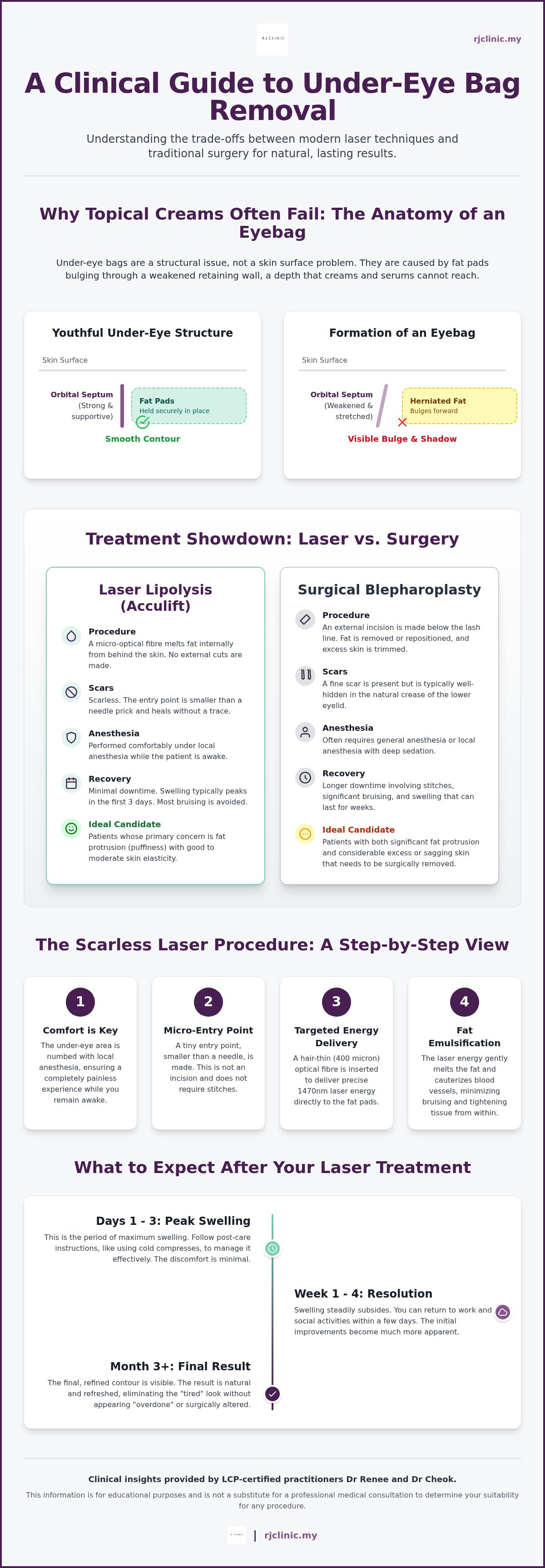
How Laser-Assisted Eyebag Reduction Works
Laser-assisted eyebag reduction is a minimally invasive approach that uses laser energy to target unwanted fat beneath the lower eyelids.
At RJ Clinic, AccuLift laser eyebag removal uses 1444nm Nd laser technology. A fine optical fibre is introduced through a small entry point to deliver controlled laser energy into the targeted tissue.
The laser energy helps break down the targeted fat while producing a thermal effect that may support tissue tightening and collagen remodelling.
Unlike conventional lower blepharoplasty, the procedure does not involve an external surgical incision to remove excess lower-eyelid skin.
How the Procedure Is Performed
The treatment process generally involves several stages:
1. Consultation and assessment
The doctor examines the under-eye fat distribution, skin elasticity and degree of puffiness to determine whether laser-assisted reduction is appropriate.
2. Preparation and local anaesthesia
The treatment area is prepared, and local anaesthesia is administered according to the treatment protocol to improve comfort.
3. Laser fibre insertion
A fine optical fibre is introduced through a small entry point to access the targeted tissue beneath the skin.
4. Controlled laser treatment
Laser energy is delivered to the targeted fat to support fat reduction and stimulate a thermal tissue response.
5. Post-treatment care
The doctor provides personalised aftercare instructions and follow-up recommendations based on the treatment performed.
Potential Benefits of Laser Eyebag Removal
For appropriately selected patients, laser-assisted treatment may offer several advantages:
Minimally invasive approach: Uses a small entry point rather than a conventional external surgical incision.
Targeted fat reduction: Addresses selected areas of prominent under-eye fat.
Skin-tightening effect: Thermal energy may support collagen remodelling and improve mild skin laxity.
No external lower-eyelid surgical incision: Avoids the external incision used in skin-excision blepharoplasty.
Generally shorter recovery: May involve less extensive downtime than conventional lower blepharoplasty, although swelling and bruising can still occur.
Who May Be Suitable for Laser Treatment?
Laser-assisted eyebag reduction may be considered for patients who have:
Mild to moderate under-eye fat protrusion.
Relatively good lower-eyelid skin elasticity.
Limited excess skin.
Under-eye puffiness caused primarily by prominent fat.
A preference for a minimally invasive treatment approach.
However, laser treatment has limitations. It does not physically remove significant excess skin or provide the same degree of tissue repositioning as surgery.
For more information about the procedure, visit RJ Clinic's AccuLift Laser Eyebag Removal treatment page.
How Lower Blepharoplasty Works
Lower blepharoplasty, commonly known as surgical eyebag removal, is an operation designed to improve the appearance of the lower eyelids by addressing prominent fat, excess skin and, where necessary, supporting tissue structures.
Unlike laser-assisted fat reduction, surgery allows the surgeon to directly access the lower-eyelid tissues and remove or reposition fat according to the patient's anatomy.
The appropriate surgical technique depends on the amount of excess skin, fat protrusion, eyelid support and desired correction.
1. Transconjunctival Lower Blepharoplasty
A transconjunctival approach involves making an incision on the inside of the lower eyelid.
Through this access point, the surgeon can remove or reposition prominent orbital fat without creating an external skin incision.
This technique may be suitable for selected patients with prominent fat pads but limited excess skin.
Although there is no external lower-eyelid skin incision, it remains a surgical procedure and still requires appropriate recovery and follow-up care.
2. Transcutaneous Lower Blepharoplasty
A transcutaneous approach involves an incision just below the lower eyelashes.
This allows the surgeon to access the underlying fat and remove excess skin when necessary. Depending on the patient's condition, the procedure may also involve tissue tightening or fat repositioning.
It may be considered for patients with more pronounced lower-eyelid skin laxity or structural changes that cannot be adequately addressed through fat reduction alone.
3. Fat Repositioning
In some cases, simply removing fat may not provide the most balanced result, particularly when the patient also has a noticeable tear trough hollow.
Fat repositioning involves redistributing selected orbital fat to improve the transition between the lower eyelid and cheek.
This approach aims to reduce the appearance of protruding fat while addressing the hollowing beneath it.
Potential Benefits of Surgical Eyebag Removal
Depending on the surgical technique and individual anatomy, lower blepharoplasty may offer:
Direct fat removal or repositioning: Allows the surgeon to address prominent fat pads.
Excess skin correction: Can remove loose lower-eyelid skin when necessary.
Structural contour improvement: May improve the transition between the lower eyelid and cheek.
Treatment of more pronounced concerns: Can address anatomical changes that minimally invasive fat-reduction treatments may not adequately correct.
Surgery is more extensive than laser-assisted treatment and requires careful assessment of eyelid position, tissue support and potential complications.
Laser Eyebag Removal vs Surgery: Key Differences
Both laser-assisted eyebag reduction and surgical blepharoplasty aim to improve the appearance of under-eye bags. However, their techniques, treatment capabilities and recovery requirements are different.
The most important distinction is that laser treatment primarily focuses on reducing targeted fat and supporting skin tightening, whereas surgery can directly remove or reposition fat and address excess skin.
Comparison of Laser Eyebag Removal and Surgical Blepharoplasty
Comparison | Laser Eyebag Removal (AccuLift) | Surgical Blepharoplasty |
Indications | Selected patients with mild to moderate fat protrusion and limited skin laxity | Patients with more significant fat bulging, excess skin or structural lower-eyelid changes |
Technique | Fine laser fibre delivers energy into targeted tissue through a small entry point | Surgical access through the inner lower eyelid or an external incision below the eyelashes |
Fat treatment | Laser energy helps reduce targeted fat | Fat can be removed or repositioned |
Skin treatment | May support mild skin tightening through thermal collagen remodelling | Excess skin can be surgically removed when indicated |
Anaesthesia | Local anaesthesia is used according to the treatment protocol | Local anaesthesia with sedation or general anaesthesia may be used depending on the surgical plan |
External incision | No conventional external lower-eyelid surgical incision; a small entry point is required | Depends on the technique; transconjunctival surgery has an internal incision, while transcutaneous surgery has an external incision |
Recovery | Generally shorter recovery, although swelling and bruising may occur and recovery varies | Typically more extensive recovery, with swelling and bruising often taking around 1–2 weeks to improve |
Limitations | Does not remove significant excess skin or provide extensive structural repositioning | More invasive, requires surgical recovery and may involve visible incision-related healing |
Possible complications | Swelling, bruising, infection, thermal injury, contour irregularity or an inadequate response may occur | Bleeding, infection, dry eyes, eyelid malposition, scarring, asymmetry, vision-related complications or revision surgery may occur |
Comparison is general educational information. Actual techniques, anaesthesia, recovery and risks depend on the treatment plan, practitioner and individual patient.
Which Procedure Offers More Natural-Looking Results?
Neither procedure automatically produces a more natural-looking outcome.
The appearance of the result depends on the underlying anatomy, the amount of fat treated, skin elasticity and the doctor's treatment planning.
For patients with limited fat protrusion and relatively firm skin, conservative laser-assisted reduction may provide an appropriate improvement without an external skin incision.
For patients with significant excess skin, lower-eyelid laxity or pronounced fat protrusion, surgical treatment may offer more comprehensive correction.
The goal should be to achieve a balanced under-eye contour rather than remove as much fat as possible.
Recovery, Risks and Expected Outcomes
Recovery is an important consideration when comparing laser eyebag removal and surgical blepharoplasty.
Although laser treatment is generally less invasive, it does not mean that patients will experience no swelling, bruising or downtime. Similarly, surgical recovery varies depending on the incision technique, extent of correction and individual healing response.
Recovery After Laser Eyebag Removal
Following AccuLift laser treatment, patients may experience temporary:
Under-eye swelling.
Mild bruising or discolouration.
Tenderness or tightness.
Temporary sensitivity around the treated area.
Some patients may feel comfortable returning to light daily activities relatively early, while others may need additional recovery time.
The visible improvement develops progressively as swelling settles and the tissues heal. Collagen remodelling may continue over the following weeks or months.
For more detailed guidance, read our Laser Eyebag Removal Recovery Timeline.
Recovery After Surgical Blepharoplasty
Surgical lower blepharoplasty generally involves a more extensive healing process.
Depending on the surgical technique, patients may experience:
More noticeable swelling and bruising.
Temporary discomfort or tightness.
Wound or incision care requirements.
Temporary dryness or irritation around the eyes.
A period of restricted physical activity.
Many patients require approximately 1–2 weeks for the initial swelling and bruising to improve sufficiently for normal social activities. However, complete healing and final contour refinement may take several weeks or longer.
Follow the surgeon's instructions regarding medication, wound care, exercise, makeup and follow-up appointments.
Possible Risks and Complications
Both approaches involve potential risks, and patients should understand them before proceeding.
Possible considerations with laser treatment include:
Temporary swelling and bruising.
Infection at the treatment entry point.
Thermal injury to surrounding tissues.
Uneven contour or insufficient fat reduction.
Persistent or unexpected tissue changes.
Possible complications of surgical blepharoplasty include:
Bleeding and infection.
Dry eyes or irritation.
Unfavourable scarring with external incisions.
Lower-eyelid retraction or outward turning (ectropion).
Asymmetry or contour irregularities.
Difficulty closing the eyes.
Temporary or, rarely, serious vision-related complications.
The possible need for revision surgery.
The type and likelihood of complications vary according to the technique, patient's anatomy and practitioner's experience. Your doctor or surgeon should explain the specific risks associated with your proposed treatment.
How Long Do the Results Last?
Both laser-assisted fat reduction and surgical fat removal or repositioning can provide lasting improvements, but neither stops the natural ageing process.
After treatment, the surrounding skin, connective tissues and facial structures continue to change over time.
The longevity and appearance of the results depend on the original anatomy, treatment technique, degree of correction and individual ageing process.
It is therefore important to have realistic expectations rather than assume that either treatment will permanently prevent future under-eye changes.
Which Option Is More Suitable for You?
Choosing between laser eyebag removal and surgical blepharoplasty should be based on your under-eye anatomy, not simply the amount of downtime you prefer.
At RJ Clinic, an individual assessment helps determine whether the primary concern is protruding fat, loose skin, fluid-related puffiness or a combination of factors.
Laser Eyebag Removal May Be Considered If:
You have mild to moderate under-eye fat protrusion.
Your lower-eyelid skin has relatively good elasticity.
You have limited excess skin.
You prefer a minimally invasive approach.
You want to reduce under-eye puffiness without conventional lower-eyelid surgery.
Surgical Eyebag Removal May Be Considered If:
You have significant excess lower-eyelid skin.
Your eyebags are more pronounced.
You have substantial skin laxity.
Fat repositioning is needed to address under-eye contour irregularities.
Your anatomical concerns require more extensive correction.
When Neither Procedure May Be the First Choice
Not every under-eye concern requires laser treatment or surgery.
If the appearance is mainly caused by fluid retention, allergies or pigmentation, another treatment approach or management of the underlying condition may be more appropriate.
For patients whose primary concern is tear trough hollowing rather than protruding fat, a doctor may also discuss other options, such as carefully selected volume-restoration treatments.
The correct treatment depends on identifying the actual cause of the concern.
Why Clinical Assessment Matters
The lower eyelid is a delicate anatomical area. Treatment planning should consider:
Amount and distribution of orbital fat.
Skin thickness and elasticity.
Lower-eyelid position and support.
Tear trough depth and cheek structure.
Degree of skin laxity.
Medical history and individual treatment expectations.
A treatment that works well for one patient may not be appropriate for another.
At RJ Clinic Malaysia, our doctors assess these factors before recommending laser-assisted eyebag reduction or discussing other suitable treatment options. Patients who require more extensive correction may be referred for an appropriate surgical assessment.
Making an Informed Decision About Eyebag Treatment at RJ Clinic
Laser eyebag removal and surgical blepharoplasty offer different approaches to improving under-eye bags.
AccuLift laser treatment may suit selected patients with mild to moderate fat protrusion and limited skin laxity who prefer a minimally invasive approach. Surgical blepharoplasty may be more appropriate when significant excess skin, pronounced fat bulging or structural changes require direct surgical correction.
Neither option is universally better. The most suitable treatment depends on the cause of your eyebags, lower-eyelid anatomy, skin condition and desired outcome.
At RJ Clinic Malaysia, our LCP-certified aesthetic physicians assess individual concerns and explain suitable treatment options based on clinical findings.
If you are considering treatment, you can explore AccuLift Laser Eyebag Removal at RJ Clinic or arrange a consultation to discuss your under-eye concerns and treatment suitability.
An informed treatment decision begins with understanding what is causing your eyebags.
Frequently Asked Questions
Is laser eyebag removal better than surgery?
Neither treatment is universally better. Laser-assisted eyebag reduction may suit patients with mild to moderate fat protrusion and limited skin laxity. Surgical blepharoplasty may be more suitable for significant excess skin, pronounced fat bulging or cases requiring fat repositioning. A clinical assessment is needed to determine the appropriate approach.
Does laser eyebag removal remove excess skin?
Laser-assisted eyebag reduction primarily targets fat and may support mild skin tightening through thermal collagen remodelling. It does not physically remove significant excess skin. Patients with substantial lower-eyelid skin laxity may require surgical assessment.
Is surgical eyebag removal permanent?
Surgical blepharoplasty can provide long-lasting improvement by removing or repositioning fat and, where appropriate, excess skin. However, the surrounding tissues continue to age naturally, so future changes may still occur.
Does laser eyebag removal leave scars?
AccuLift uses a small treatment entry point rather than a conventional external lower-eyelid surgical incision. This avoids the external incision associated with transcutaneous blepharoplasty. However, no procedure can guarantee that there will never be a visible mark or healing-related change.
How long is the recovery for laser eyebag removal compared with surgery?
Laser treatment generally involves a shorter recovery period than conventional lower blepharoplasty. Temporary swelling and bruising may still occur after either procedure. Individual recovery depends on the technique, treatment extent and healing response.
Can I choose laser treatment if I have severe eyebags?
Not necessarily. Severe fat protrusion, significant skin laxity or lower-eyelid structural changes may require surgical correction. Your doctor needs to assess the amount of fat, skin elasticity and eyelid support before recommending a treatment.
Does laser eyebag removal treat dark circles?
Laser-assisted fat reduction primarily addresses structural under-eye puffiness. It may not resolve dark circles caused by pigmentation, thin skin, visible blood vessels or tear trough hollowing. Additional treatment may be considered depending on the underlying cause.
Can I combine laser eyebag removal with other aesthetic treatments?
Some patients may benefit from complementary treatments to address concerns such as skin texture, pigmentation or tear trough hollowing. However, treatment combinations should be planned according to individual anatomy, treatment timing and safety considerations. Your doctor can advise whether combining procedures is appropriate.


Comments