


Hair Transplant Not Thick Enough? Causes & Solutions

Updated: Jul 15

The success of a hair restoration isn't measured solely by the total number of grafts moved, but by how many of those follicles actually survive and thrive in their new environment. If you've reached the twelve-month mark and feel your hair transplant is not thick enough, it's natural to feel a sense of disappointment or even anxiety regarding your remaining donor supply. You've made a significant emotional and financial investment, and seeing a result that appears sparse under certain lighting can be deeply unsettling.
I understand these concerns, as density is often the most critical factor in achieving a truly undetectable, sophisticated result. My goal is to provide you with a clear, clinical perspective on why your density might be lower than expected and what can be done to improve it. We'll explore the biological limits of donor hair, the impact of graft survival rates, and the specific medical strategies Dr. Renee and Dr. Cheok utilize to refine and enhance a thinning transplant for a more robust, natural appearance.
Table of Contents
The Science of Hair Density: Why Transplants Aren’t a 1:1 Replacement
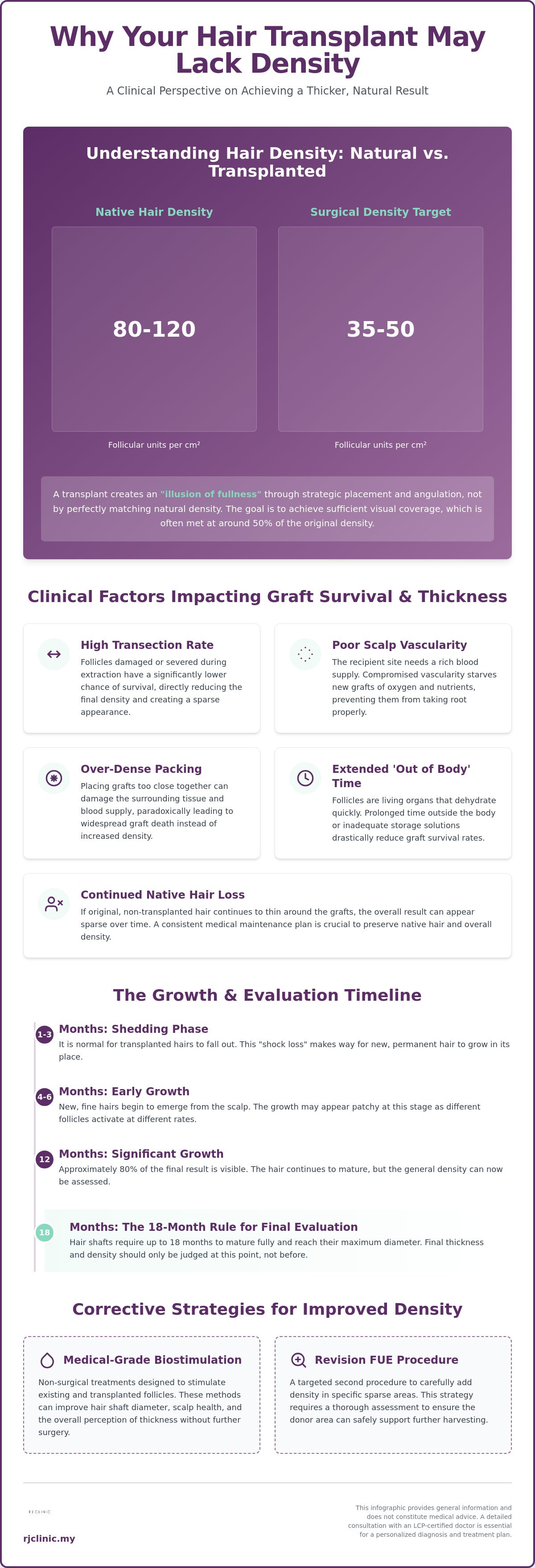
A common misconception in hair restoration is that we can perfectly replicate the density nature provided before hair loss began. In reality, a hair transplant procedure is an exercise in strategic redistribution. While natural scalp density typically ranges from 80 to 120 follicular units per square centimetre (cm²), surgical density usually targets 35 to 50 units per cm². This mathematical gap is why some patients feel their hair transplant not thick enough, especially under harsh overhead lighting or when the hair is wet. We aren't creating new hair; we're moving it from one location to another to create the best possible visual impact.
Surgeons bridge this gap by creating an "illusion of fullness." By placing grafts at specific angles and mimicking natural growth patterns, we ensure that hair shafts overlap one another. This overlapping effect covers the scalp more efficiently than a vertical placement would. If the angulation is off, or if the graft survival rate is lower than expected, the "see-through" effect becomes more prominent, leading to dissatisfaction with the final volume.
The Threshold of Visual Coverage
The human eye is surprisingly forgiving. Most people only begin to perceive thinning once they've lost approximately 50% of their original hair density. This is known as the 50% rule. Consequently, achieving 50% of natural density through a FUE hair transplant is often sufficient to satisfy the eye. However, the calibre or diameter of the hair shaft plays a larger role in volume than the sheer number of grafts. Fine hair requires more grafts to achieve the same visual impact as coarse hair. Additionally, high contrast between hair colour and skin tone can make even a successful transplant appear thinner than it is.
Donor Area Limitations
We must treat the donor area as a finite, non-renewable resource. The safe donor zone at the back and sides of the head contains a limited number of follicles that are genetically resistant to DHT. If a surgeon attempts to reach near-natural density in the recipient area, they risk over-harvesting the donor site. This results in a "moth-eaten" appearance that's difficult to correct. Dr. Renee and Dr. Cheok focus on balancing your immediate desire for density with the long-term reality of future hair loss, ensuring you don't exhaust your donor supply prematurely.
Clinical Reasons Your Hair Transplant May Look Thin
When a patient feels their hair transplant not thick enough, we must investigate beyond the numbers to the biological and technical variables of the surgery itself. One primary culprit is a high transection rate. This occurs when the hair follicle is damaged or severed during the extraction process, often due to improper punch alignment or excessive force. A damaged follicle may still be implanted, but its chances of survival are significantly diminished, leading to sparse results that don't match the initial graft count promised.
Scalp health is another critical, yet often overlooked, factor. The recipient site acts as the "soil" for the transplanted "seeds." If the vascularity or blood supply is compromised, the grafts cannot receive the oxygen and nutrients required to take root. Clinical reasons for thin hair transplants often include poor scalp perfusion, which can be exacerbated by technical errors like placing grafts too close together. This "over-dense packing" can actually starve the surrounding tissue of blood, leading to graft death rather than the intended fullness.
Biological and Technical Factors
Graft survival is also a race against time. Follicles are living organs; once removed from the body, they begin to dehydrate immediately. If the "out of body" time is too long or the storage solution is inadequate, the survival rate drops. Similarly, if the implantation depth is inconsistent, it leads to "pitting" where grafts are placed too deep, or "tenting" where they are too shallow. Both technical errors result in an unnatural, thin appearance. Lifestyle factors like smoking also significantly impair microcirculation, further hindering the healing process.
The Progression of Native Hair Loss
It's vital to distinguish between a failed transplant and the continued loss of original hair. If you don't adhere to a strict hair loss treatment plan involving medical maintenance, your native hair will continue to thin around the transplanted grafts. This creates a receding look behind the newly established hairline, making the overall density appear insufficient over time. During your consultation, Dr. Renee and Dr. Cheok evaluate whether your current thinness is a surgical failure or simply a progression of androgenetic alopecia that requires further medical intervention.
The Evaluation Process: Diagnosing the Growth Timeline
Patience is as much a part of the prescription as the surgery itself. One of the most frequent clinical observations we make is the premature anxiety patients feel during the first year of recovery. Judging whether a hair transplant not thick enough at the six-month mark often leads to unnecessary stress because the biological timeline of hair maturation is not yet complete. A comprehensive clinical overview of hair transplantation confirms that while initial growth begins early, the final diameter and texture of the hair shafts can take up to 18 months to fully manifest.
The Maturation Phase
The journey to full density moves through distinct stages. Between months four and eight, most patients experience the "ugly duckling" phase, where new hairs are fine, wispy, and may grow at irregular intervals. From months eight to twelve, you will notice a significant increase in hair calibre, as the shafts thicken and the texture begins to match your native hair. The period between month 12 and 18 is particularly crucial for the crown area. Because the scalp is tighter and blood supply is more distal in the crown, this region often matures several months behind the hairline.
To accurately assess the "yield," Dr. Renee and Dr. Cheok use trichoscopy, a high-magnification diagnostic tool. This allows us to see beneath the surface and determine if follicles are actively growing, dormant, or if there was a genuine technical failure in graft survival. When a patient reports their hair transplant not thick enough, this diagnostic step is essential to distinguish between a failed procedure and a late-maturing one. We calculate the percentage of transplanted grafts that have successfully emerged to determine if the sparse appearance is due to slow maturation or a low survival rate.
When to Seek a Professional Revision
There are specific clinical signs that indicate a need for intervention. If you notice persistent "patchy" growth or large gaps where no follicles have emerged by the 12-month mark, it may suggest a technical issue from the primary surgery. Before committing to a second session, we must carefully evaluate your remaining donor health to ensure another extraction won't cause visible thinning in the safe zone. If you are concerned about your progress, exploring hair loss treatment options at RJ Clinic can help bridge the gap between surgical results and your aesthetic goals.
If your results haven't met your expectations, schedule a clinical assessment with Dr. Renee or Dr. Cheok to evaluate your graft yield and discuss a personalized refinement plan.
Corrective Strategies: How to Improve Your Hair Density
If you've reached the end of the recovery timeline and conclude that your hair transplant not thick enough, the clinical focus shifts from waiting to active refinement. The path forward depends on your remaining donor supply and the specific nature of the thinning. Many patients assume another surgery is the only answer, but we often see significant aesthetic improvement by addressing hair shaft diameter through non-surgical means before considering a second extraction session. At our practice in Kuala Lumpur, we prioritize a multi-layered approach that balances immediate visual results with long-term scalp health.
Non-Surgical Density Boosters
Medical-grade biostimulation uses your own growth factors to "wake up" dormant follicles and, more importantly, thicken the calibre of existing hairs. Treatments like Density RF play a vital role in optimizing scalp health and improving the environment for both native and transplanted hair. By increasing the diameter of each hair shaft even by a small percentage, the total volume of hair coverage increases exponentially. This approach is particularly effective for those with fine hair who want to avoid the risks of over-harvesting their donor area. We often combine these treatments with clinical-grade topicals to maintain the health of the surrounding native hair.
Planning a Second Transplant
When non-surgical options aren't enough to satisfy your aesthetic goals, a second FUE hair transplant at RJ Clinic can be planned to strategically fill gaps. We treat your donor area as a finite biological bank account; if you've already made a large withdrawal during your initial procedure, we must be meticulous with the remaining grafts. Dr. Renee and Dr. Cheok use "filler grafting" techniques to place new units in high-impact areas, such as the front-centre of the hairline, to maximize the visual illusion of thickness while preserving your remaining donor supply for the future.
For patients who want to eliminate the "see-through" effect under bright lights without further surgery, Scalp Micropigmentation (SMP) offers a sophisticated solution. This medical tattooing technique deposits pigment into the dermal layer to mimic the appearance of hair follicles, effectively reducing the contrast between the scalp and hair. Whether through surgical refinement, biostimulation, or SMP, the goal is a refined, natural result that stands up to clinical scrutiny and restores your self-confidence.
Restoring Density Through Clinical Precision
A hair transplant not thick enough is rarely the end of the road; it's often an indication that your restoration strategy requires clinical refinement. By shifting the focus from sheer graft numbers to hair shaft maturation and scalp vascularity, we can often bridge the gap between a sparse result and the robust, sophisticated density you originally envisioned. This process begins with a precise diagnosis of your current graft yield and an honest assessment of your remaining donor bank; you can also discover The Hair Clinic for more detailed clinical insights into FUE density benchmarks.
Dr. Renee and Dr. Cheok bring a meticulous, doctor-led approach to every revision, utilizing advanced scalp diagnostics to ensure any further intervention is both safe and effective. As LCP-certified physicians with specialized experience in complex FUE cases, they prioritize the long-term health of your hair as much as the immediate aesthetic outcome. You don't have to settle for results that fall short of your expectations.
Book a Clinical Evaluation with Dr. Renee or Dr. Cheok to explore a personalized path toward a more confident, natural-looking restoration.
Frequently Asked Questions
Is it normal for a hair transplant to look thin at 6 months?
It is entirely normal and expected for a hair transplant to appear sparse at the six-month mark. At this stage, you're typically seeing only about 40% to 50% of the final hair count, and the hairs that have emerged are often fine and immature. You'll need to wait until the 12 to 18-month window to see the full diameter and textural maturity of the shafts.
Can I get a second hair transplant if the first one is not thick enough?
Yes, a second procedure is a common solution when a patient feels their initial hair transplant not thick enough. However, we must first confirm that your donor area has sufficient follicular units to allow for a second extraction without causing visible thinning at the back. We typically recommend waiting at least one full year to assess the final yield of the first surgery before committing to a revision.
Will my transplanted hair get thicker over time?
Transplanted hair undergoes a maturation process where the hair shaft diameter increases significantly over the first year. The initial hairs that emerge from the scalp are often vellus-like or baby hairs. As the blood supply to the new follicle stabilizes, the hair transitions into a terminal state, becoming coarser, darker, and more robust in texture.
How many grafts do I need for a thick-looking hairline?
The number of grafts required is highly individualized, but a standard hairline reconstruction typically involves between 1,500 and 2,500 grafts. The goal isn't just a high number; it's about the density per square centimetre. If you have fine hair, you may require a higher graft count to achieve the same visual coverage as someone with coarse hair.
Does smoking or diet affect the thickness of my hair transplant?
Smoking is clinically proven to impair microcirculation, which limits the oxygen and nutrients reaching the newly implanted follicles. This can lead to stunted growth or poor shaft quality. Similarly, a diet deficient in protein, iron, or zinc can slow the maturation phase, making the hair appear thinner than it should be during the first year of recovery. For patients seeking to optimize their metabolic health to support these results, Dr. Renato Lobo offers expert guidance on nutrition and hormonal balance.
What is the difference between poor graft survival and shock loss?
Poor graft survival refers to the permanent failure of transplanted follicles to take root, often due to technical issues or poor aftercare. Shock loss is the temporary shedding of existing native hair triggered by the trauma of surgery. While shock loss usually resolves within three to four months as the native hair regrows, poor graft survival results in permanent gaps that may require a revision session.


Comments