


Hair Transplant Recovery Day by Day: A Clinical Timeline for Optimal Results (2026)

Updated: Jul 13

Many patients arrive for their consultation focusing on the hours spent in the surgical suite, yet the success of a follicular unit extraction depends almost entirely on the biological window of the first fourteen days. It's a common misunderstanding that once the grafts are placed, the technical work is over. In reality, navigating your hair transplant recovery day by day is a delicate process where daily discipline dictates whether those follicles thrive or fail. Small mistakes, like an accidental graze or improper washing, can compromise the final density before the hair even has a chance to grow.
We recognize the anxiety that comes with every itch or bead of sweat, particularly when navigating the heat and humidity of Kuala Lumpur. This clinical timeline provides the clarity you need to protect your investment and manage the "ugly duckling" phase with confidence. You'll understand exactly how to manage the scalp during the critical first seventy-two hours, what to expect when the inevitable shedding begins, and how to safely transition back into your professional routine. Following these medically vetted milestones allows you to move through the healing process with a sense of calm, knowing that each change is a predictable step toward a natural and refined result.
Table of Contents
The Critical First 72 Hours: Graft Stabilization and the Inflammatory Cascade
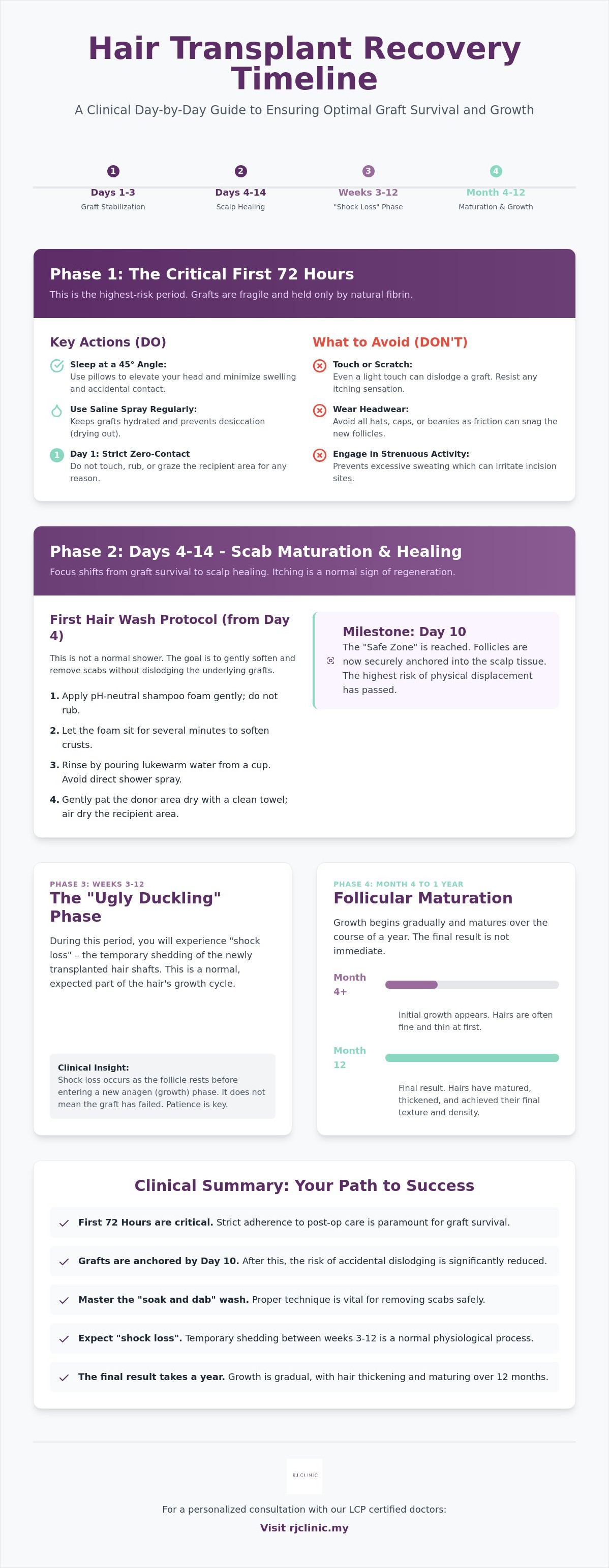
The success of an FUE hair transplant is not determined in the surgery room, but in the immediate 72 hours that follow. During this window, the newly implanted follicles are in a state of biological transition. They have been disconnected from their primary blood supply and placed into a recipient site where they rely on a process called plasma imbibition for survival. Because the grafts are held in place only by the natural glue of fibrin and blood clots, this is the highest-risk period for accidental displacement. Understanding your hair transplant recovery day by day starts with recognizing that these grafts are essentially floating until the body begins the process of neovascularization, or re-establishing blood flow.
You will notice a pinkish or reddish hue across the recipient area. This is a normal inflammatory response, indicating that the body is sending white blood cells and nutrients to the tiny incisions to begin the healing process. To support this, we provide a sterile saline spray. Its role is twofold: it prevents follicular desiccation, or the drying out of the graft, and maintains a hydrated environment that encourages cellular migration. Neglecting this spray can lead to excessive crusting, which can jeopardize the delicate graft-host interface.
Beyond standard topical care, some patients choose to enhance cellular repair through specialized oxygen treatments. Researching Per-session medical hyperbaric oxygen therapy fees at a facility like KLO2 Medspa can provide insight into how this advanced therapy can be integrated into your early recovery phase to support tissue regeneration.
Day 1: The Immediate Physiological Response
On the first day, the primary focus is stabilization. As the local anesthesia wears off, you may experience a tight or tingling sensation across the scalp. In the donor area, minor pinpoint bleeding is expected as the small extraction sites begin to close. Dr. Renee and Dr. Cheok emphasize a strict zero-contact policy for the recipient site during these first 24 hours. Even a light graze from a fingernail or a towel can dislodge a graft. Sleep posture is equally vital; resting at a 45-degree angle helps manage fluid drainage and prevents the scalp from rubbing against pillows. This elevation is a non-negotiable step in modern hair transplantation protocols to minimize post-operative complications.
Days 2-3: Peak Swelling and Early Crusting
By the second and third days, the inflammatory fluid and residual anesthesia begin to migrate. Due to gravity, this swelling often moves from the forehead toward the periorbital region, sometimes causing temporary puffiness around the eyes. While this can look concerning, it's a physiological necessity as the lymphatic system clears the fluids. You will also see the formation of small crusts or scabs around each graft. Healthy crusts are tiny, dry, and firmly attached; they should never be picked or scratched. During this phase, it's essential to avoid any headwear, including loose hats, as the friction can snag the grafts. Maintaining a controlled environment, especially in the humid climate of Kuala Lumpur, helps prevent excessive sweating that might irritate the fresh incision sites.
Days 4 to 14: Scab Maturation and the 'Safe Zone' Transition
Transitioning from the high-risk stabilization phase, days four through fourteen represent a period of structural integration. This is where the hair transplant recovery day by day moves from graft survival to scalp healing. The donor area extraction sites, which were pinpoint wounds on day one, now begin to epithelialize and close. You'll likely experience some tightness in the back of the head and an itch in the recipient area. This itching is a positive sign of the inflammatory cascade subsiding and nerves regenerating, but it requires discipline. Scratching at this stage can still cause micro-trauma to the follicle, potentially impacting the final density.
The Clinical Protocol for Your First Hair Wash
We typically recommend the first wash around day four. This isn't a standard shower; it requires a "soak and dab" technique using a pH-neutral shampoo. You should create a foam in your hands or a cup and gently lay it over the recipient area, allowing it to sit for several minutes to soften the scabs. Never let the showerhead spray directly onto the grafts. Instead, use a cup to pour lukewarm water over the area with minimal force. By day 10, the grafts are physically part of the scalp tissue. This milestone marks the end of the highest-risk period for displacement. For a deeper look at the technical aspects of this procedure, you can consult our Hair Transplant Malaysia: A Clinical Guide.
Environmental Protection in the Malaysian Climate
The hair transplant recovery process requires extra vigilance in tropical climates. In Kuala Lumpur, the combination of high humidity and heat can lead to excessive perspiration. Sweat contains salts and bacteria that can irritate fresh incisions and potentially lead to folliculitis if not managed correctly. We advise staying in air-conditioned environments as much as possible during the first ten days to keep the scalp cool and dry. Additionally, UV protection is critical. Sunburn on a healing scalp can cause permanent pigment changes and damage the follicles. Avoid direct sunlight and don't wear hats until after the 10-day mark; if you must go outside, use an umbrella for shade. If you have concerns about how your skin is reacting to the heat, our team can provide a personalized assessment of your FUE hair transplant progress.
Weeks 3 to 12: Navigating the 'Ugly Duckling' Phase and Shock Loss
The period between the third week and the third month is often the most psychologically challenging part of the hair transplant recovery day by day. During this window, the majority of the transplanted hair shafts will shed. This is a physiological phenomenon known as shock loss, or telogen effluvium. It's essential to understand that while the visible hair falls away, the follicular bulb remains safely anchored beneath the skin. This phase earns its "ugly duckling" moniker because the scalp may appear patchy, red, or even thinner than it was before the procedure. This is not a sign of failure; it's a necessary reset of the hair's growth cycle.
According to clinical hair transplant guidelines, this shedding occurs as the follicles transition from the trauma of transplantation into a resting phase. You might also notice some small, red bumps similar to acne. This is typically mild folliculitis, occurring as new, fine hairs attempt to breach the skin surface. While it can be tempting to pick at these, doing so risks infection. We recommend using warm compresses and maintaining strict scalp hygiene to allow these shafts to emerge naturally. If you're concerned about the rate of shedding or scalp irritation, you can explore our hair loss treatment options to support follicular health during this dormant period.
Why Shedding is a Sign of Success
Shedding indicates that the follicle is preparing to enter the anagen, or growth, phase with a new, stronger hair shaft. It's a biological clearing of the old to make way for the new. Interestingly, some patients also experience temporary thinning in the donor area. This is a sympathetic response to the surgical intervention and almost always resolves as the scalp's vascular system stabilizes. Dr. Renee and Dr. Cheok monitor these transitions closely during follow-up appointments to ensure the scalp environment remains conducive to high-density regrowth.
Resuming Physical Activity and Lifestyle
By week four, the structural integrity of the recipient area is sufficient to resume most lifestyle activities. You can typically return to heavy lifting and cardiovascular exercise, though we advise caution with contact sports that involve direct head impact until at least week eight. If you're a cyclist or motorcyclist, it's now safe to wear helmets, provided they don't cause excessive friction on the recipient sites. Maintaining a clean scalp remains a priority; sebum buildup can clog pores and hinder the emergence of new hairs. If you're ready to optimize your regrowth with professional guidance, book a consultation for an FUE hair transplant assessment to ensure your recovery is on the ideal clinical trajectory.
Month 4 to One Year: Follicular Maturation and the Final Result
The shift from dormancy to the anagen growth phase begins in earnest around month four. While the previous weeks of your hair transplant recovery day by day were defined by clinical patience, this stage is characterized by visible, tangible progress. You'll notice fine, vellus-like hairs appearing across the recipient area. These initial hairs often possess a wiry or slightly frizzy texture. This occurs because the follicle is still adjusting to its new placement and the sebaceous glands have not yet fully integrated with the new shaft. Over the subsequent months, as the hair caliber thickens and the follicle matures, this texture naturally softens to match your native hair.
By the eight-month mark, density reaches a critical threshold where styling becomes possible. Most patients observe approximately 80% of their total growth by this stage, allowing for a significant return to social and professional confidence. The final maturation of the hair shaft and the complete settling of the hairline continue until the 12 to 18-month mark. This timeline is biologically fixed. While individual healing rates vary slightly, the physiological process of follicular maturation requires this full cycle to achieve its peak aesthetic potential.
Optimizing Density and Long-term Growth
We often recommend clinical interventions to support the maturing follicles during this window. The role of adjuvant therapies like Density RF in thickening new growth is significant, as it utilizes radiofrequency energy to stimulate the vascular environment surrounding the follicles. 100% of the final aesthetic result is typically visible by month 12. During your one-year review, we also evaluate the donor area to ensure the extraction sites have healed with the subtle, organic appearance that is the hallmark of a successful FUE procedure. Maintaining scalp health through this entire year ensures that the donor area remains natural and indistinguishable from non-treated zones.
The RJ Clinic Commitment to Subtle Results
Our philosophy centers on restoration that stands the test of time. Dr. Renee and Dr. Cheok design hairlines that age naturally with the patient, prioritizing a conservative and artistic approach over aggressive, artificial-looking placements. This foresight ensures that as your facial structure changes over the decades, your transplant remains a seamless part of your appearance. Regular follow-up appointments are essential to track follicular health and address any concerns regarding density or texture. For those seeking a permanent solution to thinning, the FUE hair transplant at RJ Clinic offers a sophisticated, medically-led journey toward a refined and natural result.
Securing Your Aesthetic Investment through Clinical Precision
Navigating your hair transplant recovery day by day is a journey that requires both clinical precision and personal patience. The most critical takeaway is that while the surgical placement is the foundation, your adherence to post-operative protocols during the first fourteen days dictates the ultimate survival of those grafts. Whether it's managing the initial inflammatory response or understanding that the shedding phase is a biological necessity for new growth, being informed allows you to recover with a sense of calm and confidence.
Our approach at RJ Clinic combines the expertise of LCP-certified aesthetic physicians with the precision of FDA-approved FUE technology. We don't just perform a procedure; we provide personalized post-operative care protocols tailored to your unique healing profile and the specific environmental factors of Kuala Lumpur. This ensures that every stage of maturation, from the first fine hairs to the final dense result at one year, is monitored with professional rigor to achieve a subtle, organic look.
Schedule a clinical consultation with Dr. Renee or Dr. Cheok today to discuss a customized plan for your hair restoration. We're committed to ensuring your path to a natural and refined aesthetic is supported by expert partnership at every milestone.
Frequently Asked Questions
When can I sleep normally after a hair transplant?
You can typically return to your preferred sleeping position after the 10th to 14th day. During the initial phase of your hair transplant recovery day by day, it's mandatory to sleep at a 45-degree angle using a travel pillow. This elevation prevents the recipient area from making direct contact with bedding and facilitates the drainage of inflammatory fluids, which minimizes periorbital swelling. By the end of the second week, the follicular units are sufficiently anchored into the dermis to withstand standard nocturnal movement.
Is it normal for my scalp to feel numb several weeks after the FUE procedure?
Temporary numbness, or hypesthesia, is a standard physiological response that can persist for several weeks or even months. This occurs because the extraction and implantation processes temporarily disrupt the microscopic cutaneous nerve endings within the scalp. As these nerves regenerate, you may experience a "pins and needles" sensation before full feeling returns. It's a routine part of the healing cascade and rarely indicates any long-term neurological concern.
What should I do if I accidentally hit my head during the first week?
If you sustain a head impact during the first seven days, you should immediately inspect the site for pinpoint bleeding or the visible loss of a graft. Please contact our clinic for a clinical assessment so Dr. Renee or Dr. Cheok can evaluate the trauma. Because the first 72 hours represent the peak window for graft displacement, any physical trauma during this time requires professional verification to ensure the surrounding follicles haven't been compromised.
Can I use a hairdryer or style my hair during the first month of recovery?
You should avoid using a hairdryer or chemical styling products for at least four weeks post-procedure. Intense heat can damage the sensitive, healing follicles and lead to graft desiccation, while styling agents may cause irritation or trigger folliculitis. If you must use a hairdryer after the first month, ensure it's set to the "cool" setting and held at a significant distance from the scalp to protect the maturing hair shafts.
How do I know if my hair transplant has failed during the shedding phase?
It's impossible to determine if a transplant has failed during the shedding phase, as the loss of the hair shaft is a required biological step for new growth. This "shock loss" occurs in nearly all patients between weeks three and twelve. A genuine failure can only be diagnosed after the 12-month mark if there's a lack of regrowth. Following a medically precise hair transplant recovery day by day ensures you don't mistake this successful transition for a clinical failure.
When is it safe to swim in a chlorinated pool or the ocean after FUE?
You should wait at least four weeks before swimming in chlorinated pools or the ocean. Chlorine is a harsh chemical that can irritate healing incisions and cause excessive scalp dryness, while seawater may contain bacteria that increase the risk of infection. Ensuring the scalp is fully epithelialized and the inflammatory phase has completely subsided is essential before exposing the delicate recipient area to these environments.


Comments