


Hair Transplant Malaysia: A Clinical Guide to FUE and Permanent Restoration (2026)

Updated: Apr 29

A dense hairline is often viewed as the ultimate goal of restoration, yet density without artistry is precisely what creates the unnatural, "pluggy" appearance most patients dread. When researching a hair transplant Malaysia, you've likely spent hours comparing the technicalities of FUE and DHI, perhaps feeling more overwhelmed by conflicting jargon than when you first began your research. It's common to worry that the transition from a receding line to a full head of hair will be obvious to colleagues or that the downtime will disrupt your professional life in Kuala Lumpur.
In this clinical guide, we'll clarify how modern protocols at RJ Clinic prioritize follicular precision and bespoke design to ensure your results are both permanent and undetectable. Dr Renee and Dr Cheok believe that a successful procedure isn't just about moving hair; it's about the strategic placement that respects your natural growth patterns. We'll examine the 2026 standards for graft survival, the transparent factors influencing total cost, and the specific suitability criteria we use to guarantee a natural, sophisticated outcome.
Key Takeaways
Understand the clinical logic of distinguishing permanent androgenetic alopecia from temporary thinning, specifically how the Malaysian climate and lifestyle factors influence scalp inflammation.
Explore the aesthetic artistry behind FUE, where the precision of graft angle and depth is tailored to create a bespoke hairline that mirrors your natural growth pattern and facial structure.
Evaluate your suitability for a hair transplant malaysia by assessing donor area quality and understanding why medical management is often prioritized over surgery for younger patients.
Learn how to identify LCP-certified clinics in Kuala Lumpur to ensure your procedure is performed by qualified practitioners like Dr Renee or Dr Cheok rather than unlicensed technicians.
Table of Contents
Understanding Hair Loss and the Evolution of Restoration in Malaysia
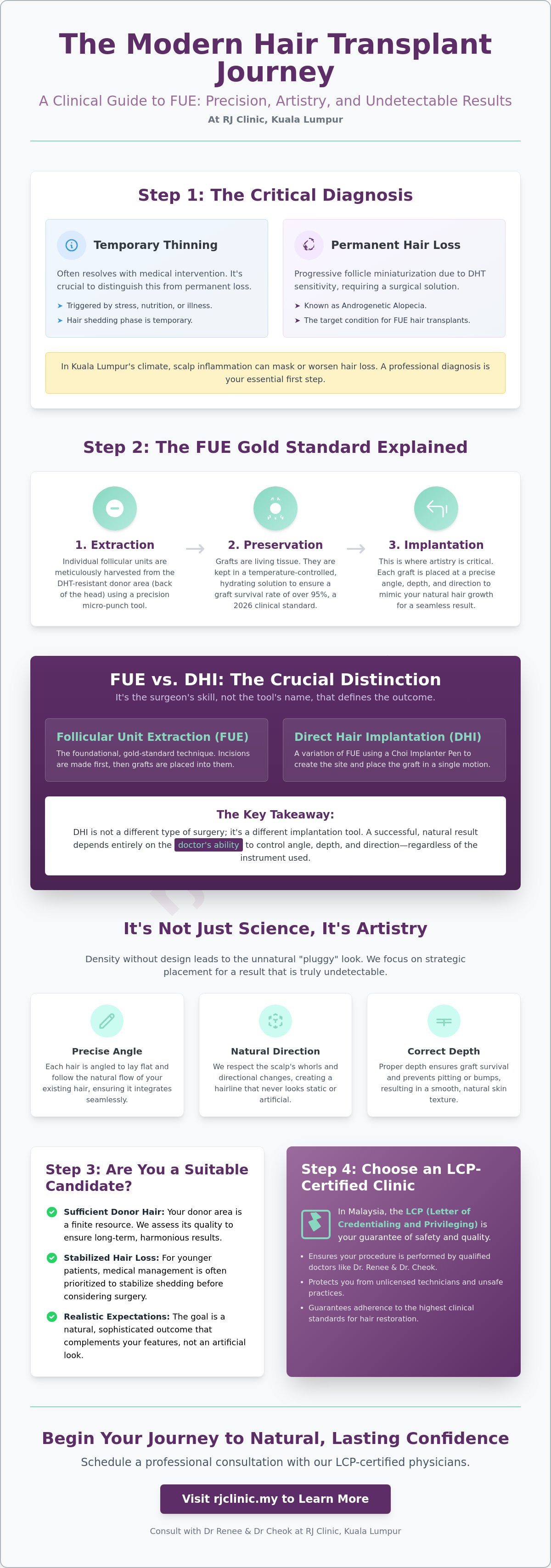
Patients often walk into our consultation rooms at RJ Clinic unable to distinguish between a temporary shedding phase and the onset of permanent hair loss. It's a critical distinction. Temporary thinning, often triggered by stress or nutritional gaps, typically resolves with medical intervention. Permanent androgenetic alopecia, however, involves the progressive miniaturization of follicles due to genetic sensitivity to dihydrotestosterone (DHT). In the tropical humidity of Kuala Lumpur, scalp inflammation caused by excess sebum and sweat can often mask or exacerbate these underlying conditions, making a professional clinical diagnosis the first step toward any hair transplant malaysia journey.
The field has evolved significantly from the days of Follicular Unit Transplantation (FUT), where a strip of scalp was surgically removed, leaving a linear scar. Modern restoration focuses on minimally invasive techniques that prioritize both the donor area's health and the recipient's aesthetic naturalism. At RJ Clinic, Dr Renee and Dr Cheok emphasize that a "one-size-fits-all" approach is clinically unsound in a diverse population. A Chinese patient's straight, coarse follicles require different extraction angles and depths than the finer or more textured hair profiles found in our multi-ethnic community. Precision is the only way to ensure the redistributed hair integrates seamlessly with existing growth patterns.
The Mechanism of Follicular Unit Extraction (FUE)
The gold standard for modern restoration is Follicular Unit Extraction (FUE), a technique where individual follicular units are harvested directly from the donor zone, typically the back of the head where hair is genetically resistant to balding. Once extracted, the survival of these grafts depends entirely on meticulous handling. We maintain strict protocols for temperature control and hydration to ensure maximum viability before implantation. FUE is a scarless, precision-based method of redistribution. This approach allows for a faster recovery, often letting patients return to their routine within a few days without the burden of visible sutures.

FUE vs. DHI: Debunking the Jargon
There's often confusion surrounding Direct Hair Implantation (DHI). It's important to clarify that DHI isn't a different surgery; it's a variation of FUE that utilizes a specialized tool called a Choi Implanter pen. While the tool allows for simultaneous site creation and graft placement, the clinical outcome doesn't depend on the brand of the device. Instead, it relies on the doctor’s skill in controlling the angle, depth, and direction of every single hair. For many patients, a comprehensive hair loss treatment plan involving topical or oral therapies is recommended months before considering a hair transplant malaysia to stabilize shedding and optimize the donor site. We prioritize the hand's artistry over the tool's marketing, ensuring each graft is placed to mimic the natural flow of your original hairline.
The Science of FUE: Balancing Surgical Precision with Aesthetic Artistry
Many patients approach a hair transplant malaysia consultation focusing solely on the number of grafts they require. However, the success of a procedure isn't determined by quantity alone; it's defined by the surgical logic of placement and the physician's ability to anticipate how hair behaves over time. A hairline that appears dense but ignores the natural "flow" of the scalp will always look artificial. At RJ Clinic, we view the donor area as a finite resource that must be managed with long-term strategy, ensuring that the results remain harmonious as the patient ages.
The technical execution of FUE involves more than just extraction. The angle, depth, and direction of each incision determine whether the new hair will lay flat or stand at an awkward, unnatural angle. This level of detail is a cornerstone of Modern Surgical Hair Restoration Techniques, which have moved away from the "plug" looks of the past toward microscopic refinement. Dr Renee and Dr Cheok, both LCP-certified physicians, personally supervise the entire process to ensure that the extraction doesn't over-harvest the donor site, which could lead to visible thinning in the back of the head.
Bespoke Hairline Design for Men and Women
Designing a hairline requires an understanding of gender-specific facial geometry. Men typically require a defined temporal peak to maintain a masculine profile, while women often benefit from a softer, more rounded transition that minimizes the forehead. We utilize a "feathering" technique at the leading edge, where only the finest single-hair grafts are placed to mimic the natural graduation of a hairline. For those seeking to enhance facial symmetry beyond the scalp, an eyebrow hair transplant applies these same meticulous micro-grafting principles to restore thinning or over-plucked brows.
Maximizing Graft Survival Rates
The "take rate" or survival of the follicles is heavily influenced by how long the grafts remain outside the body. Dr Renee and Dr Cheok utilize specialized, chilled holding solutions to keep the follicles hydrated and viable during the transition. Once implanted, the graft relies on the scalp's blood supply to "root" effectively. To optimize this environment, we often discuss the synergy between PRP and hair transplants, as the concentrated growth factors can accelerate healing and improve the vascularization of the newly placed hair.
Managing expectations is vital, especially for patients in advanced stages of balding. If you're at a Norwood Scale 6 or 7, the goal often shifts from total density to strategic coverage. We prioritize the frontal hairline and mid-scalp to create a visual frame for the face, ensuring the most impactful areas receive the highest concentration of grafts. If you're ready to discuss a tailored plan for your restoration, you can book a clinical assessment with our team to explore your options.
Evaluating Suitability: Are You a Candidate for a Hair Transplant?
A common misconception we encounter during consultations is the belief that a hair transplant creates new hair. In clinical reality, the procedure is a redistribution of your existing "hair capital." We move healthy, DHT-resistant follicles from a donor site to the thinning areas. If your donor area, typically the back and sides of the head, lacks sufficient density or hair quality, the results may not meet your aesthetic goals. Dr Renee and Dr Cheok prioritize a thorough scalp analysis to ensure you have enough "currency" to achieve the look you desire without over-harvesting the donor zone.
Age is another critical factor in our decision-making process. We often advise patients under the age of 25 to delay surgery in favor of medical management. At this stage, your final hair loss pattern hasn't fully revealed itself. Performing a hair transplant malaysia too early can result in an unnatural "island" of hair if the native hair around the transplant continues to recede. We also screen for medical contraindications such as active scalp inflammation or systemic issues like uncontrolled diabetes, which can impair the healing of the delicate micro-incisions.
The Norwood Scale and Planning Your Restoration
The Norwood Scale provides a standardized roadmap for hair restoration, ranging from Stage 1 (minimal recession) to Stage 7 (severe loss). A Stage 3 patient might require approximately 1,800 to 2,200 grafts to restore a receding hairline. However, a Stage 5 patient might need over 4,000 grafts to cover both the front and the crown. These requirements directly influence the total investment, as clinics in Kuala Lumpur often structure their fees based on graft volume. For a detailed breakdown of how these clinical stages impact your budget, you can review our guide on hair transplant cost in the local market.
Recovery and Post-Operative Expectations
The success of your hair transplant malaysia depends heavily on the first 72 hours after the procedure. During this window, the newly implanted grafts are fragile and haven't yet established a secure blood supply. Any friction or pressure can displace them. You'll need to follow a specific washing protocol and sleep at a 45-degree angle to minimize swelling.
Patients should also prepare for the "Shock Loss" phase, which typically occurs between weeks two and eight. This is a temporary shedding of the transplanted hair shafts. It's a natural physiological response, and it doesn't mean the follicles are dead. Real growth typically begins around month four, with the final, high-density results appearing between 12 and 18 months. Patience isn't just a virtue in hair restoration; it's a clinical requirement.
If you're ready to determine if your donor density is sufficient for a permanent restoration, schedule a clinical scalp assessment with our LCP-certified doctors.

Navigating the Consultation: Choosing an LCP-Certified Clinic in Kuala Lumpur
Many patients arrive for a consultation assuming that a general medical degree is the only prerequisite for performing a hair transplant malaysia. In reality, the technical precision required for follicular unit extraction necessitates a specific validation from the Ministry of Health Malaysia known as the Letter of Credentialing and Privileging (LCP). This certification is the gold standard for aesthetic practitioners; it ensures your doctor has undergone rigorous training and adheres to the safety protocols required to manage both the surgical and aesthetic aspects of your restoration.
During your clinical assessment, you should move beyond basic pricing questions and focus on the technical execution of the procedure. A critical question to ask is who actually performs the extractions and the site creation. In some high-volume clinics, these vital steps are delegated to technicians, which can lead to poor graft survival or an unnatural growth direction. You should also scrutinize before-and-after galleries for consistency. Look specifically at the hairline design; a successful transplant doesn't just add density, it mimics the irregular, soft transition of a natural hairline without appearing as a straight, artificial row of grafts.
A successful outcome also depends on a long-term partnership with your clinical team. A hair transplant is a permanent restoration of specific areas, but it doesn't stop the biological progression of androgenetic alopecia in non-transplanted follicles. Your doctor should provide a clear roadmap for post-operative follow-ups and a maintenance plan to protect your existing hair, ensuring the results remain seamless as you age.
The RJ Clinic Approach to Hair Restoration
Dr Renee and Dr Cheok prioritize a philosophy of subtle, natural enhancement. They combine surgical expertise with a holistic view of scalp health, ensuring the donor area remains healthy while the recipient site achieves optimal density. Our KL branches utilize FDA-approved technologies to maintain the highest safety standards during every FUE hair transplant. By integrating surgical intervention with bespoke long-term maintenance plans, we help you achieve a rejuvenation that looks authentic from every angle.
Next Steps: Booking a Clinical Assessment
Your journey begins with a comprehensive scalp analysis at RJ Clinic. During this session, we evaluate your donor hair density, scalp elasticity, and the specific pattern of thinning to determine your suitability for the procedure. We focus on customizing a treatment plan that fits your professional schedule and aesthetic goals, ensuring you understand the trade-offs and expected timelines for growth. Consult with our LCP-certified doctors for a bespoke hair restoration plan tailored to your needs.
Your Trajectory Toward Lasting Hair Density
Restoring a youthful profile requires more than the mechanical transfer of follicles; it demands a sophisticated blend of surgical precision and aesthetic intuition. When we evaluate patients at the clinic, we prioritize the long term viability of the donor area and the natural flow of the new hairline. A successful hair transplant malaysia isn't defined by density alone, but by how seamlessly the restoration integrates with your existing features. Choosing an LCP-certified physician ensures that your procedure adheres to rigorous safety standards while utilizing FDA-approved technologies designed for graft survival.
The transition from thinning to a full head of hair is a clinical journey that starts with an accurate diagnosis of your scalp health. Dr Renee and Dr Cheok emphasize bespoke treatment plans because every patient's hair loss pattern is distinct. We believe that professional judgment and refined artistry are the most critical factors in achieving a result that looks authentic even under close inspection. Taking the first step toward restoration is a commitment to your self-confidence and your long term professional image.
We look forward to partnering with you on this transformative path toward a more confident and rejuvenated version of yourself.
Frequently Asked Questions
How much does a hair transplant cost in Malaysia in 2026?
Market data for 2026 indicates that a hair transplant in Malaysia generally costs between RM 8,000 and RM 30,000. Most premium clinics in Kuala Lumpur price their FUE services at RM 6 to RM 12 per graft. Your total investment depends on the graft count needed to achieve your desired density and the complexity of the restoration. We believe in transparent, bespoke pricing that reflects the clinical expertise and advanced technology required for a successful, natural result.
Is a hair transplant permanent, or will I need another one later?
The results of an FUE procedure are permanent because we harvest follicles from the occipital region, which is genetically programmed to resist hair loss. Once these follicles take root in their new location, they continue to grow for a lifetime. However, it's vital to remember that your native, non-transplanted hair may still be subject to natural thinning over time. Dr Renee typically integrates medical therapies into your post-operative care to maintain the density of your surrounding hair and prevent the need for future touch-ups.
How long is the downtime after an FUE hair transplant in KL?
You can expect a recovery period of approximately 3 to 7 days before returning to most social and professional obligations. While the physical incisions from an FUE hair transplant in KL heal quickly, small scabs will form around the grafts and usually shed within a week. We provide a detailed aftercare kit to accelerate healing and ensure the scalp remains hydrated. Most patients find they can resume intense gym sessions or contact sports after 14 days of careful protection.
Does a hair transplant procedure hurt?
The procedure isn't painful as we utilize localized numbing agents to ensure you remain comfortable throughout the day. The only sensation you'll likely feel is the initial administration of the anesthetic, which feels like a few brief pinpricks. Many patients find the experience quite relaxing and even nap during the graft placement phase. After the numbing wears off, any slight tenderness is manageable with mild pain relief, and most discomfort vanishes within 48 hours.
Can I get a hair transplant if I have very thin hair at the back of my head?
Having thin donor hair doesn't automatically disqualify you, but it does require a more strategic clinical approach. If the hair at the back of your head is sparse, Dr Cheok will assess whether we can achieve your aesthetic goals without compromising the donor site's appearance. We prioritize a natural look and will never over-harvest an area. In some instances, we might recommend a more conservative hairline or combine the transplant with other rejuvenation therapies to enhance the overall visual density.
What is the success rate of FUE hair transplants at RJ Clinic?
At RJ Clinic, we consistently achieve graft survival rates exceeding 95% through refined handling and temperature-controlled storage of follicles. A successful hair transplant malaysia outcome relies on both technical precision and the doctor's artistic eye for graft orientation. We focus on a bespoke approach for every patient, ensuring that the transplanted hair blends seamlessly with your existing features. Our commitment to using FDA-approved technologies and rigorous medical standards remains the cornerstone of our high patient satisfaction levels.


Comments