


PRP vs Hair Transplant vs Hair Filler: A Doctor’s Guide to Hair Restoration in KL

Updated: Apr 16

A patient named Ahmad*(name changed to protect patient privacy) sat in my consultation room at RJ Clinic, expressing a frustration I hear at least 15 times a week. He was tired of seeing his scalp through thinning hair but felt paralyzed by the conflicting advice he found online. When weighing prp vs hair transplant vs hair filler, it's easy to feel overwhelmed by technical jargon and the fear of a "pluggy" or unnatural result. You've likely spent months researching, yet you're still unsure which injectable or surgical route actually restores a youthful hairline without months of downtime.
I understand that hair loss isn't just a cosmetic concern; it's a deeply personal journey that affects your confidence during every board meeting or social gathering in Kuala Lumpur. My goal is to help you move past the confusion and discover a bespoke solution tailored to your specific stage of thinning. In this guide, I'll break down the scientific differences between prp, hair transplant and hair filler for hair restoration. I'll provide a clear timeline for maintenance and the clinical insights needed to achieve a thick, natural look that stands the test of time.
Key Takeaways
Understand the biological mechanisms behind hair follicle miniaturization to determine whether your restoration journey requires cellular stimulation or surgical replacement.
Gain clinical clarity on the comparison of prp vs hair transplant vs hair filler by matching bespoke solutions to your specific stage on the Norwood or Ludwig hair loss scales.
Distinguish between common industry myths and medical realities to ensure your chosen path offers sustainable, natural-looking density rather than a temporary aesthetic fix.
Identify the essential criteria for selecting LCP-certified aesthetic physicians in Kuala Lumpur to ensure your hair restoration journey prioritizes both clinical excellence and safety.
Table of Contents
The Science of Hair Loss and the Three Pillars of Restoration
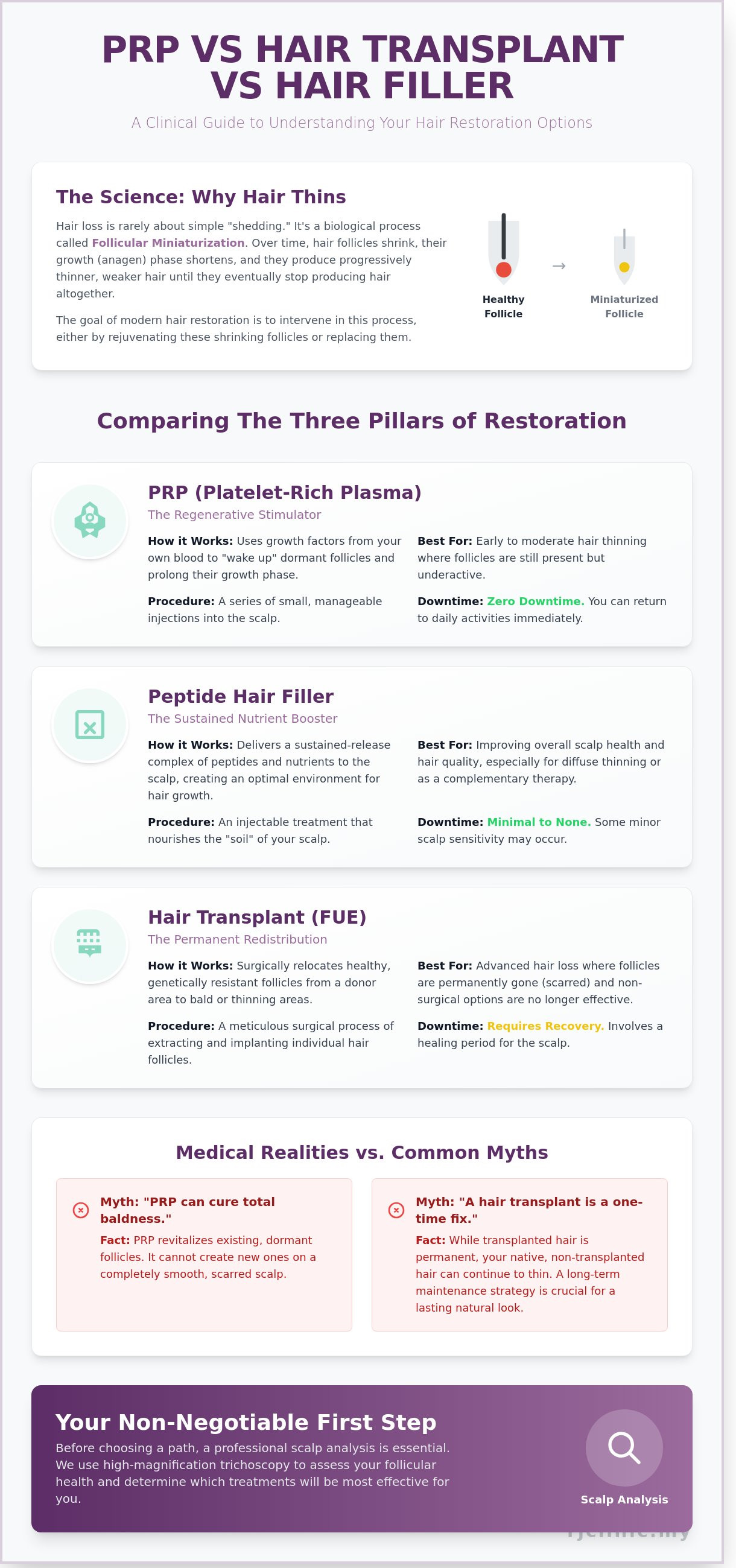
When you notice your scalp becoming more visible under the bright lights of a Kuala Lumpur boardroom, it is rarely just a matter of "shedding." In my practice, I find that most patients are dealing with a fundamental disruption of the hair growth cycle. Hair follicles do not simply vanish overnight. Instead, they undergo a transition where the anagen, or growth phase, becomes shorter while the telogen, or resting phase, extends. For high-performing professionals in KL, this thinning is more than a cosmetic nuisance; it often impacts self-perception and executive presence in high-stakes environments.
Effective restoration relies on three distinct clinical pillars: regenerative, peptide-based, and surgical. Choosing between prp vs hair transplant vs hair filler depends entirely on the current state of your follicular health and your long-term goals. Regenerative treatments like Platelet-Rich Plasma (PRP) utilize your own growth factors to "wake up" sluggish follicles. Peptide-based fillers provide a sustained release of nutrients to the scalp, while surgical options offer a permanent redistribution of hair. Follicular miniaturisation is the primary target of clinical hair therapy, representing the progressive shrinking of the follicle until it can no longer produce a visible hair strand.
I cannot stress enough that a professional scalp analysis is the non-negotiable first step in any hair loss treatment plan. We use high-magnification trichoscopy to determine if your follicles are merely dormant or if they have reached a stage of permanent scarring. If the follicle has scarred over, non-surgical injections will not yield results, and we must pivot toward more advanced interventions.

Why "Miracle" Tonics Often Fail Malaysian Patients
Many patients come to me after spending thousands of RM on over-the-counter "miracle" tonics that promised results in weeks. In Malaysia's intense humidity, these topical solutions often struggle to penetrate the skin. They frequently sit on the surface, mixed with sweat and environmental debris, rather than reaching the follicle bulb where they are needed. It is crucial to distinguish between temporary shedding, which might be triggered by stress or diet, and permanent follicle death; for those seeking professional guidance on clinical-grade support, you can discover Terra Medical and their hair growth supplements. Seeking medical-grade intervention early is vital because once a follicle has completely miniaturized and scarred, the window for non-surgical restoration closes.
The Role of Scalp Health in Treatment Success
I often use the analogy that you cannot grow a prize-winning garden in depleted soil. In an urban center like KL, your scalp is constantly battling high sebum production and microscopic pollution particles that can trigger micro-inflammation. This compromised environment significantly hinders the absorption of active ingredients. Before we proceed with injections or modern hair transplantation techniques like FUE, we must first stabilize the scalp. This preparation ensures that whether you choose a hair transplant or a series of bio-stimulating injections, the "soil" is ready to support and sustain new growth for years to come.
PRP, Hair Transplants, and Fillers: Debunking Common Myths
In my practice, I often encounter patients who believe PRP is a guaranteed cure for total baldness. It isn't. PRP relies on your body's own biological resources to stimulate existing follicles. If a follicle has completely miniaturized and the scalp is smooth, no amount of plasma will bring it back. Similarly, many assume a hair transplant is a "one and done" solution. While the transplanted hair is genetically resistant to thinning, your original hair surrounding the graft continues to age. Without a maintenance strategy, you might find yourself needing a second procedure years later as the native hair recedes. Understanding the nuances of prp vs hair transplant vs hair filler is the first step toward a successful restoration journey.
PRP (Platelet-Rich Plasma): The Regenerative Power of Your Blood
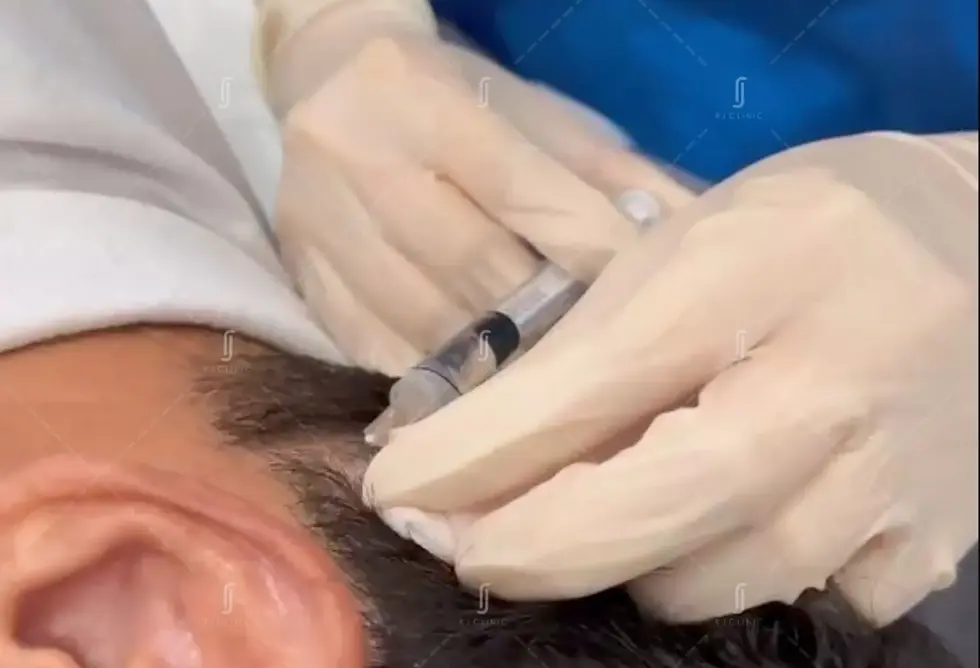
PRP uses a concentrated sample of your own blood to harvest platelets. We spin the sample in a centrifuge to isolate these regenerative cells, which are then injected back into the scalp. These autologous growth factors essentially wake up dormant follicles and push them back into the growth phase. The procedure, often nicknamed the "vampire" hair treatment, involves a series of small injections. Most of my patients describe the sensation as a mild pinching, easily managed with topical numbing. It's an ideal choice for those noticing early thinning, as it provides a subtle, natural-looking increase in density with zero downtime.
Hair Fillers: The Peptide Revolution in Scalp Care
Hair fillers are often confused with the dermal fillers used for facial contouring, but they operate on a completely different biological level. Instead of adding physical volume, they utilize biomimetic peptides. These are lab-engineered molecules designed to mimic the body's natural signaling system. The standout advantage of modern fillers is their sustained-release technology. While PRP provides a sudden burst of growth factors, hair fillers release active peptides slowly over a 14-day period. This makes them a preferred option for patients with low blood volume or those who want a standardized, potent dose of nutrients without the variability of biological samples.
FUE Hair Transplants: Relocating for Permanent Coverage
Follicular Unit Extraction (FUE) is a surgical approach where we relocate healthy follicles from a "donor site" at the back of the head to the thinning areas. I often have to debunk the myth of the "pluggy" look; modern surgical artistry allows us to mimic natural growth patterns with incredible precision. It is helpful to research the hair transplant procedure and results to manage expectations regarding graft survival and density. We focus heavily on donor site management to ensure the back of your head remains looking full even after extraction. You can learn more about our specific surgical techniques by exploring our hair-fue-transplant details. If you're ready to see which of these options aligns with your goals, scheduling a personalized assessment is the best way to move forward.
Choosing Your Path: A Framework for Hair Restoration Decisions
When I sit down with a patient in Kuala Lumpur, the first thing we do is identify where they sit on the Norwood or Ludwig scale. It's the medical roadmap for our clinical strategy. For those at Norwood Stage 2 or 3, we're often looking at preservation. However, if you've reached Stage 5 or higher, the conversation shifts toward reconstruction. Deciding between prp vs hair transplant vs hair filler isn't just about your budget; it's about the biological reality of your scalp and how much active hair you have left to work with.
The Best Fit for Early Thinning and Prevention
PRP and hair fillers function as a preventative shield. They essentially buy you time by revitalizing follicles that are struggling but still active. PRP is most effective when follicles are thinning but not yet absent. These are true lunchbreak procedures with zero downtime, which contrasts sharply with the surgical recovery needed for a transplant. I've seen that patients who start these treatments early often delay the need for a transplant by several years. It's a bespoke approach that focuses on keeping your natural density for as long as possible.
When is it Time for a Surgical Hair Transplant?
There's a point of no return where the follicle has completely miniaturized and the scalp becomes smooth. At this stage, non-surgical options won't bring back what's gone. A transplant is the only way to move hair from the permanent donor zone to the thinning crown or hairline. You'll need patience; after the procedure, the hair enters a resting phase, and you won't see the full density for about 9 to 12 months. For a comprehensive look at what we offer, you can explore our full range of hair loss treatment options.
I frequently recommend a hybrid approach to my patients. Using PRP alongside a transplant can significantly improve the survival rate of newly implanted grafts by providing a nutrient-rich environment for the follicles. In the Malaysian market, while a transplant requires a higher initial investment in RM, it provides a permanent solution. Conversely, PRP and fillers require ongoing maintenance sessions to sustain results. You're essentially choosing between a one-time surgical event or a long-term, non-invasive maintenance program that fits into a busy lifestyle. We aim for natural-looking results that empower you to feel your best without looking overdone.
Navigating Your Hair Restoration Journey in Kuala Lumpur

Deciding between prp vs hair transplant vs hair filler is a significant step toward reclaiming your confidence. In Malaysia, your primary focus should be on the qualifications of your provider. You must ensure your aesthetic physician holds a Letter of Credentialing and Privileging (LCP) issued by the Ministry of Health Malaysia. This certification isn't just a badge; it's your assurance that the doctor has met rigorous safety and competency standards. When you're scouting clinics in vibrant hubs like Mont Kiara or Bangsar, look for a balance of advanced technology and genuine bedside manner. A clinic shouldn't feel like a factory; it should feel like a sanctuary where your concerns are heard and your medical history is respected, a philosophy shared by specialized providers like the ED Health Clinic when dealing with confidential and sensitive health issues.
Preparing for your first consultation involves more than just showing up. I recommend patients track their hair loss patterns for a few weeks and bring a list of any supplements or medications they're currently taking. Living in Kuala Lumpur's tropical environment also means we have to be strategic about post-treatment care. The high humidity and UV index, which often hits 11 or higher in the city, can stress a healing scalp. You'll need to plan for a few days of reduced sun exposure and follow a specific cleansing routine to manage sweat and sebum without irritating the treated follicles.
The RJ Clinic Approach to Bespoke Hair Care
We've built our practice on the belief that clinical authority and a luxury patient experience should go hand in hand. Our approach is entirely bespoke, meaning we don't offer "cookie-cutter" packages. Instead, we use FDA-approved technologies to ensure every procedure meets international safety benchmarks. We're committed to natural-looking results. Whether we're analyzing the merits of prp vs hair transplant vs hair filler for your specific case, our philosophy remains the same: we want to refine your appearance so you look like a more youthful version of yourself, never artificial.
Next Steps: From Consultation to Confidence
Your journey starts with a comprehensive scalp diagnostic session. We use high-definition imaging to assess your hair follicle density and the health of your scalp environment. This data allows us to create a long-term maintenance plan that actually fits into a demanding KL lifestyle. We understand that our patients are often balancing high-powered careers with social commitments, so we prioritize efficiency and clear communication. For those who want to address facial hair thinning alongside scalp restoration, we also provide specialized solutions like the instabrow eyebrow transplant. This holistic view of hair restoration ensures that your results are balanced and harmonious across all your features.
Your Path to Restored Confidence in Kuala Lumpur
Deciding on the right approach to hair loss often feels overwhelming, but the choice becomes clearer once we align the science with your specific goals. Whether you’re considering prp vs hair transplant vs hair filler, the most effective results always stem from a medical diagnosis rather than a generic solution. At RJ Clinic, our LCP-certified doctors focus on this bespoke methodology, utilizing FDA-approved technologies to ensure every procedure meets rigorous safety standards. We've established multiple locations across KL and Selangor to provide accessible, high-end care that prioritizes your comfort and long-term satisfaction.
Our philosophy centers on subtle, natural-looking enhancements that refine your appearance without looking artificial. You don't have to navigate these options alone; a professional assessment helps you distinguish between a temporary fix and a sustainable investment in your self-confidence. We invite you to book a bespoke hair restoration consultation at RJ Clinic to begin your personalized journey. You deserve a solution that reflects your unique needs and restores your sense of self. We look forward to helping you achieve the vibrant, healthy hair you envision.
Frequently Asked Questions
Is PRP or hair filler better for female pattern hair loss?
Choosing between prp vs hair transplant vs hair filler depends on your specific thinning pattern, but for women, I often recommend hair filler. The specialized peptides offer a controlled release of nutrients that stabilize the hair cycle more effectively than PRP alone. If your scalp is still visible but you aren't ready for surgery, this non-invasive approach provides a sophisticated middle ground that avoids the downtime of a transplant.
How many sessions of PRP do I need before I see results?
You'll typically need a minimum of three to four sessions spaced four weeks apart to notice a visible change in hair density. Statistics show that 75 percent of patients report a significant reduction in active shedding after their second treatment. We usually evaluate the final outcome at the six month mark, as this allows the biological cycle of the hair follicle to respond fully to the growth factor stimulation.
Can I get a hair transplant if I have very thin donor hair?
If your donor density is lower than 50 grafts per square centimeter, a standard transplant may not achieve the lush look you desire. In these cases, we evaluate the benefits of prp vs hair transplant vs hair filler to see if a hybrid approach works better. We might use fillers to thicken the donor area first or suggest a smaller FUE session to ensure the back of your head doesn't look over-harvested.
What is the recovery time for a hair transplant in KL climate?
The initial recovery phase lasts about 10 days, but Kuala Lumpur's high humidity means you must stay in air-conditioned environments for the first 5 days. Sweat can increase the risk of infection in the tiny recipient sites, so I advise patients to avoid outdoor activities in the Malaysian heat. Most of my patients return to their office jobs within 3 days, provided they can remain in a cool, dust-free setting.
Are hair filler injections painful compared to PRP?
Hair filler injections are generally less painful than PRP because the procedure uses a much finer needle and requires fewer injection points. Since we don't need to draw blood for fillers, the overall experience is faster and more comfortable for those with needle phobias. We apply a high-strength topical numbing cream 30 minutes prior to ensure the process is as relaxing as possible for every patient.
Does insurance in Malaysia cover hair restoration procedures?
Medical insurance providers in Malaysia, such as AIA or Prudential, don't cover hair restoration because these are classified as elective cosmetic treatments. According to the Life Insurance Association of Malaysia (LIAM) guidelines, procedures for androgenetic alopecia are considered aesthetic rather than medically necessary. We recommend checking if your employer offers a flexible spending account or wellness benefit that might offset some of your consultation costs.


Comments