


FUE Hair Transplant Success Rate in Malaysia: A Clinical Deep-Dive for 2026


Why is it that two patients can receive the exact same number of grafts, yet one achieves a dense, undetectable hairline while the other struggles with visible thinning just two years later? Most patients arrive at the clinic focusing solely on the quantity of hair, yet the FUE hair transplant success rate in Malaysia is actually determined by the microscopic details of graft handling. While industry standards often cite a 90% to 95% survival rate, these figures depend entirely on clinical variables like follicular hydration and precise depth management. If these biological nuances are ignored, even an extensive procedure can result in the unnatural, "pluggy" look that many of our patients fear most.
You've likely encountered conflicting claims about what makes a transplant successful, and it's natural to feel anxious about the permanency of your donor site. This clinical deep-dive explains the specific biological and technical factors that dictate real-world graft survival and aesthetic density in 2026. We will explore how Dr Renee and Dr Cheok prioritize donor preservation and why modern techniques, such as Percutaneous FUE, are shifting the focus from simple growth to sophisticated, organic-looking restoration that ages naturally.
Table of Contents
Defining Success in FUE Hair Transplants: Beyond the Percentage
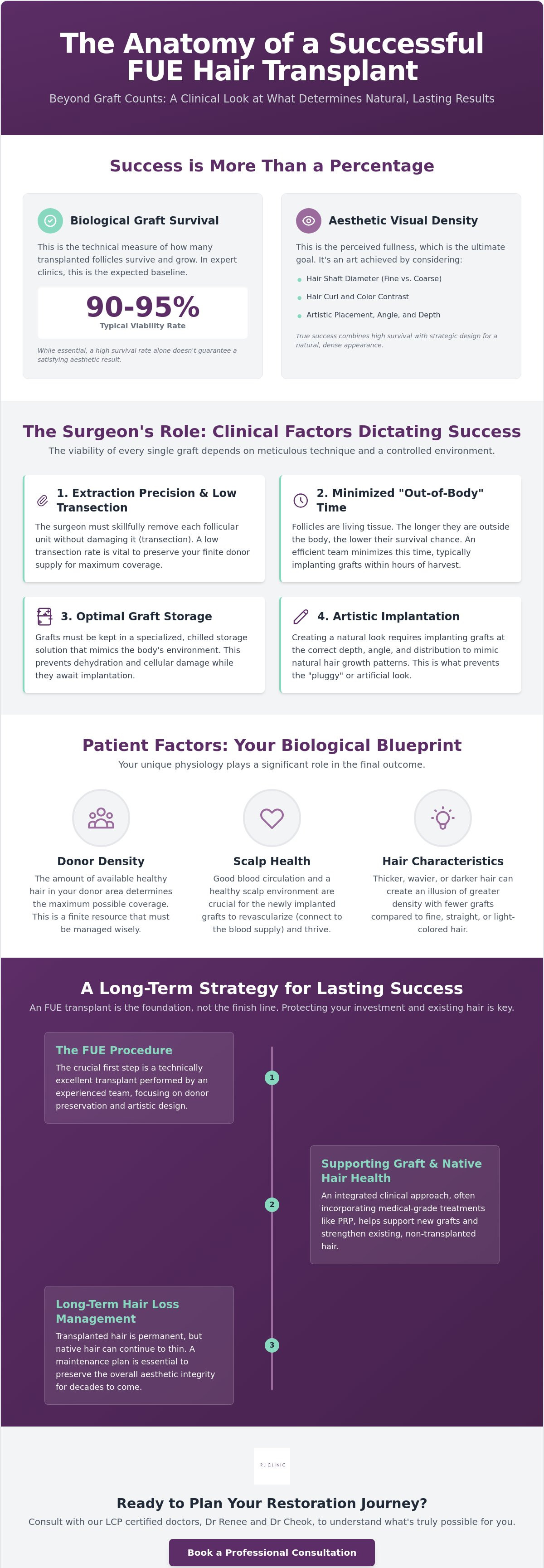
Success in hair restoration is frequently reduced to a simple percentage, yet a clinical perspective reveals that a high survival rate is only the baseline for a quality outcome. When we discuss the FUE hair transplant success rate malaysia, we are referring to the biological viability of the grafts, which typically ranges from 90% to 95% in high-performing clinics. However, a patient can achieve a 95% survival rate and still be dissatisfied if the visual result lacks the expected volume or looks artificial. True success is the intersection of graft health and artistic placement.
To properly evaluate your options, it's vital to understand What is Follicular Unit Extraction (FUE)? as a microsurgical process. It isn't just about moving hair from one spot to another; it's about managing a finite resource to create a lasting aesthetic. A successful procedure must balance the immediate desire for density with the long-term necessity of donor area preservation.
The Distinction Between Survival and Density
Graft survival is a biological metric; it measures how many of the transplanted follicles successfully revascularize and grow in their new location. Aesthetic density, conversely, is a visual perception influenced by hair shaft diameter, curl, and color contrast against the scalp. If a patient has fine hair, even a successful hair FUE transplant with high survival may require strategic placement to mimic the appearance of fullness. We focus on this distinction during consultations to ensure your expectations align with your unique hair characteristics. Clinical success means the hair grows, but aesthetic success means it provides the coverage you desire.
Aesthetic Success: Designing for Natural Aging
True success includes the invisible aspects of surgery: a donor area that remains looking full and a hairline that avoids the "pluggy," artificial look of older techniques. Dr Renee and Dr Cheok emphasize a design that accounts for the fact that your face will change over the next twenty years. A hairline that looks good at 30 must still look appropriate and dignified at 60. This requires placing grafts at specific angles and depths to mimic natural growth patterns.
It's also a common misunderstanding that a transplant stops all future hair loss. While the transplanted follicles are typically permanent, your existing, non-transplanted hair remains susceptible to natural thinning. Maintaining your results often requires a long-term hair loss treatment plan to protect the surrounding hair and preserve the integrity of the overall look. Without this, the "success" of the transplant may eventually be undermined by the loss of the original hair around it.
Clinical Determinants of FUE Success: The Surgeon’s Role
While the biological potential of your hair is the foundation, the technical proficiency of the clinical team acts as the primary safeguard for your donor hair. The FUE hair transplant success rate malaysia is heavily dictated by the surgeon’s ability to manage the delicate "out-of-body" phase of the procedure. From the moment a follicular unit is extracted until it is safely implanted, it is vulnerable to dehydration, temperature fluctuations, and mechanical trauma. Ensuring that these living tissues remain viable requires a disciplined surgical environment and meticulous handling protocols.
Extraction Precision and Transection Rates
The first critical hurdle is the extraction process itself. Follicular transection occurs when the extraction tool accidentally cuts through the hair bulb or shaft, rendering the graft non-viable. According to a Clinical Review of FUE Techniques, minimizing the transection rate is essential for preserving the limited donor supply. A skilled surgeon uses precision instrumentation to feel the resistance of the tissue, adjusting the depth and angle of the punch in real time. This level of tactile feedback is what separates an expert restoration from a generic procedure, ensuring that every harvested graft has the maximum potential to thrive in its new location.
Graft Hydration and Storage Protocols
Once extracted, grafts enter a race against time. The longer a follicle stays outside the body, the higher the risk of cellular death. We prioritize efficiency to keep "out-of-body" time to a minimum, typically aiming for implantation within a few hours of harvest. During this interval, grafts must be kept in a specialized, chilled storage solution that mimics the body’s natural environment. This prevents the delicate cells from drying out and maintains their metabolic health. If you are considering a hair FUE transplant, it's worth asking about these specific storage and hydration steps during your consultation.
The Importance of LCP Certification in Malaysia
In Malaysia, the Ministry of Health maintains strict regulations to protect patient safety. Only doctors who hold a Letter of Credentialing and Privileging (LCP) are officially authorized to perform aesthetic procedures like hair transplants. Dr Renee and Dr Cheok are LCP-certified practitioners who understand the complex anatomy of the scalp and the nuances of surgical restoration. This certification isn't just a formality; it's your assurance that the clinician has the verified training to handle complications and deliver results that are both safe and aesthetically refined. Choosing an accredited expert is the most reliable way to ensure your procedure follows the highest medical standards.
Biological Variables: Why Patient Factors Influence the Outcome
While surgical precision is half the battle, your own biology is the silent partner that dictates the FUE hair transplant success rate malaysia. Many patients focus exclusively on the total number of grafts, yet the clinical reality is that the quality of your donor hair is far more influential than the quantity. If the donor area is depleted or the hair shafts are excessively fine, achieving the desired visual density becomes a much more complex task. We don't just count hairs; we evaluate the biological vigor of the follicular units themselves.
Donor Site Integrity and Graft Quality
A high-quality donor site isn't defined by hair count alone. We look for a high ratio of multi-hair grafts, which are follicles containing two to four hairs, and a robust hair shaft diameter. Patients with thicker hair shafts naturally achieve better coverage with fewer grafts compared to those with fine, wispy hair. If your donor area has been over-harvested in a previous procedure, or if you have diffuse thinning, we must be more conservative to ensure the donor site remains looking natural and full. Protecting this finite resource is a hallmark of the care provided by Dr Renee and Dr Cheok.
Post-Operative Care and Scalp Hygiene in KL’s Climate
The tropical humidity in Kuala Lumpur presents specific challenges during the recovery phase. In the first 14 days, the newly implanted grafts are essentially establishing a new blood supply. Excessive sweat and sebum in our warm climate can lead to inflammation or exacerbate conditions like seborrheic dermatitis, which can compromise graft survival. We provide strict protocols for gentle cleansing to prevent crusting without dislodging the follicles. Staying in a cool, temperature-controlled environment during the first week isn't just a matter of comfort; it's a clinical necessity to minimize the risk of infection and ensure the scalp remains a healthy environment for growth.
Lifestyle Factors: Smoking, Nutrition, and Blood Flow
One of the most significant biological hurdles to a successful transplant is poor microcirculation. Smoking is a major deterrent because nicotine acts as a vasoconstrictor, narrowing the blood vessels and reducing the oxygen supply to the scalp. This directly hinders the revascularization process that the grafts need to survive. Similarly, a diet deficient in essential micronutrients like iron and zinc can slow down the healing process. We advise patients to optimize their nutrition weeks before the procedure to ensure their scalp environment is as fertile as possible for the new grafts.
To understand if your donor hair is suitable for a successful restoration, you can schedule a clinical assessment for a hair FUE transplant with our team.
The RJ Clinic Approach: Maximizing Success for the Long Term
A successful hair transplant isn't a one-time event; it's the start of a multi-year aesthetic strategy. At RJ Clinic, we view the restoration process as a lifelong partnership rather than a transactional surgery. While the technical precision of the extraction and implantation is vital, the long-term FUE hair transplant success rate malaysia depends on how we support the scalp environment before, during, and after the procedure. Our methodology integrates advanced microsurgery with medical-grade maintenance to ensure that your results remain as dense and natural-looking a decade from now as they do in the first year.
Integrated Hair Restoration: FUE and PRP Synergy
The transition from a harvested follicle to a thriving hair graft requires an immediate and robust blood supply. We've found that incorporating PRP treatment into our surgical protocol acts as a biological catalyst for this process. By utilizing your own growth factors, we can accelerate the revascularization of the newly implanted grafts. This synergy doesn't just help the new hair grow; it also revitalizes the surrounding thinning hair, creating a more cohesive and voluminous result that standard FUE procedures often miss. It's a proactive way to protect your investment from the very first day.
Personalized Graft Mapping at RJ Clinic
Every face has a unique geometry, and a "one-size-fits-all" hairline is the fastest way to achieve an artificial, surgical look. Dr Renee and Dr Cheok utilize a custom-designed mapping technique that considers your facial proportions, age, and future hair loss patterns. We don't just place grafts in a row; we mimic the irregular, soft transitions found in nature. This individualized approach ensures that the density is concentrated where it matters most for visual impact while maintaining a subtle, organic-looking hairline that ages gracefully with you. We prioritize artistry as much as clinical science to ensure you never have to worry about looking like you've "had work done."
Long-Term Maintenance: Protecting Your Investment
It's a clinical reality that while transplanted hair is generally permanent, your original hair remains subject to the same genetic and hormonal factors that caused thinning in the first place. Without a comprehensive plan, you may find yourself with a successful transplant surrounded by new areas of thinning. We emphasize a holistic hair loss treatment regimen that may include medical-grade topicals or oral medications to stabilize your existing hair. During your consultation, we'll establish realistic goals and a clear roadmap for maintenance, ensuring that the confidence you gain from your restoration is preserved for the long term.
Securing Your Aesthetic Future
Determining the right path for hair restoration requires moving past marketing percentages and focusing on the clinical variables that actually preserve your donor hair. Achieving a high FUE hair transplant success rate malaysia is a reflection of meticulous graft handling, biological suitability, and the artistic foresight of your surgeon. By prioritizing medical-grade precision alongside aesthetic mapping, you ensure that your new hairline looks natural not just today, but as you age. Success is found where rigorous science meets a deep understanding of natural facial geometry.
At RJ Clinic, Dr Renee and Dr Cheok combine their LCP-certified surgical expertise with a comprehensive approach to medical hair loss management. This dual methodology ensures that every graft is placed with high-density intent while your existing hair is stabilized through integrated protocols. If you're ready to move toward a permanent, organic-looking solution, we invite you to Book a Clinical Consultation for FUE at RJ Clinic. Taking this step allows us to design a restoration plan that is as unique as your own biology, ensuring results that reflect your best and most confident self.
Frequently Asked Questions
What is the typical FUE hair transplant success rate in Malaysia?
The typical FUE hair transplant success rate malaysia ranges between 90% and 95% when the procedure is performed by qualified, LCP-certified clinicians. This percentage specifically measures graft survival, which is the ability of the harvested follicles to successfully revascularize and produce new hair in the recipient area. Achieving this high rate requires precise extraction techniques and specialized storage protocols to maintain the metabolic health of the follicles while they are outside the body.
Can a hair transplant fail after several years?
Transplanted follicles are harvested from the "safe zone" and are genetically resistant to thinning, so they don't typically fail or fall out over time. However, a patient’s overall appearance can change if their original, non-transplanted hair continues to thin around the grafts. This progression can create a patchy or unnatural look, which is why we often integrate medical-grade hair loss treatments to stabilize the surrounding hair and protect the integrity of the initial result.
How do I know if I have enough donor hair for a successful FUE?
Determining donor suitability requires a clinical assessment where we measure your hair density and hair shaft diameter using microscopic imaging. We look for a high concentration of follicular units that contain multiple hairs, as these provide the most visual density. If your donor area is already thin or has been over-harvested previously, we must carefully map out a conservative strategy to ensure we don't leave the back of your head looking sparse.
Does the humid climate in Kuala Lumpur affect hair transplant healing?
The humidity in Kuala Lumpur doesn't damage the grafts themselves, but it can increase sweat and sebum production, which may lead to scalp irritation or inflammation during the first two weeks. We advise patients to stay in a cool, temperature-controlled environment as much as possible during the initial seven days of recovery. Maintaining a clean, dry scalp is essential in our tropical climate to prevent crusting and ensure the new follicles take root without complication.
Are the results of an FUE hair transplant truly permanent?
The results are considered permanent because the transplanted hair follicles are taken from areas of the scalp that aren't susceptible to androgenetic alopecia. Once these grafts successfully integrate into the recipient site, they will continue to grow for a lifetime. It's important to remember that while the new hair is permanent, your facial structure will continue to age, which is why Dr Renee and Dr Cheok focus on designing hairlines that look natural and dignified decades into the future.
What should I do if my hair transplant results look thin?
If your results appear thin, you should first allow at least 12 to 18 months for the full growth cycle to complete, as the final density often takes over a year to manifest. If the area still looks sparse after this period, it may be due to the continued thinning of your original hair rather than a failure of the transplant. In these cases, we often recommend density-boosting treatments like PRP or specialized medical regimens to revitalize existing follicles and improve the overall visual volume.


Comments