


Filler vs Deusaderm: Which to Choose in Kuala Lumpur?

Updated: Jul 22
Why does the very treatment meant to refresh your eyes sometimes result in a heavy, unnatural puffiness? It's a question Dr. Renee and Dr. Cheok address daily as more patients move away from the "overfilled" look toward more subtle, structural enhancements. When weighing Filler vs Deusaderm, the decision isn't merely about popularity; it's a clinical choice about how a material interacts with your unique anatomy.
You're likely here because you want to address persistent dark circles or volume loss without the risk of the Tyndall effect or the dreaded "pillow face" syndrome. We agree that the goal of any aesthetic intervention should be a result that looks entirely organic to your face. This analysis provides a professional comparison of porcine-derived collagen injectables and traditional hyaluronic acid fillers to help you make an informed decision. We'll examine the science of tissue integration, the reality of long-term skin quality improvement, and the specific factors that determine which treatment will provide the most refined outcome for your skin type.
Table of Contents
Understanding Deusaderm vs. Traditional Dermal Fillers
In our practice, we find that patients often use the term "filler" as a broad label for any injectable treatment. However, the clinical distinction between a traditional injectable filler and a structural biomaterial like Deusaderm is profound. Most traditional fillers are composed of Hyaluronic Acid (HA) gels. These products work by occupying space and attracting water to create volume. While HA fillers are excellent for certain applications, they are essentially inert substances that provide temporary projection.
Deusaderm represents a different approach to facial rejuvenation. It is a 99% pure porcine-derived collagen injectable designed specifically for dermal restoration. Instead of simply "filling" a fold, it introduces a structural protein that the skin recognizes as its own. Collagen injectables have a long history in aesthetic medicine, dating back to the 1980s. While early versions required skin testing due to potential sensitivities, modern purification technology has eliminated these concerns. Today's medical-grade collagen is highly biocompatible, mimicking human dermal tissue so closely that it integrates seamlessly without the inflammatory response often seen with older materials.
We've observed a significant shift among our patients in Kuala Lumpur. There is a growing preference for regenerative materials over pure volumization. This trend is driven by a desire for results that don't just look natural but actually improve the underlying health of the skin tissue. When comparing Deusaderm vs Filler, the choice often comes down to whether you need to add bulk or restore the skin's internal architecture.
What Makes Deusaderm a Unique Biomaterial?
The efficacy of Deusaderm lies in its multi-fiber induction technology. This process condenses collagen into stable, high-density bundles that provide immediate structural support upon injection. One of its most valuable clinical features is its "milky white" opacity. This characteristic is particularly useful for patients with thin skin under the eyes. While clear HA gels can sometimes exacerbate the appearance of dark circles, the opaque nature of Deusaderm acts as a masking agent for underlying vascularity. It creates a physical barrier that brightens the area while simultaneously strengthening the dermis.
The Evolution of Injectables in Malaysian Aesthetic Practice
The aesthetic landscape in areas like Bangsar and Mont Kiara has evolved. Our patients are increasingly sophisticated, moving away from the over-contoured looks of the past toward "stealth" aesthetics. The focus has shifted from "filling holes" to "restoring skin architecture." This requires a more nuanced understanding of tissue dynamics. While we still utilize traditional fillers for structural projection in the nose or chin, we increasingly recommend Deusaderm for delicate zones where tissue quality is the primary concern. Deusaderm is a biostimulatory collagen gel rather than a simple inert filler.
The Clinical Differences: Collagen vs. Hyaluronic Acid
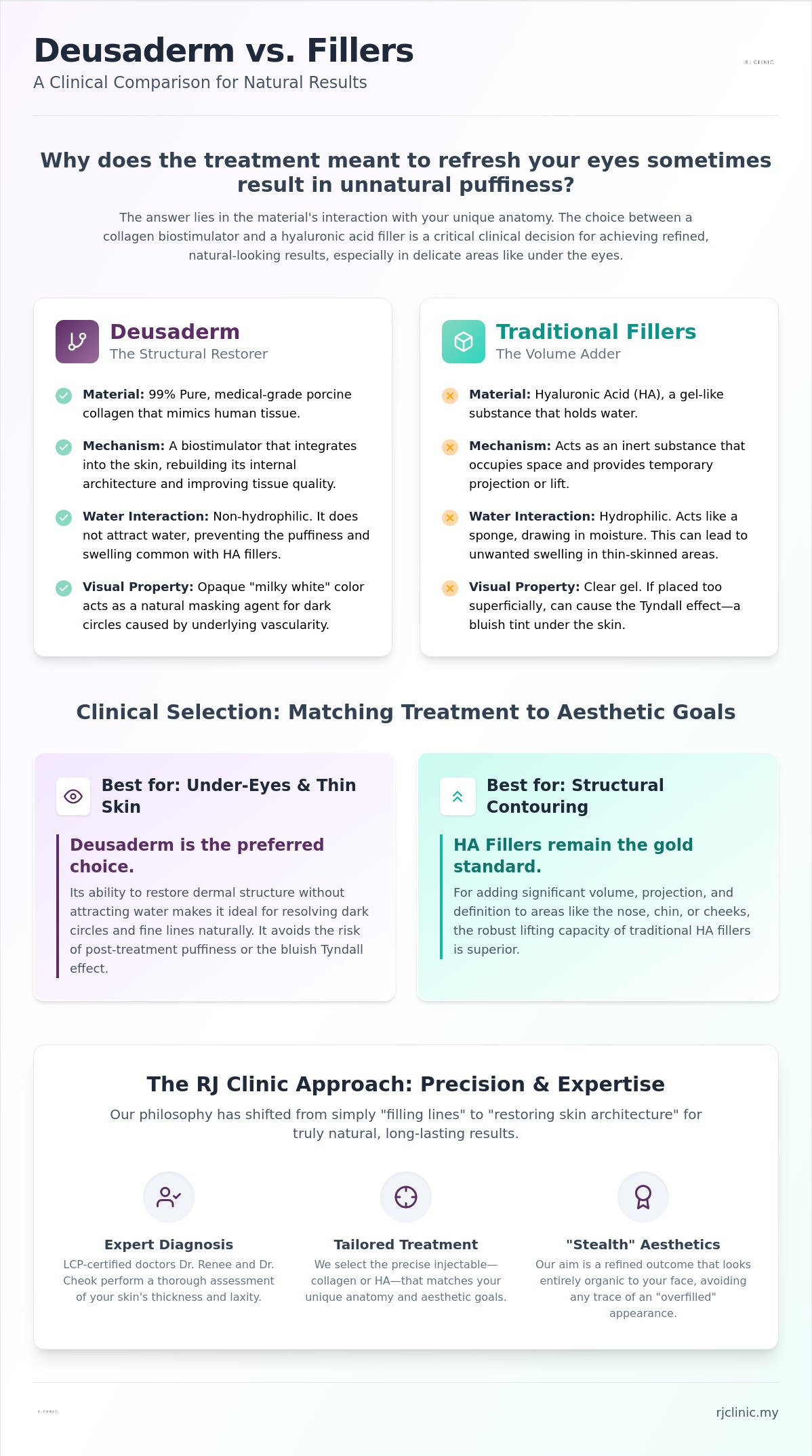
The primary distinction between these two modalities lies in their relationship with water. Hyaluronic acid (HA) is inherently hydrophilic, meaning it acts like a sponge, drawing in moisture to create volume. While this is beneficial for many FDA-approved dermal fillers, it can be a disadvantage in high-mobility or thin-skinned areas. In contrast, Deusaderm replenishes structural protein directly. It doesn't rely on water absorption to achieve its effect. This fundamental difference is why we often suggest a comparison of Deusaderm vs Filler based on the patient's propensity for facial swelling.
Tissue integration also differs significantly. HA fillers sit as a cohesive gel within the tissue. Collagen fibers, however, weave into the existing dermal matrix. This integration helps avoid the Tyndall effect, a bluish tint that occurs when light scatters through clear HA gel placed too superficially. Because collagen is opaque and matches the skin's natural architecture, it remains invisible even under the most delicate skin. For patients who have had poor experiences with HA in the past, understanding these mechanical differences is the first step toward a more refined result.
Hydrophilic Swelling and Lymphatic Drainage
The undereye area is particularly sensitive to fluid dynamics. Traditional HA fillers can sometimes obstruct lymphatic flow or attract excess water, leading to a "heavy" or puffy appearance. This is especially common in patients who already struggle with morning edema. Deusaderm is non-hydrophilic. It stays exactly where it's placed and doesn't migrate or fluctuate in volume based on your hydration levels. For those with poor lymphatic drainage, choosing collagen over HA can prevent the "overfilled face" look that many fear.
Immediate Correction vs. Long-term Regeneration
When you choose HA, the volume you see is largely what you get, and it's instantly reversible with hyaluronidase. Deusaderm provides a dual-action benefit. You receive immediate replenishment from the injected collagen, but the material also acts as a scaffold for your own fibroblasts. Over time, your body synthesizes new collagen around this structure. While HA is a temporary occupant, collagen is naturally metabolized by the body as it encourages your skin to repair itself. If you're looking for a treatment that works with your biology, you might consider a personalized Deusaderm assessment to see if your skin architecture would benefit from this regenerative approach.
Clinical Selection: Which Treatment Suits Your Aesthetic Goals?
Choosing between Deusaderm vs Filler requires a careful assessment of your facial anatomy and skin quality. While volume restoration is a common goal, the delivery method matters. Dr. Renee often recommends Deusaderm for the delicate periorbital zone because thin skin in this area doesn't always tolerate the weight of traditional gels well. Conversely, when we look at structural contouring for the nose or chin, dermal fillers remain the gold standard. These areas require the high G-prime, or firmness, of hyaluronic acid to provide the projection and sharp definition that collagen fibers alone cannot achieve.
Suitability often depends on the trade-off between skin quality and volume. If your primary concern is "crepey" skin or fine lines on the cheeks and around the mouth, collagen acts as a biostimulator to thicken the dermis. This is a shift from simply filling a line to improving the skin's canvas. We find that patients in their late 30s and 40s in Kuala Lumpur who are starting to notice a loss of elasticity benefit most from this approach. It addresses the early signs of aging without changing the fundamental shape of your face.
The Undereye and "Concealer" Effect
One unique clinical advantage of Deusaderm is its immediate brightening effect. Because the material is naturally opaque, it provides what we call a "concealer effect" for dark circles caused by visible vascularity. Traditional HA fillers are transparent. If they're placed too superficially, they can actually highlight pigmentation or create a shadow rather than hiding it. For patients with both deep hollows and severe dark circles, we sometimes combine treatments, using HA for deep volume and a layer of collagen for surface refinement.
Longevity, Maintenance, and Trade-offs
While HA fillers may offer longer duration in static areas, Deusaderm provides better aging grace as it integrates into your tissue. We typically recommend a series of 2 to 3 sessions for optimal "collagen banking," allowing the skin to build its own structural support over time. Modern Sunmax purification technology ensures that porcine allergies are exceedingly rare, making skin tests largely unnecessary in contemporary practice. To determine which material is most compatible with your skin thickness, you can book a diagnostic consultation for Deusaderm with our LCP-certified team.
The RJ Clinic Approach: Precision Injectables in KL
When selecting an aesthetic provider in Kuala Lumpur, the technical skill of the injector is as vital as the product itself. At RJ Clinic, we emphasize that advanced treatments like Deusaderm require a deep understanding of facial layers and tissue dynamics. This is why we maintain strict adherence to Ministry of Health standards. Every procedure in our clinic is performed by doctors who hold a Letter of Credentialing and Privileging (LCP), ensuring that your treatment is grounded in medical safety and clinical precision.
The diagnostic phase is where the choice of Deusaderm vs Filler is solidified. During your consultation, Dr. Cheok performs a detailed assessment of your tissue laxity, skin thickness, and underlying bone structure. We don't simply look at a single wrinkle; we look at why that volume loss occurred. If there is significant skin sagging alongside hollowing, we might recommend a holistic approach, pairing collagen restoration with Ultherapy to provide a non-surgical lift from the foundation up. When we compare Deusaderm vs Filler, we prioritize the longevity of your skin health over a quick, temporary fix.
Our commitment to safety means we only use medical devices and injectables that are KKM-registered and FDA-cleared. We believe that luxury care is synonymous with patient safety and predictable, refined outcomes. This meticulous approach allows us to bridge the gap between clinical science and the artistry of facial rejuvenation.
A similar commitment to bridging clinical science with aesthetic artistry is found in the work of specialists like Dr Samintharaj Kumar, who focuses on complex oral and facial rehabilitation to achieve balanced, natural results.
Customized Treatment Plans
We avoid the "cookie-cutter" approach that often leads to the overfilled look seen in less experienced hands. Each patient receives a bespoke strategy designed to enhance their unique profile. The "RJ Clinic Signature" is a result that looks refreshed and rested. It’s the kind of change your friends will notice and compliment, yet they won't quite be able to pinpoint what has changed. For those seeking professional, discreet care, we offer these personalized services at our clinics in both Mont Kiara and Bangsar.
For patients seeking similar high-quality, nurse-led care in other regions, you can explore Cosmetic Injectables and Advanced Skin Treatments at Bella Complexion, where the focus remains on achieving refined and natural results.
What to Expect During Your Procedure
Comfort is a priority in our clinical environment. We typically utilize Deusaderm LIDO, which contains Lidocaine to ensure the injection process is as painless as possible for the patient. Most people find the procedure straightforward, with minimal downtime. You might experience minor bruising or slight swelling for 24 to 48 hours, but these are manageable and temporary. Our goal isn't to change your fundamental appearance. Instead, we aim to restore the structural integrity of your skin, helping you look as vibrant as you feel.
Restoring Your Natural Radiance with Clinical Precision
The decision between collagen and hyaluronic acid isn't about which product is "better," but which material aligns with your tissue's specific needs. While HA fillers remain superior for projecting the chin or nose, Deusaderm offers a unique structural advantage for the delicate undereye area. It effectively masks dark circles and strengthens thin skin without the risk of water-retention or puffiness. Understanding the nuances of Deusaderm vs Filler ensures you avoid the common pitfalls of over-volumization and achieve a truly refreshed appearance.
With over 10 years of clinical experience in Kuala Lumpur, Dr. Renee and Dr. Cheok specialize in natural-looking undereye rejuvenation. Our focus is always on subtle refinement and long-term skin quality. We invite you to consult our LCP-certified doctors at RJ Clinic for a personalized Deusaderm assessment. Taking the time to evaluate your skin's architecture is the first step toward results that look as organic as they feel. We look forward to partnering with you on your aesthetic journey.
Frequently Asked Questions
Is Deusaderm safer than traditional hyaluronic acid fillers?
Both treatments are clinically safe when administered by LCP-certified physicians, but they offer different safety profiles. Hyaluronic acid fillers have the advantage of being instantly reversible with an enzyme called hyaluronidase. Deusaderm, while not reversible in the same way, is highly biocompatible and carries a lower risk of long-term swelling or the Tyndall effect because it doesn't attract water. We choose the material based on your history of sensitivities and the specific anatomical zone being treated.
Can Deusaderm be used together with other fillers in the same session?
Yes, we frequently combine these materials to achieve a more comprehensive result. This approach allows us to use traditional dermal fillers for deep structural support, such as lifting the cheeks, while using collagen for superficial refinement in the tear troughs. Layering these products requires a sophisticated understanding of tissue depth to ensure they integrate properly without interfering with one another.
Will I look overfilled or puffy after a Deusaderm treatment?
It's very unlikely that you'll experience the "overfilled" look with Deusaderm because the material is non-hydrophilic. Traditional fillers can sometimes swell as they draw in moisture from the surrounding tissue, leading to a puffy appearance. Since collagen is a structural protein that doesn't bind to water in the same way, the volume we place during the procedure remains stable and predictable.
How long does it take to see the final results of Deusaderm vs. Filler?
Hyaluronic acid fillers provide an immediate change in volume that settles within two weeks. With Deusaderm, you'll see an initial brightening effect, but the true improvement in skin density develops over four to six weeks as your body's fibroblasts respond to the collagen scaffold. When comparing Deusaderm vs Filler, HA is the choice for instant projection, while collagen is a gradual investment in your skin's structural integrity.
Is Deusaderm suitable for vegans or those with porcine sensitivities?
Deusaderm is a porcine-derived product, meaning it's not suitable for vegans or individuals with religious or ethical objections to porcine materials. For those with medical sensitivities, the 99% purification process used in modern collagen injectables makes allergic reactions extremely rare. We always review your medical history and lifestyle preferences during the consultation to ensure the chosen biomaterial is appropriate for you.
What is the price difference between Deusaderm and HA fillers in Malaysia?
In the Malaysian aesthetic market, the cost per syringe for these treatments is often quite similar, though the total investment depends on your clinical goals. Deusaderm typically requires a series of two to three sessions to achieve optimal "collagen banking" and skin thickening. Traditional fillers are often a single-session treatment. We focus on which material provides the best long-term value for your specific skin concerns rather than just the initial cost per syringe.


Comments