


Female Hair Loss Treatment in Kuala Lumpur: A Clinical Perspective on Restoration


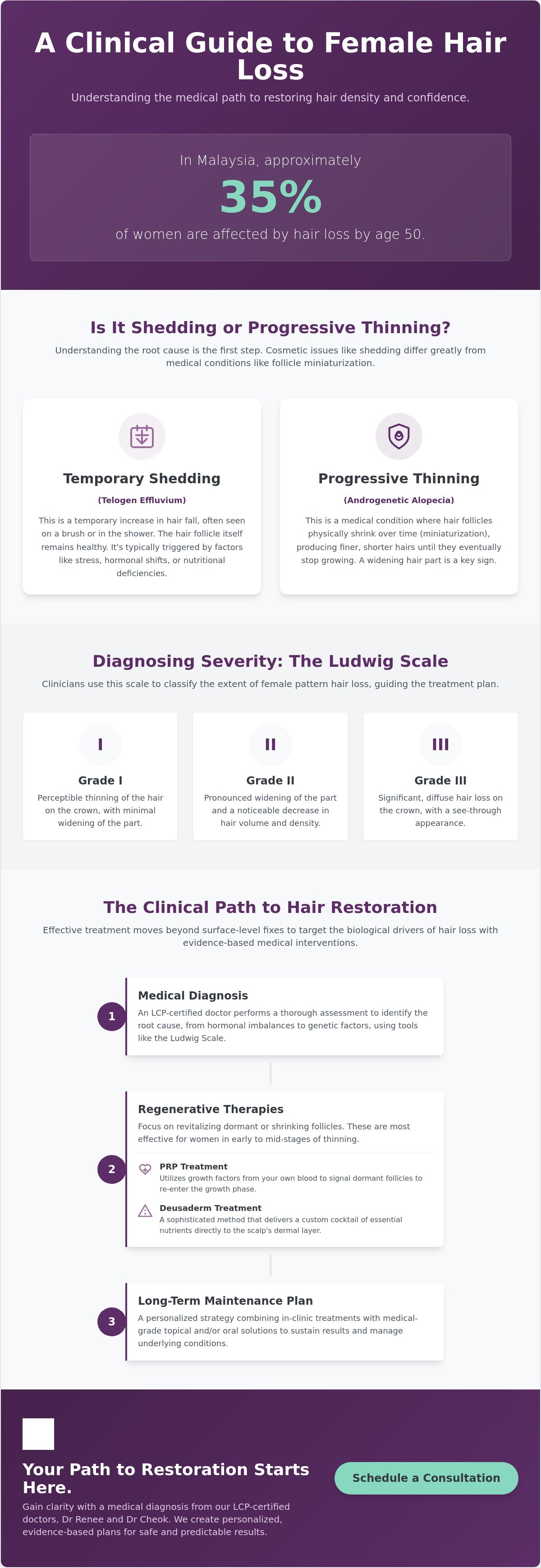
Approximately 35% of women in Malaysia are affected by hair loss by the age of 50, yet many find that the search for an effective female hair loss treatment in Kuala Lumpur leads to more confusion than clarity. You've likely noticed your hair part widening or a loss of volume at the crown, prompting a search for solutions that go beyond superficial fixes. It's natural to feel concerned about how hormonal changes are impacting your confidence, particularly when the distinction between medical restoration and standard aesthetic procedures isn't clearly defined.
This guide provides a doctor-led perspective on the clinical logic required to achieve restored hair density and natural-looking results. You'll learn how Dr Renee and Dr Cheok prioritize a clear medical diagnosis to address the root causes of thinning rather than just the symptoms. We'll outline the journey from initial stabilization to a long-term maintenance plan, helping you move forward with a treatment strategy that values scientific integrity as much as artistry. By understanding the medical foundation of hair health, you can transition from anxiety to a structured path of restoration.
Table of Contents
Understanding Female Hair Loss Treatment: Clinical Patterns vs. Common Misconceptions
Patients often arrive at the clinic after months of trying botanical shampoos or salon "scalp detoxes," only to find their hair density continuing to decline. The fundamental error is treating hair loss as a cosmetic surface issue rather than a medical condition of the follicle. For an effective female hair loss treatment in Kuala Lumpur, we must first distinguish between temporary shedding and progressive thinning. While seeing hair in the shower drain is alarming, it often represents telogen effluvium, a temporary shift in the hair cycle. True restoration concerns itself with miniaturisation, where follicles physically shrink over time due to hormonal or genetic factors.
Clinical term for this progressive thinning is androgenetic alopecia, often referred to as Pattern hair loss. Unlike the receding hairlines seen in men, women typically experience a diffuse thinning across the mid-scalp. This is why salon-grade treatments frequently fail; they address the hair shaft's condition but do nothing to reverse the biological signals causing the follicle to shut down. At RJ Clinic, Dr Renee and Dr Cheok focus on these underlying medical drivers to ensure that any intervention is based on follicular health rather than temporary aesthetic masking.
Shedding vs. Thinning: Identifying the Root Cause
The hair growth cycle consists of three phases: Anagen (growth), Catagen (transition), and Telogen (resting). In a healthy scalp, about 90% of hair is in the growth phase. When this balance shifts, you may notice excessive shedding. However, a widening part is a far more reliable indicator of a long-term problem than hair found on a brush. We use the Ludwig Scale to categorise the severity of this thinning. Grade I involves perceptible thinning on the upper crown, while Grade II and III indicate more pronounced rarefaction. Identifying where you sit on this scale is the first step in clinical decision-making.
The Role of Hormones and Lifestyle in Malaysian Women
Local factors in Malaysia often complicate the clinical picture. The high humidity in Kuala Lumpur can lead to scalp inflammation or seborrheic dermatitis, which, if left untreated, creates a poor environment for hair retention. Beyond the environment, we frequently identify "hidden" medical causes during our assessments. These include iron deficiency, thyroid dysfunction, and the significant hormonal shifts following childbirth. In our high-stress professional environment, many women also suffer from chronic telogen effluvium, where the body's stress response prematurely pushes hairs into the shedding phase. Conditions like PCOS or the onset of menopause are also primary drivers that require a nuanced, doctor-led approach to manage effectively.
Advanced Medical Interventions for Hair Density and Scalp Health
Clinical restoration requires moving past the aisle of over-the-counter supplements. While vitamins support overall health, they rarely possess the potency to reverse follicle miniaturisation. Effective female hair loss treatment in Kuala Lumpur relies on evidence-based medical treatments for hair loss that target the biological drivers of thinning. This often involves a combination of medical-grade topical solutions, oral prescriptions to stabilise hormonal influence, and in-clinic regenerative procedures.
Regenerative Therapy: PRP and Growth Factor Treatments
Regenerative medicine has transformed how we approach hair density. A cornerstone of our clinical practice is PRP treatment, which utilises the patient's own blood to extract a high concentration of growth factors. Once injected into the scalp, these factors signal dormant follicles to re-enter the anagen (growth) phase. The success of this procedure isn't just in the blood draw; it's determined by the concentration levels achieved during centrifugation and the precision of the injection technique. For patients seeking a non-surgical alternative, Deusaderm treatment offers a sophisticated method of follicular revitalisation by delivering essential nutrients directly to the scalp's dermal layer.
Regenerative therapies are most effective for women in the early to mid-stages of thinning. If you're noticing a gradual loss of volume but the follicles are still active, these treatments can significantly improve hair diameter and scalp coverage. If you're unsure which stage you're in, Dr Renee or Dr Cheok can provide a detailed scalp analysis during a consultation at our Kuala Lumpur clinic.
FUE Hair Transplant: When is it Appropriate for Women?
In cases where thinning has progressed to visible gaps or a significantly receded hairline, a FUE hair transplant becomes the most viable permanent solution. We often employ a "no-shave" FUE technique for our female patients. This method allows us to extract individual follicular units without the need for a full buzz cut, ensuring the procedure remains entirely discreet. The clinical reasoning for surgery in women is usually focused on hairline lowering or increasing density in specific zones like the crown or temples.
Suitability for FUE depends heavily on donor area density. We must ensure that the hair at the back of the head is robust enough to be relocated without compromising the donor site's appearance. It's a delicate balance of science and artistry, where the goal is a result that looks entirely organic and integrates seamlessly with your existing hair. Choosing the right path involves weighing the immediate results of surgery against the gradual improvement of regenerative therapy.
Navigating the Decision: Suitability, Trade-offs, and Results
One of the most frequent dilemmas patients face is deciding when to transition from maintenance therapies to more permanent surgical interventions. It's a decision that requires clinical honesty rather than a one-size-fits-all package. While some providers suggest that every patient is a candidate for every procedure, our approach at RJ Clinic is to evaluate the specific biological markers of your condition. For instance, Female pattern baldness often presents as a diffuse thinning that may not always be suitable for immediate surgery if the donor site is also affected.
Determining Candidacy for Non-Surgical vs. Surgical Options
The primary distinction lies in your aesthetic goal. If the objective is to thicken existing hair and stop the cycle of miniaturisation, non-surgical regenerative therapies like PRP or Deusaderm are the standard. However, if the goal is to relocate hair to a completely bare area, such as lowering a high forehead or filling a specific gap, FUE is the appropriate tool. During a physical examination, Dr Renee or Dr Cheok will assess your "active loss" status. We generally advise against surgical intervention during periods of acute shedding, as the surrounding native hair must be stable to ensure a long-lasting, natural-looking result.
Managing Expectations: Timeline and Longevity of Results
Patience is perhaps the most difficult part of any medical hair restoration journey. We often discuss the "three-month rule" because follicles require an entire growth cycle to reflect the changes induced by treatment. You won't see the full density of a PRP session or a transplant overnight. Medical hair restoration is a marathon, not a sprint. To maintain these results against Kuala Lumpur's heat and environmental pollutants, a consistent post-treatment regimen is essential. This might include medical-grade topicals or periodic maintenance sessions to protect your investment.
Choosing the wrong treatment path can lead to wasted resources and emotional fatigue. It's vital to identify red flags early; if your hair loss is accompanied by extreme fatigue or skin changes, it may indicate a systemic issue like thyroid dysfunction or severe nutrient deficiency rather than simple pattern loss. Before committing to a restoration plan, ensure you have received a comprehensive medical assessment. You can schedule a clinical consultation for female hair loss treatment in Kuala Lumpur with our LCP-certified doctors to explore your options with professional clarity.
The RJ Clinic Approach: Personalised Hair Restoration in Kuala Lumpur
At RJ Clinic, we view hair restoration as a sophisticated medical discipline rather than a series of disconnected aesthetic procedures. Our role as practitioners is to bridge the gap between rigorous clinical standards and the personal, often emotional journey of regaining hair density. By positioning ourselves as a centre of clinical excellence, we ensure that every female hair loss treatment in Kuala Lumpur we perform is backed by evidence-based protocols and a deep understanding of follicular biology. This partnership between doctor and patient is built on a foundation of transparency, where results are measured by both clinical success and your restored self-confidence.
Why LCP-Certified Expertise Matters for Scalp Health
The significance of LCP (Letter of Credentialing and Privileging) certification is a critical factor when choosing a provider in Malaysia. This credential, issued by the Ministry of Health, confirms that your doctor has met stringent requirements for safety and proficiency in aesthetic medicine. It marks the difference between an aesthetic physician and a general beauty practitioner. LCP-certified physicians like Dr Renee and Dr Cheok possess the medical training to diagnose complex underlying conditions and manage clinical interventions with precision. This level of clinical oversight is vital for reducing the risk of complications and ensuring that your scalp health is managed within a safe, controlled environment.
Integrating Medical Care with Aesthetic Artistry
Our philosophy focuses on restoration over transformation. We believe the most successful outcomes are those that remain undetectable, providing a subtle enhancement that looks entirely organic. This holistic approach often extends beyond the scalp to address the full architecture of the face. For many women, an Instabrow Eyebrow Transplant serves as a perfect complement to scalp restoration. By framing the eyes and restoring lost density to the brows, we can achieve a more comprehensive and refined rejuvenation. This integration of hair health with overall aesthetics ensures that your results feel tailored rather than transactional.
Ultimately, achieving a natural look requires a meticulous eye for detail and a commitment to scientific integrity. If you're ready to move beyond temporary fixes and explore a medically sound restoration strategy, we invite you to consult with Dr Renee or Dr Cheok for a personalised hair restoration plan. Together, we can design a long-term maintenance strategy that respects your individual needs and delivers the lasting density you desire.
Restoring Your Confidence Through Clinical Excellence
Transitioning from the uncertainty of over-the-counter products to a medically supervised restoration plan is the most effective way to address hair thinning. As we've discussed, success depends on an accurate diagnosis that distinguishes between temporary shedding and progressive miniaturisation. Whether your path involves FDA-approved regenerative technologies or our specialised "no-shave" FUE techniques for women, the focus remains on achieving a result that integrates seamlessly with your natural aesthetics. Selecting the most appropriate female hair loss treatment in Kuala Lumpur is a decision that should be guided by professional expertise and clinical safety standards.
Dr Renee and Dr Cheok are LCP-certified doctors who bring both scientific integrity and an artistic eye to every case. By prioritising a personalised approach, we ensure that your treatment plan is as unique as your hair's biological needs. You don't have to navigate the complexities of hair restoration without expert guidance. To begin your journey toward lasting density and a renewed sense of self, Book a Clinical Consultation for Hair Restoration at RJ Clinic. We're here to provide the clarity and care you need to move forward with confidence.
Frequently Asked Questions
How do I know if my hair loss is normal shedding or a medical condition?
Normal shedding typically involves losing between 50 to 100 hairs per day as part of the natural telogen phase of the growth cycle. You likely have a medical condition if you observe a widening part, visible scalp at the crown, or a noticeable decrease in the ponytail's thickness. Clinical assessment is required to determine if these changes are due to temporary telogen effluvium or the progressive follicle miniaturisation seen in pattern loss.
Is FUE hair transplant suitable for women with diffuse thinning?
FUE suitability depends heavily on the density and health of the donor area at the back of the scalp. In cases of diffuse thinning, the donor site itself may be affected, which can make a transplant less effective or even unviable. If the donor area is robust, we can use FUE to fill specific gaps; otherwise, we prioritse medical stabilisation through regenerative therapies to improve overall density without surgery.
What is the downtime for PRP hair loss treatment in Kuala Lumpur?
The downtime for PRP female hair loss treatment in Kuala Lumpur is minimal, with most patients returning to their professional and social activities immediately after the session. You might experience mild scalp tenderness or slight swelling at the injection sites for 24 to 48 hours. We recommend avoiding intense exercise and chemical hair treatments for the first two days to allow the scalp to remain undisturbed during the initial healing phase.
Can I continue using my regular hair products during medical treatment?
You can generally continue using your preferred shampoos and styling products, provided they don't contain harsh irritants that cause scalp inflammation. During your consultation, we often review your current regimen to ensure it supports your clinical goals. We do advise pausing the use of chemical dyes, bleaches, or perms for at least seven days following any injectable or surgical restoration procedure to protect the follicles.
How many sessions of regenerative therapy are typically required to see results?
Most patients require an initial series of three to six sessions, typically spaced four weeks apart, to achieve visible improvements in hair density. Because hair grows in cycles, you won't see immediate changes; instead, you'll likely notice a reduction in daily shedding first. A gradual increase in hair diameter and scalp coverage usually becomes perceptible between the third and sixth month of a consistent treatment plan.
Are the results of a female hair transplant permanent?
Transplanted hair follicles are permanent because they are harvested from donor sites that are genetically resistant to the factors causing thinning. While these relocated hairs will continue to grow for a lifetime, your existing native hair remains subject to natural aging and hormonal changes. For this reason, we often design a long term maintenance strategy to protect your native hair and ensure the overall results remain dense and natural looking as the years progress.


Comments