


Do You Need a Second Hair Transplant?


What if the appearance of new thinning after your initial procedure isn't a sign that your surgery failed, but rather a predictable milestone in your hair restoration journey? Many patients feel a sense of alarm when they notice a widening gap or an "island effect" where native hair continues to recede behind the transplanted area. It's a common clinical observation that androgenetic alopecia is a progressive condition, meaning your first procedure was often just the opening chapter. Deciding on a second hair transplant requires a sophisticated understanding of your remaining donor hair supply and the biological timeline of your hair loss.
We understand the anxiety that comes with managing a finite number of grafts while pursuing the density you originally envisioned. In this discussion, we'll examine the clinical reasoning behind multi-stage procedures and the precise donor management strategies Dr. Renee and Dr. Cheok use to protect your future options. You'll learn how to identify the optimal timing for a follow-up and how we integrate new grafts with your existing transplant to create a seamless, organic result. By focusing on long-term scalp health and artistic refinement, we can transform a receding pattern into a permanent, confident aesthetic.
Table of Contents
Understanding why a second hair transplant is rarely a sign of failure
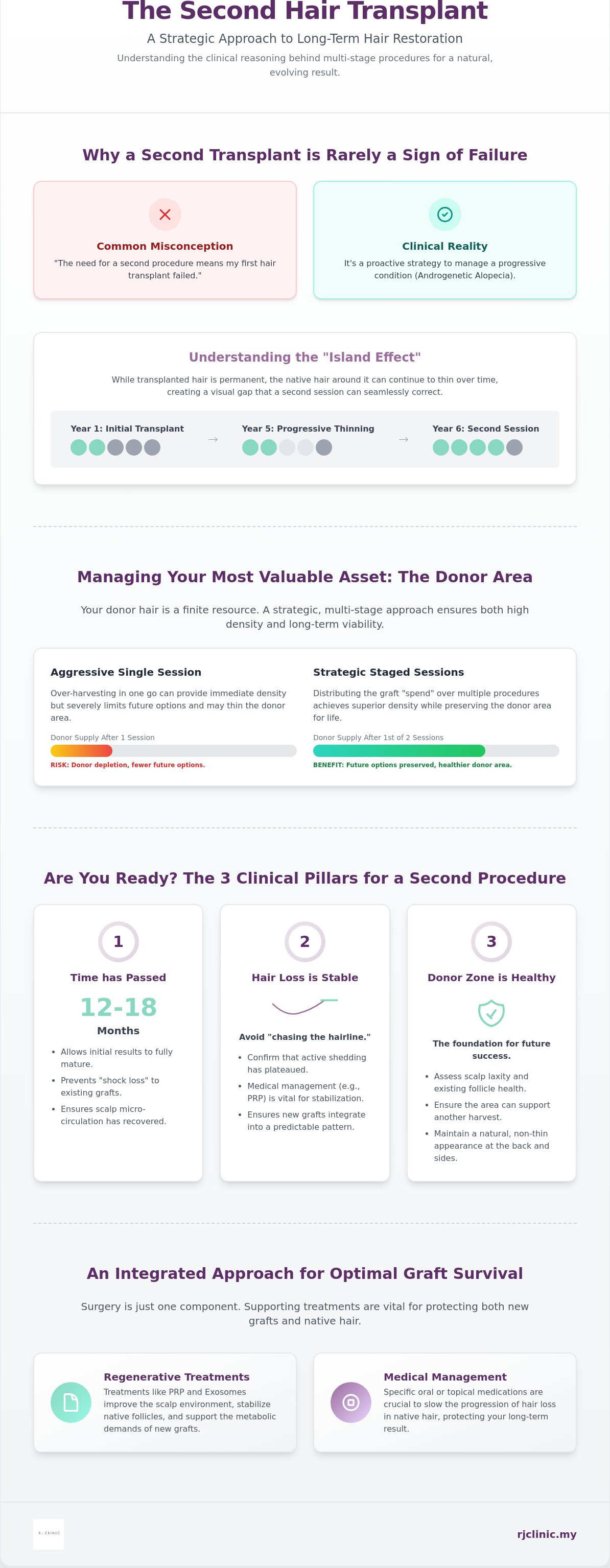
A common misconception among patients is that the need for a second hair transplant indicates a failure of the initial surgery. In a clinical setting, we often observe the opposite. A follow-up procedure is frequently a sign of a proactive, long-term restoration strategy. The primary reason for this is the biological reality of Androgenetic Alopecia. While a surgeon can successfully relocate DHT-resistant follicles, the surgery itself does not halt the genetic progression of hair loss in the surrounding native hair. This leads to what we call the "Island Effect," where the transplanted hair remains robust while the native hair behind it continues to recede, creating an unnatural gap that requires further intervention.
A strategic second session is a planned density refinement common in elite hair restoration, designed to reinforce the hairline or fill receding gaps as the patient's natural hair loss pattern matures. Rather than a correction, this session is often the second phase of a curated aesthetic journey. At RJ Clinic, we view hair restoration as a dynamic process. We don't just look at where you are losing hair today; we anticipate where you will be in five or ten years. This foresight ensures that your results remain balanced and natural-looking as you age.
The progressive nature of hair loss
The technical success of Hair transplantation relies on moving permanent follicles to areas of thinning. However, the native hair surrounding these new grafts remains susceptible to the miniaturizing effects of DHT. Without medical stabilization, such as the use of specific oral or topical medications, the contrast between the permanent transplant and the thinning native hair becomes visible over time. Dr. Renee and Dr. Cheok prioritize medical management alongside surgery to slow this progression. Clinical observations at our practice suggest that the timing of a second session should only occur once the initial grafts have fully matured and the surrounding hair loss has been stabilized.
Managing patient expectations for density
Achieving high density often requires a staged approach. During an initial FUE hair transplant, surgeons may adopt a conservative strategy to preserve your donor hair "capital." Since the donor supply is finite, over-harvesting in the first session can leave a patient with insufficient resources for future needs. We focus on a sophisticated balance between immediate satisfaction and long-term donor availability. By distributing the "spend" of your hair follicles over two sessions, Dr. Renee and Dr. Cheok can achieve a much higher total density while ensuring the donor area remains healthy and looks natural from every angle.
Evaluating your readiness: The three clinical pillars
Determining if you are ready for a second hair transplant involves more than just looking in the mirror. It requires a clinical assessment of your scalp's current state and your long-term aesthetic trajectory. We treat your donor hair as a finite "bank account." Every graft extracted is a withdrawal that cannot be replenished. Under the LCP-certified oversight of Dr. Renee and Dr. Cheok, we evaluate scalp laxity and follicle health to ensure any further intervention is both safe and sustainable for your future years.
Pillar 1: Has enough time passed?
Patience is a clinical necessity. We generally require a waiting period of 12 to 18 months before considering a repeat session. This timeframe allows the full aesthetic result of your first FUE hair transplant to manifest. Operating too early carries a significant risk of "shock loss," where the trauma of a new surgery causes existing or newly transplanted hair to shed prematurely. Additionally, the scalp’s micro-circulation needs time to fully recover to support the metabolic demands of a new set of grafts successfully.
Pillar 2: Is your hair loss stable?
"Chasing the hairline" is a common pitfall in hair restoration. If you are still experiencing active shedding, a second procedure may only provide a temporary solution as the native hair continues to retreat further back. We use diagnostic tools to confirm your hair loss has reached a plateau. Often, we recommend integrating PRP treatment to stabilize native follicles and improve the quality of the scalp environment before proceeding with more surgery. This stabilization ensures that the new grafts integrate into a predictable and steady landscape.
Pillar 3: Donor hair capital
The health of your donor zone is the ultimate limiting factor in any restoration plan. We must assess how many grafts can safely be harvested without making the donor area look sparse or "moth-eaten." If your first procedure was aggressive, the donor site may show signs of thinning or micro-scarring that require a more nuanced approach. The clinical logic for a second round involves adjusting our extraction patterns to ensure the remaining "capital" is spent on the areas where it will have the most significant visual impact. If you are unsure about your current donor status, a detailed scalp analysis can provide the clarity needed to plan your next step safely.
Refinement vs. Repair: Addressing different surgical goals
When considering a second hair transplant, the clinical objective usually falls into one of two categories: refinement or repair. Refinement is the pursuit of higher density or a more mature hairline as the face ages. Repair, however, involves correcting aesthetic errors or poor graft placement from a previous clinic—much like how individuals seeking to resolve persistent neurological issues might explore Revision Spine Surgery with a specialist like Dr. Rodrigo Ávila Cervantes to correct a prior back procedure. Each path requires a different level of surgical artistry. Blending new grafts with existing transplanted hair is significantly more complex than working on a "virgin" scalp. We must account for the altered blood supply and the presence of sub-dermal scar tissue from previous extractions or incisions, which can impact the survival rate of new follicles.
In the tropical climate of Kuala Lumpur, managing the scalp after a second procedure requires extra diligence. Sweat and humidity can increase the risk of folliculitis, especially in areas with existing scar tissue where the skin's natural defenses may be slightly compromised. Dr. Renee and Dr. Cheok prioritize a meticulous post-operative protocol to ensure that these secondary grafts thrive despite the physiological challenges of a previously operated donor and recipient site.
Correcting an unnatural hairline
Correcting an unnatural hairline is a common request for repair cases. Many older techniques or less experienced clinics create hairlines that are too straight or utilize multi-hair grafts at the very front, resulting in a "pluggy" appearance. We utilize a technique where ultra-fine, single-hair grafts are placed in a staggered, irregular pattern in front of the old hairline. This mimics the soft, transitional zone found in nature. We also pay meticulous attention to the exit angles of the hair, ensuring they align perfectly with your existing growth for a cohesive look.
Strategic density enhancement
Strategic density enhancement focuses on the "visual bridge" of the hair, specifically the forelock and the crown. By concentrating grafts in these high-impact zones, we can achieve a more youthful V-shape contour. This refinement often complements other aesthetic goals, such as face slimming, by framing the face more effectively. It’s about creating the illusion of a full head of hair with limited donor resources. If you are noticing gaps between your first transplant and your native hair, exploring comprehensive hair loss treatment options early can help preserve your remaining follicles. For a deeper look at these techniques, you can refer to our clinical guide to permanent restoration.
The RJ Clinic approach to long-term hair restoration
At RJ Clinic, we don't view hair restoration as a single event, but as a lifelong commitment to your aesthetic health. Dr. Renee and Dr. Cheok design a "lifetime plan" for every patient, recognizing that a second hair transplant is often a strategic step in a much larger journey. By adhering to LCP-certified safety standards and utilizing advanced surgical technologies in our Kuala Lumpur facilities, we provide a foundation of medical integrity. Our goal is to ensure that every graft used today is part of a sustainable design that will look natural as your facial features and hair patterns evolve over the coming decades.
The success of a repeat procedure depends heavily on the preparation of the scalp and the preservation of the donor area. We offer a luxury, patient-centric environment where clinical precision meets personalized care. Whether you are a local resident or visiting us from abroad, our focus remains on a meticulous, results-driven methodology that prioritizes your long-term confidence over short-term fixes.
Regenerative synergy: Exosomes and PRP
One of the ways we distinguish our approach is through the integration of non-surgical adjuncts. We often recommend Exosome therapies and PRP treatment to maximize the success of a second hair transplant. These regenerative treatments work by strengthening the donor area months before the next FUE session and accelerating the healing process once the new grafts are placed. By improving the metabolic environment of the scalp, we can enhance graft "take" and ensure that the delicate integration between new and old transplanted hair is seamless. Scalp health is the soil in which your results grow; we treat it with the same level of expertise as the surgery itself.
Your consultation in Kuala Lumpur
A successful secondary procedure begins with an exhaustive clinical assessment. During your consultation, we ask that you bring any previous surgical records and high-resolution photos of your first result. This historical data is vital for Dr. Renee and Dr. Cheok to understand your previous graft distribution and healing response. We perform a comprehensive digital scalp analysis to precisely count your remaining follicular units and assess the density of your donor "bank account." This data-driven approach removes the guesswork, allowing us to build a predictable and safe surgical plan. If you are ready to refine your results or address ongoing thinning, you can schedule a clinical assessment for your second hair transplant with RJ Clinic to explore your options with our expert team.
Securing your aesthetic future through precision planning
Managing progressive hair loss is a dynamic commitment that extends far beyond a single surgical session. A successful second hair transplant isn't about correcting a failure; it's about evolving your restoration to match the natural biological changes of your scalp. By prioritizing donor hair preservation and integrating regenerative therapies like PRP and Exosomes, we ensure your results remain robust and refined as you age. This sophisticated approach protects your future options while delivering the density you desire today.
At RJ Clinic, Dr. Renee and Dr. Cheok utilize LCP-certified expertise and advanced FUE techniques to bridge the gap between clinical science and artistic restoration. With multiple locations across Kuala Lumpur and Selangor, we provide the ongoing support necessary to maintain a seamless, organic-looking result. Whether you're seeking to restore lost density or refine an existing transplant, a personalized clinical assessment is the essential first step toward a permanent, confident aesthetic.
Take the next step in your hair restoration journey and Book a Consultation for Hair Restoration at RJ Clinic. We look forward to partnering with you on a look that is both sophisticated and enduring.
Frequently Asked Questions
How many hair transplants can a person safely have in a lifetime?
Most patients can safely undergo two to four procedures over their lifetime, provided their donor density remains sufficient. The ultimate limit is determined by the health of your "safe donor zone" and how many follicular units can be extracted without causing visible thinning. Dr. Renee and Dr. Cheok prioritize a conservative harvest to ensure that if future hair loss occurs, you still have follicular capital available for another session.
Is a second hair transplant more painful than the first one?
The physical experience of a second hair transplant is virtually identical to the first. We utilize advanced local anesthesia to ensure the procedure remains comfortable throughout. While there may be some localized scar tissue from the previous session, this doesn't increase pain during the surgery. Most patients find the recovery phase equally manageable, with any minor discomfort easily controlled using our standard post-operative care protocols.
Will the recovery time be longer for a second hair transplant?
Recovery timelines generally mirror those of your initial procedure, with most patients returning to light activities within three to five days. However, if we're working in areas with significant scar tissue from a previous surgery, the skin's micro-circulation may be slightly different. We often recommend adjuncts like PRP or Exosomes to support faster cellular repair and ensure the newly transplanted follicles receive optimal nourishment during the critical first week of healing.
Can a second hair transplant fix a failed result from another clinic?
Yes, repair surgeries are a frequent clinical objective for secondary procedures. We can often correct unnatural hairlines, poor graft angles, or sparse density resulting from previous substandard work. This process is more technically demanding than a primary transplant, as it requires camouflaging old grafts with finer, single-hair units. Dr. Renee and Dr. Cheok focus on creating a softer, more organic transition that integrates seamlessly with your existing hair.
How long should I wait between my first and second hair transplant?
You should wait at least 12 to 18 months before committing to a second hair transplant. This duration is necessary for the first transplant to reach full maturity and for the scalp’s blood supply to recover completely. Operating too early can compromise the survival of both the old and new grafts. This waiting period also allows us to see the final density of the first procedure, enabling more precise planning for the refinement stage.
Will my donor area look thin after a second FUE procedure?
Your donor area shouldn't look thin if the extraction is managed by an experienced surgeon who respects the biological limits of your follicular supply. We use a strategic harvesting pattern to ensure the remaining hair provides adequate coverage. However, if the first procedure was overly aggressive, a second extraction requires even greater precision. We perform a detailed digital analysis to confirm that your donor bank can support another withdrawal without aesthetic compromise.


Comments