


Chemical Skin Peel in Kuala Lumpur: A Doctor’s Guide to Safe Resurfacing

Updated: May 7

Why do many patients view a chemical skin peel as a risky skin stripping procedure rather than the precision medical resurfacing it actually is? While social media often portrays these treatments as aggressive or dramatic, the reality in a clinical setting is far more controlled and sophisticated. It’s natural to feel hesitant if you’re struggling with persistent acne scars or melasma, especially when the fear of Post-Inflammatory Hyperpigmentation (PIH) is a valid concern for those of us living in a tropical climate.
At RJ Clinic, Dr Renee and Dr Cheok prioritize a bespoke approach to acid selection to ensure your results are both restorative and safe for SE Asian skin types. We promise to guide you through the clinical reasoning behind medical-grade peels so you can distinguish between professional resurfacing and high-risk home kits. This article explores the different depths of treatment, the impact of the Medical Device Order 2026 on safety standards, and practical advice for navigating downtime. You'll also learn about current pricing in Kuala Lumpur, which typically ranges from RM200 for superficial treatments to RM900 for medium-depth peels, helping you make an informed decision for your skin's health.
Key Takeaways
Understand the medical science behind a chemical skin peel and how controlled resurfacing triggers natural cellular renewal to address deep-seated skin concerns.
Learn how to identify your Fitzpatrick skin type to minimize the risk of rebound pigmentation and select the specific acid profile suited for your unique skin condition.
Discover why priming the skin with tyrosinase inhibitors is a non-negotiable step for achieving safe, even results in the intense Malaysian climate.
Master the essential post-treatment protocols, including the 48-hour golden rule for sun and heat avoidance, to protect your newly rejuvenated complexion.
Gain insight into the clinical value of bespoke acid cocktails formulated by LCP-certified doctors compared to standardized, one-size-fits-all treatments.
Table of Contents
What is a Chemical Skin Peel? Understanding Controlled Resurfacing
How to Choose the Right Peel for Your Skin Type and Concern
Preparation and Post-Care: Navigating the Malaysian Sun
The RJ Clinic Approach: Safety, Artistry, and Bespoke Care
What is a Chemical Skin Peel? Understanding Controlled Resurfacing
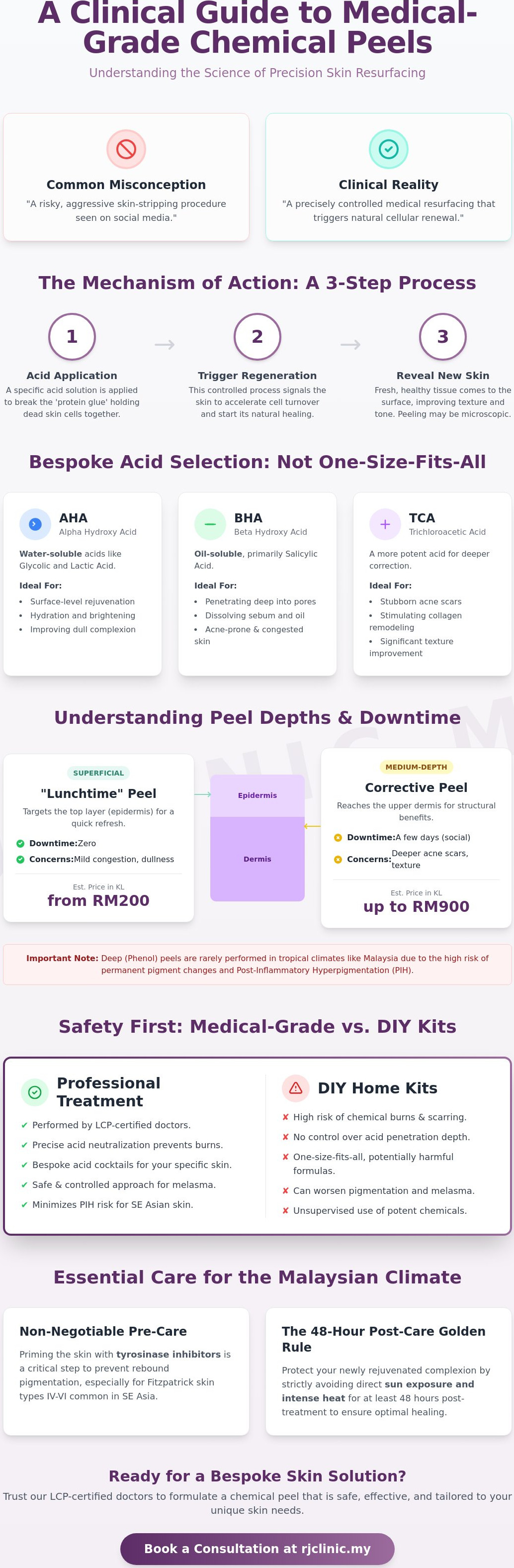
Patients often feel a sense of trepidation when they hear the word "injury" during a clinical consultation. However, a medical chemical skin peel is exactly that: a precisely calibrated, controlled injury to the epidermis and, in some cases, the dermis. By applying a specific acid solution, we break the desmosome bonds, which are the protein "glue" holding dead skin cells together. Once these bonds dissolve, the skin's natural regenerative signals are triggered, forcing an acceleration of cell turnover that brings fresh, healthy tissue to the surface.
The intensity of this biological reset is governed by two critical factors: concentration and pH. A solution's pH level determines how much "free acid" is active on the skin. A lower pH allows for deeper penetration, even if the concentration remains the same. It's also a common clinical observation that a successful chemical peel doesn't always result in visible, dramatic skin shedding. Many modern formulations achieve "micro-peeling," where cells flake off at a microscopic level. You might not see the skin falling away, but the structural improvements in texture and tone are happening beneath the surface.
The Mechanism of Action: AHA, BHA, and Beyond
In our practice, Dr Renee and Dr Cheok select acids based on your specific skin pathology rather than a one-size-fits-all menu. Alpha Hydroxy Acids (AHAs), such as Glycolic or Lactic acid, are water-soluble and excellent for surface-level rejuvenation, hydration, and brightening. Beta Hydroxy Acids (BHAs), specifically Salicylic acid, are lipophilic. Because they are oil-soluble, they can penetrate deep into the pores to dissolve sebum, making them the gold standard for acne-prone skin. For deeper structural correction, such as addressing stubborn acne scars, we utilize Trichloroacetic Acid (TCA) to reach the papillary dermis and stimulate collagen remodeling.

Why Medical-Grade Peels Surpass Over-the-Counter Kits
The primary danger of DIY home treatments lies in the failure of neutralization. If an acid is not neutralized at the exact right moment, it continues to penetrate the skin layers, which can lead to chemical burns and permanent scarring. Clinical-grade peels utilize concentrations that are far too potent for unsupervised use. This professional oversight is particularly vital for melasma treatment, where the depth of the peel must be managed with extreme precision. If the treatment is too aggressive, the resulting inflammation can actually trigger more pigment, whereas a doctor-led approach ensures the inflammatory response is therapeutic rather than traumatic.
How to Choose the Right Peel for Your Skin Type and Concern
Selecting a chemical skin peel isn't about picking the strongest acid available; it's about matching biological reality with clinical goals. In Kuala Lumpur, our primary diagnostic tool is the Fitzpatrick scale. Most SE Asian patients fall into types IV through VI, meaning their melanocytes are highly reactive. A peel that's too aggressive can cause the very hyperpigmentation we're trying to treat. This is why Dr Renee and Dr Cheok often favor a progressive approach. We find that a series of three to five lighter treatments often yields more predictable, safer results than a single high-risk deep peel.
Superficial vs. Medium Depth Peels
Superficial peels, often called "lunchtime" treatments, use mild AHAs or BHAs to target the very top of the epidermis. They're perfect for mild congestion or just refreshing a dull complexion with zero downtime. If we're treating deeper acne and scars, we move to medium-depth TCA peels that reach the papillary dermis. While these require a few days of social downtime, the structural benefits are superior. You should know that deep phenol peels, common in Western clinical literature, are rarely performed in our tropical climate. The risk of permanent pigment loss or severe PIH under the intense Malaysian sun simply outweighs the benefits. When choosing the right chemical peel, we must prioritize your skin's long-term integrity over a "quick fix" mentality.
Specialized Peels for Pigmentation and Jeragat
For stubborn "jeragat" or sunspots, we often utilize modified Jessner’s solutions. These blends combine salicylic acid, lactic acid, and resorcinol to lift pigment without overstimulating the skin. Because SE Asian skin is prone to Post-Inflammatory Hyperpigmentation, we sometimes combine these peels with advanced modalities like the Hollywood Spectra laser. This dual-action approach targets pigment at multiple depths while minimizing thermal stress. If you're unsure which depth is appropriate for your goals, a bespoke skin assessment is the most reliable way to design a plan that respects your skin's unique biology.
Preparation and Post-Care: Navigating the Malaysian Sun
Successful outcomes for a chemical skin peel aren't just determined in the clinic; they begin at home. In Malaysia, where the UV index frequently hits 11+, "priming" the skin is essential. We often prescribe Tyrosinase inhibitors for 14 days before the procedure to suppress melanin activity. This reduces the risk of "rebound" pigmentation, which occurs when the skin's defense mechanism overreacts to the peel's acidity. Understanding what to expect during a chemical peel and the recovery period helps you differentiate between healthy healing and an adverse reaction.
Following the treatment, we enforce a strict "Golden Rule" for the first 48 hours. You must avoid heat, steam, and direct sunlight. This means no outdoor exercise or hot showers. Excessive heat can exacerbate inflammation, turning a controlled injury into a potential complication. Your choice of moisturizer is also critical. We recommend occlusive, fragrance-free barriers that support the lipid layer without clogging pores. While some redness is expected, it should subside within 24 to 48 hours. If you notice persistent throbbing, blistering, or spreading redness, it's vital to contact Dr Renee or Dr Cheok immediately.
The 7-Day Recovery Timeline
Recovery is a methodical process. During Days 1 and 2, your skin will likely feel tight, similar to a mild sunburn. Existing pigmented spots might appear darker as they move toward the surface. Days 3 to 5 represent the shedding phase. It's tempting to pull at the flaking skin, but you must resist. Forced peeling can lead to raw, unprotected tissue and long-term scarring. By Days 6 and 7, the new skin is revealed. It's bright and smooth, but also extremely vulnerable to UV damage, requiring continued vigilance.
Sun Protection in a Tropical Climate
In our high-humidity environment, physical sunscreens containing zinc oxide or titanium dioxide are often preferred post-peel. They sit on top of the skin and reflect UV rays immediately without the risk of chemical irritation. Even if you're staying indoors, UV rays penetrate through windows and screens. Managing sweat is also a priority. We suggest staying in air-conditioned environments during the first 72 hours to prevent sweat-induced stinging or follicular irritation. If you're ready to start your skin's transformation with a medically supervised plan, book your pre-peel consultation with our LCP-certified team today.

The RJ Clinic Approach: Safety, Artistry, and Bespoke Care
At RJ Clinic, we view the application of a chemical skin peel as a medical art form rather than a routine facial. The safety of our patients depends entirely on the clinical judgment of an LCP-certified doctor who understands how different skin pathologies react to specific acid concentrations. While a commercial spa might offer a standard glycolic treatment, Dr Renee and Dr Cheok specialize in formulating bespoke acid cocktails. By layering different agents, we can address multiple concerns, such as active acne and superficial pigmentation, in a single session without overstressing the skin's barrier.
Integrating these peels into your broader aesthetic clinic Kuala Lumpur journey often yields the best long-term results. We frequently use peels as a foundational treatment to refine skin texture before moving on to more targeted energy-based devices. Our final clinical advice is always the same: prioritize patience. Aggressive intervention often leads to complications; consistency with a well-designed, medical-grade plan is what truly transforms the skin's health.
Safety Standards and FDA-Approved Solutions
We utilize only high-purity, medical-grade ingredients that meet rigorous safety standards. During the procedure, we meticulously monitor for the "frosting" endpoint, a white, cloudy appearance that indicates the acid has reached the desired protein depth. This visual signal tells us exactly when to neutralize the solution to prevent over-penetration. To further protect the skin, our post-procedure protocols involve specialized soothing agents designed to dampen inflammation immediately and support the repair process.
Next Steps: Your Consultation in KL
Your journey begins with a comprehensive skin analysis. During this initial meeting, we evaluate your Fitzpatrick type, current skin health, and any secondary concerns. For instance, we may determine if you're a candidate for concurrent treatments like skin tag removal or if a chemical skin peel should be your primary focus. Our goal is to create a long-term maintenance schedule that keeps your skin resilient and radiant throughout the year, ensuring your results look natural and refined.
Restoring Your Natural Glow with Clinical Expertise
Navigating the path to clearer skin requires a sophisticated balance of medical science and artistic judgment. A successful chemical skin peel relies on more than just the acid concentration; it requires a deep understanding of your skin's unique biology and the specific environmental challenges of the Malaysian climate. By prioritizing a bespoke approach over a one-size-fits-all solution, you can effectively address persistent pigmentation or scarring while minimizing the risk of inflammatory complications. Choosing professional resurfacing ensures your skin receives the exact depth of treatment it needs to regenerate without unnecessary trauma.
Dr Renee and Dr Cheok are dedicated to providing the high-purity ingredients and meticulous oversight your skin deserves. With multiple locations across KL and Selangor, our LCP-certified team is ready to guide you through a safe, results-driven transformation tailored specifically to SE Asian skin types. We invite you to Book a Bespoke Skin Consultation with Our LCP-Certified Doctors to begin your personalized treatment plan. Your skin's health is a long-term investment, and we're here to help you achieve a naturally refined and confident complexion.
Common Questions About Medical Resurfacing
How much does a chemical skin peel cost in Malaysia?
The cost of a chemical skin peel in Kuala Lumpur generally ranges from RM200 to RM400 for superficial treatments and RM500 to RM900 for medium-depth TCA peels. These price points reflect the strength of the acid and the clinical expertise required for safe application. Across the 68 clinics offering these services in the city, prices can start as low as RM190 for very mild, entry-level sessions.
Will a chemical peel make my skin thinner or more sensitive?
A professionally administered peel doesn't thin the skin; it actually promotes a thicker and more resilient dermal layer by stimulating collagen synthesis. While you'll experience temporary sensitivity during the 7-day shedding phase, the long-term result is a rejuvenated barrier. Dr Renee and Dr Cheok carefully control the acid depth to ensure the treatment strengthens rather than compromises your skin's integrity.
Can I do a chemical peel if I have active cystic acne?
You can undergo a peel with active cystic acne, but it must be a doctor-led treatment using specific lipophilic acids like Salicylic acid. This Beta Hydroxy Acid (BHA) penetrates the sebaceous unit to dissolve oil and reduce inflammation within the cyst. It's an effective way to calm active breakouts while simultaneously addressing the risk of future scarring under medical supervision.
How many sessions are typically required to see results for acne scars?
Most patients require 3 to 6 sessions spaced 4 weeks apart to achieve visible improvement in acne scars. While a single treatment can refine surface texture, deep remodeling of scar tissue is a cumulative process. You can typically expect a 50% to 70% improvement in skin smoothness after completing a full clinical cycle, depending on the initial severity of the scarring.
Is it safe to do a chemical peel during the haze season in KL?
It's safe to proceed during the haze, but you must take extra precautions against PM2.5 pollutants that can irritate vulnerable skin. Particulate matter in the air can settle on the skin during the first 72 hours of recovery, potentially causing inflammation. We recommend staying in air-conditioned environments and using a high-quality occlusive barrier cream to protect your new skin from environmental triggers.
What is the difference between a medical facial and a clinical chemical peel?
A medical facial is a maintenance treatment focused on deep cleansing and surface exfoliation, whereas a chemical skin peel is a corrective medical procedure designed for structural change. Peels use lower pH solutions to reach deeper layers of the epidermis and dermis to trigger cellular renewal. While facials are excellent for skin health, clinical peels are necessary for treating stubborn melasma or deep-seated scars.


Comments