


Laser vs. Chemical Peel in Malaysia: Which Skin Resurfacing Treatment is Right for You?

Updated: Apr 21

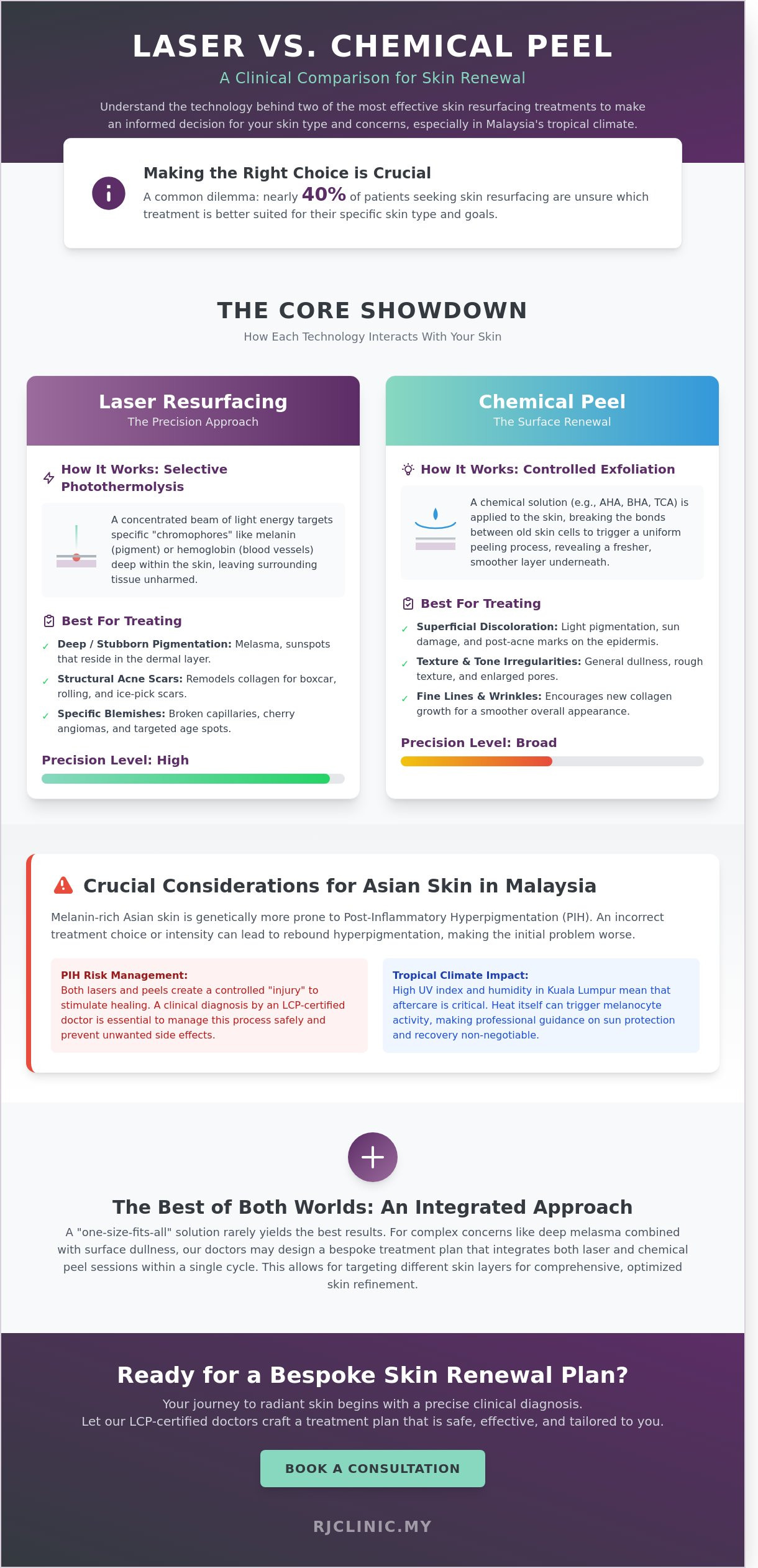
If you assume a high-tech laser is always the superior choice for skin resurfacing, you might be overlooking the specific biochemical advantages of a medical-grade peel. It's a common dilemma we see during consultations. In a typical month at our KL branch, nearly 40% of patients seeking resurfacing are unsure if their skin type is better suited for light-based therapy or deep chemical exfoliation. You're likely exhausted by a cycle of expensive skincare that fails to lift persistent melasma or smooth out stubborn acne marks, and you want a solution that works without the risk of post-inflammatory hyperpigmentation.
This clinical comparison of laser vs chemical peel malaysia helps you navigate these two distinct paths to skin renewal. Our doctors provide an expert breakdown of how each technology interacts with specific skin layers to restore a refined, even tone. We'll examine the trade-offs between immediate results and downtime, ensuring your choice aligns with your busy lifestyle in Kuala Lumpur. By the end of this guide, you'll understand why a bespoke approach is essential for achieving natural-looking results while prioritizing safety and FDA-approved technologies.
Key Takeaways
Recognize how the intense Malaysian climate accelerates photo-aging and why clinical-grade resurfacing is required to reach depths that over-the-counter serums cannot penetrate.
Compare the technical mechanisms of laser vs chemical peel malaysia to choose between the precision of laser-targeted pigments and the uniform surface renewal of a chemical peel.
Explore the clinical safeguards necessary to manage Post-Inflammatory Hyperpigmentation (PIH) risks, ensuring safe and predictable outcomes for patients with melanin-rich Asian skin.
Understand the rationale behind bespoke treatment plans where our RJ Clinic doctors may integrate both lasers and peels within a single cycle for optimized skin refinement.
Table of Contents
Beyond the Surface: Why Patients in Kuala Lumpur Seek Clinical Resurfacing
Many patients arrive at our clinic after exhausting high-end topical regimens that promise to erase pigmentation, only to find the results plateau within weeks. In a clinical setting, we observe that while serums can improve the stratum corneum's hydration, they rarely penetrate deep enough to address the dermal-epidermal junction where stubborn pigment resides. This is particularly true for Asian skin types, which are genetically more prone to post-inflammatory hyperpigmentation (PIH). When deciding between laser vs chemical peel malaysia patients must first understand that home care is a supportive measure, not a corrective one for structural damage or deep-seated melasma.
The decision to move from over-the-counter products to clinical resurfacing often stems from a realization that "brightening" is not the same as "restoring." While a cream might temporarily shed dead cells, it cannot remodel the collagen fibers required to lift an acne scar or break down the dense clusters of melanin that form age spots. Clinical intervention provides the controlled "injury" necessary to trigger the body's natural healing response, a process that is far more sophisticated than simple exfoliation.
The Limits of Home Care in a Tropical Climate
Kuala Lumpur’s relentless 80% average humidity and high UV index create a unique challenge for the skin barrier. While humidity prevents some dryness, it can also lead to a congested barrier that hinders the absorption of active ingredients like Retinol or Vitamin C. A common misconception is that applying a higher SPF allows for prolonged sun exposure after a resurfacing session. In reality, the heat itself can trigger melanocyte activity even if you're wearing sunscreen. We often see patients who've overused "brightening" creams containing harsh acids, which thins the skin and increases sensitivity without addressing the root cause. Historically, Dermabrasion and other resurfacing techniques were the primary methods for physical renewal, but modern clinical options offer much more precision for our tropical environment.
Identifying Your Primary Skin Concern
Effective treatment begins with a precise clinical diagnosis by an LCP-certified doctor. We categorize concerns into three main tiers to determine whether laser vs chemical peel malaysia is the appropriate path:
Pigmentation (Jeragat): This includes melasma, sunspots, and freckles. Proper melasma and pigmentation treatment requires identifying whether the pigment is epidermal or dermal.
Acne Scars: Structural indentations like rolling, boxcar, or ice-pick scars require deeper remodeling than a standard peel can provide.
Texture and Tone: General dullness, enlarged pores, and fine lines that give the skin a "tired" appearance.
Choosing a generic "one-size-fits-all" beauty package without a medical assessment often leads to disappointing results or rebound hyperpigmentation. Our doctors prioritize a bespoke approach, ensuring the chosen modality aligns with the patient's specific skin thickness and recovery capacity. A clinical diagnosis isn't just a formality; it's the prerequisite for safety in any resurfacing procedure.

Laser vs. Chemical Peel: A Comparative Breakdown of Mechanisms and Efficacy
Many patients visit our consultation rooms asking for "skin resurfacing" without realizing that the choice between laser vs chemical peel malaysia depends entirely on the specific depth of their skin concerns. While both treatments aim to reveal a fresher complexion, they interact with your skin's architecture in fundamentally different ways. The decision isn't merely about which is "stronger," but rather which mechanism matches the biological reality of your skin condition.
How Lasers Work: Targeted Energy Delivery
Lasers utilize the principle of selective photothermolysis. This involves using specific light wavelengths to target "chromophores," such as the melanin in a dark spot or the hemoglobin in a broken capillary, without heating the surrounding healthy skin. It's a high-precision approach that allows Dr Renee and Dr Cheok to treat specific issues without affecting the entire face. Advanced technologies like the Hollywood Spectra Laser are particularly effective for this. Because the energy can be calibrated to reach the deeper dermal layers, lasers are often the superior choice for stubborn, deep-seated pigments or structural concerns like acne scarring that a surface treatment cannot reach.
How Chemical Peels Work: Controlled Regeneration
In contrast, chemical skin peels work through a process of controlled chemical exfoliation. Instead of targeting a specific pigment, a bespoke acid solution is applied to the entire treatment area to lower the skin's pH, causing the damaged outer layers to eventually shed. This process stimulates the body's natural healing response, prompting the production of new collagen and elastin. When understanding chemical peels, it's helpful to categorize them into light, medium, and deep levels. While a light peel might only affect the epidermis to brighten the skin, a medium peel reaches the upper dermis to treat fine lines. Peels remain a gold standard for managing active acne and oily skin textures because they clear the follicular lining across the entire face simultaneously.
The distinction between medical-grade peels and spa facials is significant. Clinical peels used at RJ Clinic involve higher concentrations of active ingredients like Glycolic, Salicylic, or TCA, which require professional supervision to ensure safety and depth control. While lasers act like a sniper, hitting a specific target at a precise depth, a peel acts like a broad sweep, refining the texture of the entire surface. If you're struggling to decide which mechanism will best restore your glow, Dr Renee or Dr Cheok can provide a bespoke skin assessment to determine the most effective path for your unique profile.
To learn more about the clinical logic behind advanced skin treatments, you can explore the methodologies used by medical aesthetic professionals to achieve safe, high-impact results.
Navigating the Risks for Asian Skin: Managing Downtime and PIH
Many patients arriving at our clinic express a singular fear: will this treatment leave me with darker spots than I started with? This concern isn't misplaced. For the majority of our patients in Malaysia, skin typically falls within Fitzpatrick types III to V. These skin types possess highly active melanocytes that react to heat or chemical trauma by producing excess pigment. This biological response, known as Post-Inflammatory Hyperpigmentation (PIH), is the primary reason why the laser vs chemical peel malaysia debate requires a nuanced, medical perspective rather than a one-size-fits-all approach.
Dr Renee and Dr Cheok prioritize a comprehensive skin assessment before any high-energy intervention. They evaluate your history of scarring, current sun exposure habits, and any previous "rebound" darkening you've experienced. By understanding how laser resurfacing works on a cellular level, our doctors can calibrate the energy levels of devices like the Hollywood Spectra Laser to ensure we're stimulating repair without triggering a defensive pigment response. Sometimes, the safest path involves prepping the skin with specific inhibitors for 14 days prior to the procedure to "quiet" the melanocytes.
Why Asian Skin Requires a Meticulous Approach
The danger of over-treating Asian skin is real. If a laser is too aggressive or a peel is too acidic, the skin's basement membrane can become compromised. This lead to stubborn melasma and pigmentation issues that are far harder to treat than the original concern. Clinical judgment often dictates a "low and slow" strategy. We find that three moderate sessions often yield more elegant, natural-looking results than one high-intensity session that carries a 30% higher risk of PIH in darker skin tones.
Downtime Realities: Planning Your Social Calendar
Managing your expectations for recovery is essential for a stress-free experience. If you choose a medium-depth chemical skin peel, days one and two typically involve a "tight" sensation. By day three, visible shedding begins, usually around the mouth and nose. By day five, the peeling is mostly complete, revealing fresh, luminous skin. It's a predictable cycle that fits well into a standard KL work week if timed for a Wednesday start.
Laser resurfacing involves a different recovery profile. Immediately after the session, your skin will feel like it has a mild sunburn. Redness is the primary feature here, which can last for 3 to 7 days depending on the depth of the treatment. During this window, strict adherence to post-treatment protocols is non-negotiable. This includes:
Applying a physical-block sunscreen every 3 hours, even if you stay indoors.
Avoiding all forms of heat, including hot yoga, saunas, or spicy "laksa" steam, for at least 72 hours.
Using only pH-balanced, medical-grade cleansers to avoid disrupting the new skin barrier.
Ready to discover which resurfacing path aligns with your skin's unique biology? Schedule a bespoke consultation with Dr Renee or Dr Cheok today.
The RJ Clinic Consultation: Crafting a Bespoke Skin Renewal Plan
Patients often arrive at our clinic with a specific procedure already in mind, usually influenced by social media trends or a friend's recommendation. However, Dr Renee and Dr Cheok prioritize a holistic clinical assessment over a menu-style selection. When you're weighing the options of a laser vs chemical peel malaysia, the decision shouldn't be based on popularity, but on your skin's current integrity, your Fitzpatrick scale rating, and your specific recovery capacity. We look at the skin as a living organ that requires a strategic roadmap rather than a one-off intervention.

In many cases, the most effective results come from combination therapy. We don't view these treatments as mutually exclusive. For example, a clinician might prescribe a series of light chemical peels to refine the stratum corneum before introducing laser energy to target deeper pigmentation. This tiered approach manages the skin's inflammatory response more effectively. It's vital to remember that true skin rejuvenation is a journey. While some improvements are visible within 7 to 10 days, the most significant collagen remodeling typically occurs over a 3 to 6 month period. Our commitment to safety is anchored in using only FDA-approved technologies and maintaining LCP-certified standards to ensure every procedure is as safe as it is effective.
The Bespoke Treatment Philosophy
We tailor every treatment setting to your specific lifestyle. In Malaysia's high-UV environment, your daily sun exposure is a critical factor in our clinical decision-making. If your routine involves significant outdoor time, we adjust laser fluences to minimize the risk of post-inflammatory hyperpigmentation. For patients struggling with deep-seated acne scarring, we may integrate Potenza RF Microneedling into the cycle to provide structural remodeling that neither a standard peel nor a surface laser can achieve alone. We focus on follow-up care and precise aftercare protocols to ensure your results look natural and remain sustainable over the long term.
Taking the Next Step
During your first consultation at our KL or Selangor branches, we'll perform a detailed skin analysis to identify underlying vascularity or pigmentation that isn't always visible to the naked eye. To prepare your skin, we usually recommend pausing the use of active retinoids or strong exfoliating acids 14 days before any resurfacing procedure. This downtime for your skin cells ensures a more predictable reaction to the treatment. Modern aesthetic medicine isn't about drastic, overnight changes; it's about the scientific application of energy and chemistry to empower your skin's natural ability to heal and renew itself.
Defining Your Personal Strategy for Skin Renewal
Choosing between a laser vs chemical peel malaysia involves a nuanced understanding of your skin's unique biology and recovery capacity. While high-precision lasers are often superior for addressing deep textural scarring, chemical peels offer a reliable, progressive approach to refining surface tone and clarity. The primary challenge for patients in Kuala Lumpur is managing the risk of post-inflammatory hyperpigmentation, a concern that requires a conservative, doctor-led strategy. At RJ Clinic, we utilize FDA-approved resurfacing technologies to ensure every treatment is as safe as it is effective. Dr Renee and Dr Cheok, our LCP-certified aesthetic physicians, specialize in creating natural-looking results that enhance your features without appearing overdone. It's not just about the technology used; it's about the clinical judgment behind the settings and the bespoke care plan designed for Asian skin types. We invite you to move beyond general research and receive a professional assessment tailored to your specific goals. You deserve a treatment plan that prioritizes the long-term health and radiance of your complexion.
Frequently Asked Questions
Is a laser or a chemical peel better for melasma in Asian skin?
Melasma in Asian skin is highly reactive to heat, making low-fluence Picosecond lasers often the safer choice for precision. Dr Renee typically avoids aggressive heat to prevent triggering further pigment production. While superficial chemical peels using mandelic acid can effectively brighten the skin, lasers offer a more controlled approach to shattering deep-seated pigment without the unpredictable downtime sometimes associated with chemical exfoliants on darker skin tones.
How much does a laser treatment cost compared to a chemical peel in Malaysia?
In the Malaysian aesthetic market, chemical peels are the more accessible option, with prices generally ranging from RM250 to RM600 per session. Laser treatments require more advanced technology and clinical expertise, typically costing between RM500 and RM2,000 per session. When evaluating the laser vs chemical peel malaysia landscape, patients often find that while lasers have a higher upfront cost, they frequently deliver faster results for complex issues.
Can I do a chemical peel if I have sensitive skin?
You can safely undergo a chemical peel with sensitive skin if the treatment is bespoke to your tolerance levels. We often utilizes polyhydroxy acids (PHAs) or lactic acid for patients with reactive complexions. These specific acids have larger molecular structures that penetrate the skin slowly, providing a gentle exfoliation that strengthens the skin barrier and improves hydration without the stinging or prolonged redness caused by stronger glycolic formulas.
How many sessions will I need to see a visible difference in my acne scars?
Most patients require 4 to 6 sessions to see a 50% to 70% improvement in the depth and texture of acne scars. While a single session can refine the skin surface, collagen remodeling is a biological process that takes time. We typically space these treatments 4 weeks apart to allow the dermis to heal and regenerate, ensuring that the cumulative results look natural and provide long-term skin smoothing.
What is the "rebound effect" and can lasers make my pigmentation worse?
The rebound effect refers to post-inflammatory hyperpigmentation (PIH) caused by excessive heat or trauma during a treatment. If a laser setting is too intense for your specific skin type, the melanocytes may overproduce pigment as a defense mechanism. This is why we use FDA-approved cooling systems and precise wavelengths to ensure we target the melanin directly while keeping the surrounding tissue cool and protected from thermal damage.
Can I go back to work immediately after a chemical peel or laser treatment?
Most non-ablative lasers and superficial "lunchtime" peels allow you to return to the office immediately, as any mild redness usually fades within 2 to 3 hours. However, intensive resurfacing treatments like a deep TCA peel or an ablative CO2 laser require 5 to 7 days of downtime. During this recovery phase, the skin will visibly peel or form a protective crust, which is a necessary part of the rejuvenation process.


Comments