


Vaginal Rejuvenation in Malaysia: A Clinical Perspective on Functional Restoration (2026)

Updated: May 11

Many patients assume that vaginal rejuvenation is primarily an aesthetic choice, yet for the majority of women we see at RJ Clinic, the motivation is clinical functionality rather than just appearance. It's often a decision driven by the daily frustration of stress urinary incontinence or the physical discomfort that follows childbirth and hormonal shifts. You may find yourself questioning if a non-surgical laser can truly address tissue laxity or if surgery is the only definitive path to restoring your quality of life.
We recognize that choosing between energy-based treatments and surgical intervention requires a nuanced understanding of your specific tissue integrity. This guide provides a clinical perspective on how modern technologies work to restore the vaginal mucosa and pelvic floor support, helping you move past the discomfort of intimacy and the anxiety of mild urinary leakage. With the Medical Device (Prescribed Medical Devices) Order 2026 taking effect on June 1, 2026, ensuring your treatment is performed by LCP-certified doctors like Dr Renee or Dr Cheok is more critical than ever for safety. We will examine the specific trade-offs between laser, radiofrequency, and surgical restoration to help you determine which bespoke protocol fits your physiological goals.
Key Takeaways
Differentiate between cosmetic trends and the clinical reality of restoring vaginal tissue and pelvic floor function.
Evaluate the technical differences between energy-based laser treatments and surgical vaginoplasty to determine which approach aligns with your health goals.
Identify the specific clinical markers, such as mild stress urinary incontinence, that make a patient an ideal candidate for non-surgical vaginal rejuvenation.
Navigate the diagnostic requirements of a professional consultation, including how our female-led team screens for contraindications.
Gain clarity on the safety standards of FDA-approved technologies and why clinical expertise is essential for achieving predictable, natural results.
Table of Contents
Understanding Vaginal Rejuvenation Beyond the Marketing Labels
Patients often arrive at our consultation rooms with a sense of hesitation, unsure if their concerns are medical enough to warrant a professional intervention. In our clinical experience at RJ Clinic, the term vaginal rejuvenation is frequently misunderstood as a purely cosmetic pursuit. From a medical standpoint, we define it as the functional restoration of the vaginal mucosa and its supporting endopelvic structures. While external aesthetics might be a secondary benefit, the primary clinical goal is to address the physiological changes that occur after childbirth or during the transition into menopause.
The underlying cause of these changes is typically a depletion of collagen and elastin. This occurs through mechanical stretching during a vaginal delivery or via hypoestrogenism, the natural decline of estrogen levels. When these structural proteins diminish, the vaginal walls lose their thickness and elasticity. It’s important to distinguish this internal restoration from vulvoplasty, which focuses on the external labia. Many patients are surprised to learn that Vaginoplasty procedures cover a spectrum from reconstructive surgery to non-surgical energy-based tightening. The choice between them depends entirely on the degree of tissue compromise and the specific functional symptoms present.
The Physiological Impact of Tissue Laxity
When tissue integrity decreases, the support for the bladder neck often weakens. This leads to Stress Urinary Incontinence (SUI), where simple actions like coughing or sneezing cause involuntary leakage. It’s a sign that the pelvic fascia is no longer providing adequate resistance. Additionally, a thinning mucosal lining results in decreased lubrication and chronic dryness. Our clinical objective is to stimulate neo-collagenesis to restore the rugal folds, which are the natural ridges of the vaginal wall, and the tissue's inherent moisture-producing capacity. Restoring this architecture is essential for both comfort and long-term pelvic health.
Common Misconceptions in the Malaysian Market
A prevalent myth we encounter is that these treatments are reserved for aesthetic vanity. This couldn't be further from the clinical reality. Most patients seen by Dr Renee and Dr Cheok seek help for functional health, such as resolving mild urinary leakage that interferes with their active lifestyles. Another misunderstanding is the one-and-done expectation. Reversing years of physiological change usually requires a structured, bespoke protocol rather than a single session. We focus on health restoration rather than just tightening to ensure that patient expectations align with the biological limits of the technology used. With the new Medical Device Order 2026 now in effect, it's also vital to recognize that these are medical procedures requiring registered devices and qualified expertise.
Non-Surgical vs. Surgical Approaches: A Clinical Comparison
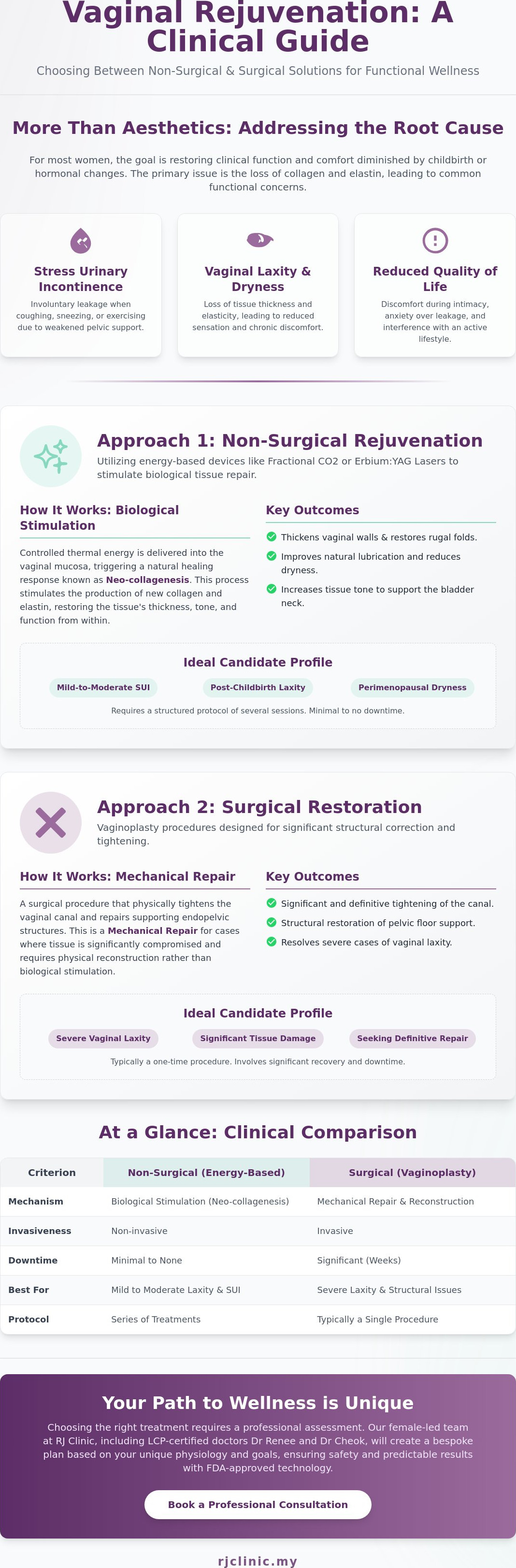
Determining whether a patient requires a surgical scalpel or a laser handpiece is the most critical decision made during a feminine wellness consultation. At RJ Clinic, our approach is rooted in clinical evidence; we prioritize the least invasive pathway that can realistically achieve your functional goals. While marketing often portrays energy-based devices as a universal fix, a professional assessment must distinguish between tissue that needs biological stimulation and tissue that requires mechanical repair. The "suitability gap" is a real clinical boundary that we respect to ensure you don't undergo a procedure that is unlikely to meet your expectations.
Energy-based vaginal rejuvenation focuses on the biological quality of the tissue. Fractional CO2 and Erbium:YAG lasers deliver controlled thermal energy into the vaginal mucosa, triggering a localized healing response known as neo-collagenesis. This process stimulates the production of new collagen and elastin fibers, thickening the vaginal walls and restoring natural lubrication. For many of our patients, this biological "reset" is sufficient to resolve mild stress urinary incontinence and improve tissue tone without the need for an operating theater.
Energy-Based Treatments: Laser and Radiofrequency
The success of non-surgical treatments relies on bespoke protocols. A post-partum patient in her 30s requires different energy depths and densities compared to a menopausal patient in her 50s. By adjusting these parameters, Dr Renee and Dr Cheok can target specific layers of the mucosa to maximize the healing response. Because these treatments trigger a natural cellular process, the results appear gradually and feel entirely natural. For patients pursuing a more comprehensive aesthetic transformation, we often discuss these treatments alongside other restorative procedures like precision body contouring to address total body confidence.
When Surgery is the Appropriate Pathway
Despite the advancements in laser technology, surgical intervention remains the gold standard for severe structural compromise. If a patient presents with high-grade pelvic organ prolapse or significant separation of the levator ani muscles, energy-based devices cannot provide the necessary mechanical support. Surgical vaginoplasty involves the physical excision of excess vaginal lining and the manual tightening of the underlying pelvic floor muscles. While surgery offers immediate and dramatic structural changes, it requires approximately six weeks of downtime and carries the standard risks associated with anesthesia. If your case involves complex reconstructive needs, we will always advise the surgical route to ensure your safety and long-term health. If you are uncertain which category your symptoms fall into, you can schedule a discreet consultation to discuss a tailored plan.
Clinical Suitability and Managing Patient Expectations
Patient selection is the most significant factor in the success of non-surgical vaginal rejuvenation. While technology has advanced significantly, it isn't a "one-size-fits-all" solution. The ideal candidate typically presents with mild to moderate tissue laxity or early-stage stress urinary incontinence (SUI). If you experience minor leakage while exercising or a noticeable loss of sensation during intimacy, but your physical examination doesn't reveal a high-grade prolapse, you're likely to achieve excellent functional results. We prioritize FDA-approved technologies because they offer a consistent, predictable safety profile that is essential in a medical-grade environment.
Managing the timeline for results is a core part of our consultation process. It's vital to understand that biological restoration doesn't happen overnight. While you may feel an immediate "tightness" due to the initial contraction of existing collagen fibers, the peak clinical benefit—driven by neo-collagenesis—usually manifests between 3 to 6 months post-treatment. This is the period when the new collagen and elastin fibers have fully matured, providing the structural support required to resolve functional symptoms like dryness or mild leakage.
Safety Protocols and Downtime Realities
The aesthetic industry often markets these procedures as having "no downtime," which is true regarding your ability to return to work or daily activities immediately. However, clinical healing requires specific boundaries. Dr Renee and Dr Cheok implement a strict protocol where patients must avoid intimacy, swimming, or soaking in hot baths for 3 to 7 days post-procedure. This window is necessary to allow the mucosal lining to stabilize without the risk of irritation or infection. Any temporary sensitivity or minor discharge is a normal part of the healing response, and as LCP-certified doctors, we provide specific post-care guidance to ensure your comfort throughout this brief recovery phase.
Longevity and Maintenance of Results
Because the body continues to age, the results of energy-based restoration are not permanent. On average, patients enjoy the functional benefits of their treatment for 12 to 18 months. Lifestyle choices play a significant role here; for example, smoking or frequent weight fluctuations can accelerate the breakdown of new collagen. To counteract the natural aging process, we typically recommend a single maintenance session every year. We often view this as part of a holistic anti-aging strategy, noting the synergy between internal tissue health and external treatments like collagen stimulators, which many patients use to maintain overall skin integrity. To determine if you are a candidate for this bespoke approach, you can book a private assessment with our clinical team.
The Consultation: Crafting a Bespoke Feminine Wellness Plan
The decision to pursue vaginal rejuvenation is deeply personal, and the environment where you discuss these concerns should reflect that level of sensitivity. At RJ Clinic, we provide a discreet, female-led space where you can speak openly with Dr Renee or Dr Cheok. This initial session isn't just a formality; it's a rigorous diagnostic screening. We conduct a thorough history taking and a physical examination to rule out contraindications such as active pelvic infections, undiagnosed vaginal bleeding, or high-grade prolapse that may require surgical intervention rather than laser therapy. This ensures that any energy-based treatment we propose is both safe and clinically appropriate for your mucosal health.
A significant risk currently present in the Malaysian market is the proliferation of "budget packages" offered at non-medical beauty centers or home-based services. These facilities often use unregistered devices that lack precise thermal control, which can lead to mucosal burns, chronic inflammation, or permanent scarring. With the Medical Device (Prescribed Medical Devices) Order 2026 now in effect as of June 1, 2026, it's illegal for non-medical practitioners to operate these high-intensity devices. Our clinical oversight ensures that every treatment utilizes FDA-approved technology operated under strict medical protocols to protect your long-term health.
The Importance of LCP Certification in Malaysia
In Malaysia, the Letter of Credentialing and Privileging (LCP) is the Ministry of Health's primary mechanism for ensuring patient safety in aesthetic medicine. It confirms that a physician has undergone specific training and assessment to perform medical-grade aesthetic procedures. Understanding the importance of a doctor’s credentials is vital when choosing a provider for internal restorative procedures. Medical-grade lasers are powerful tools; they require a doctor’s precise understanding of vaginal anatomy and tissue response to prevent complications and achieve the intended functional restoration of the rugal folds and mucosal thickness.
Next Steps: Your Personalised Pathway
We encourage a "consultation-first" mindset. Rather than selecting a treatment from a marketing brochure, we allow the clinical findings of your examination to dictate the most effective pathway. For many women, feminine wellness is one component of a broader journey toward self-confidence and physical comfort. We often integrate these restorative plans into a wider medical slimming and contouring framework, ensuring a holistic approach to your health and aesthetic goals. If you're ready to move forward with a clinical assessment, you can schedule a bespoke consultation with our clinical team to discuss your options in a secure, professional environment.
Restoring Functional Health and Confidence
Navigating the options for feminine wellness requires a shift from viewing vaginal rejuvenation as an aesthetic trend to recognizing it as a vital medical restoration. We've examined how the choice between non-surgical biostimulation and surgical repair depends entirely on your unique tissue integrity. By prioritizing clinical evidence over marketing labels, you'll ensure your treatment plan is grounded in biological reality rather than temporary fixes.
The transition to a more comfortable and active lifestyle is best achieved under the guidance of experienced medical professionals. At RJ Clinic, Dr Renee and Dr Cheok provide LCP-certified oversight, utilizing FDA-approved laser and radiofrequency technologies to deliver predictable results. Our private, luxury clinical environments in KL and Selangor are designed to offer you the highest standard of care in a setting that values your discretion. Reclaiming your physical health is a significant step toward long-term wellbeing, and it's a priority we take seriously. We invite you to Book a Discreet Consultation for Bespoke Feminine Wellness and begin your personalized journey toward restoration.
Frequently Asked Questions
Is vaginal rejuvenation painful, and do I need anaesthesia?
Non-surgical procedures are generally painless and don't require general anaesthesia or sedation. Most patients describe the sensation as a gentle, localized warmth during the laser or radiofrequency application. We may apply a topical numbing cream to the external vulvar area to ensure your comfort, but the internal mucosal lining has very few pain receptors, making the treatment easily tolerable in a clinical setting.
How many sessions are typically required for noticeable functional improvement?
A standard clinical protocol usually involves three sessions spaced 4 to 6 weeks apart to achieve optimal results. While some patients notice a decrease in dryness or improved comfort after a single visit, the full biological restoration of the tissue requires cumulative stimulation. Your specific plan is determined by the baseline health of your tissue during your assessment with Dr Renee or Dr Cheok.
Can I undergo laser rejuvenation if I am planning to have another child?
You can safely undergo vaginal rejuvenation between pregnancies, but it's important to understand that a subsequent vaginal delivery will likely reverse the structural improvements. We generally suggest waiting until your family is complete to ensure the longest possible duration of your results. If you're currently struggling with significant discomfort or urinary leakage, we can provide interim treatments to manage those symptoms effectively.
What is the difference between non-surgical tightening and a vaginoplasty?
Non-surgical tightening focuses on improving the biological quality and thickness of the vaginal walls, while vaginoplasty is a surgical procedure that physically reconstructs separated pelvic muscles. If you have a high-grade prolapse or severe muscle trauma from childbirth, energy-based devices won't provide the mechanical repair you need. Laser and RF treatments are ideal for mild to moderate laxity where tissue quality is the primary concern.
Are the results of vaginal rejuvenation permanent?
The results aren't permanent because your body continues to undergo natural aging and hormonal shifts. Most patients maintain their functional improvements for 12 to 18 months before noticing a gradual decline in tissue tone. We typically recommend a single maintenance session every year to counteract these ongoing physiological changes and preserve the health of the restored mucosal lining.
How soon after childbirth can I start rejuvenation treatments?
We recommend waiting at least 3 to 6 months after a vaginal delivery before starting any energy-based treatments. This duration allows the post-partum inflammation to subside and gives your pelvic tissues time to stabilize naturally. It's also clinically advisable to wait until you have finished breastfeeding, as the low estrogen levels during lactation can affect how your tissue responds to the rejuvenation process.


Comments