


Lip Filler vs Lip Flip: Which Better Improves Shape and Definition?


The most effective way to make your lips appear fuller might not involve adding any volume at all. Many patients arrive at the clinic requesting more volume to fix a disappearing upper lip, assuming that dermal fillers are the only solution for a more defined smile. However, the choice between a lip filler vs lip flip often comes down to whether your aesthetic goals require structural expansion or simply a subtle muscular adjustment.
It's understandable to feel hesitant about injectables when the fear of an overfilled or artificial appearance is so prevalent. We prioritize a refined, natural aesthetic that respects your unique facial proportions and avoids the common pitfall of an overdone look. This clinical comparison provides an authoritative look at how these two distinct procedures function, helping you determine which approach aligns with your anatomical needs. The following analysis examines the technical differences between hyaluronic acid fillers and botulinum toxin, the specific correction of a gummy smile, and how Dr. Renee and Dr. Cheok tailor these treatments to achieve symmetry without compromising your natural character.
Table of Contents
Fundamental Differences: Lip Filler vs. Lip Flip
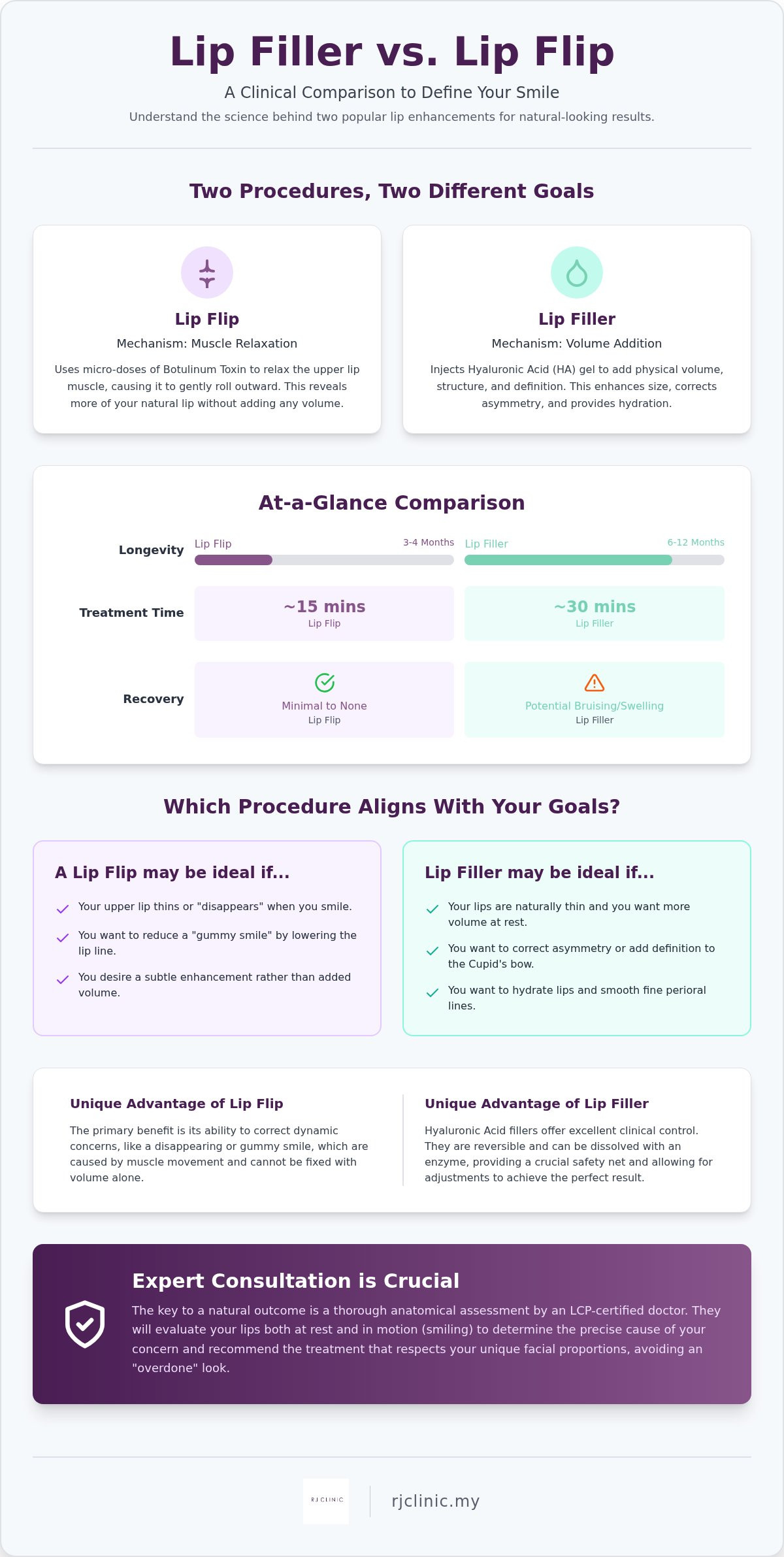
Understanding the choice between a lip filler vs lip flip requires looking beyond the surface of the skin. While both procedures aim to enhance the perioral area, they utilize entirely different biological mechanisms. Lip fillers rely on Hyaluronic Acid (HA), a substance naturally found in the body, to provide physical volume and structure. In contrast, a lip flip uses botulinum toxin to temporarily relax the orbicularis oris muscle. This relaxation allows the upper lip to gently roll outward, revealing more of the vermilion border without adding any exogenous volume.
During a consultation, Dr Renee and Dr Cheok focus on how your lips behave during dynamic movements, such as smiling or speaking. This is a critical distinction in lip augmentation procedures. If your upper lip disappears when you smile because the muscle pulls it inward, a lip flip may be the more appropriate anatomical correction. It creates a subtle vertical roll that makes the lip appear taller. Fillers, however, create 3D projection, adding depth and fullness that is visible from all angles, making them the preferred choice for those seeking to correct asymmetry or lost volume at rest.
At a Glance: Comparison Table
Choosing the right procedure also involves practical considerations regarding your schedule and how long you wish the results to last. A lip flip is often considered a "tweakment" due to its speed and subtle nature, while fillers are a more significant structural investment.
The Role of Hyaluronic Acid in Lip Augmentation
HA fillers are the gold standard for those seeking lip filler augmentation because they integrate seamlessly with your natural tissue. Beyond the immediate structural support, HA is hydrophilic, meaning it attracts moisture to keep the lips hydrated and supple from within. This is particularly beneficial for patients noticing fine lines or a "deflated" appearance as they age.
Safety is a cornerstone of our practice. A significant advantage of using HA is its reversibility. Should a patient desire a change or if adjustments are needed, the product can be dissolved using a specific enzyme. This offers a level of clinical control and peace of mind that permanent implants or non-HA materials cannot provide. Dr Renee and Dr Cheok prioritize this flexibility to ensure every outcome remains refined and aligned with your evolving aesthetic goals.
The Science of Injection: Volume vs. Muscle Relaxation
The effectiveness of a lip filler vs lip flip depends entirely on the biological mechanism we choose to engage. A lip flip involves precisely placing micro-doses of botulinum toxin into the orbicularis oris, which is the circular muscle surrounding the mouth. This treatment does not add volume. Instead, it relaxes the superficial muscle fibers that cause the upper lip to curl inward when you smile. Dr. Cheok frequently explains to patients that this procedure does not increase lip size in a literal sense; it simply reveals more of your existing vermilion tissue by preventing it from tucking away.
Dermal fillers operate on a different principle of physics and chemistry. Hyaluronic acid is naturally hydrophilic, meaning it attracts and binds to water molecules to create physical space and lift. This provides the structural projection needed to reshape the lips from within. According to FDA safety information on dermal fillers, these products are approved for specific structural enhancements. Their ability to integrate with tissue allows for immediate, visible changes in volume that a neuromodulator cannot achieve.
Correcting the Gummy Smile with a Lip Flip
For many patients, a gummy smile is caused by hyperactive lip elevator muscles that lift the upper lip too high. A strategic lip flip acts as a dual-purpose treatment in these cases. By relaxing these muscles, we can lower the lip line to cover excessive gum exposure while simultaneously creating a subtle outward roll. Clinical limitations do exist; if the gum exposure is severe or caused by skeletal structure rather than muscle activity, a lip flip alone may not provide a complete correction.
Structural Contouring with Dermal Fillers
True artistry in lip enhancement involves more than just filling the center of the lip. We use dermal fillers to define the Cupid's bow and reinforce the philtral columns, the two vertical lines running from the nose to the upper lip. This structural approach is essential for correcting asymmetry or restoring the definition lost through the natural aging process. Our philosophy at RJ Clinic focuses on subtle enhancement. We aim to refine your features rather than create an overfilled look that ignores your natural facial proportions. If you are noticing a loss of definition, you might consider how dermal fillers can restore balance to your smile.
Anatomical Considerations: Choosing the Right Procedure
Clinical assessment is the most critical step in determining the right approach. Dr. Renee evaluates the lips in two states: at rest and during a dynamic smile. This distinction is vital because a patient might have perfectly proportioned lips while silent, yet their upper lip may vanish the moment they laugh. This specific anatomical behavior is a primary factor in the academic review of lip filler vs. lip flip, which highlights how muscle hypermobility dictates treatment success. If the lip disappears due to muscle pull, a flip is the answer. If the lip is thin regardless of expression, filler is required.
Sometimes, the most natural result comes from a hybrid approach. By combining a small amount of filler for structural support with a lip flip to prevent the lip from curling under, we can achieve a multi-dimensional enhancement. This prevents the "shelf" effect where filler is pushed forward by strong muscles, ensuring the profile remains soft and organic. We find that patients who struggle with both volume loss and a gummy smile benefit most from this dual-modality strategy.
Asian Facial Architecture and Lip Projection
In our practice, we often consider how lip projection interacts with the overall facial profile. Asian facial architecture typically benefits from a balanced lower face that follows the Ricketts' E-line. This is an imaginary line from the tip of the nose to the chin. If the chin is slightly recessed, adding significant volume to the lips can disrupt this balance and create an artificial appearance. For this reason, face slimming treatments or chin augmentation are frequently discussed alongside lip enhancement to ensure the lower third of the face remains proportional. Our goal is to respect your natural proportions while refining the V-shape silhouette.
Clinical Trade-offs: Longevity and Maintenance
Patients must also weigh the practical trade-offs regarding maintenance. Because the mouth is an area of constant movement, a lip flip typically has a shorter lifespan of 8 to 12 weeks. The body metabolizes the neuromodulator quickly in these active muscle fibers. Dermal fillers offer more longevity, usually enduring for 6 to 12 months. It's common for first-time patients to see a slightly faster metabolism of the filler as the tissue integrates with the product for the first time. If you are ready to determine which procedure aligns with your anatomy, you can schedule a facial analysis with Dr. Renee or Dr. Cheok at our Kuala Lumpur or Selangor branches.
The Patient Journey: Safety, Cost, and Expectations
A successful aesthetic outcome begins long before the first injection. Every patient at RJ Clinic undergoes a rigorous clinical protocol to manage expectations and screen for contraindications. Dr. Renee and Dr. Cheok prioritize your health by identifying factors like active cold sores or underlying vascular conditions that might necessitate delaying the procedure. This medical screening ensures that the choice between a lip filler vs lip flip is made with your long-term safety in mind rather than just immediate visual goals.
The healing phase requires patience. While you'll see immediate volume with fillers, the final, settled result typically takes 10 to 14 days. During this window, minor swelling and bruising are common. We advise patients to avoid strenuous exercise, saunas, and intense heat for at least 48 hours to ensure product stability. This is particularly important for fillers, as heat can exacerbate swelling and potentially affect how the hyaluronic acid integrates with your tissue.
Managing Potential Risks and Complications
Precision in technique is the only way to prevent complications like lip filler migration. When product is placed too superficially or in excessive quantities, it can shift beyond the vermilion border, creating an unnatural shadow. Dr. Cheok and Dr. Renee utilize advanced injection methods to maintain vascular safety, reducing the risk of arterial occlusion. With a lip flip, the primary side effect is a temporary weakness in the orbicularis oris muscle. You might find it difficult to use a straw or whistle for a few weeks; it's a normal, albeit inconvenient, trade-off for the muscle relaxation required to achieve the outward roll.
Cost Analysis vs. Value
When evaluating the financial aspect of a lip filler vs lip flip, it's essential to look at the annual investment rather than the per-session cost. Lip flips are often viewed as entry-level treatments due to their lower initial price point. However, because they require maintenance every 8 to 12 weeks, the cumulative cost can rise over a year. High-quality HA fillers represent a larger upfront investment but offer structural results that last significantly longer. Choosing 'budget' fillers from uncertified providers often leads to higher correction costs later. We emphasize that LCP certification is a non-negotiable trust signal. Your injector's medical background is the most significant factor in achieving a result that is both beautiful and safe.
Refining Your Aesthetic Strategy
Choosing between a lip filler vs lip flip is a clinical decision grounded in your unique anatomy and how your features move. A lip flip offers a subtle solution for a disappearing smile through targeted muscle relaxation, while hyaluronic acid fillers provide the structural foundation needed for lasting volume and symmetry. Both treatments require a meticulous eye for detail to ensure results remain organic and proportional to your facial architecture.
At RJ Clinic, we prioritize safety and artistry by using only FDA-approved premium injectables. Our LCP-certified medical practitioners, Dr Renee and Dr Cheok, provide personalized assessments at our locations in KL and Selangor to help you make an informed choice. Whether you seek to correct a gummy smile or restore youthful definition, we invite you to schedule a clinical consultation with Dr. Renee or Dr. Cheok at RJ Clinic. We look forward to partnering with you to achieve a look that feels both elevated and authentically yours.
Common Questions Regarding Lip Enhancements
Is a lip flip better than filler for a natural look?
Neither procedure is inherently better; the choice depends on your anatomical needs. A lip flip is often perceived as more natural because it adds no exogenous volume, simply relaxing the muscle to reveal your existing tissue. However, dermal fillers produce equally organic results when administered by LCP-certified doctors like Dr. Renee or Dr. Cheok. The decision between a lip filler vs lip flip rests on whether you require physical volume or a subtle muscular adjustment.
Can I get a lip flip and filler at the same time?
Combining both treatments is a frequent clinical recommendation for patients seeking comprehensive enhancement. This hybrid approach allows us to use fillers to build structural support and symmetry while the lip flip addresses dynamic concerns like a gummy smile. By using both, we can achieve a more refined outcome that looks balanced both at rest and in motion, ensuring the lips don't appear overfilled or shelf-like from the side profile during speech.
Does a lip flip hurt more than lip filler injections?
Most patients find the lip flip to be significantly less uncomfortable than filler. The procedure involves fewer injection sites and a very fine needle to deliver micro-doses of botulinum toxin. While lip fillers involve deeper tissue integration and more product volume, we use advanced techniques and topical numbing agents at our Kuala Lumpur clinics to ensure your comfort. The sensation for a flip is often described as a quick, minor pinch that subsides almost immediately.
How much does a lip flip cost compared to filler in Malaysia?
In Malaysia, a lip flip is considered an entry-level injectable treatment with a lower per-session cost than dermal fillers. This is because it requires a smaller amount of product and less time to perform. However, it's important to consider the long-term maintenance. A lip flip lasts approximately three months, whereas high-quality HA fillers can last up to a year. We recommend a consultation at our Selangor or KL branches to discuss the best value for your specific goals.
Will a lip flip make it hard to talk or eat?
You may experience a temporary change in how your lips move during the first few weeks after a lip flip. Because the treatment relaxes the orbicularis oris muscle, some patients find it slightly difficult to use a straw, whistle, or pronounce certain words clearly. These effects are usually mild and resolve as your body adjusts to the muscle relaxation. Dr. Cheok ensures precise dosing to minimize these functional changes while still achieving the desired aesthetic outward roll of the vermilion border.
How long does it take to see results from a lip flip vs. filler?
The timeline for visible results differs significantly between the two procedures. Dermal fillers provide immediate gratification, as the physical volume and shape are apparent the moment the injection is complete, though final settling takes about two weeks. In contrast, the effects of a lip flip develop gradually. It typically takes three to seven days for the neuromodulator to relax the muscle fibers, with the full vertical roll becoming visible after approximately ten days. Understanding the lip filler vs lip flip timeline helps in planning for social events.


Comments