


Density RF vs Ultherapy Prime: Which Skin Tightening Treatment Is Right for You?

Updated: Aug 17

Selecting the most advanced energy device won't deliver a refined profile if the technology doesn't align with your specific tissue depth. Many patients arrive at our Kuala Lumpur clinic requesting a "lift" when their primary concern is actually surface laxity, or they worry that any heat-based procedure might lead to unwanted facial fat loss. Understanding the nuances of Density RF vs Ultherapy is essential to achieving a defined jawline without the risks of an over-treated, hollow appearance.
It's understandable to feel overwhelmed by the technical specifications of ultrasound versus radiofrequency. You want restored elasticity and a natural look, but the investment in these premium treatments requires clinical certainty. This doctor-led breakdown explains how Ultherapy Prime targets the foundational SMAS layer to lift, while Density RF focuses on tightening the skin's envelope through collagen remodeling. You'll learn which treatment matches your facial anatomy and how Dr Renee and Dr Cheok utilize these FDA-approved technologies to create personalized, 3D rejuvenation protocols that prioritize safety and subtle, organic-looking outcomes.
Table of Contents
The Science of Depth: How Ultherapy and Density RF Differ
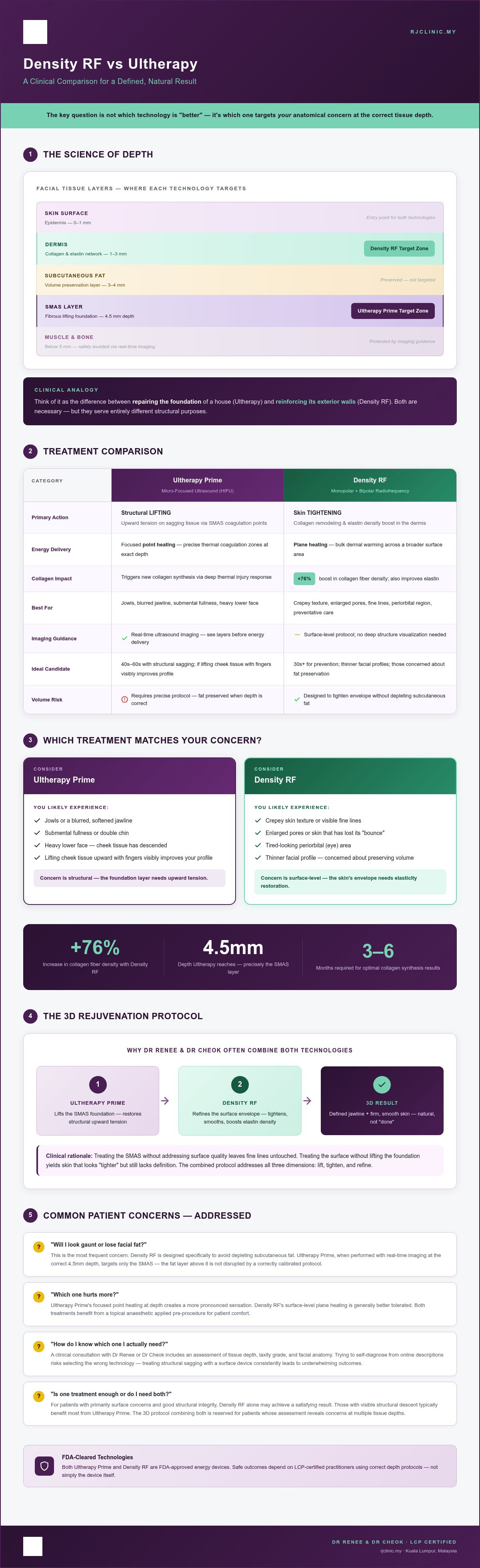
The primary distinction when comparing Density RF vs Ultherapy lies in the anatomical depth each technology reaches. To achieve a sophisticated, natural result, we must determine if your concern is structural sagging or surface-level skin laxity. Think of it as the difference between repairing the foundation of a house and reinforcing its exterior walls; both are necessary, but they serve entirely different clinical purposes.
Ultherapy and the SMAS Foundation
Ultherapy Prime remains the gold standard for non-surgical lifting because it targets the Superficial Musculoaponeurotic System (SMAS). This is the fibrous layer 4.5mm beneath the surface that surgeons physically manipulate during a traditional facelift. By utilizing High-Intensity Focused Ultrasound (HIFU), the device creates precise thermal coagulation points at this deep level without disrupting the skin's surface.
The "Prime" evolution of this technology allows for enhanced visualization. Dr Renee and Dr Cheok use real-time ultrasound imaging to see the tissue layers before delivering energy. This ensures we don't hit bone or blood vessels; instead, we focus energy exactly where it can trigger a structural lift. This "point" heating mechanism is what differentiates Ultherapy as a lifting procedure rather than just a tightening one.
Density RF: Volumizing the Dermis
While ultrasound focuses on depth, Density RF utilizes radiofrequency to treat the "envelope" of the face. It employs a combination of monopolar and bipolar energy to heat the dermis in a "plane" rather than individual points. This bulk heating triggers an immediate contraction of existing collagen fibers while stimulating a significant long-term boost in elastin density. Research has shown this technology can lead to a 76% boost in collagen fiber density, providing a smoother, firmer appearance.
For patients in Kuala Lumpur with thinner facial profiles, Density RF is often the preferred choice. The technology is designed to refine skin texture and restore elasticity without the risk of depleting the subcutaneous fat that provides youthful volume. By focusing on the skin's surface integrity, it addresses fine lines and crepey textures that deeper ultrasound treatments might bypass. Understanding the synergy between Density RF vs Ultherapy is the first step toward a customized 3D rejuvenation plan.
Suitability: Choosing Based on Your Facial Anatomy
Choosing between Density RF vs Ultherapy isn't a matter of which machine is "better," but rather which one addresses your specific anatomical changes. During a clinical consultation, Dr Renee or Dr Cheok will assess whether your concerns are grounded in structural sagging or surface-level laxity. This distinction is vital; treating sagging tissue with a surface-level device often leads to disappointment, while over-treating thin skin with deep energy can compromise facial harmony.
The Best Candidate for Ultherapy Prime
Patients with a "heavy" lower face or significant submental fullness (a double chin) typically see the most transformative results from Ultherapy Prime. Because this technology reaches the SMAS layer, it provides the upward tension necessary to pull jowls back into place and sharpen a blurred jawline. If you can physically "lift" your cheek tissue with your fingers and see an improvement in your profile, your concern is likely structural. For a deeper look at how we apply this in a local context, you can read our guide on Ultherapy in Kuala Lumpur.
When Density RF is the Clinical Priority
Conversely, Density RF is the superior choice when the "envelope" of the skin has lost its bounce. This manifests as crepey texture, enlarged pores, or fine lines that appear when you smile. It's an excellent preventative tool for patients in their 30s who want to maintain collagen density before gravity takes hold. Its unique cooling system also makes it suitable for the delicate periorbital region, where it can safely refresh tired-looking eyes without the intensity of deeper ultrasound waves.
One of the most frequent anxieties we address is the fear of looking "gaunt" or losing facial fat. This is where clinical expertise becomes paramount. While some energy devices carry risks if used at incorrect depths, modern protocols and the FDA safety communication on RF microneedling and related technologies emphasize the importance of practitioner technique. At our clinic, we use real-time imaging and precise depth control to ensure we're tightening the skin and lifting the foundation, not depleting the fat pads that provide youthful volume. If you're unsure which category your skin falls into, a personalized skin assessment can clarify the most effective path forward for your unique features.
Clinical Expectations: Results, Pain, and Longevity
Understanding the procedural experience of Density RF vs Ultherapy helps manage expectations regarding comfort and the recovery period. While both are non-invasive, they involve distinct sensations. Ultherapy Prime often presents as a "spiky" or prickly warmth as energy reaches the deep SMAS layer. In contrast, Density RF feels like a steady, deep heat that builds across the treatment area. Both procedures allow you to return to your daily routine in Kuala Lumpur immediately; there is no bruising or significant downtime involved.
Pain Management and Procedure Comfort
Dr Renee and Dr Cheok prioritize patient comfort through meticulous energy titration and the application of high-grade topical numbing. Ultherapy Prime utilizes faster transducers compared to legacy devices, significantly reducing the duration of treatment and associated discomfort. Meanwhile, Density RF features an advanced cooling mechanism that protects the epidermis. This ensures the heat remains focused on the dermis while the surface stays comfortable, making it a highly tolerable experience even for those with sensitive skin.
Maintenance and Long-Term Protocols
Results from these treatments follow two distinct timelines. You'll likely notice an immediate "glow" or slight contraction due to heat-induced fiber tightening. However, the true transformation occurs within a 3-6 month collagen window as the body synthesizes new structural proteins. Ultherapy typically offers greater longevity, with results often lasting 12-18 months. Density RF is generally viewed as an annual maintenance treatment to keep collagen levels "banked" and maintain surface firmness.
In Malaysia's tropical climate, high UV exposure can degrade collagen faster than in other regions. We advise strict sun protection and medical-grade skincare to preserve your results. While a single session of Ultherapy Prime is often sufficient for over a year, Density RF may benefit from occasional booster sessions to maintain surface refinement. Setting realistic expectations is key; these treatments refine and restore rather than creating an artificial or over-stretched appearance.
Ready to see which timeline fits your lifestyle? Schedule a clinical assessment with our LCP-certified doctors today to design your maintenance protocol.
The RJ Clinic Perspective: The 3D Rejuvenation Approach
In our clinical experience, treating the face as a single-layer problem often leads to incomplete results. True facial harmony requires a multi-dimensional strategy. While the debate of Density RF vs Ultherapy often frames them as competitors, we view them as complementary tools. Dr Renee and Dr Cheok utilize a 3D rejuvenation approach that addresses both the deep structural foundation and the superficial skin quality, ensuring a result that is both lifted and refined.
Designing Your Custom Lifting Protocol
A personalized protocol often begins with establishing the "scaffolding." We frequently sequence treatments by performing Ultherapy Prime first to secure the SMAS layer and provide a structural lift to the jawline and submental area. Once this foundation is stable, we integrate Density RF at RJ Clinic to address surface-level concerns. This allows us to target specific zones with surgical precision: ultrasound for the heavy lifting of the lower face, and radiofrequency for volumizing the cheeks and smoothing the delicate periorbital region.
Safety and LCP Certification in KL
The efficacy of these high-energy devices is inseparable from the skill of the practitioner. In Kuala Lumpur, the market is unfortunately saturated with "cheap" HIFU or RF alternatives that often use non-medical grade equipment or counterfeit consumables. These carry significant risks, including thermal burns or permanent nerve damage. At RJ Clinic, our commitment to safety is anchored by our LCP-certified doctors and the exclusive use of FDA-approved hardware. This certification isn't just a formality; it's your guarantee that the person handling the device understands the intricate anatomy of facial nerves and tissue planes.
This level of clinical rigor defines modern aesthetic medicine globally, whether you are seeking facial rejuvenation in Malaysia or specialized care such as laser snoring treatment Melbourne, which is part of a broader suite of confidence-restoring non-invasive procedures.
Moving beyond the machine, the ultimate outcome depends on the doctor's clinical judgment and aesthetic artistry. We believe in subtle enhancements that respect your natural features rather than over-treating to the point of distortion. To begin your journey toward a naturally rejuvenated profile, you can schedule a consultation with Dr Renee or Dr Cheok at any of our branches.
Achieving Your Refined Profile through Clinical Precision
Choosing between Density RF vs Ultherapy doesn't have to be a binary decision. While one excels at lifting the foundational SMAS layer to redefine your jawline, the other focuses on tightening the skin's surface to restore a youthful, healthy bounce. By integrating these FDA-approved technologies into a cohesive 3D rejuvenation plan, you can address multiple signs of aging without the risks of an overdone or artificial appearance. This multi-layered approach ensures that your results are both structurally sound and aesthetically refined—a standard of excellence also practiced at Tseng Plastic Surgery for advanced facial rejuvenation.
At RJ Clinic, we believe that state-of-the-art hardware is only as effective as the clinical judgment behind it. Our LCP-certified doctors, Dr Renee and Dr Cheok, prioritize a personalized methodology that respects your unique facial anatomy and long-term goals. Whether you visit us at our award-winning locations in Kuala Lumpur or Selangor, you'll receive a consultation grounded in medical integrity and artistic refinement. We're here to help you navigate these choices with confidence and clarity.
If you're ready to move beyond general information and discover the specific protocol that will best enhance your features, we invite you to take the next step. Book a Consultation for Personalized Face Lifting at RJ Clinic and begin your journey toward a naturally restored profile. You deserve a treatment plan that's as unique as you are.
Frequently Asked Questions
Is Density RF more painful than Ultherapy?
Density RF is generally considered the more comfortable of the two procedures. It utilizes a sophisticated cooling system and bulk radiofrequency heating to manage the sensation on the skin's surface. Ultherapy Prime targets the deeper SMAS layer, which can result in a "spiky" or prickly warmth during energy delivery. While both are well-tolerated with topical numbing, patients often find the radiofrequency experience to be more relaxing.
Can I do Density RF and Ultherapy in the same session?
Yes, combining these treatments is a core part of our 3D rejuvenation approach at RJ Clinic. Dr Renee and Dr Cheok often perform both in a single session to address different anatomical depths simultaneously. This allows us to lift the structural foundation with ultrasound while refining the surface envelope with radiofrequency. This synergy often produces a more comprehensive, natural-looking result than using either technology in isolation.
Will Ultherapy make my face look thinner or hollow?
Ultherapy will not cause a hollow appearance when performed by an LCP-certified doctor who understands facial fat distribution. The device includes real-time imaging that allows us to visualize your tissue layers during the procedure. This ensures we target the SMAS layer for lifting rather than the subcutaneous fat pads. Precision in depth control is exactly how we maintain your youthful volume while sharpening the jawline.
How much does Ultherapy vs Density RF cost in Malaysia?
The investment for Density RF vs Ultherapy in Malaysia depends on the number of shots required and the specific areas being treated. Generally, a full-face Ultherapy Prime session involves a higher cost because it targets the deep structural layers and uses specialized transducers. Density RF is often positioned as an annual maintenance or prevention treatment. Your final price in Malaysian Ringgit (RM) will be determined during a clinical consultation based on your tissue density.
How soon can I see results after a Density RF treatment?
You may notice a subtle, immediate "glow" or temporary tightening due to the heat-induced contraction of existing collagen fibers. However, the most significant changes occur during the 3-6 month window as your body synthesizes new structural proteins. Clinical studies show a 76% boost in collagen fiber density following treatment. These organic results continue to improve over several months as the skin's internal matrix becomes more robust and resilient.
Which treatment is better for a double chin reduction?
Ultherapy Prime is the superior choice for submental lifting and double chin reduction. It reaches the 4.5mm depth where the SMAS layer resides, providing the structural tension needed to pull sagging tissue upward. While Density RF is excellent for tightening the skin's surface "envelope" and improving texture under the chin, it does not provide the same level of deep structural support required to significantly lift a heavy lower face or blurred jawline.


Comments