


Signs of a Failed Hair Transplant: A Clinical Perspective on Diagnosis and Revision


If you find yourself scrutinizing your hairline in the mirror every morning, you're likely caught between the hope of a delayed growth phase and the growing fear that your investment hasn't yielded the results you expected. It's a difficult position to be in, especially when the line between normal post-operative shedding and the actual signs of a failed hair transplant feels frustratingly thin. While "shock loss" is a standard part of the healing timeline within the first three months, a persistent lack of density or an unnatural, "doll-like" appearance after the one-year mark often points to deeper clinical issues rather than a slow recovery.
We understand that the anxiety of a potential failure is as much about the emotional toll as it is about the physical result. In this guide, we provide a clear medical framework to help you evaluate your progress, explaining why graft survival rates might drop below the critical 80% threshold and how technical missteps can be corrected. You'll gain a thorough understanding of the diagnostic process used by LCP certified doctors like Dr Renee and Dr Cheok to determine if a revision is viable. This clinical perspective ensures your path toward restoration is guided by scientific integrity and a commitment to the sophisticated, natural outcomes you originally sought.
Table of Contents
Distinguishing Between Normal Healing and Clinical Failure
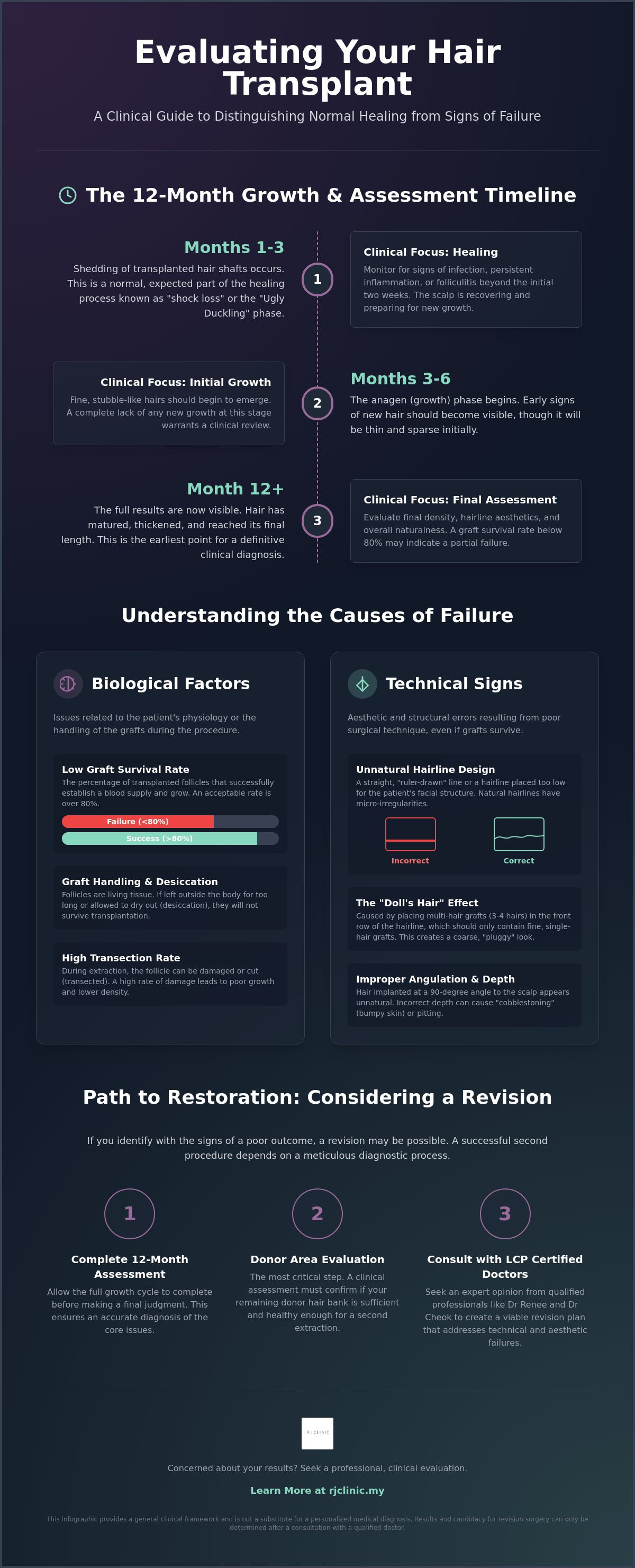
During the first few weeks following a procedure, almost every patient enters what we clinically refer to as the "Ugly Duckling" phase. This period is characterized by the shedding of transplanted hair shafts, which often triggers significant anxiety. It is, however, a physiological necessity. The follicle isn't dead; it's simply entering a dormant state before initiating a new growth cycle. Distinguishing this natural transition from the actual signs of a failed hair transplant requires both patience and professional oversight. We generally advise against making any definitive judgment before the 12-month mark, as this allows for a full anagen growth cycle to manifest across the entire treated area.
While shedding is expected, acute clinical failure presents with distinct markers. Persistent, deep-seated inflammation or recurring folliculitis beyond the initial two-week healing window are significant red flags. By the six-month milestone, we expect to see at least fine "stubble" emerging. A complete lack of any new growth by this stage warrants a detailed review. During follow-up consultations, Dr Renee and Dr Cheok utilize high-resolution scalp analysis to evaluate the health of the recipient site and ensure the scalp environment is properly supporting the follicles.
Shock Loss vs. Permanent Graft Death
Shock loss, or telogen effluvium, is a temporary condition where existing hair sheds due to the trauma of surgery. This can occur in both the recipient and donor areas but typically resolves as the scalp heals. In contrast, permanent graft death often results from graft desiccation, where the follicle dries out or is physically damaged during the extraction phase of modern hair transplantation. Graft take is the successful revascularization of the follicle within 72 hours. If this biological connection fails to establish, the hair will not grow back, leading to permanent gaps in coverage.
Understanding Expected Density vs. Thinning
It's a common clinical misunderstanding that a single session can restore 100% of a patient's original hair density. Biologically, placing grafts too close together can compromise the local blood supply, which actually reduces the overall survival rate. Successful surgery relies on the "illusion of density," where strategic graft placement creates a full appearance. However, if you notice distinct "see-through" patches where growth was promised, it likely indicates a survival rate lower than the acceptable 80% threshold. This remains one of the most visible signs of a failed hair transplant and is a primary reason patients seek a corrective FUE hair transplant to refine their results.
Primary Technical Signs of a Poorly Executed Transplant
Technical failure isn't always marked by a total lack of growth. Often, the most distressing signs of a failed hair transplant are those that make the procedure obvious to the naked eye. One of the most frequent errors we see is the "doll’s hair" effect. This occurs when a surgeon mistakenly places multi-hair follicular units (grafts containing 3 or 4 hairs) into the very first row of the hairline. In a natural setting, only fine, single-hair grafts exist at the front. When multi-hair grafts are used here, it creates a coarse, pluggy appearance that lacks the softness of an organic transition.
Directional misalignment is another significant clinical red flag. If hair is implanted at a 90-degree angle to the scalp or in a direction that opposes your natural flow, it becomes nearly impossible to style and appears stiff. We also look for "cobblestoning" or pitting at the base of the hair. This indicates the grafts were placed at an incorrect depth, causing the skin to heal with an uneven, bumpy texture. Identifying these signs of a failed hair transplant early is essential for planning a successful revision with Dr Renee or Dr Cheok.
The Aesthetic Failure: Unnatural Hairline Design
A straight, "ruler-drawn" hairline is a classic hallmark of an inexperienced approach. Natural hairlines are never perfectly symmetrical or linear; they consist of micro and macro-irregularities that we carefully replicate to mimic a natural Malaysian hair pattern. If the hairline height is placed too low, it can result in an aged, "forehead-heavy" appearance that doesn't age gracefully. Achieving a subtle result requires an artistic eye as much as surgical precision to ensure the hairline remains appropriate for your facial proportions over time.
Donor Area Mismanagement and Scarring
Donor depletion is perhaps the most serious technical failure because it's often irreversible. When a surgeon extracts too many grafts from a small area, it leaves a "moth-eaten" appearance characterized by visible white spots or thinning patches. This mismanagement severely limits your future restoration options. Utilizing refined extraction tools and maintaining a safe distance between punch sites is vital to preserving your "donor bank." If you're concerned about the density of your donor site, a professional FUE Hair Transplant Malaysia assessment can help determine if your remaining follicles are sufficient for corrective work. You might also consider a hair loss treatment consultation to explore non-surgical ways to support your existing hair health while evaluating a revision.
Biological and Technical Factors Leading to Unsuccessful Results
While aesthetic errors like an unnatural hairline are immediately visible, the biological causes behind low density are often rooted in the technical handling of the grafts. High transection rates are a primary culprit. This occurs when the extraction punch shears the hair follicle bulb during harvest, rendering the graft non-viable before it even reaches the recipient site. Even if the follicle survives extraction, its "extra-corporeal time"—the duration it remains outside the body—is critical. Once a graft is harvested, its metabolic clock begins to tick. If it isn't implanted within a strictly controlled window, the survival rate drops significantly, leading to the sparse growth patterns that are classic signs of a failed hair transplant.
Successful integration also depends heavily on the recipient site's vascularity. Smoking remains a significant clinical contraindication because nicotine constricts blood vessels, effectively starving new grafts of the oxygen required for successful revascularization. Similarly, poor post-operative hygiene can lead to localized infections or folliculitis, which triggers graft rejection. These biological barriers often explain why a procedure might look technically sound on day one but fail to produce results by month twelve. Professional follow-ups are essential to monitor these variables and ensure the scalp environment remains conducive to growth.
The Surgical Learning Curve and LCP Certification
Technician-led clinics frequently see higher failure rates because they may lack the rigorous medical oversight required for delicate graft handling. In Malaysia, LCP certification is the gold standard, ensuring that a practitioner has the verified clinical skills to perform invasive aesthetic procedures safely. Dr Renee and Dr Cheok prioritize a doctor-led approach where every follicular unit is managed with extreme precision. This level of care minimizes physical trauma to the follicles, which is the most effective way to prevent the common signs of a failed hair transplant caused by poor surgical technique.
Scalp Health and Underlying Conditions
In some cases, the failure isn't due to the surgery itself but an undiagnosed scalp condition. Scarring alopecias, such as Lichen Planopilaris, can cause the body to attack and destroy transplanted follicles. A thorough pre-surgical consultation is the most critical step in preventing this outcome. For patients experiencing active thinning, a targeted hair loss treatment plan can optimize scalp health and stabilize hair loss before any surgical intervention is considered. If you are concerned about your previous results, a diagnostic evaluation for a corrective FUE hair transplant can help determine if biological factors were the root cause of your dissatisfaction.
Path to Restoration: When to Consider a Revision Hair Transplant in Malaysia
Navigating the path to a second surgery requires a shift in perspective. While your first procedure was about restoration, a revision is often about rescue and refinement. We maintain a strict clinical requirement of waiting at least 12 months before considering a corrective procedure. This ensures the scalp has fully healed and the final results of the initial surgery are visible, allowing us to accurately diagnose the signs of a failed hair transplant. Attempting a repair too early can compromise the already delicate blood supply and lead to further graft loss.
The most critical constraint in any revision is the "donor bank." Because follicular units are a finite resource, we must carefully assess whether you have enough healthy hair left for a second harvest. If the donor area was over-harvested previously, we might explore alternative sources such as beard hair or utilize medical adjuncts like Deusaderm to strengthen existing follicles. Corrective techniques often involve the meticulous removal of "pluggy" grafts, which are then redistributed to create a softer, more feathered hairline that looks organic rather than manufactured.
Strategic Revision Planning
Repairing a failed result is not a standard procedure; it's a specialized skill. We often use "camouflage" grafting, where fine single-hair units are placed in front of larger, poorly positioned grafts to hide the previous work. If the donor area shows visible scarring or thinning from a previous FUE attempt, we can integrate Scalp Micro-Pigmentation (SMP) to restore the appearance of density. These multi-layered approaches ensure that the final outcome isn't just an improvement, but a complete aesthetic restoration that respects your unique facial proportions.
Choosing the Right Partner for Rescue Surgery
When selecting a surgeon for a revision, you should prioritize those with a proven track record in complex repair cases. In Malaysia, it's vital to ensure your doctor holds the appropriate LCP certification for invasive aesthetic work. Ask specifically about their strategy for donor conservation and how they plan to rectify the specific signs of a failed hair transplant you're experiencing. At RJ Clinic, Dr Renee and Dr Cheok approach every revision with a custom-designed plan that prioritizes safety and subtle, long-term results. For a deeper look at the standards of care you should expect, refer to our Hair Transplant Malaysia: A Clinical Guide (2026).
Achieving the Natural Results You Deserve
Identifying the signs of a failed hair transplant is the first step toward reclaiming your aesthetic goals. Distinguishing between the temporary "ugly duckling" phase and permanent graft loss requires a patient, 12-month observation period. Whether your concerns stem from an unnatural hairline design or significant donor area depletion, understanding the underlying biological and technical causes allows for a more targeted corrective approach. The complexities of rescue surgery demand a high level of surgical artistry and a deep respect for your remaining donor resources.
At RJ Clinic, we bridge the gap between medical rigour and personalized care. Our LCP-certified doctors, Dr Renee and Dr Cheok, specialize in natural-looking hair restoration using advanced FUE techniques designed for maximum graft survival. By prioritizing comprehensive post-operative protocols, we ensure your scalp environment is optimized for long-term health and density. If you're ready to move beyond a disappointing result, we invite you to consult Dr Renee or Dr Cheok for a professional hair restoration assessment. It's possible to correct previous missteps and achieve the sophisticated, organic appearance you've always envisioned.
Frequently Asked Questions
Is it normal to see no hair growth 3 to 4 months after a transplant?
It is entirely normal to see little to no growth 3 to 4 months after your procedure. This period, often called the dormant phase, follows "shock loss," where transplanted shafts shed to allow follicles to enter a new growth cycle. Most patients only begin to see fine, new hairs emerging between months four and six. Because full maturation takes 12 to 18 months, early absence of density isn't usually one of the definitive signs of a failed hair transplant.
Can a completely failed hair transplant be fixed with a second procedure?
Most unsuccessful outcomes can be corrected through a revision procedure, provided your donor area remains healthy. A clinical assessment is required to determine if you have sufficient "donor bank" follicles for a second attempt. We focus on removing poorly placed grafts and redistributing new ones to create a more natural flow. Success in revision surgery depends heavily on the technical skill of the practitioner and the preservation of the remaining scalp vascularity.
How can I tell if my donor area has been over-harvested?
Over-harvesting is typically identified by a "moth-eaten" or patchy appearance in the back or sides of the scalp where hair was extracted. You might notice visible white spots or a significant decrease in hair density that makes the scalp easily visible even with longer hair. This occurs when too many grafts are taken from a concentrated area. If you suspect donor depletion, a professional scalp analysis can confirm if the extraction pattern was too aggressive.
What are the most common causes of graft death in the first 48 hours?
The primary causes of graft death in the immediate post-operative window are desiccation and poor revascularization. Follicles are incredibly fragile; if they dry out or are handled roughly during implantation, they won't survive. Additionally, if the follicle fails to establish a blood supply within the first 72 hours, it will not "take." This is why precise surgical technique and keeping the recipient site hydrated are critical for graft survival.
Does smoking or alcohol consumption significantly increase the risk of transplant failure?
Smoking significantly increases the risk of failure by constricting blood vessels and reducing oxygen delivery to the newly implanted grafts. This compromised circulation can prevent follicles from establishing the blood supply they need to survive. While alcohol can interfere with the healing process and increase bleeding, smoking is the more critical clinical contraindication. We strongly advise patients to abstain from smoking for several weeks before and after surgery to protect their investment.
Why is LCP certification important when choosing a hair transplant clinic in Malaysia?
LCP certification is a mandatory credential issued by the Malaysian Ministry of Health, ensuring a doctor has the verified skills to perform invasive aesthetic procedures. Choosing a certified practitioner like Dr Renee or Dr Cheok guarantees that your surgery meets strict safety and ethical standards. This certification acts as a primary trust signal, reducing the likelihood of encountering the technical signs of a failed hair transplant often associated with unlicensed or technician-led facilities.


Comments