


How Many Hair Grafts Do You Really Need? A Malaysia Hair Transplant Guide

Updated: Aug 15
The common assumption that a higher graft count automatically leads to a denser, more natural result is one of the most persistent misunderstandings in the field of hair restoration. When considering a hair transplant malaysia, patients often arrive with a specific number in mind, driven by the fear that fewer grafts might result in an artificial look or visible thinning. It's understandable to focus on quantity when trying to gauge value and outcome, but clinical success is rooted in the physiological limits of your donor site and the survival rate of every individual follicle extracted.
We agree that achieving a seamless, organic hairline is the ultimate priority, yet this requires a nuanced balance between your aesthetic goals and the medical reality of your scalp. This guide provides a clinical perspective on modern FUE techniques, explaining the logic behind graft calculations and the factors that dictate long-term success. You'll learn how Dr Renee and Dr Cheok approach follicular unit extraction to maximize density while preserving the donor area, ensuring you understand the necessity of LCP-certified expertise and surgical precision before making a decision.
Table of Contents
Understanding Hair Loss and the Clinical Shift Toward FUE in Malaysia
Androgenetic alopecia, commonly known as male or female pattern baldness, remains the primary driver for patients seeking a hair transplant malaysia. In our local climate and lifestyle, the psychological impact of thinning hair is significant, leading to a demand for solutions that are both permanent and discreet. Historically, hair restoration was dominated by the "strip method," but the clinical landscape has shifted decisively toward more refined, minimally invasive techniques that respect the patient's aesthetic and physiological needs.
The Limitations of Traditional Hair Restoration
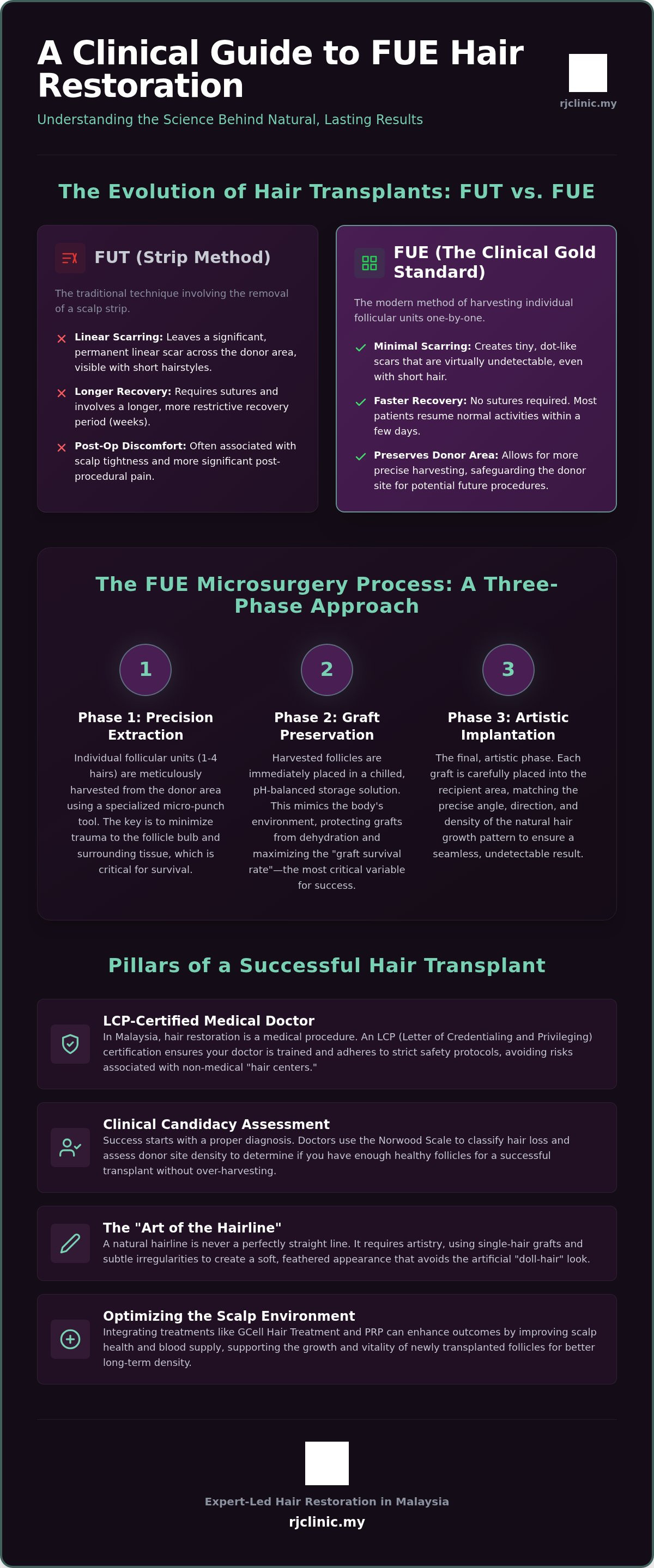
Follicular Unit Transplantation (FUT) involved removing a horizontal strip of scalp from the donor area, which inevitably left a permanent linear scar. For many patients in Malaysia, this was a significant deterrent, especially for those who prefer shorter hairstyles where a scar would be easily visible. Modern restoration has evolved with Follicular Unit Extraction (FUE), a method that harvests individual follicles one by one. This approach eliminates the need for sutures, drastically reduces recovery time, and avoids the "tightness" often felt in the scalp after strip surgery. Most patients can return to their daily routines within a few days, compared to the weeks of restricted activity required by traditional methods.
Why Medical Credentials Matter in Malaysia
Safety and clinical integrity are non-negotiable when performing surgical procedures. In Malaysia, the Ministry of Health mandates that any doctor performing hair restoration must possess a Letter of Credentialing and Privileging (LCP) in Aesthetic Medical Practice. This certification ensures the practitioner has undergone rigorous training and adheres to strict safety protocols. At RJ Clinic, Dr Renee and Dr Cheok operate under these high medical standards, prioritizing graft survival and patient safety over high-volume throughput.
We often see patients who have visited non-medical "hair centers" where unlicensed technicians perform "ghost transplants" without direct doctor supervision. These unregulated environments carry high risks of infection, poor graft survival, and unnatural results that are difficult to correct. Choosing an LCP-certified practitioner is the first step in ensuring your hair restoration is a medical success rather than a cosmetic compromise. It's about more than just moving hair; it's about the clinical logic of surgical placement and long-term scalp health.
The Science of Follicular Unit Extraction: Precision and Graft Survival
Success in a hair transplant malaysia depends entirely on the biological integrity of the harvested units. FUE is a meticulous microsurgical technique where individual follicular units, groupings of one to four hairs, are harvested from the donor area using specialized micro-punches. The primary objective is to minimize trauma to both the follicle and the surrounding tissue. This requires a precise balance of punch depth and speed. If the punch is too deep, it can transect the follicle bulb; if it's too shallow, the protective sheath of the graft may be compromised, leading to poor growth.
Extraction and Preservation Protocols
Follicles are delicate biological entities. Once removed from the scalp, they're disconnected from their blood supply and become vulnerable to dehydration and temperature fluctuations. During a hair transplant procedure, "out-of-body" time is the most critical variable for success. We maintain graft viability by storing the units in chilled, pH-balanced solutions that mimic the body’s natural environment until they're ready for placement. Graft survival is the ratio of successfully rooted follicles to the total number of transplanted units. Minimizing the time between extraction and implantation is essential for ensuring these follicles transition into the growth phase successfully.
Implantation and Angulation
The aesthetic outcome relies on how these grafts are placed within the recipient sites. It isn't enough to simply create density; we must replicate the natural growth patterns of your original hair. This involves matching the exit angle and direction of existing strands, which varies significantly across different regions of the scalp. For example, the hairline requires single-hair units placed at a very acute angle to appear soft, while the crown needs a whorl-like distribution to look natural. High-precision placement also prevents "pitting," ensuring the skin surface remains smooth once healed.
Beyond surgical skill, your own scalp physiology plays a role in the "take" rate. Factors like local blood supply and the health of the recipient site determine how quickly the new follicles establish a connection to your vascular system. To support this biological transition, we often suggest adjunctive therapies like Platelet-Rich Plasma (PRP) to stimulate local healing and follicle health. Understanding these technical nuances helps patients appreciate why a bespoke approach is necessary for lasting, natural-looking results.
Suitability and Planning: What to Expect During Your Consultation
Determining your suitability for a hair transplant malaysia begins with a precise clinical assessment of your current stage of hair loss. We use the Norwood Scale to categorize the progression of male pattern baldness, which ranges from minor recession at Stage 2 to extensive loss at Stage 7. During your consultation, we don't just look at where hair is missing; we evaluate the quality and density of your donor site. The number of grafts you need is a calculation based on the surface area of the thinning zone and the desired density required to create a natural look. For patients with advanced Stage 6 or 7 baldness, we must manage expectations carefully. In these cases, the goal often shifts from total restoration to strategic coverage that frames the face effectively.
While there are many reasons for a hair transplant, the primary objective is to achieve a balanced result that remains aesthetically pleasing as you age. This requires a deep understanding of facial proportions and the biological limits of your scalp.
Evaluating the Donor Area
It's a clinical reality that a hair transplant is a redistribution of existing follicles rather than the creation of new hair. Your donor area, typically at the back and sides of the head, has a finite lifetime harvest potential. Most patients have between 5,000 and 8,000 grafts available for their entire life. If we harvest too many in a single session, we risk "over-harvesting," which can leave the donor area looking thin or patchy. For those in the earliest stages of thinning, we often recommend exploring Hair Loss Treatment alternatives to stabilize your condition before committing to a surgical intervention.
Long-Term Maintenance and Stability
Surgery addresses the areas that are already bald, but it doesn't stop the biological progression of hair loss in neighboring, non-transplanted follicles. If your hair loss isn't stabilized, you may continue to thin behind the transplanted area, leading to an unnatural "island" of hair. This is why we prioritize medical therapy to maintain your existing hair density. At RJ Clinic, Dr Renee and Dr Cheok design long-term maintenance plans that integrate post-operative care with clinical treatments to ensure your results remain seamless for years to come. To begin your personalized restoration journey, you can schedule a clinical assessment for a hair transplant malaysia with our LCP-certified team.
Achieving Natural Results: The RJ Clinic Approach to Hair Restoration
The most common fear among patients considering a hair transplant malaysia is the prospect of an unnatural hairline. In clinical practice, we refer to this as the "Art of the Hairline" because achieving a seamless look requires more than just density. Perfect symmetry is actually a hallmark of artificial results; natural hair grows in subtle, irregular patterns with varying densities. Dr Renee and Dr Cheok focus on micro-angulation and the strategic placement of single-hair follicles at the very front to ensure the transition from forehead to hair is indistinguishable from nature. This meticulous design prevents the "doll-hair" appearance and ensures the results age gracefully with your facial structure.
Synergistic Treatments: GCell and PRP
To optimize the scalp environment, we integrate regenerative medicine into our surgical protocols. GCell Hair Treatment is a sophisticated approach that uses autologous tissue to stimulate dormant follicles, essentially priming the recipient area for better graft acceptance. This is often paired with PRP Treatment, which concentrates growth factors in the scalp to accelerate tissue healing and strengthen follicle strength. For long-term maintenance and to support the health of non-transplanted hair, we often recommend RJ FollicleBoost Hair Microneedling. This holistic approach ensures the transplant isn't an isolated event but part of a comprehensive strategy for lifelong hair health.
The Recovery and Growth Timeline
Understanding the biological timeline of hair growth is essential for managing post-operative expectations. Shortly after the procedure, usually within the first three to four weeks, patients experience a "shedding phase" or shock loss. This is a normal physiological response where the transplanted hair shafts fall out while the follicles remain securely rooted and enter a resting phase. It can be an anxious time for many, but it's a necessary step before new, permanent growth begins.
New hair typically starts to break through the skin surface by the third month. Visible results typically emerge between months 4 and 6, with full density achieved at one year. Throughout this period, the hair will continue to thicken and mature in texture. We provide detailed care steps, including gentle washing techniques and specific scalp serums, to protect the follicles during these critical early stages. By viewing FUE as a clinical partnership between the doctor and the patient, we ensure that your results are both aesthetically refined and medically sound.
Restoring Your Confidence Through Clinical Precision
Choosing to undergo a hair transplant malaysia is a significant decision that requires a balance of surgical expertise and artistic vision. We've explored how successful restoration depends on more than just graft counts; it relies on the biological health of the donor area, the precision of FUE extraction, and the nuanced design of a natural hairline. By prioritizing graft survival through state-of-the-art FUE technology and synergistic treatments like GCell, we ensure that every follicle has the best opportunity to thrive in its new environment.
The journey toward a fuller, more youthful appearance is highly individualized. Our LCP-certified medical team, led by Dr Renee and Dr Cheok, utilizes personalized hairline mapping to ensure your results are both medically sound and aesthetically refined. If you're ready to move beyond temporary solutions and explore a permanent path to hair restoration, we invite you to take the next step in your transformation.
Book a Clinical Consultation for Hair Restoration at RJ Clinic to receive a professional assessment tailored to your unique physiology. We look forward to helping you achieve a natural, lasting result that restores both your hair and your self-assurance.
Frequently Asked Questions
How much does a hair transplant cost in Malaysia?
The total investment for a hair transplant malaysia depends on the specific number of grafts required and the technical complexity of your restoration plan. Because every patient has a unique donor density and recipient area size, a standardized fee is rarely appropriate for medical-grade results. During your consultation, we provide a transparent breakdown based on your Norwood Scale classification and the specific FUE technique chosen to achieve your desired density.
Is an FUE hair transplant painful?
We perform the procedure under local anesthesia to ensure the donor and recipient areas are completely numb, making the experience quite comfortable. Most patients report feeling only mild pressure or a slight tugging sensation during the extraction and implantation phases. Any post-operative tenderness is typically manageable with standard over-the-counter analgesics and usually subsides within 48 hours as the micro-incisions begin their natural healing process.
How long is the recovery period after an FUE procedure?
Most patients return to their professional routines within three to five days, as FUE doesn't involve the long incisions or sutures required by older methods. While the tiny extraction sites heal within a week, the recipient area may show slight redness or scabbing for up to 14 days. We provide a specific post-operative protocol to protect the follicles, advising you to avoid strenuous exercise and direct sun exposure for at least two weeks.
Will the transplanted hair look natural?
Transplanted hair looks natural when the surgeon meticulously replicates the organic growth angles and distribution of your original hair. Dr Renee and Dr Cheok utilize single-hair follicular units at the front of the hairline to create a soft, seamless transition. By intentionally avoiding perfect symmetry and following your scalp's natural whorls, we ensure the results are indistinguishable from your existing hair, even upon close inspection.
Can women undergo FUE hair transplants for thinning hair?
Women are often excellent candidates for FUE, particularly those experiencing female pattern hair loss or seeking to lower a high hairline. Clinical success in female patients requires a thorough diagnostic assessment to ensure the donor area is stable and the thinning isn't caused by temporary medical factors. We often utilize non-shaven FUE techniques for women, allowing the procedure to remain discreet while the new follicles establish themselves.
What happens if I continue to lose my original hair after a transplant?
While the transplanted follicles are harvested from DHT-resistant zones and are generally permanent, your original, non-transplanted hair remains susceptible to ongoing thinning. This is why we view a hair transplant malaysia as part of a broader hair health strategy. We often recommend stabilizing existing hair through medical therapy or regenerative treatments like GCell to prevent new gaps from forming behind the restored area, maintaining a consistent density.


Comments