


Face Fat vs. Sagging Skin: A Doctor’s Guide to Facial Contouring in Kuala Lumpur

Updated: May 16
Treating a heavy jawline with fat-reduction techniques when the underlying issue is actually tissue laxity is a common clinical oversight that often leads to a hollow, aged look rather than a refined one. In our practice, we find that the distinction between face fat vs sagging skin is rarely clear-cut to the patient, yet it dictates the success of every contouring procedure. You have likely noticed that a double chin persists despite a healthy lifestyle, or that your V-shape jawline seems to be softening into heavy jowls, leaving you unsure if you need to melt volume or tighten the surface.
We understand the frustration of seeing a silhouette that does not reflect how you feel inside. This guide clarifies how to differentiate between adipose tissue and skin elasticity to ensure you invest in the most effective clinical pathway for natural-looking rejuvenation. As the Malaysian cosmetic surgery market grows at a rate of 11% annually through 2029, and with the Medical Device Order 2026 taking effect on June 1 to ensure higher safety standards for technologies like Ultherapy Prime, it's more important than ever to understand the science behind your treatment. Dr Renee and Dr Cheok provide a nuanced look at diagnostic criteria, the role of FDA-approved technologies, and how to achieve a bespoke result without the risks of invasive surgery.
Key Takeaways
Learn how to perform a clinical "pinch and pull" test to determine if your jawline concerns are caused by excess volume or a loss of structural elasticity.
Understand why the distinction between face fat vs sagging skin is the most critical factor in avoiding an over-filled or unnatural appearance.
Discover how fat pad migration and UV-induced collagen breakdown contribute to the "heavy jowl" effect common in tropical climates like Malaysia.
Identify whether your specific tissue profile requires the precision of Accusculpt laser lipolysis for fat removal or the deep lifting capabilities of Ultherapy Prime.
Gain insight into why seeking an LCP-certified practitioner is vital for a safe, bespoke treatment plan that prioritizes facial harmony over generic results.
Table of Contents The Mirror Test: Distinguishing Between Excess Face Fat and Sagging Skin The Biology of Facial Aging: Why Fat Clusters and Skin Sags Clinical Solutions in KL: Matching Treatment to Your Tissue The RJ Clinic Approach: Bespoke Rejuvenation and Natural Results
The Mirror Test: Distinguishing Between Excess Face Fat and Sagging Skin
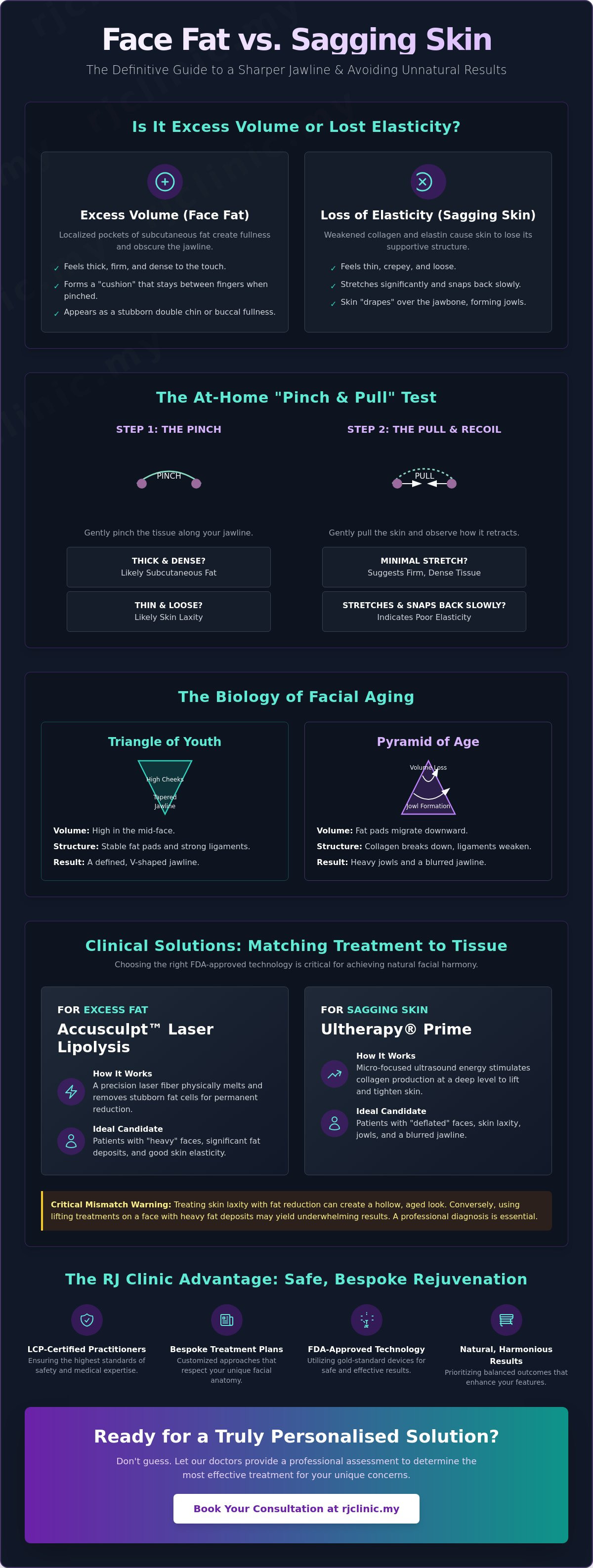
Distinguishing between face fat vs sagging skin is the first step in any successful consultation. Patients often visit our clinics in Kuala Lumpur pointing to their lower face, assuming a double chin or heavy jowls are purely a matter of weight gain. However, clinical observation frequently reveals that what looks like submental fat is actually a loss of skin tension. To understand your own profile, we recommend the "Pinch and Pull" test. Gently pinch the tissue along your jawline. If the tissue feels thick and firm, like a dense cushion that stays between your fingers, you're likely dealing with subcutaneous fat. If the tissue feels thin, crepey, or stretches significantly before slowly snapping back, the primary issue is skin laxity.
Visual markers also tell a specific story. Stubborn fat pockets typically appear as localized fullness in the buccal (mid-cheek) area or directly under the chin. In contrast, sagging is characterized by the formation of marionette lines and a blurred jawline where the skin seems to "drape" over the bone. These nuances are a core part of modern facial rejuvenation techniques, which aim to restore balance rather than just removing volume. Misidentifying these signs often leads to patients choosing treatments that don't address the root cause of their concerns.
The Role of the Jawline in Self-Diagnosis
A common misunderstanding is that a "double chin" always requires fat reduction. In many cases, what appears as fullness is actually platysmal bands; vertical neck muscles that have lost their support and begun to pull the skin downward. It's also a reality that significant weight loss can exacerbate the problem. When you lose facial fat, the skin has less "scaffolding" to hold onto, which can make the lower face appear more "hanging" than before. This is why Dr Renee and Dr Cheok emphasize a professional assessment. They look for the difference between tissue weight and structural descent to determine if you need volume removal or a lifting intervention.
Suitability: Who is a Candidate for Which Treatment?
Suitability depends on whether you're a "heavy-faced" or "deflated" patient. Genetics and lifestyle in urban areas like Bangsar and Mont Kiara, including high UV exposure, accelerate these changes differently for everyone. The danger of misdiagnosis is high; treating skin laxity with fat-melting injections on a patient who is already losing volume can lead to a hollowed, prematurely aged look. Conversely, using Ultherapy Prime on a face with high fat density may yield underwhelming results if the weight of the tissue exceeds the lifting capacity of the treatment. For those with significant fat deposits, Accusculpt laser lipolysis is often the superior choice to physically remove the weight before addressing the skin.
The Biology of Facial Aging: Why Fat Clusters and Skin Sags
To understand the clinical debate of face fat vs sagging skin, one must look beneath the surface at the structural shifts occurring within the facial architecture. In a youthful face, volume is distributed in what we call the "Triangle of Youth," where the widest point sits at the cheekbones and tapers down to a refined, narrow chin. As we age, this triangle inverts into the "Pyramid of Age." This transition isn't just about skin getting older; it's a multi-layered collapse involving the migration of fat, the thinning of the dermis, and the gradual resorption of the facial bones that provide our primary scaffolding.
While many patients believe they've simply gained weight in their lower face, the reality is often more complex. Research published by the American Society of Plastic Surgeons highlights how fat loss accelerates facial aging by removing the internal support that keeps skin taut. When the deep fat pads in the mid-face deplete, the overlying skin loses its anchor and begins to drape downward, creating a heavy appearance that mimics excess fat.
Fat Migration: The Downward Shift
Fat migration is the anatomical relocation of superficial fat pads due to gravity and ligament weakening. In your 30s and 40s, the ligaments that once held fat pads firmly in the cheeks begin to slacken. This causes volume to "slide" from the upper face toward the jawline and mouth. This shift creates the illusion of new fat deposits in the jowls, when in fact, it's simply displaced tissue that was once higher on the face. Distinguishing this movement is vital because dissolving this "new" fat without addressing the lost volume above can lead to a deflated, aged look.
Environmental Factors in Kuala Lumpur
Local environmental stressors play a significant role in how quickly these biological changes manifest. In Malaysia’s high UV environment, chronic sun exposure degrades elastin fibers much faster than biological aging alone. Elastin is the structural "glue" that allows skin to bounce back; once it's compromised, the skin becomes prone to stretching under the weight of migrating fat pads. Combined with urban "inflammaging" from pollutants in the city, patients in Kuala Lumpur often notice sagging and a loss of jawline definition earlier than those in temperate climates. If you've noticed your jawline softening, a bespoke lifting plan can help restore the structural integrity that environmental factors have eroded.
Clinical Solutions in KL: Matching Treatment to Your Tissue
Selecting the right intervention for a heavy or undefined jawline isn't a matter of which technology is the most popular, but which one addresses the specific anatomical cause of your concern. When we evaluate the dilemma of face fat vs sagging skin, we're choosing between two fundamentally different clinical objectives: volume reduction or structural lifting. Applying the wrong modality doesn't just waste time; it can actively detract from your facial harmony. For instance, using fat-melting injections on a patient whose jawline is actually obscured by skin laxity can lead to a "deflated" look that emphasizes wrinkles rather than hiding them.
Non-Surgical Lifting with Ultherapy Prime
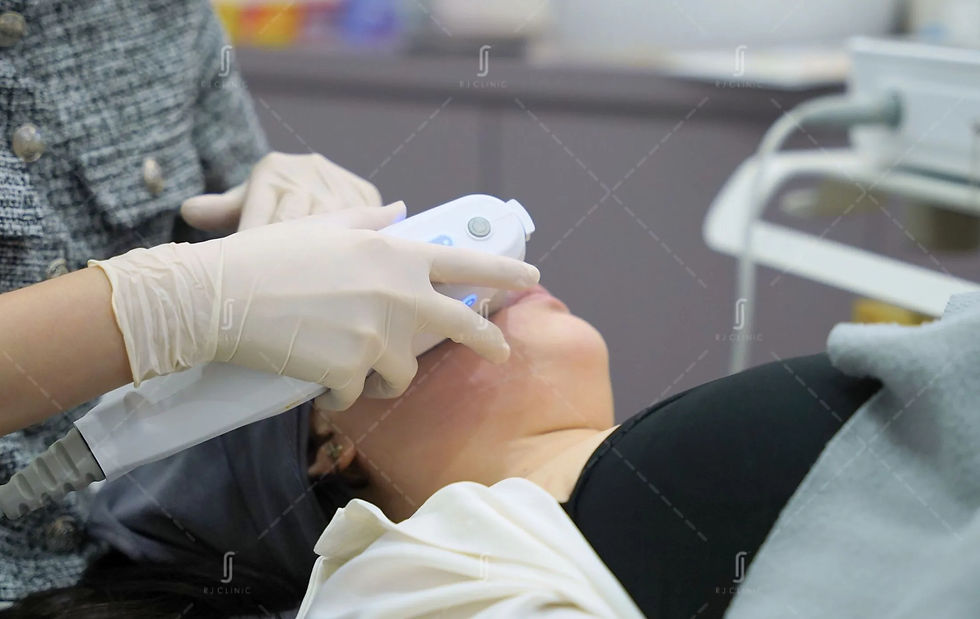
For patients dealing with "hanging" tissue rather than "heavy" fat, Ultherapy remains the gold standard. This technology uses micro-focused ultrasound to bypass the skin's surface and deliver thermal energy directly to the SMAS layer, the same deep tissue layer addressed in a surgical facelift. The Ultherapy Prime system allows Dr Renee and Dr Cheok to see the tissue layers in real-time, ensuring the energy is delivered precisely where it will trigger the most effective collagen production. It's an ideal choice for those who want a sharper jawline without the downtime or risks of incisions.
Precision Fat Removal with Laser Lipolysis
When the primary issue is actual adipose tissue, such as a persistent double chin or heavy buccal fat, we often turn to Accusculpt Face Slimming. This laser lipolysis technique uses a specific 1444nm wavelength to emulsify fat cells with surgical precision. Unlike traditional Medical Slimming Treatments for the body, Accusculpt is designed for the delicate contours of the face, providing a secondary benefit of skin contraction as the laser's heat stimulates the dermis. This "melt and tighten" effect is crucial for ensuring the skin doesn't look loose once the fat volume is removed.
In our experience treating professionals in Bangsar and across Kuala Lumpur, many cases are actually "hybrids" that require a tiered approach. We might first remove the weight of excess fat with laser lipolysis and then follow up with ultrasound lifting to refine the skin's "snap-back." Recovery is manageable for a busy schedule; while Ultherapy has zero downtime, Accusculpt typically involves only 3 to 5 days of minor swelling. If you're unsure which category your concerns fall into, we invite you to schedule a professional facial contouring assessment to determine the most effective sequence for your unique profile.
The RJ Clinic Approach: Bespoke Rejuvenation and Natural Results
A "one-size-fits-all" approach to facial contouring is the primary cause of the unnatural, "overfilled" or "frozen" looks that many patients rightly fear. Achieving a refined jawline requires more than just high-end technology; it demands a deep understanding of how different tissues respond to intervention. The clinical distinction between face fat vs sagging skin is the foundation of our philosophy. Dr Renee and Dr Cheok prioritize a "benefit-first" strategy, where the ultimate goal is a restored V-shape that respects your unique bone structure and fat distribution rather than forcing a generic aesthetic template onto every face.
The Consultation: More Than Just a Price Quote
Every journey at RJ Clinic begins with a comprehensive facial analysis. We don't simply provide a price quote for a requested service; we assess the interplay between your skin's elasticity, the position of your fat pads, and the strength of your underlying musculature. It's common for us to advise against a treatment a patient "thinks" they need. For instance, if you request fat-melting injections for a jawline that actually requires structural lifting, we'll explain why removing volume might worsen the appearance of hanging skin. This transparency allows us to build a multi-year aesthetic roadmap that delivers subtle, age-appropriate results that evolve gracefully with you.
Safety and FDA-Approved Technology
Our commitment to your safety is reflected in our choice of equipment and our clinical credentials. We exclusively utilize original, FDA-approved devices such as Ultherapy Prime and Accusculpt to ensure that every pulse of energy is delivered with clinical precision. LCP certification ensures your doctor has met the Ministry of Health’s rigorous standards for aesthetic practice, providing a level of security that is essential when undergoing medical-grade enhancements.
Long-term maintenance is particularly vital in Malaysia, where high UV levels can quickly degrade the collagen produced during your treatment. We provide bespoke guidance on protecting your investment, ensuring the structural integrity of your skin remains intact long after you leave the clinic. Whether you're visiting our facilities in Mont Kiara or Bangsar, our team is dedicated to providing a tranquil, professional environment focused on your individual needs. To explore a tailored solution for your profile, we invite you to schedule a consultation for facial contouring at one of our Kuala Lumpur locations.
Defining Your Path to a Refined Silhouette
Distinguishing between face fat vs sagging skin is more than a simple diagnostic exercise; it's the essential blueprint for a result that looks like you, only more rested and refined. A heavy jawline often stems from a complex interplay of displaced fat pads and lost structural elasticity. Success depends on choosing a modality that addresses your specific tissue type, whether that means removing the weight of localized fat through laser lipolysis or restoring the tension of the SMAS layer with ultrasound energy. Relying on a professional assessment ensures you don't over-treat volume when you actually need structural support.
At RJ Clinic, our LCP-certified physicians utilize only original, FDA-approved technologies to ensure every treatment is as safe as it is effective. We specialize in natural-looking V-shape contouring that respects your unique features and avoids the common pitfalls of over-filled or artificial-looking transformations. Book a bespoke facial assessment with our LCP-certified doctors today to determine the most effective strategy for your profile. Taking the first step toward rejuvenation should feel empowering, and we're here to guide you with clinical integrity and artistic precision.
Frequently Asked Questions
How can I tell if my double chin is fat or loose skin?
A professional consultation is the most reliable way to distinguish between face fat vs sagging skin, but you can start with a simple pinch test at home. Gently grasp the tissue under your chin; if the fold is thicker than 2 centimeters and feels firm, you're likely feeling subcutaneous fat. If the tissue is thin and stretches easily before slowly returning to place, your concern is primarily skin laxity and a loss of dermal elasticity.
Can I do Ultherapy if I have a lot of face fat?
Ultherapy is safe for patients with higher fat density, though it's important to understand the clinical difference between face fat vs sagging skin before choosing a single modality. While ultrasound energy effectively lifts the SMAS layer, it won't physically remove large volumes of fat. For "heavy-faced" patients, we often recommend first reducing volume with laser lipolysis to ensure the weight of the tissue doesn't hinder the lifting effects of the ultrasound treatment.
Is face slimming permanent, or will the fat come back?
Fat removal via Accusculpt laser lipolysis provides permanent results because the procedure physically eliminates the targeted fat cells. Unlike traditional weight loss which only shrinks cells, this medical intervention reduces the total cell count in the submental or buccal areas. While the removed cells won't return, maintaining a stable weight is essential. If you experience a weight increase of 5% or more, the remaining fat cells can expand and potentially soften your contoured jawline.
What is the downtime for non-surgical skin tightening in KL?
Non-surgical lifting treatments like Ultherapy Prime typically involve zero social downtime, making them a preferred choice for busy professionals in Kuala Lumpur. You can return to your daily schedule immediately after the session, though 15% of patients might notice minor redness or slight swelling for 24 to 48 hours. If your bespoke plan includes laser lipolysis, you should prepare for 3 to 5 days of moderate swelling as the treated tissue heals and the contour refines.
Which is better for jowls: fillers or Ultherapy?
Ultherapy is typically the better choice for jowls because it addresses the structural descent of the tissue rather than just masking the symptoms. Dermal fillers are useful for camouflaging minor indentations like the pre-jowl sulcus, but relying on them to "lift" heavy jowls can lead to an unnatural, overfilled appearance. We prioritize deep tissue tightening to restore the jawline's foundation before using fillers for subtle, artistic refinements to the chin or mid-face.
Can weight loss fix sagging skin on the face?
Weight loss cannot fix sagging skin and, in many cases, makes the appearance of laxity significantly worse. When you lose facial fat, you're removing the internal volume that keeps the skin taut, which often leads to a deflated or hanging look in the lower face. This is particularly noticeable in the 35 to 50 age group. For those undergoing professional weight management, who might check out Nusbaum Medical Centers for their medical solutions, these structural changes are an important consideration. Once the fat support is gone, clinical intervention is required to tighten the skin and stimulate new collagen production through targeted energy-based therapies.


Comments