


Early Hair Loss Signs: Miniaturisation Before Visible Baldness


Did you know that by the time you notice a visible patch of scalp or a receding hairline, you may have already lost nearly 50% of your hair density in that area? This clinical reality often catches patients by surprise because they've been looking for falling strands rather than subtle changes in hair quality. It's understandable to feel a sense of uncertainty when trying to distinguish between normal daily shedding and the progressive thinning that signals a more permanent shift in your hair cycle.
Identifying the early signs of hair loss requires looking beyond the bathroom sink and focusing on follicular miniaturisation, a process where hair strands gradually become finer, shorter, and less pigmented. You deserve a clear, scientific understanding of what is happening beneath the surface of your scalp before the window for non-surgical intervention begins to close. In this discussion, we'll outline the specific clinical markers that Dr Renee and Dr Cheok look for during a consultation and the advanced diagnostic tools used to measure density accurately. We'll also examine how early intervention strategies can be custom-designed to reinforce your existing hair, ensuring you have the knowledge to move from hesitation to a proactive, medically-backed plan for preservation.
Table of Contents
The Clinical Definition of Early Hair Loss: Follicular Miniaturisation
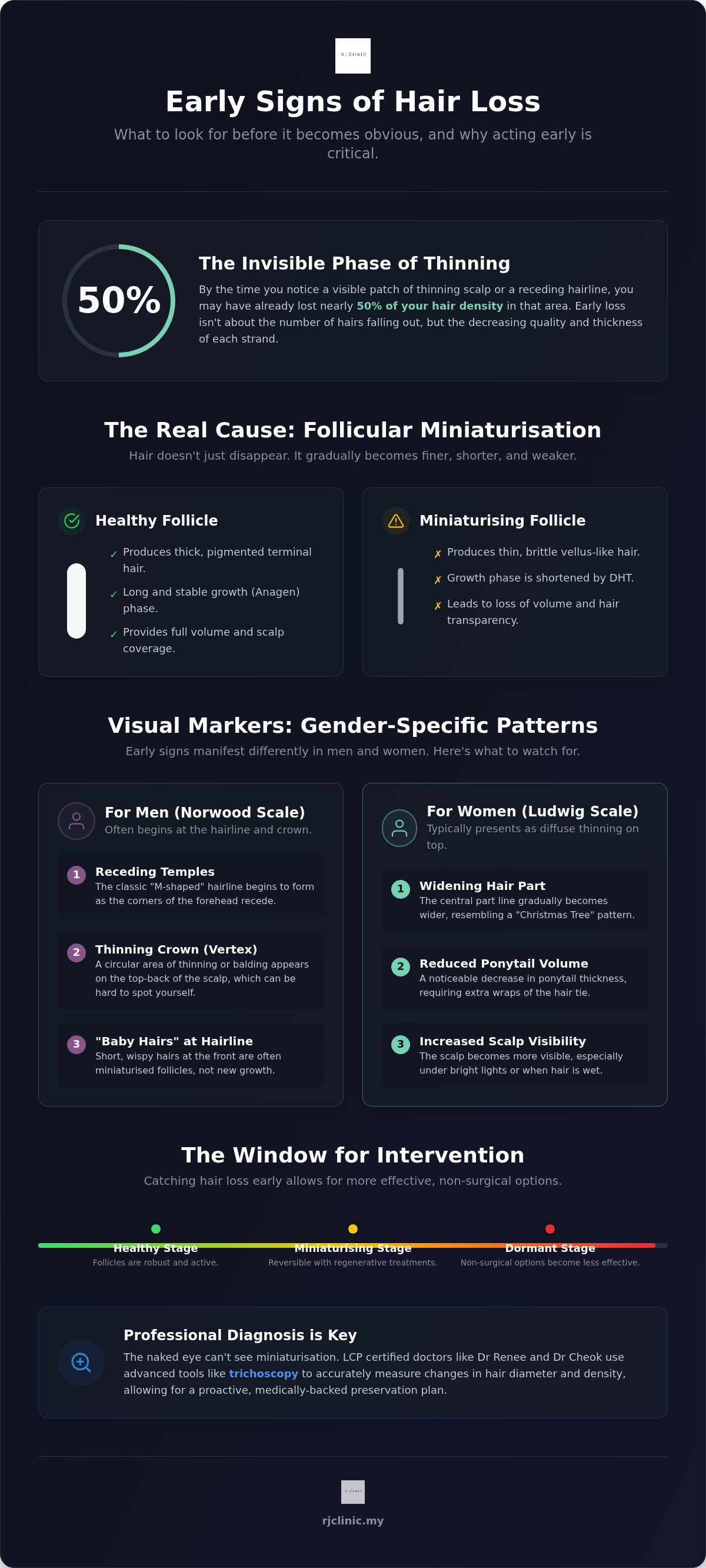
The term "hair loss" is often a misnomer in its beginning stages. For many of our patients at RJ Clinic, the issue isn't that the hair is falling out and never returning; it's that the hair is returning smaller. This biological degradation is known as follicular miniaturisation. It's the physiological process where your hair follicles produce progressively thinner, shorter, and more brittle strands over time. In clinical terms, miniaturisation is the precursor to permanent follicle dormancy.
This process is largely driven by dihydrotestosterone (DHT), a hormone that binds to receptors in the scalp. In individuals predisposed to Pattern hair loss, DHT effectively chokes the follicle, shortening the anagen (growth) phase of the hair cycle. Each time a hair sheds and regrows, it emerges weaker than the last. Because this happens gradually across thousands of follicles, you might still feel you have a full head of hair even while experiencing active, clinical early signs of hair loss.
Texture and Quality Changes
One of the most reliable early signs of hair loss is a change in the physical characteristic of the hair shaft itself. You might notice your hair transitioning from terminal hair (thick, pigmented strands) to vellus-like hair, which resembles peach fuzz. This change often manifests as a sudden difficulty in styling hair that previously had significant volume or body. Under bright clinical lighting, we often observe increased transparency of the hair shaft, indicating that the follicle is no longer receiving the nutrients required to produce a robust, healthy strand.
The 'Invisible' Phase of Thinning
Clinical data suggests that up to 50% of hair density can be lost before thinning becomes obvious to the naked eye. This is the invisible phase, where the quantity of hair remains relatively stable, but the total volume decreases because each individual strand is shrinking. This is why Dr Renee and Dr Cheok focus on looking at the scalp's health and follicle spacing rather than just the hair length. Identifying these changes during this reversible window is critical. Once a follicle has undergone complete miniaturisation, non-surgical hair loss treatment options become significantly less effective, as the goal shifts from restoration to more invasive replacement.
Visual Markers: Receding Hairlines and Widening Parts
Transitioning from the microscopic process of miniaturisation to what you observe in the mirror involves looking for specific, gender-distinct patterns. In men, we typically refer to the Norwood Scale to categorise the recession. This often begins at the temples, creating the classic "M-shaped" hairline. Women, conversely, tend to follow the Ludwig Scale, which tracks diffuse thinning across the top of the scalp while the frontal hairline usually remains intact. Identifying these early signs of hair loss requires a systematic approach, as subtle shifts can be obscured by daily styling or changes in hair length.
Male Pattern Visuals: The Receding Front
The recession of the frontal hairline is the most recognisable marker for men. However, the role of the 'forelock', the tuft of hair right in the middle of the forehead, is often overlooked; it may remain while the temples retreat, creating a disconnected appearance. Thinning at the vertex, or crown, is equally significant but harder to track without a double-mirror check. It's also a common misunderstanding that "baby hairs" at the hairline represent new growth. In many cases, these are actually miniaturised follicles that can no longer produce full-length terminal hair. These short, wispy strands are often one of the first early signs of hair loss that men notice during their morning routine.
Female Pattern Visuals: Diffuse Thinning
For women, the primary indicator is often a widening of the central part, sometimes described as a "Christmas Tree" pattern where the thinning is most pronounced at the front of the part. You might also notice increased scalp visibility when your hair is wet or when standing under direct sunlight. A practical way to assess this is the "ponytail test." If you find you need to wrap your hair tie an extra time to secure your ponytail, it's a clear signal of reduced density. Proper hair loss diagnosis and treatment starts with acknowledging these visual cues before they progress to significant transparency. Unlike men, women rarely experience a fully receding hairline, making the widening part the most critical marker to monitor.
If you've noticed your part widening or your hairline shifting, a professional assessment of your scalp health can help determine the best path forward. A consultation with Dr Renee or Dr Cheok can clarify whether hair loss treatment or a regenerative approach like GCell is appropriate for your specific density profile.
Shedding vs. Loss: Distinguishing the Patterns
Seeing hair in the shower drain or on a hairbrush often triggers immediate concern. It's essential to understand that shedding is a natural part of the hair's life cycle. On average, losing 50 to 100 strands a day is physiologically expected and doesn't necessarily indicate permanent balding. However, distinguishing between temporary shedding and progressive loss is critical for effective intervention. While shedding is a symptom of a cycle shift, true hair loss is a symptom of follicle death. If you're noticing 'clump' shedding, where hair comes away in significant bunches rather than individual strands, it may indicate a systemic issue rather than the gradual miniaturisation that defines the early signs of hair loss.
The primary clinical difference lies in the recovery. Telogen Effluvium (TE) is a temporary condition often triggered by stress, illness, or hormonal shifts, causing a large number of follicles to enter the resting phase simultaneously. Once the trigger is addressed, the hair typically regrows. In contrast, Androgenetic Alopecia is a permanent genetic progression where the follicle itself shrinks until it can no longer produce a hair shaft. Identifying which pattern you're experiencing determines whether you need temporary support or a long-term preservation strategy.
The Scalp Health Connection
Scalp health acts as the foundation for follicle longevity. Chronic inflammation, often described by patients as a 'burning' or 'tingling' sensation, frequently precedes a period of heavy shedding. In the tropical climate of Kuala Lumpur, high humidity and heat can exacerbate an oily scalp, leading to seborrheic dermatitis. This condition doesn't just cause itchiness; the excess sebum can harbour micro-inflammation that compromises the hair follicle's environment. Ignoring an itchy or inflamed scalp can accelerate the transition from temporary shedding to the permanent early signs of hair loss.
The Pillow and Shower Test
To gain clarity, you can perform a simple 'pillow and shower test' over a two-week period. Monitor the frequency of hair found on your linens each morning and notice if strands are appearing on your desk or clothes throughout the day. While self-monitoring provides a baseline, it lacks the precision required for a clinical diagnosis. When the volume of shedding remains high for more than a month, it's time to seek a professional trichoscopy. This digital scalp analysis allows Dr Renee and Dr Cheok to see the ratio of thick terminal hairs to thin miniaturised ones, providing a definitive answer that a mirror cannot.
A targeted hair loss treatment plan begins with this diagnostic accuracy, ensuring we address the root cause rather than just the symptoms.
Clinical Diagnosis and Early Intervention Strategies
During a consultation with Dr Renee or Dr Cheok, the diagnostic process begins with trichoscopy, a digital scalp analysis that measures hair diameter and follicle spacing with microscopic precision. This tool is essential because the early signs of hair loss are often invisible to the naked eye. We also look for underlying physiological triggers. Blood tests to evaluate iron stores, thyroid function, and hormonal balances help us determine if your thinning is purely genetic or influenced by systemic deficiencies that require a different medical approach.
Choosing a proactive strategy is vital for long-term hair density. Regenerative therapies are significantly more successful when follicles are in the miniaturisation phase rather than being entirely dormant. Many patients make the mistake of waiting until they are a candidate for surgery, but preserving your native hair is always the most effective way to maintain a natural, youthful appearance.
Regenerative Options for Early Stages
For those noticing the first shifts in density, Platelet-Rich Plasma (PRP) serves as a powerful stimulant, utilising concentrated growth factors from your own blood to wake up sluggish follicles. When we need to address thinning at a deeper cellular level, GCell Hair Treatment offers a sophisticated regenerative pathway by using autologous cells to trigger repair. We also frequently recommend RJ FollicleBoost, which uses microneedling to deliver a curated blend of scalp nutrients directly to the follicle, bypassing the barriers that topical products often face.
When to Consider a Permanent Solution
While we prioritise preservation, an FUE Hair Transplant is the definitive solution for areas where the follicles have ceased production entirely. Suitability for this procedure depends on the quality of your donor hair and the stability of your current loss pattern. It's a common misunderstanding that a transplant replaces the need for medical care. In practice, we combine surgical restoration with ongoing medical management to protect your remaining native hair. This integrated strategy ensures your results remain dense and organic-looking as you age, reflecting our philosophy of subtle, meticulous enhancement.
Take the First Step Toward Hair Preservation
Understanding that hair loss begins long before it is visible allows you to take control of your aesthetic future. Follicular miniaturisation is a progressive process, but it's not an inevitable path to permanent baldness if addressed during the early stages. By distinguishing between normal shedding and clinical thinning, you can intervene when regenerative therapies are at their most effective. Catching these changes early is the most reliable way to preserve your natural density.
At RJ Clinic, our LCP-certified doctors, Dr Renee and Dr Cheok, specialise in bridging the gap between medical science and natural-looking restoration. Through advanced trichoscopy diagnostics, we accurately measure hair diameter and follicle health to identify the early signs of hair loss that the naked eye often misses. This precision allows us to design bespoke regenerative treatment plans tailored to your specific density profile and scalp health.
Don't wait for significant thinning to occur. You can schedule a clinical hair analysis with Dr Renee or Dr Cheok at RJ Clinic today to secure the longevity of your hair. Taking proactive steps now ensures you maintain the confidence of a full, healthy head of hair for years to come.
Frequently Asked Questions
Is it normal to see my scalp through my hair under bright light?
Visible scalp isn't always a cause for alarm, but it depends on your baseline hair density and the intensity of the light source. In a clinical setting, we look for a distinct contrast between the parting and the surrounding hair. If the scalp is increasingly visible in areas where it was previously covered, it often indicates the early signs of hair loss through miniaturisation. A professional trichoscopy at our Bangsar or Mont Kiara clinics can determine if this is natural transparency or active thinning.
Can stress cause early signs of hair loss that are permanent?
Stress typically triggers Telogen Effluvium, which is a temporary shedding phase, but it can accelerate permanent genetic loss in predisposed individuals. While the stress-induced shedding itself usually resolves within six months, the inflammation associated with chronic stress can hasten follicular miniaturisation. If you have a family history of pattern baldness, high stress levels in a demanding urban environment like Kuala Lumpur might pull forward the onset of permanent thinning that would have occurred later.
At what age do early signs of hair loss usually appear in Malaysia?
In Malaysia, we increasingly observe patients seeking help in their early 20s and 30s due to a mix of genetics and environmental factors. Research suggests that approximately 40% of men show significant hair loss by age 35. Urban lifestyles in cities like KL, combined with high humidity and pollution, can lead to scalp issues that make these early symptoms more apparent at a younger age than in previous generations, requiring earlier diagnostic intervention.
Will my hair grow back if I catch the thinning early enough?
Many follicles can be revitalised if they are in the miniaturisation phase rather than being completely dormant. Regenerative treatments like PRP or GCell are designed to stimulate these weakened follicles to produce thicker, healthier terminal hair again. However, once a follicle has fully shrunken and ceased production for a long period, surgical restoration like an FUE transplant becomes the only viable method to restore density. Success depends heavily on the timing of your first early signs of hair loss treatment.
How can I tell the difference between new hair growth and miniaturised hair?
New hair growth usually has a tapered, healthy tip and consistent pigmentation, whereas miniaturised hair appears as "peach fuzz" that is finer, shorter, and often lighter in colour. Miniaturised strands lack the structural integrity of terminal hair and won't grow past a certain length. Dr Renee and Dr Cheok use digital scalp analysis to differentiate between these two, as they can look remarkably similar to the untrained eye during a casual mirror check at home.
What is the first thing I should do if I notice my hairline is receding?
The first step is to obtain a professional clinical diagnosis to establish a baseline for your hair density. Avoid self-diagnosing with over-the-counter products, which may not address the specific cause of your recession. A consultation at RJ Clinic involves a thorough scalp examination and a review of your medical history. This allows us to create a custom preservation plan that stabilises your hairline before permanent follicle death occurs in the frontal region, ensuring better long-term outcomes.



Comments