


Double Eyelid Surgery in KL: A Clinical Guide to Methods and Results (2026)

Updated: May 6

A common misunderstanding in our consultation rooms is the belief that a higher eyelid crease automatically translates to a more youthful or open eye. In reality, forcing a high crease on a patient with thick skin or weak levator muscles is the primary cause of the unnatural, swollen "sausage lid" look that so many patients rightfully fear. You might be considering double eyelid surgery to resolve persistent asymmetry or to lift heavy upper lids that make you look tired even after a full night's rest. It's a delicate balance; you want the brightness that comes with a defined crease without losing the unique character of your natural features.
This clinical guide provides an expert breakdown of modern techniques, from the Double Suture and Twist (DST) method to incisional blepharoplasty, ensuring you understand which approach aligns with your anatomy. We will explore the nuances of eyelid anatomy, the implications of the June 1, 2026 Medical Device Order on patient safety, and the specific trade-offs between permanent and reversible methods. By the end of this article, you'll have a clear understanding of how Dr Renee and Dr Cheok use LCP-certified standards to design bespoke results that prioritize both medical integrity and your personal aesthetic vision.
Key Takeaways
Identify the fundamental anatomical differences between monolids and double eyelids, specifically how the levator muscle attachment dictates your natural crease potential.
Determine which technique for double eyelid surgery—non-incisional suture or incisional blepharoplasty—is clinically appropriate for your specific skin thickness and fat volume.
Learn how to manage the healing process and inflammation effectively while navigating the unique challenges of Kuala Lumpur’s humid tropical climate.
Discover how LCP-certified practitioners like Dr Renee and Dr Cheok use bespoke design to select between parallel and tapered crease shapes for a natural, harmonious look.
Gain a realistic understanding of the 3 to 6-month recovery timeline required to see your final, refined results.
Table of Contents
Understanding the Clinical Anatomy of the Asian Eyelid
Method Selection: Infiltration Suture vs. Incisional Blepharoplasty
Recovery and Aftercare in the Malaysian Climate
The RJ Clinic Approach: Bespoke Artistry and LCP Standards
Understanding the Clinical Anatomy of the Asian Eyelid

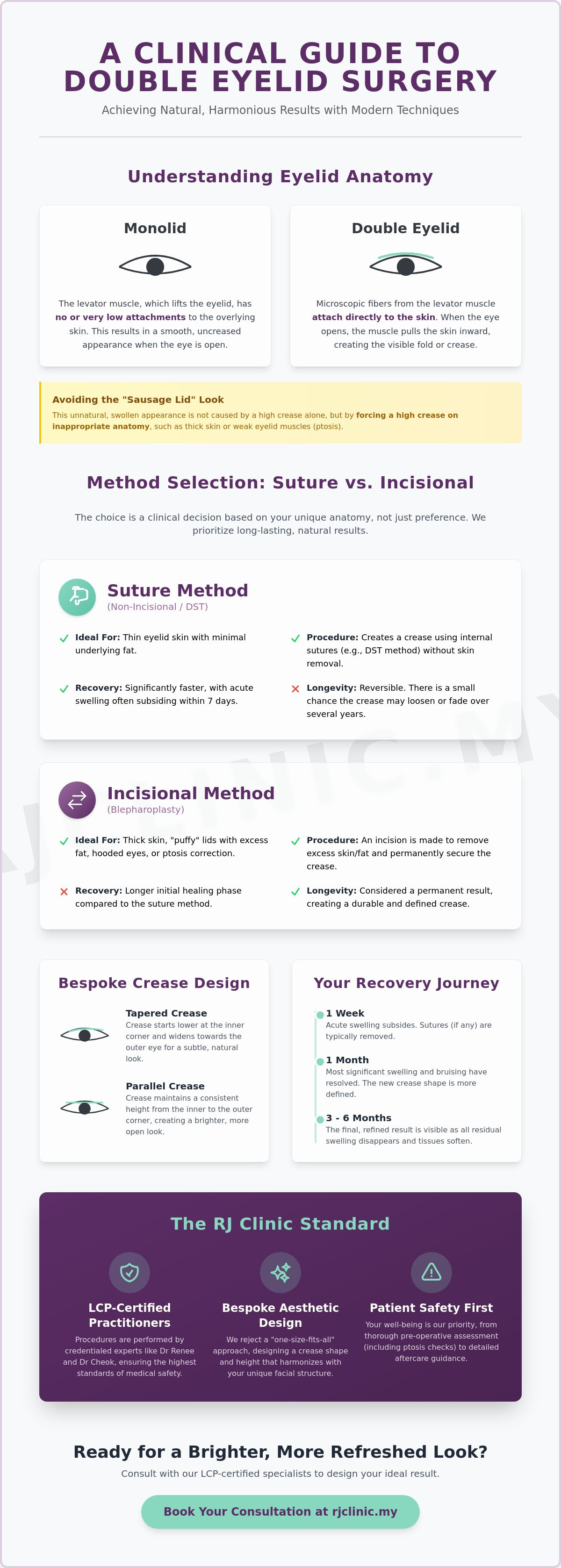
In our practice at RJ Clinic, we often see patients who believe their eyes are too small when, anatomically, they simply have a "hidden" double eyelid. This occurs when a crease exists but is obscured by overlying skin or fat. Clinically, double eyelid surgery, or East Asian blepharoplasty, is the procedure used to create or refine this pretarsal crease. The fundamental difference between a monolid and a double eyelid lies in the levator muscle, which is responsible for lifting the eyelid. In a double eyelid, microscopic fibers of this muscle attach directly to the skin. When the eye opens, the muscle pulls the skin inward, creating a fold. In roughly 50% of the Asian population, these attachments are absent or positioned very low, resulting in a smooth monolid appearance.
Achieving a natural result in Kuala Lumpur's diverse patient base requires a deep respect for the individual's orbital structure. We don't aim for a "one-size-fits-all" crease. Instead, Dr Renee and Dr Cheok evaluate the height of the tarsal plate and the surrounding bone structure to ensure the new fold harmonizes with the rest of the face. Forcing a high, Western-style crease on an eye with a shallow socket often leads to a hollow, surgically-altered look that lacks the subtle elegance our patients desire.
The Role of Eyelid Fat and Skin Thickness
The thickness of your eyelid skin and the volume of underlying orbital fat are the primary deciders of your surgical path. If you have "puffy" eyelids, this is often due to a prolapse of orbital fat. Simply placing a stitch won't resolve this; it may even make the puffiness more prominent. Clinical reasoning dictates that thick skin or significant fat deposits often preclude the suture method. The tension required to maintain a crease in heavy tissue is usually too high for sutures alone, leading to a high failure rate where the crease disappears within months. In these cases, a modified incisional approach is necessary to remove a small strip of tissue and secure the crease to the underlying structures.
Ptosis vs. Monolid: A Critical Distinction
It is vital to distinguish between a simple monolid and clinical ptosis, which is a functional weakness of the levator muscle. If a patient has a "sleepy" appearance where the eyelid covers a portion of the pupil, they likely have ptosis. If we perform a standard double eyelid surgery without addressing the muscle weakness, the new crease will actually make the eye look even more tired and heavy. A crease alone cannot fix a weak levator muscle. During your consultation, we perform a blink test and measure the marginal reflex distance to ensure that muscle repair is integrated into the procedure if needed, ensuring your eyes look bright and alert rather than just "creased."
Method Selection: Infiltration Suture vs. Incisional Blepharoplasty
Choosing between suture and incisional methods isn't a matter of simple preference; it's a clinical decision based on the structural integrity of your eyelid tissue. While marketing often pushes "scarless" options as the gold standard, our practitioners prioritize the method that will actually hold the crease over time. Clinical research into double-eyelid surgery techniques highlights that while both paths aim for the same aesthetic goal, the mechanical bond created by each is fundamentally different. At RJ Clinic, we categorize these into two primary philosophies: the non-incisional suture method and the permanent incisional approach.
The Suture Method (Non-Incisional)
The suture method, often referred to as RJ Double Eyelid Suture or "stitching," involves creating a crease via internal sutures rather than skin excision. We typically utilize the Double Suture and Twist (DST) technique, which creates multiple points of fixation between the levator muscle and the skin. It's an ideal choice for younger patients who possess thin eyelid skin and minimal fat. The primary advantage is a significantly faster recovery, with most acute swelling subsiding within 7 days. However, the trade-off is longevity; because no tissue is removed, there's a small statistical possibility of the crease fading or loosening over several years if the eyelid skin begins to sag.
The Incisional Method (Full or Partial)
For patients with significant skin laxity, hooded lids, or "puffy" eyes caused by excess orbital fat, an incisional double eyelid surgery is clinically necessary. This technique involves removing a precise strip of skin and fat to create a permanent, secure bond between the muscle and the dermis. While the initial swelling is more pronounced and the downtime extends to about 10 to 14 days, the results are far more versatile. It allows Dr Renee and Dr Cheok to sculpt the eyelid shape with higher precision, addressing concerns that a simple stitch cannot resolve. It is a one-time investment in a result that will not disappear as you age.
The Decision Matrix: Which is Right for You?
During a physical examination, we use a specialized probe to simulate different crease heights and shapes. Your decision framework should generally follow these clinical observations:
Tissue Quality: Thin skin with high elasticity favors the suture method. Thick, "heavy" skin requires an incision for a stable fold.
Fat Volume: If you require fat removal to de-puff the eyes, the incisional method is the only viable path.
Longevity Goals: Patients seeking a permanent, "set-it-and-forget-it" result often opt for the incisional approach despite the longer recovery.
In many cases, patients also present with lower lid concerns. We often find that eyebag surgery can be performed alongside double eyelid surgery to achieve total eye rejuvenation. If you're unsure which category your anatomy falls into, we suggest scheduling a clinical assessment to map out a bespoke surgical plan.
Recovery and Aftercare in the Malaysian Climate
Recovery from double eyelid surgery is a physiological process that requires patience and strict environmental management. In Kuala Lumpur, the primary challenge is our high humidity and UV index. Humidity can increase the risk of localized inflammation if the incision site is not kept clean and dry. We advise patients to remain in air-conditioned environments as much as possible during the first week to minimize perspiration. While acute swelling typically subsides within 10 to 14 days, the internal tissue remodeling continues for months. You won't see the final, refined crease shape until the 3 to 6-month mark.
To maintain the brightness of your results, sun protection is non-negotiable. UV exposure in Malaysia can cause the scar line to hyperpigment, making it visible even when the eyes are closed. Wearing UV-rated sunglasses when outdoors is a simple but effective safeguard. For patients looking to optimize their entire periorbital area, we often suggest reviewing our guide on dark eye circle treatment to complement the surgical results and ensure a holistic rejuvenation.
The First 72 Hours: Critical Steps
During the first 72 hours, managing the inflammatory response is your priority. Cold compresses are essential; they induce vasoconstriction, which limits bruising and prevents excessive fluid buildup. You should sleep with your head elevated on two or three pillows to allow gravity to assist in lymphatic drainage. Hygiene is equally vital. We provide a specific cleaning protocol using sterile saline and a soft applicator. You must avoid rubbing the area or disrupting the sutures. This early diligence ensures the structural integrity of the incisional blepharoplasty techniques used during your procedure.
Managing Social Downtime
Most of our patients in areas like Bangsar or Mont Kiara find they are "socially presentable" within 7 to 10 days. By this point, major bruising has usually faded to a faint yellowish tint. However, you must adhere to a clinical "no-go" period for certain habits. Contact lenses should be avoided for at least 10 days to prevent strain on the eyelid. Makeup, particularly around the eyes, is strictly prohibited for 14 days to avoid introducing bacteria into the healing tissue. If you are concerned about your specific healing capacity, you can consult with Dr Renee or Dr Cheok to discuss a personalized aftercare plan tailored to your lifestyle.

The RJ Clinic Approach: Bespoke Artistry and LCP Standards
At RJ Clinic, we believe the success of double eyelid surgery isn't measured by the prominence of the crease, but by its invisibility as a surgical intervention. Our "Bespoke" philosophy means we don't apply a template to your eyes. Dr Renee and Dr Cheok carefully analyze your facial symmetry to decide between a parallel crease, which stays equidistant from the lash line, or a tapered crease, which narrows toward the inner corner. A conservative approach is almost always superior; it's easier to refine a natural fold than to correct an over-excised, "hollow" eyelid that has lost too much structural fat. With clinics situated in Solaris Dutamas and Desa ParkCity, we provide a controlled, medical environment for these precise enhancements.
Why Credentials Matter in Eyelid Surgery
The risks of undergoing eyelid procedures in non-medical beauty salons are significant, ranging from chronic infection to permanent asymmetry or nerve damage. As LCP-certified practitioners, our doctors adhere to the rigorous standards set by the Ministry of Health Malaysia. This expertise is particularly vital given the Medical Device Order 2026, which takes effect on June 1, 2026, mandating stricter regulatory oversight for devices used in aesthetic treatments. We only utilize FDA-approved technologies and sterile surgical protocols to ensure your safety throughout the process. For those whose concerns are more about general skin laxity than crease structure, Ultherapy in Kuala Lumpur offers a non-surgical alternative for lifting the brow and upper face.
Scheduling Your Consultation
Your first visit is a clinical deep dive. We use high-resolution photography and precision measurements to simulate your potential results before any intervention occurs. We often navigate the debate between "Westernized" eyes and an "Asian-natural" aesthetic during these sessions. Our goal is to empower you with professional judgment, helping you choose a crease height and shape that honors your heritage while brightening your gaze. This isn't a transactional service; it's a partnership in refinement. We invite you to schedule a personalized assessment at one of our Kuala Lumpur locations to discover how a bespoke surgical plan can restore confidence in your appearance and your results.
Refining Your Vision for Natural Rejuvenation
Achieving a harmonious result requires more than just a visible crease; it demands a clinical understanding of your unique orbital anatomy and tissue elasticity. We've explored how the structural differences in the levator muscle dictate surgical success and why managing inflammation in our local climate is essential for proper scar maturation. Whether you're a candidate for the minimally invasive suture method or require the permanent precision of an incisional approach, the goal remains a subtle enhancement that respects your natural features.
Dr Renee and Dr Cheok utilize LCP-certified standards and FDA-approved technologies to prioritize patient safety and clinical integrity. As specialists in natural-looking Asian blepharoplasty, our practitioners focus on bespoke outcomes that avoid the "overdone" look often seen in non-medical settings. If you're ready to move from research to a personalized medical assessment for double eyelid surgery, we invite you to book a bespoke consultation with our LCP-certified doctors at RJ Clinic. Let's work together to refine your appearance with the precision and care your eyes deserve.
Frequently Asked Questions
How long does double eyelid surgery last?
An incisional double eyelid surgery creates a permanent bond between the skin and the levator muscle, ensuring the crease remains stable for a lifetime. In contrast, the suture method is considered semi-permanent. While techniques like the DST method are robust, the internal stitches can loosen over 5 to 10 years as skin loses elasticity. Most patients choosing sutures do so for the reversible nature and shorter downtime, accepting that a revision may be necessary as they age.
Is double eyelid surgery painful?
You won't feel pain during the procedure itself because we use a localized anesthetic block to numb the entire eyelid area. Most patients describe a mild pressure or tugging sensation while we work. Post-operatively, you might experience a dull ache or tightness for the first 48 hours, which is easily managed with standard oral analgesics. Our clinical team monitors your comfort levels throughout the process to ensure a tranquil and professional experience.
What is the difference between stitching and cutting methods?
The stitching method involves placing internal sutures through small punctures to create a fold, making it ideal for those with thin skin and no excess fat. The cutting method requires a precise incision to remove a strip of skin and orbital fat, which is essential for patients with hooded or puffy lids. While stitching offers a 7-day recovery, the incisional approach provides a more defined and permanent result that cannot be achieved with threads alone.
Can double eyelid surgery fix droopy eyes (ptosis)?
A standard double eyelid surgery only creates a skin fold; it does not address the underlying muscle weakness that causes ptosis. If you have a sleepy look where the eyelid hangs low over the pupil, we must perform a levator advancement or ptosis correction during the surgery. Ignoring this muscle weakness while only adding a crease often results in a heavy eyelid that looks aesthetically unappealing and fails to brighten the gaze effectively.
How much does double eyelid surgery cost in Kuala Lumpur?
The cost of eyelid procedures in Kuala Lumpur reflects the complexity of the case and the practitioner's expertise. Based on 2026 market data, upper blepharoplasty typically ranges from RM 3,500 to RM 6,000, while suture-based stitching averages around RM 4,500. Total costs are influenced by whether you require fat removal, ptosis correction, or combined lower lid rejuvenation. A clinical consultation with Dr Renee or Dr Cheok is necessary to provide a definitive quote based on your anatomical needs.
When can I wear eye makeup after the procedure?
You should wait a minimum of 14 days before applying any eye makeup, including eyeliner or mascara. This period is critical because the incision or puncture sites need to be fully sealed to prevent bacteria from entering the wound. Applying or removing makeup involves tugging on the eyelid skin, which can disrupt the delicate healing process of the new crease. We recommend waiting for your two-week follow-up appointment before resuming your usual cosmetic routine.


Comments