


Double Eyelid Stitching vs. Surgery: A Clinical Guide to Choosing the Right Technique (2026)


The quickest recovery path is often assumed to be the superior choice for a natural result, but in clinical practice, the "easier" option can sometimes lead to the very outcome you fear: a crease that fades or disappears within a few years. When weighing double eyelid stitching vs surgery, the decision isn't merely about personal preference or a fear of the scalpel; it's a medical determination based on the specific ratio of eyelid fat to skin elasticity. If you've been caught between the desire for a scarless finish and the anxiety of a procedure "failing," you're approaching this with the right level of professional caution.
We understand that navigating terms like "incisional" and "non-incisional" feels overwhelming when all you want is a refreshed, symmetrical gaze that allows you to return to your routine in Kuala Lumpur with confidence. This guide offers an expert clinical comparison to help you determine which technique is medically suited for your unique anatomy. We'll examine how Dr Renee and Dr Cheok evaluate tissue thickness and muscle strength to ensure your results look organic and remain stable. By the end of this breakdown, you'll have the clarity needed to choose a path that prioritizes both medical precision and your long-term aesthetic goals.
Key Takeaways
Understand how your specific eyelid anatomy, including fat volume and skin laxity, dictates whether you are a candidate for stitching or require incisional surgery.
Discover the fundamental clinical differences in double eyelid stitching vs surgery, including how non-incisional methods create a natural crease without permanent tissue removal.
Learn about the long-term durability of each procedure, specifically why suture-based creases may fade over time compared to the permanent results of incisional blepharoplasty.
Gain insights into the recovery timeline and why a physical examination by LCP-certified doctors is essential for ensuring a safe and aesthetically balanced outcome.
Table of Contents
The Clinical Distinction Between Eyelid Stitching and Incisional Surgery
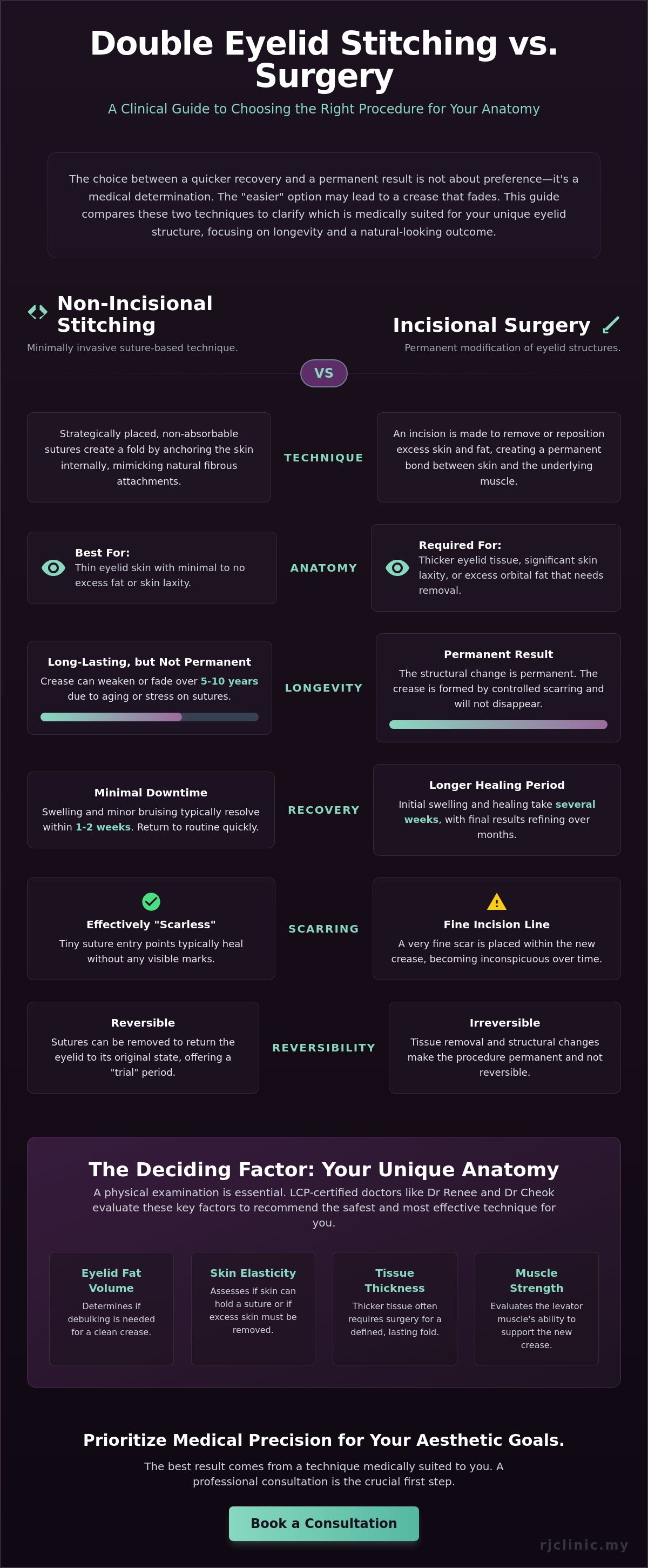
Choosing between double eyelid stitching vs surgery is a decision that rests on your unique eyelid physiology rather than just a preference for recovery time. While both procedures share the primary goal of creating a natural-looking supratarsal crease, they achieve this through vastly different mechanical approaches. Double eyelid stitching is a minimally invasive method using durable, non-absorbable sutures to anchor the skin. In contrast, incisional surgery involves a permanent modification of the eyelid structure through the removal or repositioning of tissue.
Non-Incisional Suture Techniques: How the Crease is Formed
The non-incisional method, commonly known as double eyelid stitching, relies on the strategic placement of sutures to create a fold. Instead of a continuous incision, the doctor utilizes a "pinch" technique to pass medical-grade, non-absorbable fibers through the eyelid tissue. These fibers act as internal anchors, mimicking the natural fibrous attachments found in those born with a double eyelid. This technique is highly favored for its "scarless" reputation in Kuala Lumpur, as the tiny entry points typically heal without visible marks. It is an ideal refinement for patients with thin eyelid skin and minimal fat who seek a subtle, organic-looking enhancement without the downtime of traditional East Asian blepharoplasty techniques.
The Traditional Incisional Method: Permanent Re-sculpting
The incisional method is a comprehensive re-sculpting of the eyelid. This surgical approach allows for the direct removal of excess skin and the debulking of orbital fat, which is often necessary for patients with thicker eyelid tissue or significant skin laxity. To secure the fold, the practitioner creates a permanent bond between the skin and the underlying levator muscle through intentional, controlled internal scarring. While this method requires a longer healing period, it remains the gold standard for complex eyelid anatomy. It provides an irreversible change that will not fade or disappear over time, making it a reliable long-term investment for those whose anatomy cannot be adequately supported by sutures alone. Dr Renee and Dr Cheok often recommend this route for patients who require a structural correction that stitching simply cannot provide.
Durability and Aesthetics: Comparing Long-term Outcomes
When patients visit us in KL, their most frequent question isn't about the procedure itself, but about how long the results will last. In the debate of double eyelid stitching vs surgery, durability is the primary trade-off. Stitching is an elegant, minimally invasive choice, but it's important to understand that it may not be permanent. The sutures create a fold by compression, and over time, factors like natural aging, skin laxity, or even frequent eye rubbing can cause these threads to loosen. Clinical data, including a Systematic Review of Double-Eyelid Blepharoplasty, indicates that while non-incisional methods provide excellent immediate results, they carry a higher revision rate as the crease can shallow after five to ten years.
Longevity: Will the Crease Disappear Over Time?
Surgery is fundamentally different. Because we remove a thin strip of skin and adjust the underlying fat, the resulting crease is a permanent structural change. It's a "one-and-done" solution. While stitching offers a "trial" of sorts for those hesitant about permanent changes, surgery provides the peace of mind that your look won't fluctuate. If you're seeking a definitive transformation, discussing your goals during a personalized consultation can help determine if your skin elasticity supports the longevity of a suture technique.
Symmetry and the 'Natural' Look
The fear of looking "artificial" often stems from seeing over-corrected results. Choosing between double eyelid stitching vs surgery often comes down to how much control you want over the final shape. In clinical terms, "sausage eyelids" occur when the crease is placed too high, creating a puffy, unnatural fold that doesn't taper correctly. Dr Renee and Dr Cheok prioritize anatomical harmony, measuring the distance from the lash line to the tarsal plate with extreme precision. While surgery allows for greater control over the crease shape, such as parallel vs. tapered folds, it requires more patience during the healing phase. The "final" aesthetic usually reveals itself fully after three to six months, once deep tissue swelling has completely subsided. This precision ensures the outcome looks organic rather than manufactured.
The Selection Matrix: Why Your Anatomy Dictates the Technique
The most common clinical pitfall is choosing a procedure based on a desired recovery time rather than anatomical suitability. In the debate of double eyelid stitching vs surgery, your physical traits are the ultimate deciding factor. A patient with heavy, fatty eyelids who chooses stitching may find the crease looks "buried" or unnatural because sutures cannot address the underlying tissue volume. Conversely, a patient with thin skin and high elasticity may not require the invasiveness of a full incision to achieve a beautiful, lasting result.
Who is the Ideal Candidate for Stitching?
The RJ Double Eyelid Suture technique is specifically designed for those with minimal excess skin and low fat volume. We typically recommend this for younger patients or individuals whose eyelids don't yet show signs of significant aging. It's the preferred choice for professionals in Bangsar or Mont Kiara who require the fastest possible return to work without visible scarring. If you've never had a procedure before and want a "trial" of how a crease enhances your facial harmony, stitching provides a sophisticated, reversible entry point into aesthetic refinement.
When is Incisional Surgery Medically Necessary?
A clinical review of double eyelid techniques highlights that incisional methods are often essential for structural correction rather than just cosmetic enhancement. If you have significant skin hooding that obscures your vision or makes your eyes look perpetually tired, sutures simply won't suffice. Surgery allows us to remove the exact amount of skin and fat needed to create a crisp, clean crease definition that stands the test of time.
For patients seeking total eye rejuvenation, we often combine eyelid surgery with Eyebag Surgery to address both the upper and lower orbital regions simultaneously. This approach is particularly effective when dealing with ptosis, or droopy lids, where the muscle itself needs adjustment to open the eye fully. A crease alone cannot fix a tired appearance if the levator muscle is weak. Dr Renee and Dr Cheok focus on these subtle medical nuances to ensure your results are both functional and beautiful.
To determine which technique aligns with your unique eyelid anatomy, schedule a clinical assessment with our LCP-certified doctors today.
Consultation and Recovery: Navigating Your Journey in KL
The journey toward a more defined gaze doesn't begin in the procedure room; it starts with a meticulous physical examination. When deciding between double eyelid stitching vs surgery, the choice is governed by clinical data and your unique orbital structure. In Malaysia, it's vital to seek LCP-certified aesthetic physicians who understand the regulatory safety standards required for these delicate procedures. At RJ Clinic, Dr Renee and Dr Cheok prioritize safety and personalized care, ensuring that every recommendation is grounded in medical necessity rather than a one-size-fits-all marketing approach.
The Consultation: What Your Doctor Looks For
During your assessment, we test skin elasticity and check for underlying muscle weakness, medically known as ptosis. If ptosis is present, a simple crease may not achieve the desired "awake" look, as the muscle itself requires support. We also emphasize realistic expectations. Attempting to replicate a specific celebrity's eyelid shape often leads to dissatisfaction because that shape may not harmonize with your specific heritage or facial bone structure. A successful outcome is one that respects your natural anatomy while providing a subtle, organic-looking enhancement.
Recovery Milestones: From Clinic to Confidence
Managing expectations for the first 48 hours is essential for a smooth experience. When comparing double eyelid stitching vs surgery, the recovery timelines differ significantly. With double eyelid stitching, you can typically expect a return to social activities within 3 to 5 days. Surgery requires more patience, with a 2-week window often needed for major swelling and bruising to subside. Clinical tips for faster healing include the consistent use of cold compresses and keeping your head elevated during sleep to encourage lymphatic drainage. Protecting your investment also means maintaining strict eye hygiene to prevent irritation during the critical early healing phase. Whether you're returning to a busy office in Mont Kiara or attending a social event in Bangsar, following these post-procedure protocols ensures your results remain crisp and well-defined for years to come.
Defining Your Gaze with Clinical Precision
The decision between double eyelid stitching vs surgery doesn't merely depend on a preference for downtime. It's a choice that hinges on a thorough understanding of your eyelid's unique structure. As we've discussed, fat volume and skin laxity serve as the medical blueprint for selecting either a minimally invasive suture method or a permanent incisional approach. Whether you prioritize the rapid recovery of a non-incisional technique or the definitive results of blepharoplasty, the goal remains a balanced, harmonious look that feels entirely your own.
At RJ Clinic, Dr Renee and Dr Cheok bridge the gap between medical science and aesthetic artistry. By adhering to rigorous safety standards and utilizing FDA-approved technologies, we ensure that your refinement is both safe and sophisticated. Your journey toward a refreshed appearance should be guided by professional judgment and a commitment to subtle, organic-looking outcomes that enhance your natural features without looking overdone.
Book a personalized eyelid consultation with our LCP-certified doctors to determine which path best matches your anatomy and lifestyle. We look forward to helping you achieve a look that inspires newfound confidence.
Frequently Asked Questions
Can double eyelid stitching come undone after a few years?
Yes, it is possible for the crease to shallow or disappear over time. Because the stitching method relies on internal sutures to create a fold rather than removing tissue, these threads can loosen after five to ten years. Factors such as natural aging, skin laxity, or frequent eye rubbing can affect the longevity of the results. If you want a more permanent solution, incisional surgery is typically recommended.
Is double eyelid surgery painful during and after the procedure?
You won't feel pain during the procedure because we use local anesthesia to numb the area. Most patients describe a sensation of pressure rather than sharp discomfort. After the anesthesia wears off, you may experience a sense of tightness or mild soreness. This is easily managed with prescribed medication and usually subsides within the first few days of recovery.
How do I know if I have too much eyelid fat for the stitching method?
A physical examination by an LCP-certified doctor is the only way to determine your suitability. If your eyelids appear heavy or puffy even when you are well-rested, it often indicates a higher volume of orbital fat. In these cases, the double eyelid stitching vs surgery debate favors the incisional method, as sutures alone cannot create a clean crease through thick fatty tissue.
Will there be visible scars if I choose the incisional surgery method?
The surgical incision is strategically placed within the new crease, making it virtually invisible when your eyes are open. While a fine line exists, it matures over several months into a faint, skin-colored mark that blends with your natural skin folds. Our focus at RJ Clinic is on meticulous suturing techniques to ensure the final scar is as subtle and organic-looking as possible.
How long does the swelling last for double eyelid stitching vs surgery?
Recovery timelines differ based on the invasiveness of the technique. Swelling from stitching typically peaks at 48 hours and resolves significantly within five to seven days. For incisional surgery, major swelling usually takes about ten to fourteen days to subside. It's important to remember that the final, refined aesthetic of the crease may take three to six months to fully settle as the deep tissues heal.
Can I wear contact lenses and makeup immediately after the procedure?
No, you should avoid wearing contact lenses or eye makeup for at least one week. Inserting lenses requires stretching the eyelid, which can disrupt the healing sutures or incision site. Similarly, makeup can introduce bacteria into the delicate entry points. We advise waiting until your follow-up appointment with Dr Renee or Dr Cheok before resuming your usual beauty routine to ensure the safety of your results.


Comments