


Does Microneedling Really Work for Acne Scars? A Doctor Explains

Updated: Sep 7

A microneedling treatment is often misunderstood as a simple aesthetic upgrade, but from a clinical perspective, it's a calculated, precision-engineered injury. While many patients expect a relaxing facial, the true efficacy of the procedure lies in its ability to trigger a profound wound-healing response deep within the dermis. If you've struggled with persistent boxcar or rolling scars, you already know that surface-level treatments rarely reach the structural roots of the problem. It's common to feel a sense of fatigue when topical solutions fail to smooth out acne scars or close enlarged pores.
This guide provides a direct medical perspective on how we move beyond the surface to repair the skin's architecture. You'll learn the vital distinctions between traditional mechanical needles and the thermal remodeling offered by Potenza RF technology. We'll also address the specific precautions Dr Renee and Dr Cheok take to prevent post-inflammatory hyperpigmentation in Asian skin types. By understanding how needle depth and bio-stimulants work in tandem, you can move toward a treatment plan that offers genuine, organic-looking refinement rather than temporary fixes.
Table of Contents
The Clinical Logic of Microneedling: Beyond Surface-Level Resurfacing
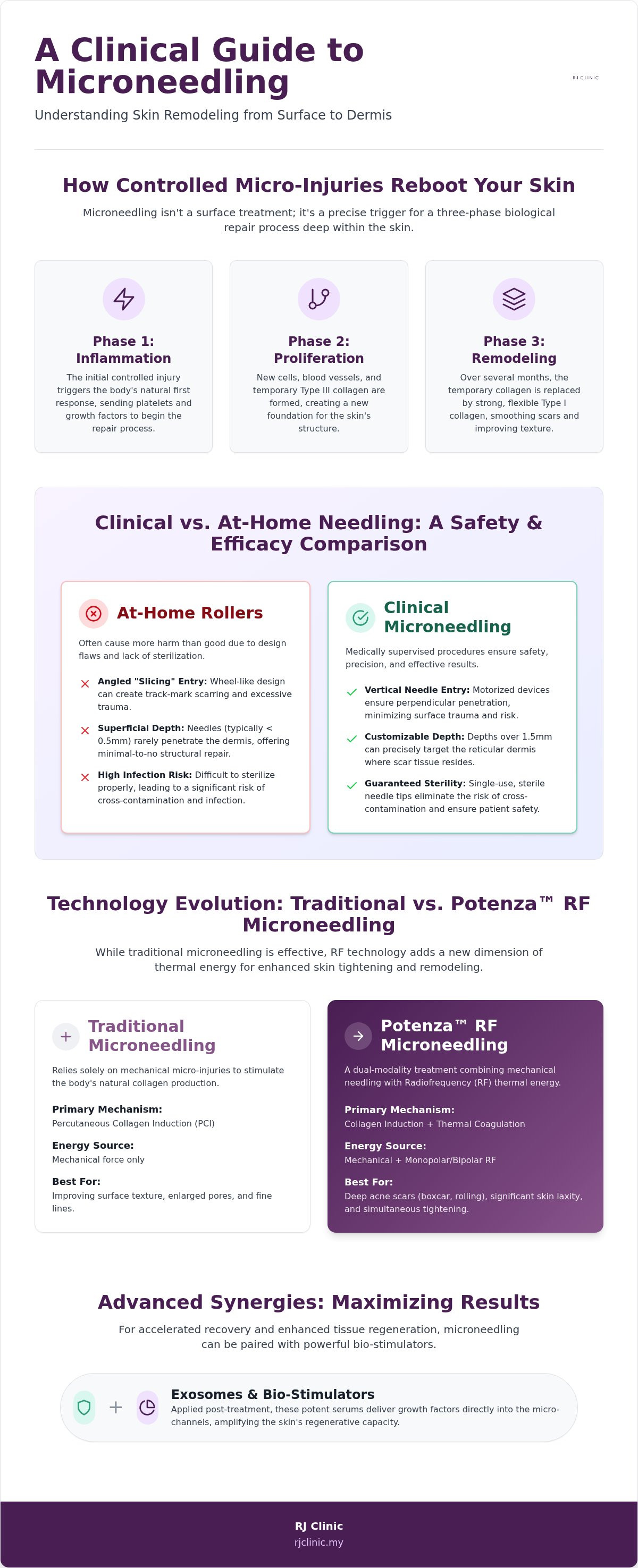
When we perform Collagen induction therapy (microneedling), we aren't just exfoliating the skin; we're initiating a controlled biological cascade. This process, known as percutaneous collagen induction, relies on the skin's innate ability to repair itself after a precise injury. A professional microneedling treatment isn't a singular event but a trigger for three distinct physiological phases. First, inflammation occurs as the body sends platelets to the site. This is followed by proliferation, where new cells and vessels form. Finally, the remodeling phase begins, which can last for months as the skin matures and strengthens its internal scaffolding.
It's vital to distinguish between superficial "cosmetic" needling and medical-grade "dermal" needling. While at-home devices usually stay within the epidermis, clinical treatments often reach depths greater than 1.5mm. This depth is necessary to reach the reticular dermis, where the fibrous bands of acne scars actually reside. There's a persistent myth in aesthetic circles that more bleeding equals better results. In reality, we aim for pinpoint capillary hemorrhage. Excessive bleeding usually indicates unnecessary tissue trauma, whereas precise pinpoint spots signal that we've reached the correct vascular layer to stimulate repair without causing secondary scarring.
How Micro-Injuries Trigger Structural Collagen Induction
The mechanical disruption of the basement membrane releases specific growth factors, most notably Transforming Growth Factor-beta (TGF-beta). These messengers tell the skin to replace disorganized Type III collagen, which characterizes scar tissue, with the flexible and resilient Type I collagen found in healthy skin. Fractional wounding is the strategic method of creating microscopic channels while leaving surrounding tissue intact to act as a reservoir for rapid healing and enhanced safety.
Clinical Microneedling vs. At-Home Rollers: A Safety Warning
At-home derma rollers often cause more harm than good due to their wheel-like design. As the needle enters and exits the skin at an angle, it can create a "slicing" effect, leading to track-mark scarring and unnecessary inflammation. Dr Renee and Dr Cheok prioritize motorized systems and RF technologies because they ensure a strictly vertical needle entry. This perpendicular penetration is far more precise and significantly reduces the risk of infection. At RJ Clinic, we use only sterile, single-use tips to maintain the highest medical standards and prevent cross-contamination during every microneedling treatment.
Potenza RF vs. Traditional Microneedling: Navigating Modern Clinical Pathways
Traditional microneedling is a robust tool for surface refinement, but it has limitations when treating deep-seated structural damage. Radiofrequency (RF) microneedling represents a significant technological leap, functioning as a dual-modality procedure. It combines the mechanical benefits of needling with precisely delivered thermal energy. When the needles reach their target depth, they emit an RF pulse that coagulates dermal tissue. This heat not only triggers a more aggressive healing response but also provides immediate contraction of existing collagen fibers. An objective evaluation of microneedling shows that while mechanical needling is effective, the addition of heat significantly enhances the histological density of the dermis over time.
Choosing this advanced microneedling treatment involves weighing specific trade-offs. It's generally more intensive than standard needling, often requiring a slightly longer window for social downtime, typically three to five days of mild swelling or erythema. However, for patients dealing with significant skin laxity or deep tethered scarring, the investment in RF technology often yields more visible results in fewer sessions compared to traditional methods. The clinical goal is to achieve structural repair that standard resurfacing simply cannot reach.
When to Opt for Potenza RF Microneedling
Potenza RF is particularly effective for "ice pick" and "rolling" scars that are resistant to lighter resurfacing. The system allows us to toggle between monopolar and bipolar RF modes. Monopolar energy penetrates deeper into the tissue for significant remodeling and tightening, while bipolar energy focuses on more superficial layers for texture and pore refinement. For those prioritizing both skin tightening and scar reduction, Potenza RF Microneedling offers a versatile clinical pathway that addresses multiple layers of the skin in a single session.
Addressing Acne Scars and Laxity in Malaysian Skin Types
Treating Fitzpatrick skin types IV through VI, which are common in Malaysia, requires a nuanced approach to avoid post-inflammatory hyperpigmentation (PIH). Standard lasers or non-insulated needles can sometimes overheat the epidermis, leading to unwanted darkening. Dr Renee and Dr Cheok utilize insulated needles that protect the skin's surface by only releasing thermal energy at the needle's tip, deep within the dermis. This precision allows us to treat deep scars effectively without compromising the safety of the outer skin layers. If you're concerned about how your skin will react to heat, we can assess your specific scar profile to design a safe, customized protocol for your microneedling treatment.
The Treatment Journey: Suitability, Procedure, and Recovery
A professional microneedling treatment follows a strict medical sequence designed to maximize safety and results. At RJ Clinic, we adhere to a five-step clinical protocol: detailed consultation, application of medical-grade numbing, the actual treatment, infusion of actives, and specialized post-care. A systematic review of microneedling studies establishes that professional oversight in these steps is vital for consistent, safe outcomes. Comfort is paramount. We utilize a high-potency numbing cream containing lidocaine and tetracaine to ensure you feel minimal sensation, even at the deeper dermal settings required for structural repair.
Immediately after the microneedling treatment, there's a "window of opportunity" lasting roughly 20 to 30 minutes. During this time, the micro-channels remain patent, allowing for the direct delivery of therapeutic infusions into the dermis. While you should expect some social downtime, including redness and mild swelling, these symptoms typically resolve within 48 to 72 hours. Managing this period correctly is as important as the procedure itself to ensure the skin heals without complication.
Identifying Ideal Candidates and Contraindications
Suitability is determined by the current state of your skin. We don't perform microneedling on active acne, as the needles can spread bacteria and exacerbate inflammation. Similarly, patients with a history of keloidal scarring or those who are pregnant are generally contraindicated. If you have active breakouts, you'll need to work with us to achieve pre-treatment stabilization before we address the underlying scars.
Post-Treatment Care in a Tropical Climate
The Kuala Lumpur sun presents a specific challenge during recovery. Sun avoidance is non-negotiable for at least 72 hours, and a medical-grade SPF 50+ must be applied daily to prevent post-inflammatory hyperpigmentation. You should also pause your use of active ingredients like Retinol or Vitamin C for one week. Focusing on intensive hydration supports the newly formed micro-channels and accelerates the healing process. To ensure your skin is ready for this transformation, consult with Dr Renee or Dr Cheok for a personalized assessment.
Advanced Synergies: Pairing Microneedling with Bio-stimulators
While the mechanical disruption of a microneedling treatment is powerful on its own, its role as a transdermal delivery system is what truly elevates clinical results. We view the micro-channels created during the procedure as a temporary gateway. By introducing bio-stimulators during this window, we can bypass the skin's barrier and deliver potent regenerative molecules directly to the fibroblasts. This approach shifts the treatment from simple resurfacing to a high-performance biological intervention. Whether we're treating deep tethered scars or generalized texture issues, the goal is to provide the skin with the specific resources it needs to rebuild itself from the inside out.
A long-term maintenance strategy typically involves a series of 3 to 6 sessions. This protocol is necessary because structural remodeling is a cumulative process. Each session builds upon the last, progressively thickening the dermis and smoothing the surface. While Platelet-Rich Plasma (PRP) has long been a staple in this field, we've observed that modern bio-stimulators often provide more predictable and concentrated regenerative signals, especially for patients with significant structural damage. To see how these advanced skin rejuvenation techniques are utilized in a premier clinical setting, you can visit Revival Med Spa.
Why Exosomes and Rejuran Enhance Microneedling Outcomes
Exosomes represent the cutting edge of regenerative medicine. They act as sophisticated signaling molecules that instruct aging or damaged cells to increase the production of collagen and elastin. When we integrate Exosome therapies into a session, we see a marked acceleration in tissue repair and a significant reduction in post-procedural inflammation. In contrast, Rejuran Healer utilizes polynucleotides (salmon DNA) to provide the actual building blocks for DNA repair in damaged skin cells. The synergistic effect is clear: the mechanical injury triggers the repair, while bio-stimulators provide the fuel.
Beyond the Face: Scalp Microneedling for Hair Restoration
The clinical logic of needling extends beyond acne scars to the treatment of androgenetic alopecia. Through RJ FollicleBoost, we utilize the same principles of controlled injury to wake up dormant hair follicles and increase local blood flow. This specialized microneedling treatment significantly improves the absorption of hair growth factors, making it a vital component of a comprehensive hair loss treatment plan. Dr Renee and Dr Cheok often combine these sessions with other clinical modalities to ensure a multi-faceted approach to follicle restoration and scalp health.
Restoring Your Skin's Structural Integrity
Dr Renee and Dr Cheok focus on creating individualized clinical pathways that prioritize long-term skin health over temporary aesthetic fixes. Whether you're addressing deep rolling scars or seeking to improve overall skin density, our LCP-certified doctors ensure every parameter is calibrated to your unique physiology. We invite you to schedule a clinical skin assessment with Dr. Renee or Dr. Cheok at RJ Clinic to explore how a tailored protocol can refine your skin's texture and restore your confidence. Your journey toward a resilient, rejuvenated appearance is a partnership built on scientific integrity and meticulous care.
Frequently Asked Questions
How much does microneedling treatment cost in Malaysia?
The investment for a professional procedure varies based on the technology used and the complexity of your scar profile. Traditional mechanical needling is generally more accessible, whereas advanced systems like Potenza RF require a higher investment due to the sophisticated technology and sterile, single-use tips. Your total cost will also depend on whether your protocol includes the addition of bio-stimulators like Rejuran or Exosomes to accelerate the remodeling process.
Is microneedling painful, and do I need numbing cream?
Most patients describe the sensation as a localized, prickly pressure rather than acute pain. We apply a high-potency, medical-grade numbing cream for 30 to 45 minutes prior to the procedure to ensure a tranquil experience. This step is non-negotiable for deeper dermal treatments, as it allows the doctor to reach the necessary depths for scar repair while you remain perfectly comfortable throughout the session.
How many sessions of microneedling are needed for deep acne scars?
Deep acne scars typically require a series of 3 to 6 sessions to achieve significant structural improvement. Because collagen induction is a biological process that occurs in phases, sessions are usually spaced 4 to 6 weeks apart. While surface radiance improves quickly, the visible reduction in scar depth is a cumulative result of multiple treatments that progressively rebuild the skin's internal scaffolding.
What is the downtime after an RF microneedling session?
You should anticipate approximately 3 to 5 days of social downtime following an RF microneedling session. The skin typically appears flushed, similar to a moderate sunburn, for the first 24 to 48 hours, often accompanied by mild swelling. Most patients find they can return to their normal routine quickly, provided they adhere to strict sun avoidance and use the gentle, hydrating post-care products we recommend.
Can microneedling cause hyperpigmentation on darker skin tones?
Post-inflammatory hyperpigmentation is a potential risk if the microneedling treatment is performed with incorrect energy settings or non-insulated needles. At RJ Clinic, we prioritize safety for Malaysian skin tones by using insulated needle technology that delivers heat only at the target depth, bypassing the pigment-producing cells in the epidermis. This precision allows us to treat deep scars effectively without triggering unwanted darkening of the skin surface.
How soon will I see results after my first microneedling treatment?
Initial improvements in skin texture and pore refinement are often visible within 1 to 2 weeks after the first microneedling treatment. However, the true remodeling of deep scars is a gradual process, with the most significant changes appearing 3 to 6 months after your final session. This timeline aligns with the natural cycle of collagen maturation, ensuring that the results you see are both organic and long-lasting.


Comments